


Far in Finnish Lapland, beyond the last petrol stations and streetlights, Lemmenjoki National Park stretches across a maze of fells, peatlands and river valleys that feel astonishingly empty. For travelers used to busy Alpine resorts or tightly managed national parks, Lemmenjoki is a shock. Trails vanish into bog and tundra, mobile coverage drops away, and human presence shrinks to a few gold miners, Sámi reindeer herders and hikers moving quietly between simple wilderness huts. In a continent where genuine remoteness is increasingly rare, Lemmenjoki stands out as one of Europe’s last great wilderness areas.
Get the latest updates straight to your inbox!
A Wilderness Measured in Days, Not Kilometers
Lemmenjoki National Park covers roughly 2,850 square kilometers in northern Lapland, making it the largest national park in Finland and one of the biggest protected areas in Europe outside Russia. Much of that area is roadless and uninhabited, with the only real access points at the tiny village of Njurgalahti on the Lemmenjoki River and a few scattered track ends used by locals. Once you leave these trailheads, distance is better measured in days of walking than in simple kilometers.
Typical first-time visitors might take the boat from Njurgalahti up the Lemmenjoki River to Ravadas Falls, then hike a marked loop of 17 to 25 kilometers back to the village over one or two days. Even on this classic route, you quickly notice how the infrastructure drops away. After the last campfire site and lean-to, waymarking becomes sparse and the path turns into a narrow track through dwarf birch and bog. On longer routes toward the Vaskojoki River or the Maarestatunturi fells, you can walk for an entire day without seeing another person, a rare experience in Europe outside a few pockets of Lapland and northern Scandinavia.
Remoteness here is also temporal. In summer, hikers commonly plan five to seven day traverses that never cross a public road. Winter ski expeditions can stretch longer, with pulks loaded with food for a week and nights split between open wilderness huts and tent camps on frozen mires. This sort of trip planning feels closer to northern Canada than to the well-serviced hut systems of the Alps, reinforcing Lemmenjoki’s reputation as a true wilderness.
Yet access remains surprisingly feasible. From Ivalo Airport, it is about a 90 minute drive to Njurgalahti via Inari, and regular grocery stores, fuel stations and simple guesthouses in Inari allow visitors to stock up before heading into the park. The contrast is striking: you can buy last-minute gas canisters and cloudberry jam in a warm supermarket in the morning, and by afternoon be unloading your pack at a trailhead where the next building lies tens of kilometers away.
Land of River Valleys, Fells and Arctic Light
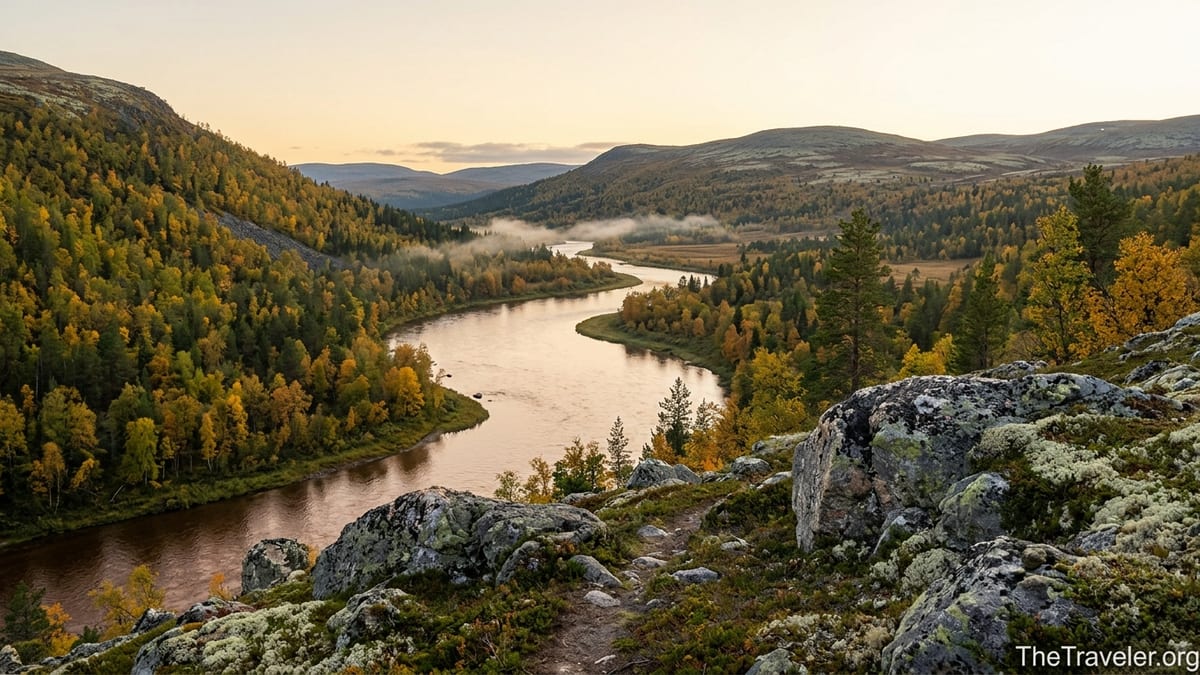
At the heart of Lemmenjoki lies the Lemmenjoki River itself, a slow, tannin-stained waterway that winds through a deep valley framed by rounded fells such as Maarestatunturi and Viipustunturi. In places the river spreads into wide, quiet reaches, with gravel bars where you might spot fresh moose tracks and the neat, heart-shaped prints of reindeer. Elsewhere it narrows into fast riffles, especially near Ravadas Falls, where tourist boats drop passengers to photograph the cascades and hike a short forest path to viewpoints.
The wider park protects a mosaic of habitats that are increasingly rare at this scale in Europe. Old-growth pine and spruce forests line the slopes above the river, while vast aapa mires fill the valleys between the fells. In late June, these mires become carpets of cotton grass and cloudberry flowers, with wooden duckboards across the wettest sections of popular trails. Higher up, the landscape opens into treeless fell heath, where low-growing crowberry and mountain birch cling to thin soils and the wind can be relentless even in August.
Seasonality adds to the sense of wilderness. In high summer, near the June solstice, the sun barely dips below the horizon, and the Lemmenjoki River glows under a sky that never fully darkens. Hikers often end up walking late into the night simply because visibility remains perfect and the soft gold light is too beautiful to resist. By contrast, in March and early April, the fells are buried in snow, daytime temperatures often stay below freezing, and the park becomes a silent white desert broken only by ski tracks and the occasional snowmobile used by reindeer herders and rangers.
The light show continues into autumn. Around mid-September, the birch woods explode into yellows and oranges, while the ground vegetation turns deep red. This is also peak time for northern lights. Travelers staying at simple cabins in Lemmenjoki village or at riverside guesthouses near Njurgalahti often step straight from hot saunas into subzero air to watch green aurora curtains ripple above the valley, framed by dark, untouched hills.
Where Culture and Wilderness Coexist
Despite its uninhabited feel, Lemmenjoki is not an empty land. It is part of the homeland of the Sámi, the Indigenous people of northern Fennoscandia, and traditional reindeer husbandry remains an important livelihood. Visitors who come in late winter might see long lines of reindeer being moved across frozen rivers, or encounter snowmobile tracks that belong not to tourists but to herders checking their animals. In summer, you may spot ear-tagged reindeer grazing on fell slopes, moving almost like wild caribou yet still tied to a herding system that has operated here for generations.
Traces of Sámi life are visible along the Lemmenjoki Nature Trail starting from Njurgalahti, where interpretive signs explain how families once moved seasonally between riverbank settlements and fell pastures. A little further into the park, hikers can visit restored turf huts and old farm buildings at sites such as Kaapin Jouni’s homestead, a former reindeer baron’s farm that illustrates how semi-nomadic herding and more settled agriculture blended in the early 20th century. Local operators based around Inari and Lemmenjoki village run guided cultural tours that might combine a short river boat ride, a walk to a traditional camp, and storytelling about Sámi beliefs, including the myths around the “River of Love” from which Lemmenjoki likely gets its name.
The park’s human story also includes gold. Small-scale gold panning began in the late 19th century and continues today under strict regulations. On the marked “Gold Route” hiking trail, you walk past active claims where prospectors spend the short summer shoveling gravel into sluice boxes, living in simple shacks or tents. Some offer demonstrations or short experiences where visitors can try panning for a small fee, usually charged per hour or per pan, with the understanding that you keep any tiny flakes you find. This unusual coexistence of living cultural traditions, regulated mining and strict nature protection is part of what makes Lemmenjoki feel like a real, working wilderness instead of a museum landscape.
At the same time, Finland’s national park rules keep permanent development at bay. There are no large hotels inside Lemmenjoki, no paved scenic drives, and only a few officially maintained boat routes and marked hiking paths. Visitor infrastructure concentrates at the edges: small guesthouses and cabins in Lemmenjoki village, lakeside cottages and hostels in Inari, and basic services like equipment rental, food shops and tour offices clustered around these communities. Once you shoulder a pack and leave the last boat dock or parking area, you step into a landscape where nature and traditional livelihoods set the terms.
Silence, Wildlife and the Feeling of Being Far Away
One of Lemmenjoki’s greatest luxuries is quiet. In many European mountain regions, even deep valleys echo with the distant hum of roads, ski lifts or aircraft. Here the dominant sounds are different: the rush of the Lemmenjoki River in spring flood, the clatter of a ptarmigan taking off above the tree line, the soft clang of reindeer bells drifting from a distant ridge. On multi day trips away from the main river corridor, you can easily go 24 hours hearing nothing mechanical at all.
The wildlife is another reminder that you are far from densely populated Europe. While large predators like brown bears and wolverines are extremely shy and rarely seen, their presence is felt in tracks and scat along remote trails. More commonly, hikers encounter willow grouse in the dwarf birch, golden plovers on the fells, and rough-legged buzzards hovering above mires hunting voles. In autumn, lucky visitors might see freshwater pearl mussels being studied by researchers along small streams, or glimpse migrating geese resting on peatland pools.
Moose are frequent but elusive residents of the park. Riverboat operators on the Lemmenjoki sometimes point out fresh browsing along willow stands, explaining that early morning or late evening rides offer the best chances to see animals at the water’s edge. Even without actual sightings, knowing that a massive ungulate may be just out of view deep in the forest adds to the sense of sharing space with wildlife instead of simply observing it.
The scarcity of other people heightens the feeling of wilderness. Outside peak summer weeks and the most popular viewpoints, it is common to have entire huts or valleys to yourself. A solo hiker might arrive at an open wilderness hut after a long day of bog crossing and find only a neatly stacked pile of firewood and a guestbook with the last entry dated several days earlier. Even in July, hikers who venture beyond the easiest loops often report encountering only a handful of people over three or four days, most of them Finnish backpackers or experienced international trekkers who came precisely for this solitude.
Simple Huts, Free Camping and Serious Self-Reliance
The way you experience Lemmenjoki further reinforces its wild character. This is not a place of plush mountain lodges and daily luggage transfers. Instead, accommodation inside the park revolves around a network of free open wilderness huts, modest reservable cabins, lean-tos and designated camping areas. Open huts typically offer wooden sleeping platforms for six to eight people, a wood-burning stove and a basic table. There is no electricity, no running water and no staff. You collect water from a nearby stream or the river, purify it if you wish, and cut or carry in your own firewood subject to local rules.
Finland’s “Everyman’s Rights” allow people to walk and, in many places, camp on uncultivated land, but in national parks like Lemmenjoki camping is generally steered to designated spots to protect fragile ground. In practice, this means pitching your tent near an official campfire site or hut area, where there is an existing fire ring and sometimes a dry toilet. It also means planning with self reliance in mind. Huts can fill up, especially in late July and early August, and local etiquette assumes that everyone carries a tent or bivouac system as backup in case the shelter is already crowded when they arrive.
For many visitors, these simple facilities are a highlight rather than a hardship. Spending the evening drying socks by a hut stove, reading past entries in the guestbook and chatting with the occasional fellow hiker feels very different from queueing for buffet dinners in a resort. Costs are minimal compared to other parts of Europe. Open huts are generally free to use for short stays, while reservable cabins and saunas near the park boundary are priced more like a budget guesthouse room than a hotel suite, often making a multi day trip here cheaper than a weekend in a central European ski town, especially for travelers comfortable cooking their own food.
At the same time, the lack of services demands respect. Trails can be muddy and poorly marked in places, stream crossings may require wading in early summer, and sudden weather changes are normal. Hikers are expected to carry proper topographic maps, a GPS or compass, and enough supplies for contingencies. Local rescue services exist but response times are longer than in more crowded regions, and mobile coverage is patchy away from the main river. This self-supported style is precisely what appeals to experienced trekkers who feel that much of Europe’s outdoors has been tamed into something resembling theme parks.
Reaching Lemmenjoki and Experiencing It Responsibly
Getting to Lemmenjoki feels like a journey to the edge of the map, yet it is surprisingly manageable from major European hubs. Most travelers fly into Ivalo via Helsinki, then either rent a car or book a transfer to Inari and onwards to Njurgalahti or Lemmenjoki village. Bus services connect Ivalo and Inari year round, though reaching the final trailheads often still requires a taxi, prearranged shuttle or private vehicle. Many visitors combine a stay in Lemmenjoki with time in nearby Urho Kekkonen National Park or a night or two in a glass-roofed cabin near Saariselkä to maximize wilderness and comfort in a single trip.
On the river itself, small local companies operate seasonal boat safaris from Njurgalahti to destinations such as Ravadas Falls and the gold fields higher upstream. These trips are typically priced per person with a minimum number of participants, and many include time ashore for a short hike, picnic or gold panning demonstration. In shoulder seasons, especially May and late September, travelers should check in advance if boats are running, as water levels and demand can fluctuate. Outside the main routes, independent canoeing and packrafting are possible for advanced paddlers with proper gear and knowledge of local regulations.
When planning a visit, timing matters. June brings long days and lingering snow patches on the fells, along with intense mosquito activity in the mires. July and early August offer the warmest conditions and the widest range of services, but also the greatest number of visitors along the main river corridor. Late August and September are ideal for those seeking quieter trails, autumn colors and a first chance of northern lights, while winter trips from February to April cater to skiers comfortable with cold temperatures and early-season ice.
Responsible travel is crucial in a landscape as fragile as Lemmenjoki. That means sticking to marked trails where they exist, avoiding shortcutting across wet mires that scar easily, and following fire regulations closely. In dry summers, temporary bans on open fires can be introduced at short notice, and visitors are expected to switch to gas stoves and use existing hearths without lighting new campfires. It also means respecting local culture: giving reindeer herds space, not flying drones over traditional Sámi sites without permission, and choosing local Sámi-owned businesses when booking cultural experiences or accommodation around Inari and Lemmenjoki village.
The Takeaway
In a continent where even remote valleys often lie a short drive from ski lifts or busy roads, Lemmenjoki National Park stands apart. Its size, roadless interior and minimal development create a sense of space that is unusual in Europe, while the living presence of Sámi culture and small scale gold mining keeps it from feeling like a frozen museum. Travelers who come prepared to carry their own gear, accept basic comforts and navigate with care are rewarded with long, quiet days on the trail, nights in simple huts and a powerful impression of what wild land can still feel like when left largely to its own rhythms.
Lemmenjoki is not necessarily the easiest Nordic destination. Weather can be harsh, services are limited and distances are real. Yet for those seeking more than postcard views and short waymarked strolls, it offers something increasingly rare: the chance to step into a landscape that remains, in essence, itself. To walk for hours accompanied only by the sound of the river and the wind on the fells is to understand why many consider Lemmenjoki one of Europe’s last great wilderness areas, and why its protection matters far beyond the borders of Lapland.
FAQ
Q1. Where exactly is Lemmenjoki National Park located?
Lemmenjoki National Park is in Finnish Lapland, west of the town of Inari and north of the Arctic Circle. The main access point for visitors is the small settlement of Njurgalahti on the Lemmenjoki River, about a 90 minute drive from Ivalo Airport.
Q2. How do I get to Lemmenjoki from Helsinki?
The most practical route is to fly from Helsinki to Ivalo, then travel by bus or rental car to Inari and onwards to Njurgalahti or Lemmenjoki village. Some travelers also drive the entire distance from southern Finland, allowing extra days for the roughly 1,100 kilometer journey.
Q3. Do I need a guide to hike in Lemmenjoki?
A guide is not mandatory, and experienced hikers with good navigation skills can follow marked trails and use wilderness huts independently. However, first time visitors to Lapland or those planning longer off trail routes often benefit from hiring local guides, especially for winter ski trips or cultural experiences that visit Sámi historical sites.
Q4. What kind of accommodation is available inside the park?
Inside Lemmenjoki you will find basic open wilderness huts, reservable cabins, lean tos and designated camping areas, all without modern comforts such as electricity or running water. More conventional accommodation, including guesthouses, rental cabins and small hotels, is located in nearby Lemmenjoki village and Inari.
Q5. When is the best time of year to visit?
July and early August offer the mildest temperatures and easiest hiking conditions, though they are also the busiest weeks. Late August and September bring autumn colors and fewer insects, while March and April are ideal for experienced visitors interested in ski touring under snow covered landscapes and bright Arctic light.
Q6. Are there many mosquitoes in Lemmenjoki?
Yes, mosquitoes and other biting insects can be abundant from mid June through late July, especially in low lying mires and near still water. Most visitors cope by wearing long sleeves, using head nets in camp and carrying effective insect repellent, and many plan major hikes later in the season to avoid the peak hatch.
Q7. Is wild camping allowed in the park?
Finland’s Everyman’s Rights allow for wide access to nature, but in Lemmenjoki camping is generally directed to designated sites near huts and official campfire places to protect sensitive ground. Hikers are still free to use their own tents, but should check current park guidelines and avoid fragile areas such as wet mires and stream banks.
Q8. Can I really see gold mining in Lemmenjoki?
Yes, small scale gold panning still takes place under permit in parts of the park, particularly along sections of the Lemmenjoki River and the so called Gold Route. Hikers often pass active claims in summer and, where allowed, can book short experiences with prospectors to try panning for themselves using hand tools and simple sluices.
Q9. How safe is it to hike there on my own?
For prepared hikers, Lemmenjoki is generally safe, but the environment is remote and you must be self reliant. Weather can change quickly, trails can be rough, and mobile phone coverage is limited away from the main river. Carry proper navigation tools, sufficient clothing and food, and always let someone know your route and expected return.
Q10. Will I see the northern lights in Lemmenjoki?
It is very possible between roughly late August and April on clear, dark nights, since the park lies well within the auroral zone and has minimal light pollution. There are no guarantees, but visitors who stay several nights in autumn or winter and keep an eye on the sky often enjoy at least one display during their trip.