


More news on this day
A midair lightning strike involving American Airlines flight AA735 from London to Charlotte has triggered an emergency return to Heathrow and added fresh strain to an already fragile web of transatlantic air links, with knock-on disruption reported across American Airlines, British Airways and Lufthansa networks that connect the United States, United Kingdom, Germany, Canada and India.
Get the latest news straight to your inbox!
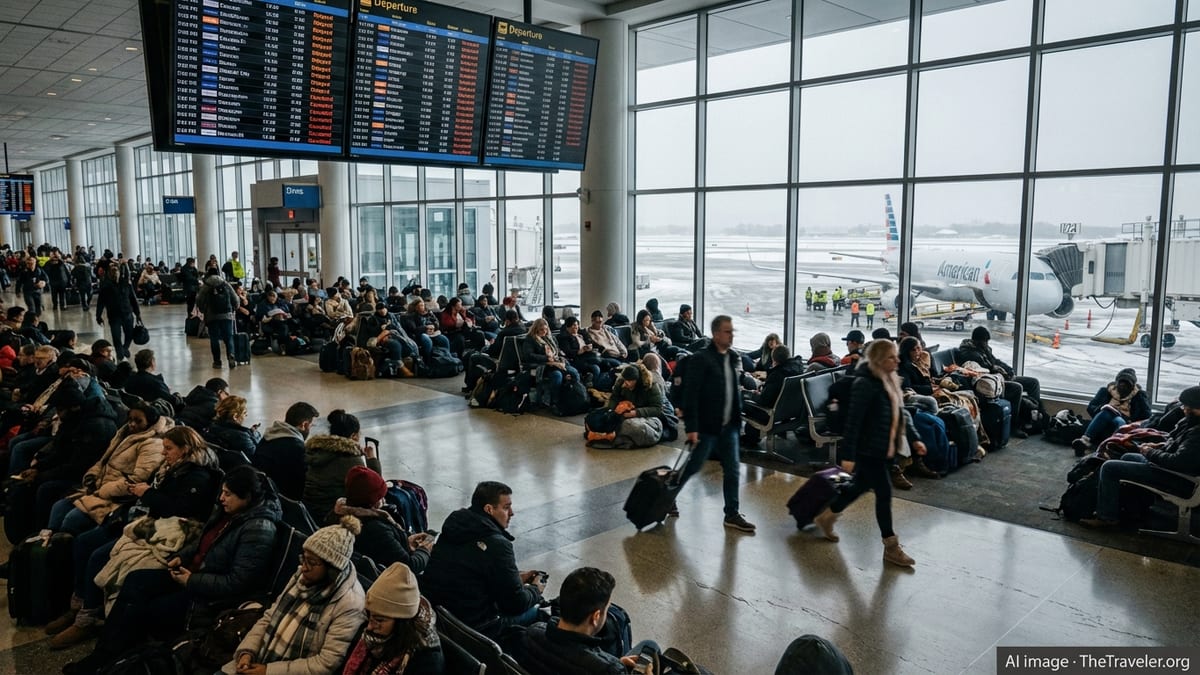
Emergency Return Highlights Weather Risks on Busy Atlantic Corridor
Publicly available flight-tracking records indicate that American Airlines flight AA735, operated by a Boeing 777-300ER, departed London Heathrow for Charlotte on 10 June 2026 and climbed to cruising altitude before squawking the emergency code 7700 and diverting back toward the United Kingdom. Aviation incident trackers and enthusiast reports state that the diversion followed a suspected lightning strike while the aircraft was over northern England.
Radar playback shows the widebody turning back after reaching the low 30,000-foot flight levels, then descending and holding before lining up for approach to Heathrow. The aircraft landed safely, but the unscheduled return disrupted a full transatlantic load of passengers, many of whom were booked onward to US domestic destinations and long-haul connections beyond North America.
Lightning encounters are not uncommon for long-haul jets operating in active frontal systems across the North Atlantic, and modern aircraft are certificated to withstand such strikes. Even so, procedures typically require extensive post-event inspections, and operators often remove an affected aircraft from service for checks that can last hours or days. That precaution can rapidly cascade through tightly scheduled transatlantic fleets, where spare widebodies are limited during peak travel periods.
According to operational data published by tracking services, AA735’s return added pressure to an American Airlines system already juggling diversions, weather disruptions and residual congestion on its core Heathrow and US East Coast routes, producing rolling delays and rebookings on subsequent departures.
Network Ripple Effects for American Airlines, British Airways and Lufthansa
The AA735 event has landed at a time when major transatlantic operators are already managing a series of operational shocks on both sides of the ocean. In recent months, American Airlines has faced a combination of infrastructure bottlenecks at London Heathrow, aircraft maintenance constraints and service downgrades on some of its flagship US–UK flights, according to industry coverage tracking the carrier’s performance on routes such as New York to London.
British Airways, which shares a deep transatlantic joint business with American Airlines, has also been navigating schedule changes and equipment swaps on key North Atlantic routes. Specialist schedule trackers show the airline repeatedly adjusting widebody assignments for services between London and major US hubs, while simultaneously coping with earlier disruption linked to equipment reliability and operational constraints on some long-haul fleets. Each widebody taken offline in London reduces flexibility for both British Airways and American to recover when irregular operations occur.
Lufthansa Group networks have not been spared either. Public reports on recent months detail how the German carrier and its subsidiaries have absorbed multiple waves of disruption related to changing traffic flows and security-driven airspace restrictions. While these issues are concentrated on Europe–Middle East and Europe–Asia markets, they intersect with transatlantic schedules through shared aircraft rotations, crew availability and congested hub banks at Frankfurt and Munich. As long-haul aircraft are repositioned or held for extended ground checks, transatlantic frequencies and connection reliability can be affected.
When events such as a lightning strike suddenly remove a Boeing 777 from an already stretched pool, airlines are left to scramble for alternative lift. That often means last-minute downgrades to smaller aircraft, consolidated departures or outright cancellations, all of which reverberate throughout partner networks that rely on carefully timed transatlantic waves to feed onward connections.
Transatlantic Passengers Face Compounding Delays Across Regions
The timing of the AA735 diversion has intensified pressure on passengers traveling between North America and Europe at the start of the northern summer season. Publicly available disruption trackers and travel forums indicate that US, UK, German, Canadian and Indian travelers have already been facing a patchwork of delays and missed connections on the Atlantic corridor, driven by localized storms, staffing shortages and the aftershocks of airspace restrictions on neighboring regions.
For US-bound flights, even a single widebody incident can push passengers onto later departures and different routings via alternative hubs such as Frankfurt, Munich or Heathrow. This can create secondary congestion for European partners, in particular British Airways and Lufthansa, as they attempt to accommodate displaced travelers from American Airlines services. Reports of longer-than-usual minimum connection times, overnight misconnects and rebookings via third-country hubs have become more frequent in recent weeks.
Canadian gateways such as Toronto and Montreal, along with major Indian hubs tied into these networks through European and UK connections, also feel the impact. Many itineraries between India and the United States or Canada are structured around a single protected transatlantic sector on American Airlines, British Airways or Lufthansa. When that segment is delayed or canceled, travelers can find themselves stranded in Europe without straightforward options, especially on peak travel days when later flights are already near capacity.
With the AA735 aircraft likely requiring detailed inspections before returning to service, capacity constraints on subsequent rotations may persist beyond the initial incident day, prolonging the effect on itineraries linking North America, Europe and South Asia.
System Strain Exposes Vulnerabilities in Airline IT and Operations
The AA735 lightning strike has not occurred in isolation. Recent months have revealed how fragile airline systems can become when confronted with simultaneous weather, technical and staffing pressures. According to publicly available airline communications and traveler reports, major carriers on both sides of the Atlantic have struggled with out-of-date passenger notifications, delayed rebooking information and overloaded customer-service channels during irregular operations.
American Airlines and British Airways, which coordinate transatlantic schedules and revenue sharing under a long-standing joint business, rely heavily on aligned reservation and departure-control systems to keep passengers informed during disruptions. When an aircraft unexpectedly returns to its origin, those systems must rapidly recalculate crew duty limits, available seats on alternative services and protected connections for premium and frequent flyers. Any lag in that process can leave passengers waiting at gates or in call queues with limited information.
Lufthansa Group has similarly complex operational and IT architectures across multiple airlines, each feeding large hub banks with tight connection windows. Recent diversions on its transatlantic flights have shown how even a single unscheduled landing can trigger a wave of missed connections, hotel placements and onward rebookings that test both automation and human staffing.
The AA735 incident therefore illustrates a broader vulnerability. A relatively contained safety event, such as a lightning strike that results in a precautionary return, can escalate into a daylong or multi-day disruption for thousands of travelers if the underlying systems for recovery, communication and capacity management are already operating near their limits.
Travelers Confront Summer of Uncertainty on the Atlantic
For travelers planning transatlantic trips in the coming weeks, the AA735 diversion serves as another signal that the 2026 peak season may be characterized by intermittent but sharp disruptions. Aviation and travel-industry analysis published in recent weeks has pointed to constrained widebody fleets, ongoing staffing imbalances and evolving geopolitical risks that can force airlines to reroute or reschedule at short notice.
Industry observers note that the United States, United Kingdom, Germany, Canada and India are especially exposed to these fluctuations because their busiest international flows are interconnected through a relatively small number of long-haul hubs and airline joint ventures. A weather-related incident, an airspace closure or a localized technical problem at one of those hubs can propagate quickly across multiple continents.
Reports from recent disruption episodes suggest that passengers with transatlantic connections may benefit from more conservative planning, including longer layovers at European and North American hubs, flexible booking options and close monitoring of flight-status tools in the days before departure. While aircraft such as the Boeing 777 are engineered to withstand adverse weather events, the AA735 emergency return underlines that the broader system carrying millions of travelers across the Atlantic each month remains susceptible to sudden stress.