


More news on this day
Rail passengers across south-west London and Surrey have faced widespread disruption after a full closure of Wimbledon station for major engineering work triggered South Western Railway cancellations, diversions and rail replacement buses across key commuter routes.
Get the latest news straight to your inbox!
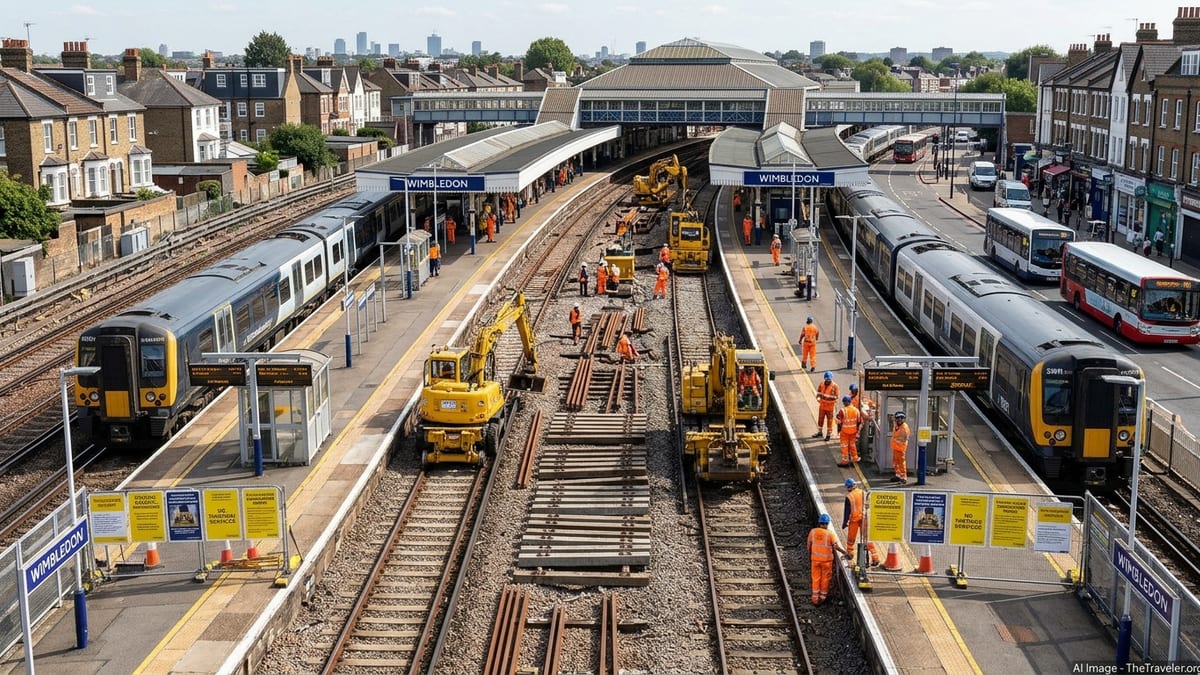
Engineering Blockade Shuts Critical South-West London Hub
Wimbledon, one of the busiest rail interchanges in south-west London, has been temporarily closed to main line trains for extensive engineering work, according to service updates from Network Rail and National Rail Enquiries. The blockade affects all South Western Railway services that would normally run to, from or through the station, forcing operators to suspend or heavily modify timetables on the routes that feed Surrey’s commuter belt.
Publicly available notices show that the works centre on the South Western main line corridor, where the tracks and signalling around Wimbledon are being renewed and reconfigured. Network maps published by South Western Railway highlight the Wimbledon area as a focal point for planned improvements designed to increase long-term reliability on routes linking London Waterloo with Surrey, Hampshire and beyond.
The closure has required lines through Wimbledon to be taken out of service, with no through trains able to operate on the affected days. This has removed a crucial junction on the approach to London Waterloo, which normally handles dense suburban traffic and long-distance services, leaving operators with limited options for routing trains around the worksite.
With services unable to use one of their main gateways into the capital, South Western Railway has advised passengers to check live journey planners closely and to expect cancellations, extended journey times and crowded alternatives while the blockade remains in place.
South Western Railway Cancels and Diverts Services Across Surrey
The Wimbledon closure has had a pronounced impact on Surrey, where many routes rely on access through the station to reach London Waterloo. Engineering summaries published by South Western Railway indicate that services on lines via Surbiton, Epsom, Chessington South and Hampton Court have been curtailed, diverted or replaced by buses during the work.
On some corridors, trains that normally run from Surrey into Waterloo via Wimbledon have been truncated to start or terminate at intermediate hubs such as Basingstoke or Guildford. Other services have been rerouted away from the usual fast lines towards London, increasing journey times for passengers and reducing the number of direct trains available from towns across Surrey.
National Rail incident pages and South Western Railway’s own disruption feeds show repeated references to revised stopping patterns, with some services omitting intermediate Surrey stations or operating on alternative routes to avoid the blocked section. In practical terms, this has meant fewer trains for communities that depend on frequent links to London for work, education and leisure.
Replacement buses have been drafted in to bridge gaps where rail services cannot operate, particularly on local branches feeding into Wimbledon. Guidance from rail operators notes that these buses are subject to road congestion and longer journey times, creating an additional layer of uncertainty for commuters attempting to plan their day.
Waterloo Bottlenecks Magnify Disruption From Wimbledon Works
The loss of capacity through Wimbledon has magnified existing pressure at London Waterloo, the country’s busiest rail terminal and the core hub for South Western Railway. Operator statements explaining recent severe disruption highlight how closely linked the station is to the wider network, with most services either starting or finishing their journeys there on a typical weekday.
Recent episodes of large-scale disruption triggered by separate signalling failures at Waterloo, coupled with incidents in the Wimbledon area, have demonstrated how quickly issues on one part of the network can cascade. In July, South Western Railway detailed how a failure connected to the Wimbledon Area Signalling Centre severely limited the use of platforms at Waterloo, leading to widespread cancellations and extensive delays across the suburban network.
That vulnerability is again evident during the current engineering blockade. With tracks through Wimbledon out of use, trains that would normally approach Waterloo along multiple corridors are being funneled onto fewer routes or withdrawn altogether. This not only constrains the number of services that can run but also reduces the ability of operators to recover from any additional unplanned incidents elsewhere on the network.
Passenger accounts shared on social media and public forums during recent disruption around Waterloo describe crowded concourses, lengthy queues for information and last-minute platform changes. While the current closure of Wimbledon is planned rather than sudden, the knock-on effect on capacity and passenger flows at Waterloo has revived concern about how resilient the south-west London rail network is to major planned works.
Knock-On Effects for Commuters and Local Economies in Surrey
The combination of cancellations, diversions and rail replacement buses has had a tangible impact on daily life for Surrey residents who rely on South Western Railway services. Reports from regular passengers describe significantly longer door-to-door travel times, increased crowding on alternative routes and difficulty securing seats on trains that remain in service.
For commuters travelling from Surrey towns such as Guildford, Woking, Epsom and Surbiton, the closure of the Wimbledon corridor has removed some of the network’s flexibility. Travellers have been directed towards other rail routes or told to consider Underground and bus connections where available, adding complexity and cost to journeys that are already among the longest in the south-east of England.
Local businesses that depend on reliable commuter flows into and out of London have also felt the effects. Retail and hospitality venues near key Surrey stations report fluctuating footfall as passengers alter their usual travel patterns, working from home more often or adjusting their hours to avoid the most congested services. The disruption comes on top of previous periods of upheaval linked to storms, signalling failures and earlier engineering work on the same corridor.
Community feedback shared in online discussions about recent rail problems across Surrey suggests a mixture of frustration and resignation. While many travellers acknowledge that major infrastructure work is necessary to improve long-term reliability, repeated episodes of large-scale disruption have eroded confidence in the day-to-day resilience of the network serving the region.
Rail Industry Argues Long-Term Gains Will Follow Short-Term Pain
Network Rail and South Western Railway have framed the current closure at Wimbledon as part of a wider programme of upgrades intended to modernise signalling, renew track and increase reliability on one of Britain’s most intensively used stretches of railway. Engineering plans published for the South Western route show sustained investment in the corridor that carries suburban, regional and long-distance services between Waterloo, south-west London and Surrey.
Industry data compiled by the Office of Rail and Road has highlighted how infrastructure faults in the Wimbledon and Waterloo areas have previously contributed to severely disrupted days on the network. By tackling ageing assets through concentrated blockades, rail planners aim to reduce the frequency of such incidents and support more punctual services in the medium to long term.
However, the experience of passengers during the current works underlines the trade-off between long-term benefits and short-term disruption. With Wimbledon temporarily offline, the network has limited capacity to absorb further shocks, leaving commuters vulnerable if weather events, signalling issues or other incidents arise during the blockade period.
Travel advice from operators continues to stress the importance of checking live journey information before setting out, allowing extra time and considering alternative routes where possible. For many Surrey travellers, the hope is that once the tracks and signalling around Wimbledon return to full operation, the region will see a tangible improvement in reliability that justifies the current period of rail chaos.