


More news on this day
Thousands of flights across the United States remained canceled or heavily delayed on Saturday as airlines and airports worked to clear backlogs from a nationwide air traffic control communications failure that triggered a rare shutdown of departures and one of the most disruptive travel days in recent history.
Get the latest news straight to your inbox!
System-wide failure leads to historic disruption
Publicly available flight-tracking data shows that the shutdown began on Friday afternoon, when the Federal Aviation Administration ordered a nationwide halt to most departing flights after a communications network that carries critical radio traffic between controllers and pilots went down. The ground stop lasted nearly five hours before departures were gradually allowed to resume.
According to figures compiled by flight-tracking service FlightAware and cited across major news outlets, airlines canceled nearly 10,000 flights within, into or out of the United States on Friday and delayed more than 7,000 others, making it one of the worst days for air travel in US history. By Saturday morning, reports indicated that more than 3,000 additional flights had already been canceled and over 1,000 delayed as the system struggled to recover.
Coverage from Reuters and other news organizations indicates that the problem affected a private telecommunications network used by the FAA to carry radio and data links for air traffic control. The outage disrupted the ability of controllers at multiple air route traffic control centers to reliably communicate with aircraft, prompting officials to keep planes on the ground until stable connections could be confirmed.
Homeland security and transportation officials have publicly stated that there is no indication so far that the disruption was caused by a cyberattack or malicious activity, though investigators are continuing to review the incident. The shutdown follows a smaller but similar communications failure in September that created hours of delays across the US Northeast.
Lingering cancellations ripple through major hubs
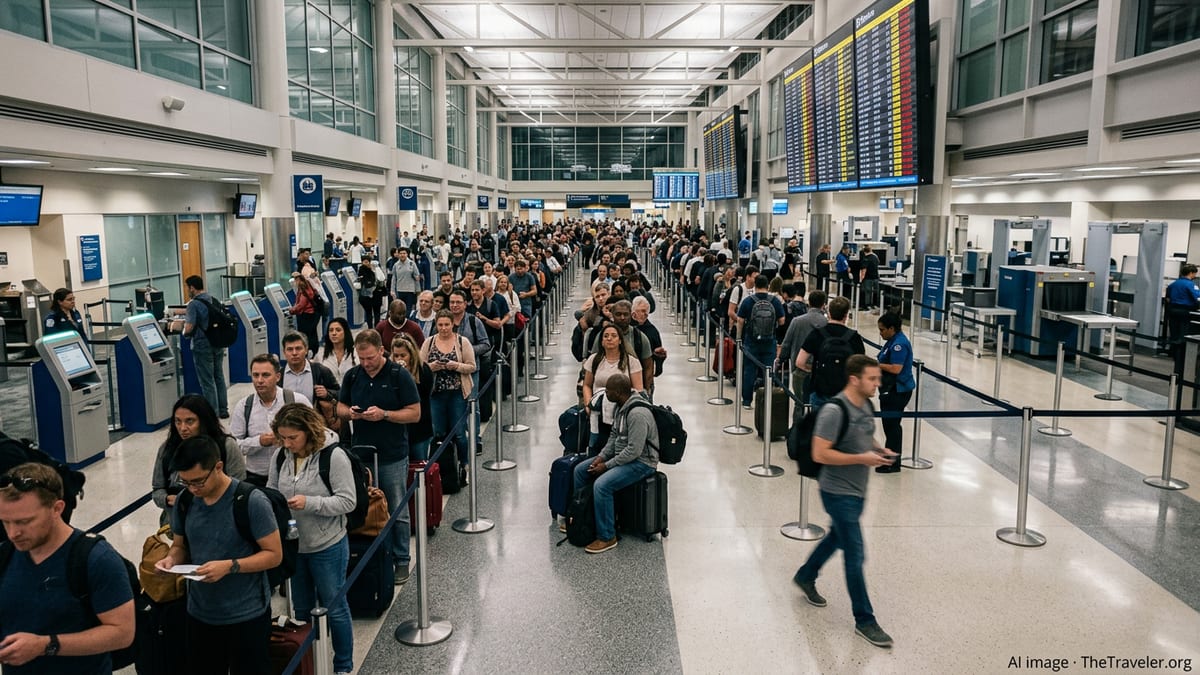
On Saturday, the fallout was visible at airports nationwide, from New York and Boston to Chicago, Dallas and Los Angeles. Airport information boards showed dense clusters of red and yellow status alerts as carriers continued to scrub flights and reset schedules. Reports from Boston Logan International, Newark Liberty International and Chicago O’Hare described long lines at ticket counters and security checkpoints as travelers tried to rebook.
Data shared in live updates from national broadcasters indicated that the heaviest concentrations of cancellations and delays were at the largest domestic hubs for American, Delta, United and Southwest, along with busy coastal gateways for transatlantic and Latin America traffic. With aircraft and crews out of position after Friday’s ground stop, airlines spent much of Saturday reducing frequencies on some routes and consolidating passengers onto fewer flights.
Smaller and regional airports were also affected, though the pattern was uneven. Some secondary airports saw relatively normal operations by midday Saturday, while others continued to experience late-day departures as inbound aircraft arrived hours behind schedule. A number of airports issued public advisories warning that even flights listed as “on time” were vulnerable to last-minute changes as the national network stabilized.
Travel industry analysts cited in US coverage noted that knock-on effects from such a widespread disruption can linger for days, especially if aircraft miss required maintenance windows or crews reach regulatory limits on duty time. That raised the possibility of residual cancellations into Sunday, even if the underlying communications network remains stable.
What caused the shutdown of US departures
Initial explanations from transportation officials, summarized across Associated Press, ABC News and CBS News reports, point to a failure in the private communications backbone that links air traffic control facilities around the country. An update to that network reportedly triggered a reboot and an overload of aging routing equipment, interrupting the flow of data and voice circuits used to manage flights.
The outage hit a system that aviation experts have long described as vulnerable because of its reliance on decades-old infrastructure. Recent reporting on FAA modernization plans notes that controllers in more than 400 facilities still depend on legacy equipment, including copper wiring and older radio systems, with full upgrades not expected to be completed until late this decade.
Friday’s shutdown is being widely compared to a national ground stop in January 2023, when an internal FAA system that distributes safety notices to pilots failed and froze departures for about 90 minutes. In the current case, the disruption lasted significantly longer and affected the foundational communications channels between controllers and pilots, rather than a standalone advisory system.
Aviation safety specialists quoted in public reports stressed that keeping aircraft on the ground is the default precaution when there are questions about communication and radar coverage. While that decision produced massive disruption, they argued that the episode underscores how crucial resilient, well-funded infrastructure is to maintaining a high level of safety in one of the world’s busiest airspaces.
Guidance for affected travelers and upcoming flights
Airlines urged passengers in public statements and social media posts to check their flight status before leaving for the airport and to use mobile apps or websites to rebook rather than lining up at crowded counters. Some carriers began offering limited fee waivers on changes for travel over the affected period, though specific policies varied by airline and route.
Travelers holding tickets for Friday and Saturday departures were frequently being shifted to flights later in the weekend where seats were available. At some major hubs, hotels near the airport reported being at or near capacity on Friday night as stranded passengers looked for rooms after missed connections. Others opted to wait out the disruption at the terminal in hopes of securing a standby seat.
Published advice from consumer travel advocates recommends that passengers keep all documentation of delays and cancellations, including boarding passes and receipts, in case they are eligible for reimbursement of meals, ground transportation or lodging under individual airline policies. For international itineraries originating in Europe or other regions with stronger passenger rights rules, additional protections may apply for segments covered by those jurisdictions.
With airlines projecting a gradual return to normal operations by late Sunday, travelers booked for upcoming trips are being encouraged to allow extra time at the airport, avoid tight connections, and monitor notifications closely. Industry data from previous large-scale disruptions suggests that schedules can remain fragile for several days, particularly during peak morning and evening waves when hubs operate near capacity.
Renewed scrutiny of US aviation infrastructure
The scale of the disruption has intensified attention on the condition of the US air traffic control system and the pace of planned upgrades. Recent analyses of federal aviation funding note that Congress approved billions of dollars in modernization investments in recent years, but many projects, including the replacement of outdated communications networks, are still in progress.
Reports from national outlets highlighted that even before this latest incident, the US system had experienced a series of regional outages tied to severed fiber lines, equipment failures and software issues. Combined with chronic staffing shortages at key facilities, those problems have raised concerns among airlines, labor groups and passenger advocates about the resilience of the network as traffic returns to or exceeds pre-pandemic levels.
The latest shutdown is likely to feature prominently in upcoming debates in Washington over infrastructure spending and oversight of aviation technology contracts. Lawmakers from both parties have previously criticized the slow pace of modernization and the continued reliance on aging hardware that can be disrupted by single points of failure.
For travelers, the episode serves as a reminder that even on clear-weather days, disruptions far from their departure or arrival airport can cascade through the tightly choreographed US flight network. While the safety record of commercial aviation remains strong, the weekend’s chaos is expected to fuel calls for faster investment in robust communications systems so that the next unexpected outage is less likely to bring most of the country’s air traffic to a standstill.