


More news on this day
Air travel across the United States remained snarled on November 14 as airlines worked to recover from a rare nationwide ground stop a day earlier, while Transportation Secretary Sean Duffy pointed to aging air traffic control technology as a central factor in the cascading failure.
Get the latest news straight to your inbox!
Flight Operations Slowly Rebuild After Friday’s Shutdown
Commercial aviation entered a second day of disruption on Saturday after the Federal Aviation Administration lifted a nationwide ground stop that halted departures across the United States on Friday, November 13. Publicly available tracking data showed thousands of flights canceled or delayed as carriers struggled to restart complex networks that had been frozen in place for hours.
Live tallies cited in national broadcast coverage indicated that more than 12,500 flights were canceled across Friday and Saturday, with some of the largest impacts at major hubs such as Atlanta, Chicago O’Hare, Dallas Fort Worth, Denver and Newark. Even after the ground stop ended Friday night, tight gate availability, crew scheduling limits and aircraft out of position restricted how quickly airlines could resume normal operations.
By Saturday afternoon, reports from multiple outlets indicated that the FAA’s systems were back at full operational capability, and departure flows were gradually increasing. However, airlines continued to trim schedules, prioritizing long-haul and high-demand routes while consolidating or canceling lower-volume services. Several carriers issued travel waivers allowing customers booked over the next several days to rebook without change fees within specified date ranges.
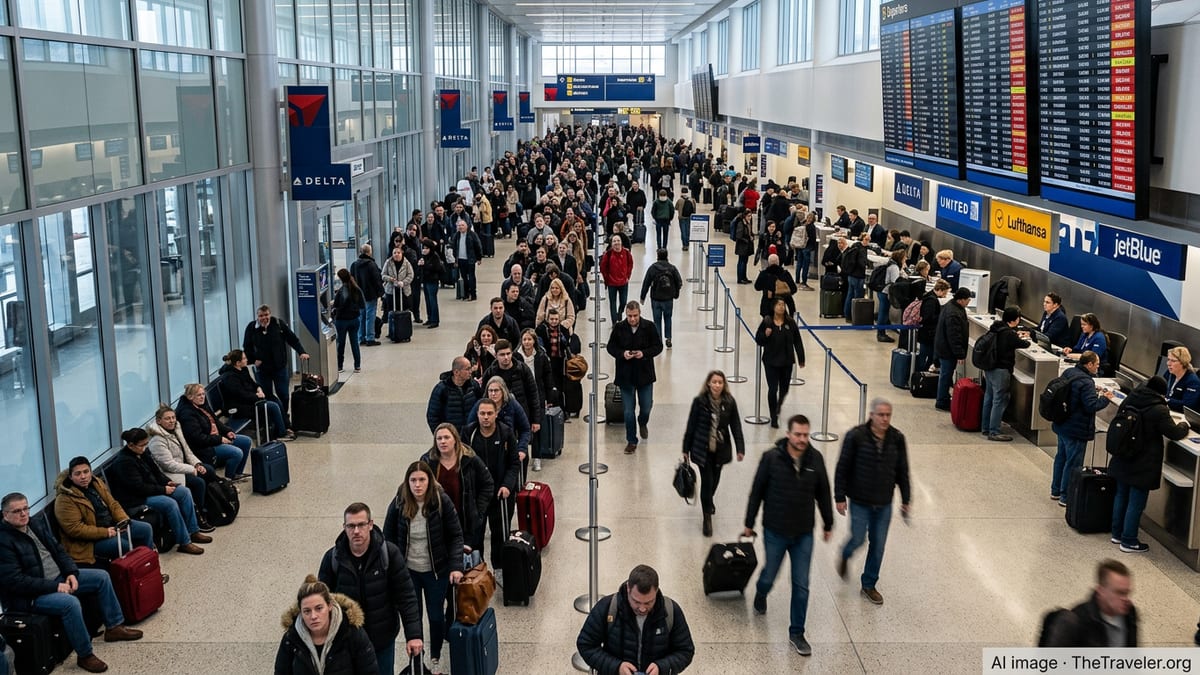
Regional airports also felt the strain as aircraft and crews failed to arrive the previous evening. Local television coverage from airports in the New York metropolitan area described long lines at ticket counters and security checkpoints early Saturday, with some passengers facing rebookings a day or more after their original departure times.
Duffy Cites Aging Systems and Overloaded Routers
In briefings in Washington on Friday night and Saturday, Transportation Secretary Sean Duffy linked the failure to a mix of aging infrastructure and stress introduced by new technology. According to publicly available transcripts and news coverage, Duffy said that old equipment in the air traffic communications network became overloaded as new systems and updates were layered on top, triggering a cascading loss of communications and radar feeds.
Officials at the White House news conference described the incident as an “emergency” for the national airspace system and said the department is seeking tens of billions of dollars in additional funding to accelerate modernization. The outage followed years of warnings from government watchdogs about the risk posed by legacy systems that remain critical to air traffic control despite repeated upgrade programs.
Initial technical descriptions shared in media reports pointed to an update on a private telecommunications network that links regional air route traffic control centers. That update reportedly caused a reboot that overwhelmed switches and routers, leading to intermittent or lost data feeds for controllers in multiple facilities. The FAA responded by ordering a ground stop to maintain safety until reliable communications could be restored.
Duffy and Federal Aviation Administration leaders also stressed that, based on information available as of Saturday, there was no evidence that a cyberattack caused the failure. Investigators are focusing instead on the interaction between long-standing hardware, newer software-based tools and the communications backbone that ties them together.
First Nationwide Ground Stop Since 2023 Outage
The incident marked the first nationwide ground stop in the United States since January 2023, when a malfunction in a key FAA computer system delivering safety notices to pilots temporarily halted departures. Before that, such a sweeping grounding had not occurred since the shutdown of U.S. airspace in the aftermath of the September 11, 2001 attacks.
Analyses published in recent days by major newspapers and policy organizations have highlighted how the 2026 event reinforces long-standing concerns about the resilience of the national airspace system. A recent report from federal auditors, for example, described aging equipment, delayed modernization projects and rising maintenance challenges across multiple core FAA programs.
Despite years of investment in NextGen air traffic technologies, including satellite-based navigation and digital communications, many underlying systems still rely on hardware and software developed decades ago. Industry observers noted that efforts to patch and overlay new capabilities on top of legacy systems can introduce unanticipated interactions, particularly when those changes affect shared communications networks.
Transportation Department materials released earlier this week outlined plans to phase out some of the most antiquated components, including information systems that still depend on outdated storage media at hundreds of facilities. The timeline for fully retiring such equipment, however, extends into the latter part of this decade, leaving an extended period in which old and new technologies must coexist.
Travelers Face Cancellations, Misconnections and Limited Options
For passengers, the technical explanations offer little immediate relief from missed events, lost vacation time and disrupted business trips. Local television stations covering major airports reported scenes of crowded concourses and overnight lines at customer service desks as travelers sought rebooking options following Friday’s shutdown.
Several airlines issued public statements warning that disruptions would continue through at least Sunday, with further cancellations possible as carriers worked to reposition aircraft and crews. One large U.S. airline told customers that rebooked travel would need to occur within specified dates in mid-November, while others encouraged travelers to use mobile apps and websites to secure alternative flights rather than waiting in line at the airport.
Because the disruption originated in the federal air traffic system rather than with individual carriers, passengers’ compensation and refund options vary based on airline policies and the fare originally purchased. Consumer advocates quoted in broadcast and online coverage advised travelers to document delays, monitor for schedule changes and contact airlines promptly about unused segments and eligible refunds.
Rail and intercity bus operators in several regions reportedly saw increased demand late Friday and Saturday as some travelers opted to abandon air plans entirely for shorter-distance journeys. Rental car counters at certain hubs also experienced heavy traffic as passengers sought to complete trips by road after cancellations of final connecting legs.
Spotlight on Long-Term Modernization and Resilience
The grounding has intensified scrutiny of the pace and scope of U.S. airspace modernization. Congress approved a multibillion-dollar package in 2025 for technology improvements across the air traffic system, and transportation leaders are now pressing for substantially more funding, arguing that Friday’s events show the cost of delay.
Policy analysts following aviation infrastructure note that the incident could influence upcoming debates over FAA reauthorization and federal transportation spending. Discussions are expected to focus on whether to concentrate resources on replacing entire system segments outright or continue the incremental “patchwork” approach that critics say leaves too many single points of failure.
For airlines and travelers, the key question is how quickly meaningful improvements can be implemented without introducing new instability. Industry groups have long supported modernization in principle, but carriers also caution that large-scale technology shifts must be carefully staged to avoid repeats of the kind of service collapse seen on November 13 and 14.
In the meantime, airlines are updating customers flight by flight, and the FAA has pledged to share additional findings from its technical review once investigators determine precisely how a single network change rippled into one of the most significant interruptions of U.S. air travel in decades.