


More news on this day
Passengers at Shreveport Regional Airport faced hours of unexpected disruption on Friday, November 13, after a rare nationwide ground stop by the Federal Aviation Administration halted departures and pushed evening flights late into the night.
Get the latest news straight to your inbox!
National Ground Stop Ripples Into Shreveport
Publicly available information from the Federal Aviation Administration shows that the agency ordered a nationwide ground stop on Friday, November 13, citing communications issues affecting multiple regional air traffic control centers. The directive temporarily halted most departing flights across the United States, triggering a wave of delays that reached even smaller facilities such as Shreveport Regional Airport.
Coverage of the event describes the halt as the first nationwide ground stop since January 2023, when a technology failure forced the FAA to pause all domestic departures. In the 2026 case, reports indicate that the order was issued late in the afternoon and was gradually lifted during the evening, but the time needed to restart normal flows left many local travelers waiting well into the night.
According to flight-status data summarized in regional news reports, operations at Shreveport did not cease entirely. Arrivals continued to trickle in, typically behind schedule, while departures were held or rescheduled as the national system adjusted. Even after the formal ground stop ended, the disruption to aircraft and crew rotations left airlines working through residual delays.
Shreveport Routes to Houston, Dallas and Atlanta Hit Hard
Local coverage focused on a cluster of key Shreveport routes that were significantly affected as the ground stop took effect. Publicly available reporting from Shreveport-based outlets indicates that one of two evening departures from Shreveport to Houston was delayed to around 5 p.m., with the second Houston-bound flight initially remaining on time but facing uncertainty as the system-wide disruption unfolded.
Other core connections from Shreveport Regional also experienced setbacks. A scheduled departure to Dallas was reported to be running about two hours late, while an outbound flight to Atlanta was roughly one hour behind schedule. Arrivals inbound to Shreveport on the same city pairs also showed late operations, complicating efforts to reassign aircraft to later departures.
The pattern mirrored what occurred at larger hubs across the country, where a single nationwide order quickly cascaded into missed connection banks and out-of-position aircraft. For a non-hub airport such as Shreveport, the impact can be outsized, because even a small number of delayed flights may represent a significant share of the day’s total schedule.
Passengers Confront Long Waits, Rebookings and Last-Minute Drives
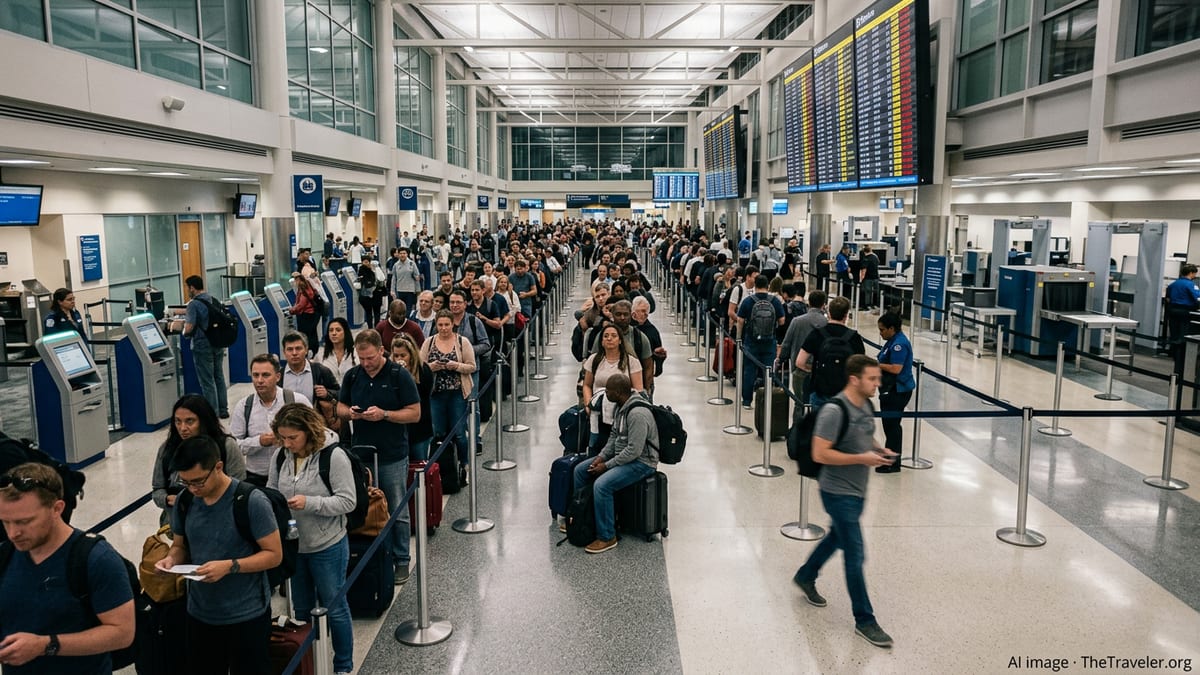
Regional news accounts from Shreveport describe terminal gate areas filled with passengers watching departure boards repeatedly refresh as revised times appeared. With the FAA’s halt in effect, airlines could not simply move flights to nearby time slots, leaving many travelers to wait for successive advisory updates from the national airspace system.
Some passengers reportedly chose to accept rebookings for later flights once limited capacity reopened, especially those with flexible arrival plans or multi-day trips. Others, facing time-sensitive commitments such as weekend events or family gatherings, opted to rent cars and drive to destinations in Texas, Arkansas, or elsewhere in Louisiana rather than risk further uncertainty.
These responses are consistent with typical passenger behavior observed during previous large-scale disruptions, when a combination of constrained aircraft availability and tightly scheduled crews can limit airlines’ ability to add extra sections or make up lost time. With Shreveport’s relatively compact daily schedule, even a handful of cancellations or extensive delays can sharply reduce same-day options.
From Ground Stop to Gradual Recovery
Statements released through federal and transportation channels overnight indicate that the FAA lifted the nationwide ground stop late Friday, allowing departures to resume under what officials described as full operating conditions by Saturday, November 14. However, by the time the order was canceled, much of the day’s departure structure had already been disrupted.
Tools that track the national airspace system showed no active ground stops by Saturday morning, suggesting that the immediate crisis had passed. Yet the impact for travelers extended into the weekend, as aircraft repositioning, crew duty-time limits, and displaced passengers continued to shape schedules at airports across the country, including Shreveport Regional.
For Shreveport, the shift from halted departures to recovery involved clearing backlogs on high-demand routes and rebuilding confidence among travelers who had spent hours in limbo the previous day. Airlines operating at the airport worked through remaining delays as aircraft and crews cycled back into regular rotations, gradually restoring something closer to a normal timetable.
What the Incident Means for Future Travelers
The November 13 disruption has renewed attention on how sudden national directives affect travelers at small and mid-sized airports. Shreveport Regional’s flight schedule is built around a limited set of key hubs, so any interruption on a single day can have outsize consequences for connections and next-day availability.
Publicly available FAA guidance encourages passengers to rely on real-time airline notifications and to verify status frequently during irregular operations, particularly when national initiatives such as ground stops or ground delay programs are in effect. For travelers using airports like Shreveport, that can mean checking both their local departure and the status of inbound aircraft that will operate their flight.
The airport’s own contingency planning documents outline procedures for extended tarmac delays and other operational irregularities, reflecting federal requirements that facilities with scheduled commercial service be prepared for prolonged disruptions. While the nationwide ground stop has now been lifted, the experience at Shreveport underscores how quickly events far from northwestern Louisiana can alter travel plans, and how important it is for passengers to build flexibility into time-sensitive itineraries whenever possible.