


More news on this day
Exceptionally low water on key stretches of the Rhine and Danube this summer is disrupting European river cruising at the height of the season, testing how nimbly operators can keep itineraries running through Austria and Hungary while climate patterns grow more volatile.
Get the latest news straight to your inbox!
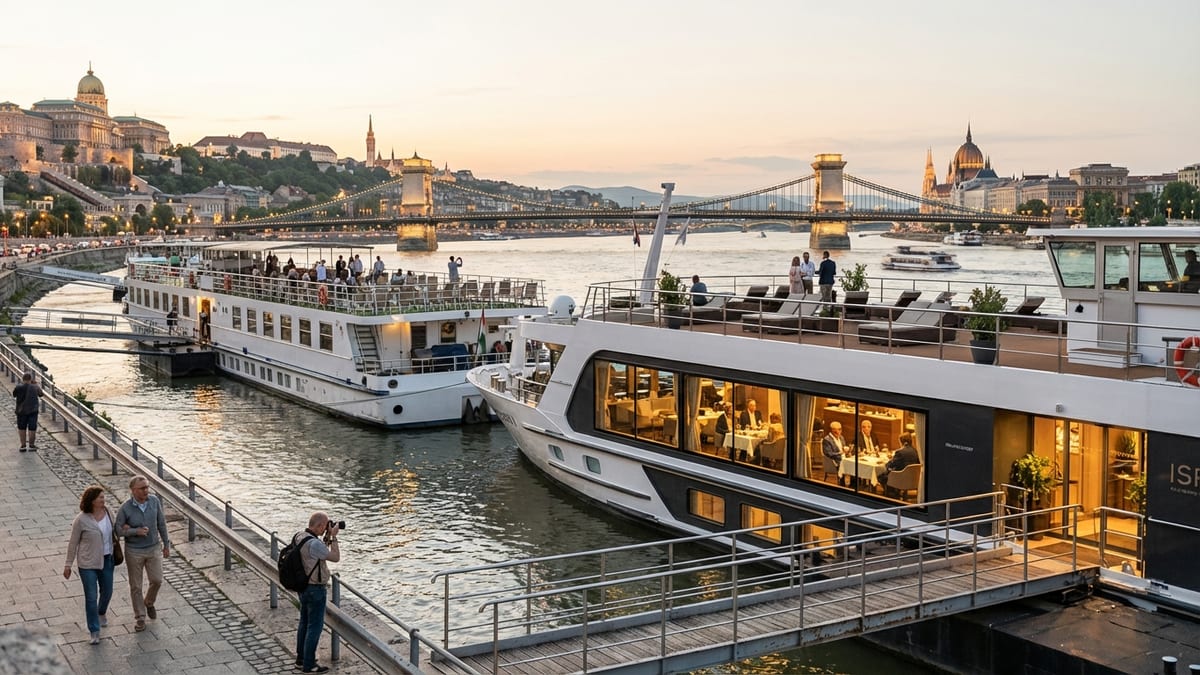
Low Water Summer Puts Central European Rivers Under Strain
After several summers of uneven conditions, 2026 has emerged as a fresh stress test for Central Europe’s river network. Trade and travel reports describe exceptionally low flows on sections of both the Rhine and the Danube, with navigation on some reaches reduced to narrow channels or paused altogether. On the cruise side, coverage from specialist outlets notes that disruptions have clustered along shallow “choke points” that limit draft, rather than along whole river systems.
On the Danube, Austrian authorities report that levels in parts of the country have dropped to ranges last seen during Europe’s benchmark dry years of 2003 and 2018. An early August communication from Austria’s transport ministry and waterway company viadonau described freight traffic as “largely at a standstill” on certain stretches, with cruise operations “significantly restricted” as captains work within tighter safe-draft margins and sporadic depth limits at critical gauges.
Further downstream, travel news coverage highlights a chain reaction across the middle and lower Danube corridor. Reports from August point to reduced depths on passes in Slovakia and Hungary that constrain how far heavily loaded ships can proceed, along with sandbanks reappearing near long, meandering sections. In parallel, industry trackers have documented the Rhine’s own challenges, including new record-low July discharges in parts of Germany and the Netherlands that have forced ships to thread narrower fairways, particularly around the Kaub gauge reach often cited as a bellwether for waterborne commerce.
Itinerary Changes, Ship Swaps and Longer Coach Days
For river cruise travelers, the most visible impact has been a surge in operational workarounds rather than wholesale season cancellations. Recent analysis from cruise-focused publications describes a familiar toolkit: ship swaps, altered embarkation and disembarkation ports, increased use of motorcoaches between affected cities and, in a smaller number of cases, outright trip cancellations when safe passage cannot be guaranteed over multiple days.
On the Danube, itineraries that usually glide from Germany through Austria and into Hungary have, in some weeks, been split into segments. Coverage of current conditions notes that lines have positioned sister ships on either side of the shallowest stretches, allowing passengers to sail into Austria, transfer overland while luggage is handled behind the scenes, and then board a second vessel to continue towards Bratislava and Budapest. Similar tactics have been reported in use on the Rhine and Main, where low water north of Basel and around Koblenz has prompted mid-cruise vessel changes and reworked castle-viewing days.
Travel reporters and passenger accounts collected by cruise forums describe mixed reactions to these changes. Many guests view revised programs that keep key city stays as an acceptable compromise, particularly when lines arrange replacement excursions and hotels where needed. Others underline the disappointment of losing iconic scenic sailings through Austrian Wachau vineyards or along Germany’s Rhine Gorge, as some departures are shifted to more time on coaches and less time actually moving on the river.
Industry commentary stresses that decisions are being made on a sailing-by-sailing basis, informed by daily checks of river gauges and short-term forecasts. According to recent explainer pieces from river cruise specialists, operators weigh ship draft, passenger counts and the positioning of spare vessels before deciding whether to run a modified voyage, implement a ship swap or cancel. Publicly available information indicates that, so far this season, most Danube and Rhine cruises have operated with adjustments rather than being scrapped entirely.
Austria and Hungary Confront Infrastructure and Climate Questions
The latest low water cycle has revived policy debates in Austria and Hungary about how to keep navigation viable as Europe warms. In Austria, recent government and viadonau communications outline a package of measures aimed at securing the Danube as a transport and tourism corridor, including targeted river engineering, dredging at bottlenecks and enhanced data for skippers. Authorities there frame these steps as part of a long-term adaptation strategy, especially as the Danube simultaneously faces intermittent high-water extremes like those that disrupted navigation during the 2024 Central European floods.
Hungary faces similar balancing acts on the middle Danube between Bratislava and Budapest and further south towards the Serbian border. During the current low-water period, regional media and navigation bulletins have reported depth restrictions and reduced barge loads that indirectly affect cruise traffic by constraining the broader use of the river channel. These episodes follow earlier seasons marked by the opposite problem: swollen levels during the 2024 flood season forced temporary halts to cruise calls in Budapest as quay infrastructure was partially submerged.
Recent European navigation market reports from Rhine and Danube commissions show how quickly annual conditions can swing. For instance, monitoring data cited in a Central Commission for the Navigation of the Rhine market review found that 2024 brought relatively favorable levels on the Rhine compared with low-water years such as 2018 and 2022, while Danube assessments for the same period described “overall stable” navigability before this year’s dry spell. Analysts suggest that such variability is becoming more pronounced as heatwaves, shifting precipitation and snowmelt patterns interact with heavily engineered river systems.
For destinations such as Vienna, Linz and Budapest, the stakes extend beyond shipping statistics. River cruises anchor significant visitor flows into historic centers, from Vienna’s Ringstrasse to Budapest’s castle district and thermal baths. Tourism boards in both countries have long marketed the Danube as a defining feature of city breaks and longer itineraries, and periods of prolonged low water highlight how dependent that model is on reliable sailing conditions from spring through late autumn.
Operators Emphasize Flexibility and Communication
As Austria and Hungary grapple with the physical realities of their rivers, cruise operators are refining playbooks honed during past low-water episodes. Trip-planning guides from specialist advisory sites emphasize that most large river lines now maintain dedicated water-level task teams and contingency plans that can be activated with little notice. These include placing additional vessels in strategic locations, building buffer days into ship rotations and pre-negotiating hotel blocks along key city pairs such as Passau–Vienna and Vienna–Budapest.
Recent coverage in consumer travel media underlines that flexibility is also being embedded into customer-facing policies. Some brands are offering updated rebooking options or future cruise credits when itineraries are significantly modified, while others focus on preserving the core experience by reshaping port times and substituting nearby destinations accessible by road. Advisory articles recommend that guests pay particular attention to contract language on water-level disruptions and be prepared for last-minute adjustments, even if their departure ultimately sails as planned.
River-cruise information platforms that monitor gauges on the Rhine, Danube and other waterways in real time also play a growing role. These tools, which aggregate official hydrological data into traveler-friendly dashboards, show color-coded status for stretches across Austria, Hungary and neighboring countries. While they cannot predict a specific ship’s fate, they provide a sense of where conditions are tightest and help explain why one sailing may operate while another, a few days later, faces route changes.
Industry associations, including Cruise Lines International Association’s European arm and river-cruise groups, continue to spotlight broader sustainability measures alongside short-term resilience efforts. Public documents point to investments in more efficient hull designs, shallow-draft vessels and cleaner onboard technologies, which together can marginally extend operability in low-water periods while reducing environmental footprints along sensitive river corridors.
What Prospective Travelers Should Expect This Season
For travelers eyeing upcoming itineraries through Austria and Hungary, recent reporting converges on a pragmatic message: low water is a real factor, but it does not automatically spell the end of a cruise. Trade guides and experienced cruisers alike suggest that guests should approach bookings with a degree of flexibility, understanding that changes might range from a missed scenic segment to additional time on coaches, and in rarer cases, more extensive reroutings.
Advisory pieces recommend booking with operators that clearly explain their low-water policies, maintain a modern fleet and have a track record of transparent communication. Travel planners also point to practical steps such as considering itineraries that include strong city-stay components in Vienna or Budapest, which can remain rewarding even if a sailing leg is shortened, and ensuring that travel insurance is in place to cover nonrefundable elements beyond the cruise fare.
Looking beyond the current season, hydrological data from the past decade indicates that truly extreme low-water years on the Rhine and Danube remain episodic rather than annual, though the swings between high and low appear to be sharpening. Analysts suggest that river cruising in Austria, Hungary and across Europe will likely continue to adapt rather than retreat, blending infrastructure improvements and operational ingenuity to keep passengers moving along two of the continent’s most storied waterways.
https://deck7.co.uk/article/europe-low-water-danube-rhine-river-cruise-disruption
https://www.cruisecritic.com/news/low-water-disrupts-danube-and-rhine-river-cruises
https://rivercruiseadvisor.com/water-levels-for-river-cruises-in-europe/
https://www.bmimi.gv.at/en/service/press/releases/2026/0804-danube.html