


Lufthansa operates one of Europe’s most extensive airport lounge networks, but for many travelers the details remain confusing. Which lounges are included with a business class ticket, what do they actually offer beyond a quiet seat and free coffee, and when is it worth paying or planning your trip around lounge access? This guide breaks down Lufthansa lounges in practical, real-world terms so you know exactly what to expect at major hubs like Frankfurt and Munich, as well as at outstations across Europe and beyond.
Get the latest updates straight to your inbox!
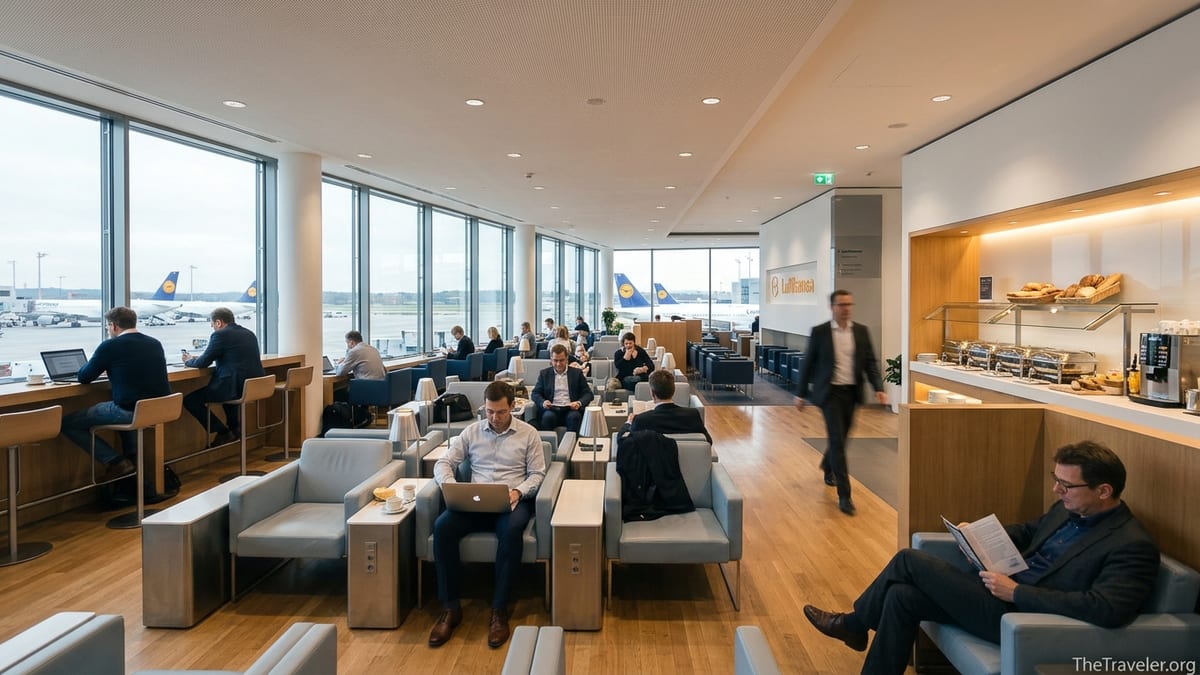
The Different Types of Lufthansa Lounges
When travelers say “the Lufthansa lounge,” they are usually talking about one of several distinct lounge brands. Lufthansa and the wider Lufthansa Group operate four core types: First Class Lounges or the separate First Class Terminal in Frankfurt, Senator Lounges, Business Lounges, and the Lufthansa Welcome Lounge in Frankfurt, which is an arrivals lounge rather than a departure space. On top of this, Lufthansa also uses partner and contract lounges at airports where it does not run its own facility.
At large hubs like Frankfurt and Munich, the distinctions are most visible. In Frankfurt’s Terminal 1, for example, a passenger flying in Lufthansa economy with Star Alliance Gold status might be directed to a Senator Lounge, while a business class passenger without status on the same flight would be sent to a Business Lounge in the same pier. A first class passenger on a Lufthansa-operated flight out of Frankfurt could be invited to the First Class Lounge or even the dedicated First Class Terminal, which has its own security check, gourmet dining, and chauffeur service to the aircraft.
Lufthansa’s Welcome Lounge at Frankfurt Airport is unusual in Europe because it focuses on arrivals rather than departures. Open in the mornings in Terminal 1’s Arrivals area, it serves passengers who have just stepped off a long-haul overnight flight and want a shower and proper breakfast before heading into the city or on to meetings. Many other Lufthansa-branded lounges form part of the departure experience instead and are located airside near the gates.
Outside the German hubs, the product becomes simpler. In places like Vienna or Zurich, Lufthansa Group passengers may use Austrian or SWISS-branded lounges. At smaller airports such as Glasgow or Bordeaux, Lufthansa typically contracts with an independent lounge. These partner facilities might not look or feel like a Lufthansa lounge, but they serve the same core purpose: a quieter environment with Wi‑Fi, snacks, and drinks for eligible travelers before departure.
Who Actually Gets Access and When
Lounge access with Lufthansa depends on a combination of ticket class, frequent flyer status and, in some cases, whether you are arriving or departing. In broad terms, passengers flying in Lufthansa or SWISS first class receive access to First Class Lounges or the First Class Terminal in Frankfurt on the day of travel. They can also use Senator and Business Lounges. Business class passengers on Lufthansa, SWISS or other Star Alliance carriers are entitled to at least a Business Lounge on departure the same day, regardless of frequent flyer status.
Frequent flyer status can unlock lounges even when you are flying economy. Lufthansa’s Miles & More Senator members and Star Alliance Gold members usually gain access to Senator or equivalent Star Alliance Gold lounges when departing on a same-day Star Alliance flight. Miles & More Frequent Traveller members gain access to Lufthansa Business Lounges when traveling on Lufthansa Group flights, even if they hold an economy ticket. A practical example: an economy passenger from New York to Frankfurt with Star Alliance Gold status on a United mileage account can use a Senator Lounge in Frankfurt before an onward Lufthansa flight to Rome.
Arrivals access is more restricted. Frankfurt’s Welcome Lounge typically allows Lufthansa Group first and business class passengers arriving on an intercontinental flight in the morning, as well as certain status holders. For example, a business class traveler landing from San Francisco into Frankfurt at 10:00 can go to the Welcome Lounge in Arrivals B to shower and have breakfast, whereas an economy passenger on the same flight without status usually cannot. At many other airports, including Munich, local regulations or layout mean there is no true Lufthansa arrivals lounge at all.
Paid access is limited and subject to availability. Lufthansa has gradually opened up the possibility for some economy or premium economy passengers without status to buy access at the door to a Business Lounge or through pre-booking for certain flights. However, this is not guaranteed, and at peak times such as Monday mornings in Frankfurt the airline sometimes restricts walk-up paid access in order to keep lounges from becoming uncomfortably crowded.
Inside a Lufthansa Business Lounge: What to Expect
Lufthansa Business Lounges are the entry-level option for most premium travelers. A typical example is the Lufthansa Business Lounge near Gate A13 in Frankfurt’s Terminal 1, which serves Schengen flights. On a mid-morning departure bank, you can expect a buffet with warm options such as scrambled eggs and sausages, several types of bread and rolls, cold cuts, cheeses, fruit, yogurt and cereals. Later in the day, the same lounge usually switches to hot dishes like pasta, stews or regional specialties, along with salads and desserts.
Drinks in Business Lounges are usually self-service. Machines dispense espresso drinks and filter coffee; there is a range of teas, soft drinks on tap or in bottles, and refrigerated beer and wine. Some lounges also offer a small selection of spirits like gin, vodka and whisky. For example, in Frankfurt and Munich it is common to find a couple of German beers on tap and at least one local Riesling among the wines. Everything is included with access, and tipping is neither expected nor required.
Seating zones vary from lounge to lounge but generally include armchairs grouped around small tables, bar-style seating near the buffet and high-top work counters with power outlets. At Frankfurt’s A13 Business Lounge, a traveler might choose a quiet seat near the windows to watch aircraft movements while charging a laptop, or sit closer to the buffet for a quick snack during a tight connection. Wi‑Fi is complimentary and tends to be faster and more reliable than in the main terminal, although at busy times speeds may drop as more passengers log on.
Business Lounges usually include at least a few shower rooms, especially at hubs. These can be important if you are connecting after an overnight flight. For instance, a passenger arriving from São Paulo into Munich in the morning and connecting onwards to Berlin in business class can head to a Business Lounge, request a shower key from reception and freshen up before their domestic sector. Shower queues can build during peak times, so it is wise to request one soon after entering the lounge.
How Senator and First Class Lounges Compare
Senator Lounges cater primarily to Star Alliance Gold and Senator-level frequent flyers, and in many airports they feel like an upgraded version of the Business Lounge. At Frankfurt, Senator Lounges often have a broader food selection, including higher-quality cold cuts, more substantial hot dishes and premium desserts. The bar options are also better, with a larger range of spirits and, at some locations, sparkling wine served from bottles instead of dispensers.
The design and atmosphere of Senator Lounges are generally a touch calmer. For example, in Munich’s Terminal 2, a Senator Lounge might feature quieter, more secluded seating areas and a designated working zone with desks, power outlets and printer access. A traveler with a late-evening flight to Singapore might choose to have a full hot meal there, answer emails and then head to the gate just before boarding, effectively using the lounge as a combination office and restaurant.
At the top of the hierarchy are Lufthansa’s First Class Lounges and, uniquely at Frankfurt, a separate First Class Terminal. Access is restricted to Lufthansa Group first class passengers and HON Circle members. Inside, the experience is closer to a boutique hotel than a typical airport lounge: à la carte dining with restaurant-style service, premium wines and champagnes, private offices, day beds, large shower suites and, in some cases, bathtubs. Guests departing Frankfurt in Lufthansa first class are often driven directly from the lounge or First Class Terminal to their aircraft in a private vehicle.
These premium spaces are aspirational for many travelers because they offer a genuine step change in comfort. However, they are only relevant if you hold a qualifying first class ticket or very high elite status. For most readers, the key comparison is between Business and Senator Lounges, both of which provide the essentials of food, drink, Wi‑Fi and showers, with Senator adding a more relaxed environment and higher-quality catering.
The Unique Lufthansa Welcome Lounge in Frankfurt
The Lufthansa Welcome Lounge at Frankfurt Airport is one of the few true arrivals lounges in Europe. Located in Terminal 1, Area B, on Level 1 in the public Arrivals area, it opens early in the morning and typically closes around midday. Its purpose is to serve passengers who have just arrived on an overnight or long-haul flight and want to recover before starting their day in Germany or connecting on a separate ticket.
The Welcome Lounge is especially appealing to business travelers landing from North America. For example, a passenger arriving from Chicago at 8:30 in the morning can clear immigration, collect their luggage and then head directly to the lounge in Arrivals B. Inside, they will find a breakfast buffet with hot and cold options, freshly baked bread, fruit, juices and coffee, along with modern shower cabins and quiet seating areas. Some travelers use the time to change clothes, answer a few emails, and then head straight into Frankfurt’s financial district for morning meetings.
Access to the Welcome Lounge is limited to specific categories. It is usually open to Lufthansa Group first and business class passengers, HON Circle members, Senators and Frequent Travellers arriving on an intercontinental Lufthansa flight. In practice, that means if you fly Lufthansa business class overnight from New York, San Francisco, or Johannesburg, you can likely use the Welcome Lounge on arrival. Passengers instead arriving on a short-haul flight from Paris or Prague generally cannot, even if they are in business class on that sector, because the service targets long-haul arrivals.
Because the Welcome Lounge is in the public Arrivals area rather than airside, it can also be useful if you are connecting to a separate ticket or ground transport. A traveler landing from Toronto who then plans to continue by train from Frankfurt’s long-distance station could spend an hour in the Welcome Lounge to shower and have breakfast before catching an InterCity Express service, turning a tiring overnight into a more manageable travel day.
Real-World Pros and Cons: Is It Worth Planning Around?
Whether a Lufthansa lounge justifies planning your itinerary or paying extra depends largely on your travel style. For a business traveler who treats the airport as an extension of the office, access can be highly valuable. In Frankfurt, for example, someone with a three-hour layover between a flight from Madrid and a long-haul leg to Tokyo could use a Business or Senator Lounge to have a hot meal, take a shower, and finish presentation slides on a stable Wi‑Fi connection. In effect, the lounge time replaces a meal out and an hour or two of office time.
For leisure travelers, the calculation is more nuanced. If you are flying economy from Berlin to Lisbon via Munich, paying separately for lounge access at both airports may not be worthwhile, especially if your layovers are short. However, if you have a six-hour layover in Frankfurt on the way from Los Angeles to Athens, buying access to a Business Lounge or using status to enter could make a huge difference to fatigue. Being able to lie back in a quieter space, snack regularly without paying terminal prices, and keep devices charged can matter on a long-haul itinerary.
There are also downsides. At peak times, particularly weekday mornings and late afternoons at major hubs, Lufthansa lounges can become crowded. Travelers have reported walking into a Business Lounge in Frankfurt’s A gates to find most seats occupied and limited power outlets available. In these scenarios, the experience may not feel much calmer than the concourse, especially if you mainly care about having a peaceful environment. If a lounge is extremely busy, finding a quieter spot in a less-trafficked gate area with a takeaway coffee might be a better use of time.
Quality can vary between locations and even between lounges in the same airport. Some travelers rank Munich’s Business Lounges slightly higher on cleanliness and food variety than their Frankfurt equivalents, while independent contract lounges in smaller airports may offer a simpler spread of packaged snacks and a basic self-service bar. If your expectations are anchored on the flagship First Class Terminal but your actual access is to a small outstation lounge before a short flight, you may be disappointed. Knowing in advance which specific lounge you will get can help set realistic expectations.
Practical Tips for Using Lufthansa Lounges
Before you fly, check your boarding pass and frequent flyer profile to confirm what you are entitled to. For example, if you are flying Lufthansa premium economy from Newark to Munich and then economy to Florence, your ticket alone does not include lounge access. However, if you also hold Miles & More Senator status or Star Alliance Gold with another airline, you may be able to enter a Senator or equivalent lounge while traveling on the same-day Lufthansa itinerary. Verifying this on the Lufthansa website or with your frequent flyer program can prevent awkward conversations at the entrance.
On the day of travel, plan the timing of your visit. Most Lufthansa lounges at hubs open early in the morning and close late in the evening, but they do not operate overnight. An early departure from Frankfurt around 5:00 in the morning might mean you arrive at security before your preferred lounge has opened. In that case, it is better to clear formalities first, check which lounges are currently open near your gate, and then decide where to spend your pre-flight time instead of walking a long distance to a closed lounge.
If showers are important to you, make this your first stop after entering. At Frankfurt and Munich, shower rooms can be fully booked just after the main wave of overnight arrivals from North America and Asia. A traveler connecting in business class from Toronto to Vienna through Munich, for example, might head straight to the lounge reception, request a shower key, and then return to the buffet once they are on the waiting list. This simple order of operations can save half an hour of waiting later.
Finally, treat lounges as shared spaces. While food and drinks are complimentary, Lufthansa expects guests to dress as they would in public, keep phone calls to a reasonable volume, and leave tables reasonably tidy for the next user. This is especially important at peak times when staff are turning over tables quickly. Being considerate of other travelers not only aligns with published house rules but also helps keep the atmosphere closer to what most people are seeking: a civil, slightly quieter break from the terminal.
The Takeaway
Lufthansa lounges are not a single uniform product but a layered system ranging from basic Business Lounges through Senator spaces to the flagship First Class Lounges and Frankfurt’s distinctive First Class Terminal and Welcome Lounge. What you receive in practice depends on where you are flying, which cabin and ticket you hold, and whether you have elite status in Miles & More or another Star Alliance program. For many travelers, the core benefits are straightforward: more comfortable seating, inclusive food and drinks, showers at major hubs, and more reliable Wi‑Fi than in the main terminal.
Planning your trip with a realistic understanding of these lounges can help you decide whether to pay extra for upgrades, chase elite status, or buy lounge access when it is offered. Business travelers on tight schedules may find that the ability to turn layovers into productive office time and arrive fresher more than justifies the effort. Leisure travelers might instead reserve lounge visits for particularly long connections or overnight arrivals when the additional comfort makes the biggest difference.
Ultimately, a Lufthansa lounge will not turn every trip into a luxury vacation, but it can smooth the rough edges of modern air travel. Used thoughtfully, especially at hubs like Frankfurt and Munich where facilities are most extensive, these spaces can shift the airport experience from something to be endured into part of the journey that you genuinely look forward to.
FAQ
Q1. Who can access a Lufthansa Business Lounge for free?
Business class passengers on Lufthansa or other Star Alliance airlines usually access a Lufthansa Business Lounge at departure for free, as do certain Miles & More status holders such as Frequent Travellers when flying on eligible Lufthansa Group tickets.
Q2. What is the difference between a Lufthansa Business Lounge and a Senator Lounge?
Senator Lounges are primarily for Star Alliance Gold and Miles & More Senator members and typically offer a somewhat quieter atmosphere, a broader food and drink selection, and sometimes additional amenities compared with Business Lounges.
Q3. Does Lufthansa premium economy include lounge access?
In general, Lufthansa premium economy tickets do not include lounge access by default. Premium economy passengers can enter if they hold eligible frequent flyer status or, in some cases, by purchasing access when space allows.
Q4. Can I buy access to a Lufthansa lounge if I am flying economy?
Lufthansa allows paid access to some Business Lounges for economy passengers on selected routes and subject to capacity, either by pre-booking or at the door, but it is not guaranteed at every airport or on every day.
Q5. How does the Lufthansa Welcome Lounge in Frankfurt work?
The Welcome Lounge in Frankfurt is an arrivals lounge in Terminal 1’s Arrivals area that opens in the morning and serves mainly Lufthansa Group first and business class passengers and certain status holders arriving on intercontinental flights.
Q6. Are there Lufthansa arrivals lounges in Munich or other cities?
Lufthansa does not generally operate dedicated arrivals lounges in Munich or most other airports; instead, lounge services there focus on departing passengers in the airside area after security.
Q7. Can Star Alliance Gold members use Lufthansa lounges when flying economy?
Yes, Star Alliance Gold members typically have access to Senator or equivalent lounges when departing on the same day on a Star Alliance flight, even when their ticket is in economy class.
Q8. Do Lufthansa lounges always have showers?
Most Lufthansa lounges at major hubs like Frankfurt and Munich have shower facilities, but smaller outstation or partner lounges may not, so it is wise to check ahead if a shower is important to you.
Q9. Can I access a Lufthansa lounge on arrival after a long-haul flight?
Outside Frankfurt’s Welcome Lounge, arrivals access is limited; at most airports you must be departing on a same-day qualifying ticket or have eligible status to use a lounge, and arrival-only access is generally not offered.
Q10. Is it worth paying for Lufthansa lounge access on a short layover?
Paying for access on a very short layover often provides limited value, but on longer connections or after overnight flights the combination of food, showers, Wi‑Fi and a quieter space can significantly improve the overall journey.