


More news on this day
Checked luggage has been piling up at Philadelphia International Airport after a major technology disruption at American Airlines snarled the carrier’s operations and left passengers separated from their bags across the network.
Get the latest news straight to your inbox!
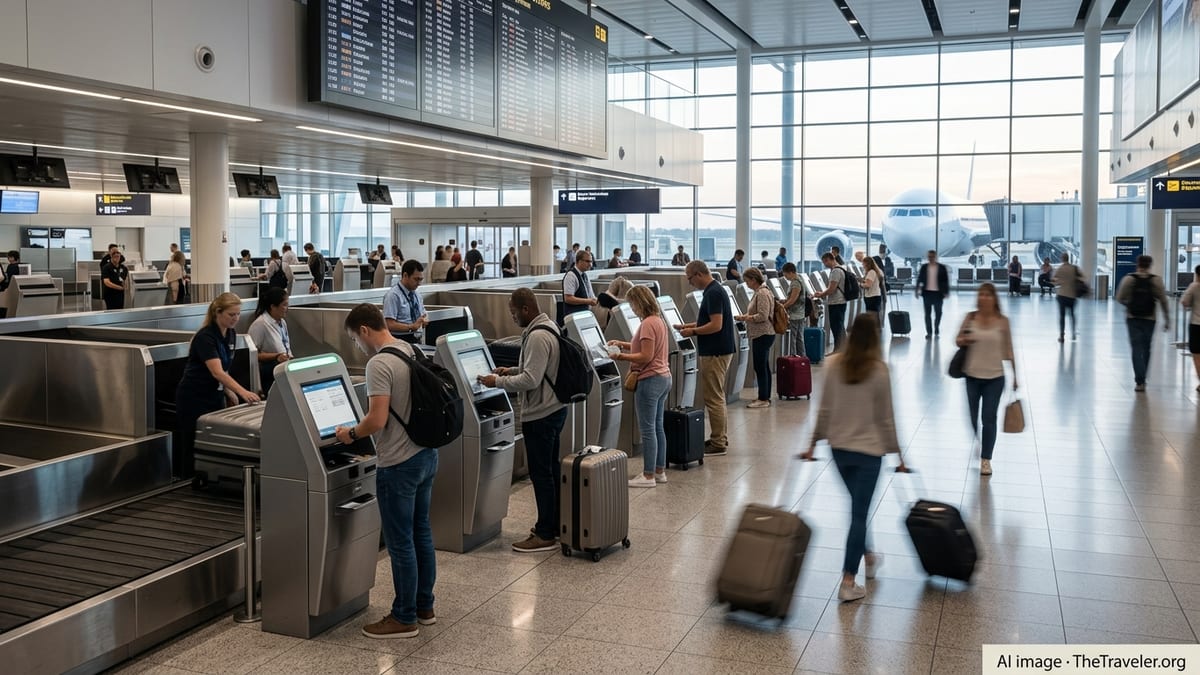
Technology outage ripples through a key American hub
American Airlines relies on Philadelphia International Airport as one of its primary hubs, with a dense schedule of domestic and transatlantic flights and high volumes of connecting traffic. When the carrier was hit by a large-scale technology failure, publicly available information indicates that the outage quickly affected flight dispatch, check-in systems, and baggage handling across multiple airports. Reports from passengers and aviation tracking platforms describe a nationwide ground stop for American, with aircraft held at gates or on taxiways while staff reverted to manual workarounds.
In a hub environment such as Philadelphia, where American operates a significant share of departures, even a short disruption can cascade rapidly. When flights are delayed or canceled in large numbers, bags that have already been checked or transferred often continue moving through conveyor belts and sorting systems, while their owners are rebooked onto new itineraries or forced to remain in the terminal. This mismatch between passenger movements and baggage routing is at the core of the current pileup at PHL.
According to published coverage of similar aviation IT failures, automated systems normally match each bag to a specific passenger, flight, and connection. When those systems become unreliable or unavailable, airlines may shift to manual tagging, paper manifests, and workarounds that are far slower and more prone to error. In Philadelphia, that has translated into luggage being held in secure storage areas and around carousels while staff attempt to reconcile routing information and determine which bags can safely move onward.
The timing of the outage has added to the strain. The disruption struck in the middle of the busy summer travel period, when American’s schedule at PHL is already operating near peak capacity. Seasonal transatlantic flights and leisure routes mean more checked bags, fuller aircraft, and tighter turn times, giving the operation less margin to absorb a system shock of this scale.
Mountains of bags and long waits for reunions
Images and descriptions shared on social platforms, as well as local broadcast coverage, show luggage stacked in long rows near baggage claim areas and in back-of-house storage spaces at Philadelphia International Airport. Suitcases bearing American Airlines tags are visible in large clusters, with handwritten notes and improvised signage apparently used to separate bags by destination or arrival date. Some travelers report waiting hours at carousels before being told their checked items would not be arriving with them.
Accounts from passengers indicate that many bags were loaded onto flights that never left the gate or were later canceled, while others were taken off aircraft and left in the terminal when crews timed out or new routing decisions were made. With outbound departures constrained by the technology problems, those bags have remained at PHL, creating a visible backlog that may take days to fully clear. For travelers who continued on different flights or rebooked on other airlines, their property is effectively stranded until American’s baggage system is fully restored and the airline can begin forwarding items to final destinations.
Publicly available information from prior operational meltdowns suggests that airlines typically prioritize reuniting passengers with medication, mobility devices, and other essential items. However, when thousands of bags accumulate within a short window of time, even urgent cases can be delayed by the sheer volume of work. At Philadelphia, reports indicate that some customers have been encouraged to leave the airport and register missing luggage claims online or through customer service channels rather than waiting in person for uncertain delivery timelines.
The scene in baggage claim contrasts sharply with the improved metrics American has highlighted in recent months. The airline has previously promoted investments in hub restructuring and schedule design intended to deliver its best-ever systemwide baggage performance. The current disruption underscores how quickly those gains can be reversed when core technology platforms fail.
American’s response and what passengers are being told
American Airlines has acknowledged a significant technology problem through public channels, describing it as an issue affecting multiple parts of its operation. The company’s standard practice in such events, as outlined in earlier advisories, is to notify affected customers via its mobile app, text message, or email, and to issue travel alerts that allow fee-free changes for certain dates and routes. In the case of the latest outage, passengers in Philadelphia report receiving messages about delays and cancellations but limited, often changing guidance on the status of their luggage.
According to published airline policies, when baggage is delayed or separated from its owner, American typically commits to locating and delivering it to a home, hotel, or alternative address once operations stabilize. At PHL, however, the backlog is so large that some travelers are being advised, through public-facing staff and customer service channels, to return to the airport at a later time if they live nearby, while others are asked to confirm delivery details and await courier service. The mix of local and connecting customers at the hub complicates that process.
Observers of the aviation industry note that the speed of recovery from a technology-induced meltdown is often determined less by the resumption of flights than by how fast data integrity can be restored. Until every bag’s record is accurately matched to its current physical location and an onward itinerary, large numbers of items must remain in place to avoid misdirecting them a second time. That dynamic appears to be playing out in Philadelphia, where the visual clutter of stranded baggage belies the painstaking sorting and scanning work occurring behind the scenes.
Customer frustration has been palpable in online posts from PHL, with travelers recounting missed connections, overnight stays in the terminal, and uncertainty about essential belongings. While some flights have resumed, the presence of luggage still waiting to be claimed serves as a visible reminder that a technical outage can continue affecting passengers long after departure boards begin to stabilize.
Operational vulnerabilities exposed at a critical airport
Philadelphia’s role as a major connecting point for American Airlines means it is particularly exposed when the carrier faces systemwide problems. Academic research on delay propagation in the United States has shown that disruptions at large hubs can quickly spread throughout the network, as late-arriving crews and aircraft knock subsequent flights off schedule. In a similar fashion, baggage misalignments at a hub can reverberate across many spoke airports, since each misrouted or delayed bag may require manual intervention and additional handling on future flights.
The latest troubles at PHL highlight how dependent modern airline operations are on tightly integrated software systems for reservations, departure control, crew scheduling, and baggage tracking. When one or more of those systems fail, workarounds often involve reverting to paper-based processes that are significantly slower than normal automated flows. That slowdown feeds directly into baggage buildup, because conveyor systems can move bags more quickly than staff can accurately reassign them to new flights under manual procedures.
Philadelphia has already been under scrutiny from travelers over baggage performance, with online discussions frequently mentioning slow delivery times at carousels even during routine operations. The current episode is amplifying those concerns, as anecdotes circulate of bags taking many hours to appear after landing or remaining missing well into the following day. For an airport seeking to project a reliable image during a busy summer and global sporting events drawing more international visitors, such scenes are an unwelcome setback.
Industry analysts observe that while large technology failures are relatively rare, their impact is magnified when they occur during peak travel seasons and at dominant hubs. The situation at PHL illustrates how quickly a single carrier’s IT problem can translate into a visible, airport-wide issue, affecting shared resources such as baggage belts, storage rooms, and ground handling teams.
What travelers through PHL can expect in the coming days
For passengers with upcoming trips through Philadelphia on American Airlines, publicly available guidance suggests preparing for continued irregular operations as the carrier clears the backlog. Travelers who can avoid checking bags may face fewer complications, since carry-on items remain in their possession if flights are delayed or rerouted. Those who must check luggage, particularly on complex itineraries with tight connections, may want to allow extra time and build flexibility into their plans.
Published airline procedures indicate that customers whose bags are delayed are generally entitled to file a claim and track the status of their luggage through online tools or customer service channels. In previous disruptions, carriers have sometimes offered reimbursements for essential purchases such as toiletries and basic clothing when bags do not arrive within a reasonable time, subject to receipts and policy limits. Travelers passing through PHL are watching closely to see what form of accommodation American will extend as the full scope of the luggage backlog becomes clear.
Airport-focused commentary notes that cooperation between airlines, ground handlers, and airport management is critical in managing large volumes of stranded baggage. At Philadelphia, where American occupies a significant footprint, coordination on storage space, access control, and passenger flow around cluttered areas will shape how visible and disruptive the problem remains. The speed with which American can restore normal baggage operations at its other hubs will also influence how quickly PHL’s own inventory of unclaimed bags can be reduced.
For now, the crowded baggage halls at PHL stand as a tangible symbol of how a few hours of technology failure can translate into days of disruption for travelers. As American Airlines works to stabilize its systems and trace each wayward suitcase, passengers across the network are being reminded that even in a highly digital, data-driven industry, the physical journey of a bag can still go frustratingly off course.