


More news on this day
Air travel across the United States faced another day of severe disruption as 4,502 flights were cancelled and 99 delayed across major hubs in California, Illinois, Colorado, Detroit, Minneapolis and other regions, affecting operations for carriers including SkyWest, United, Envoy, Horizon, Republic and several partner airlines.
Get the latest news straight to your inbox!
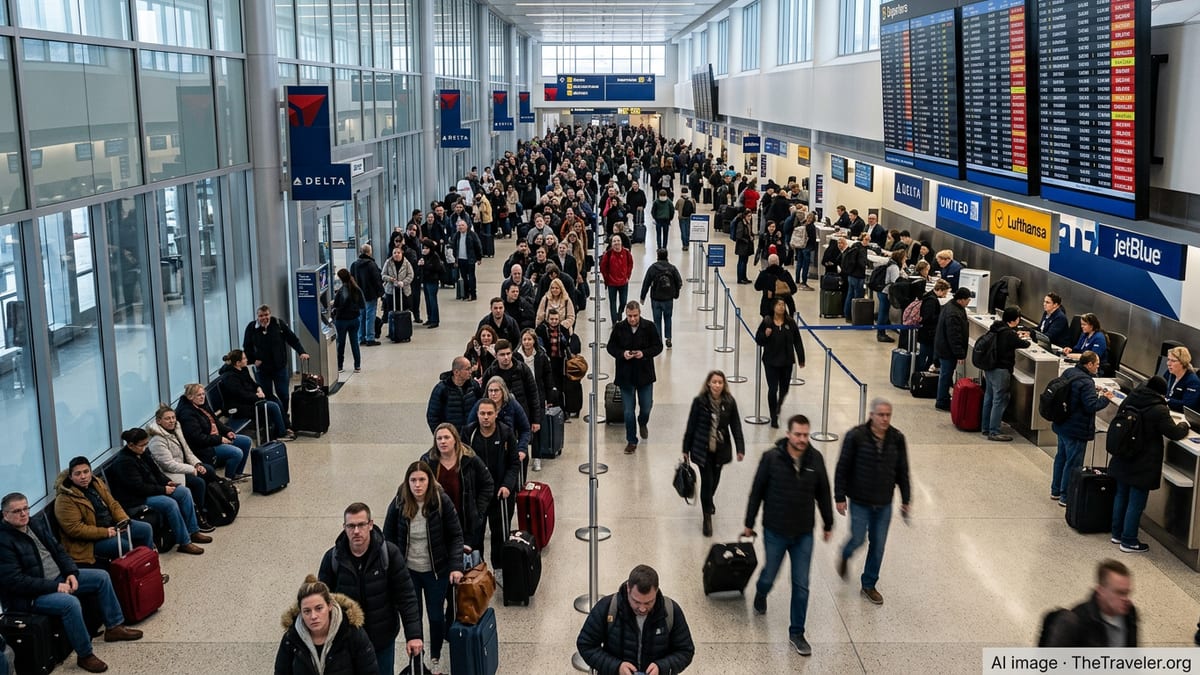
Disruptions Concentrated Across Key Midwest and West Coast Hubs
Publicly available aviation tracking data shows that the latest wave of cancellations has been widely distributed across the national network, but with notable clusters around major hubs. Airports serving California, Illinois and Colorado, along with Detroit and Minneapolis, experienced some of the sharpest operational strain as cancellations and delays rippled through tightly scheduled route maps.
In the Midwest, Chicago and Detroit continue to act as pressure points when storms or operational bottlenecks arise, often triggering knock-on effects for flights connecting smaller cities across Illinois, Michigan and neighboring states. Similar patterns have emerged in Minneapolis, where even moderate schedule disruptions can cascade across regional networks that feed into the airport.
On the West Coast, key Californian airports such as those serving San Francisco, Los Angeles and other large population centers have seen repeated rounds of disruption in recent weeks. When cancellations accumulate at these hubs, travelers across the country can feel the impact, as aircraft and crews are left out of position for subsequent departures.
Colorado has also featured in the latest statistics, reflecting the role of Denver and other regional airports as pivotal connecting points between East and West. When weather or airspace constraints affect these facilities, long-haul routes and regional services alike can quickly fall behind schedule.
Regional Carriers Bear Brunt Alongside Major Network Airlines
Regional airlines have been heavily represented in the latest cancellation tallies. Carriers such as SkyWest, Envoy, Horizon and Republic operate a large share of domestic feeder flights under the banners of major brands, meaning a disruption on a smaller regional jet can reverberate up through an entire network as missed connections and repositioning challenges multiply.
Industry data and recent published coverage highlight how regional operators serve as the backbone of connectivity for many mid-sized cities in states including California, Illinois, Minnesota and Colorado. When a surge of cancellations occurs, these communities can face limited alternative options compared with major hubs that benefit from more frequent service and competing airlines.
United and other large network carriers are also prominently affected, as their reliance on regional partners to supply connecting traffic means irregular operations can quickly swell across hundreds of daily departures. Once aircraft and crew rotations are disrupted, it often takes several days before schedules fully stabilize, especially during peak travel periods.
Analysts note that partners such as SkyWest and Republic frequently operate under multiple brand identities for large airlines, which can make it less obvious to passengers that systemwide disruptions are linked. A cancellation labeled under one major airline may in fact trace back to the operational constraints of a shared regional operator.
Weather, Congested Airspace and Tight Schedules Fuel a Fragile System
Recent patterns in U.S. aviation highlight how a combination of shifting weather systems, congested airspace and structurally tight schedules leaves airlines with limited margin when problems arise. Thunderstorms across the Midwest and Great Lakes region, changing wind patterns in the Rockies and marine layers over the West Coast can each trigger ground stops or flow-control measures that slow traffic into already-busy airports.
Federal airspace status notices and airport operations dashboards routinely show that a single weather cell or air traffic management program can reduce arrivals or departures per hour at busy fields. When this happens during high-demand periods, queues for takeoff and landing lengthen, pushing more flights outside their scheduled time slots and forcing crews up against duty-time limits.
Because carriers such as SkyWest, Envoy, Horizon and Republic operate dense schedules of short-haul segments, even a modest initial delay can expand as the day progresses. Aircraft that start the morning only minutes behind schedule may end up hours late by evening, leading airlines to cancel later flights outright to reset operations.
Operational data and historical performance reports also indicate that some regional and mainline carriers operate at very high aircraft utilization rates, a strategy that improves efficiency but leaves little slack when disruption strikes. This structural fragility makes days with thousands of cancellations more likely when severe weather, staffing constraints or ground system issues coincide.
Nationwide Impact for Travelers From California to the Great Lakes
The cumulative effect of 4,502 cancellations and 99 delays reaches far beyond the airports named in the latest disruption figures. Travelers whose journeys originate in California, Illinois, Colorado, Detroit or Minneapolis often rely on one or more connections, meaning a cancellation at a hub can strand passengers in intermediate cities or force overnight stays.
Recent travel coverage has highlighted cases where flights linking secondary airports in states such as Minnesota, Michigan and Colorado have been among the first to be cut when airlines thin schedules to recover from operational shocks. These routes are often served only once or twice per day, so a single cancellation can wipe out all same-day options.
Repercussions also extend to business and leisure travelers attempting to reach major coastal centers. Disruption at a Midwestern hub can delay or cancel transcontinental services, while problems at major Californian gateways can impede flights bound for the Mountain West and Midwest, leaving passengers facing tight connections, missed meetings and abandoned vacation days.
For some travelers, the most visible result is a series of rolling schedule changes displayed on departure boards. A flight initially listed as delayed may ultimately be cancelled if crews or aircraft cannot reach the gate in time, a pattern that has become familiar to frequent flyers during recent weeks of volatile operations.
What Passengers Can Do When Cancellations Mount
Consumer guidance from aviation rights organizations and government resources underscores several practical steps for travelers navigating days with high cancellation volumes. Passengers are encouraged to monitor flight status frequently on airline and airport channels, particularly before leaving for the airport, as schedules may change multiple times within a few hours.
Many airlines now allow same-day changes or self-service rebooking through apps and kiosks when irregular operations occur. On days when disruptions affect carriers such as United, SkyWest, Envoy, Horizon and Republic-operated services, seats on alternative departures can disappear quickly, making early action important for securing viable options.
Published consumer information also notes that compensation and refund rights vary depending on the reason for the disruption, whether the flight is cancelled or significantly delayed, and the policies of the specific airline. Travelers are often advised to document communications, keep receipts for essential expenses and review carrier conditions of carriage when seeking reimbursement.
Travel experts frequently recommend building additional connection time into itineraries that pass through weather-prone or heavily congested hubs, particularly during summer thunderstorm season or major holiday weekends. While no planning can fully insulate passengers from days when thousands of flights are cancelled, more generous buffers and flexible booking choices can reduce the risk of missed connections and extended airport stays.