


More news on this day
The Maldives is rapidly pairing high-tech travel services with ambitious marine restoration programs, positioning the Indian Ocean destination as a testbed for smart tourism and next-generation reef recovery.
Get the latest news straight to your inbox!
Biometric Borders and Seamless Arrivals
Recent government initiatives are bringing biometric processing and automated border controls to Maldivian airports, with plans for e-gates across all international gateways. Publicly available information indicates that new systems are designed to scan passports once and then use facial recognition at subsequent border crossings, significantly reducing queues for the millions of visitors who pass through the country each year.
At Velana International Airport, a recently expanded international terminal has been developed with an emphasis on passenger flow and digital services. New-generation infrastructure is intended to handle higher volumes while supporting smart identity checks, automated baggage handling and more integrated security screening, reflecting broader goals to create a friction-light arrival and departure experience.
Immigration services are also being reconfigured around mobile channels. Reports indicate that a dedicated immigration app and online platforms now support e-visa processing and digital document management, cutting the need for in-person visits for many procedures. This shift is central to a wider national strategy that treats the travel journey as an end-to-end digital experience, beginning before a visitor boards their flight.
These developments align with global trends in “smart tourism,” where biometric identity, data analytics and automation are used to streamline travel while maintaining security. In the Maldives, the stakes are particularly high, as the country depends heavily on tourism for employment and foreign exchange earnings.
Building a ‘Digital Maldives’ for Visitors
Behind the scenes, the Maldives is stitching together a broader digital ecosystem that links government services, private-sector tourism operators and visiting travelers. A national digital identity platform, known locally as a single sign-on gateway, uses biometrics and QR codes to authenticate users across multiple online services. Official documentation describes how residents can access government portals and financial tools with facial verification, and similar mechanisms can be extended to visitors through interoperable systems.
Tourism planning documents outline ambitions for richer digital touchpoints throughout a trip, from pre-arrival information and online declarations to real-time guidance on local services. Resorts and guesthouses have been experimenting with digital concierge tools, app-based check-ins and cashless payments, while the national tourism board has prioritized data-driven promotion campaigns and virtual storytelling about the atolls.
Industry publications in the Maldives highlight growing interest in artificial intelligence, analytics and cloud platforms to personalize itineraries and monitor visitor flows across islands. The aim is to use technology to ease pressure on popular spots, distribute tourism benefits more evenly and improve the quality of service for guests spending time on both private resort islands and local island stays.
At the same time, planners emphasize that a “smart destination” in the Maldives goes beyond convenience. Digital infrastructure is increasingly seen as a tool to support sustainability, from smarter energy use in resorts to closer tracking of water consumption and waste. The convergence of tourism technology and environmental monitoring is starting to shape investment decisions across the archipelago.
AI, Robotics and Community-Led Coral Restoration
In the surrounding seas, the Maldives is emerging as a laboratory for advanced coral restoration techniques that combine community action with artificial intelligence and robotics. International research partnerships with Maldivian institutes are deploying autonomous surface vessels and underwater imaging systems to map reefs, identify resilient coral colonies and optimize where new fragments should be planted.
Projects supported by global coral research programs describe small robotic boats equipped with cameras, sensors and autopilot systems that can survey large reef areas with fewer resources than traditional dive teams. These platforms collect thousands of high-resolution images and acoustic recordings, which are then processed with AI-assisted software to classify coral cover, detect bleaching and flag early signs of stress.
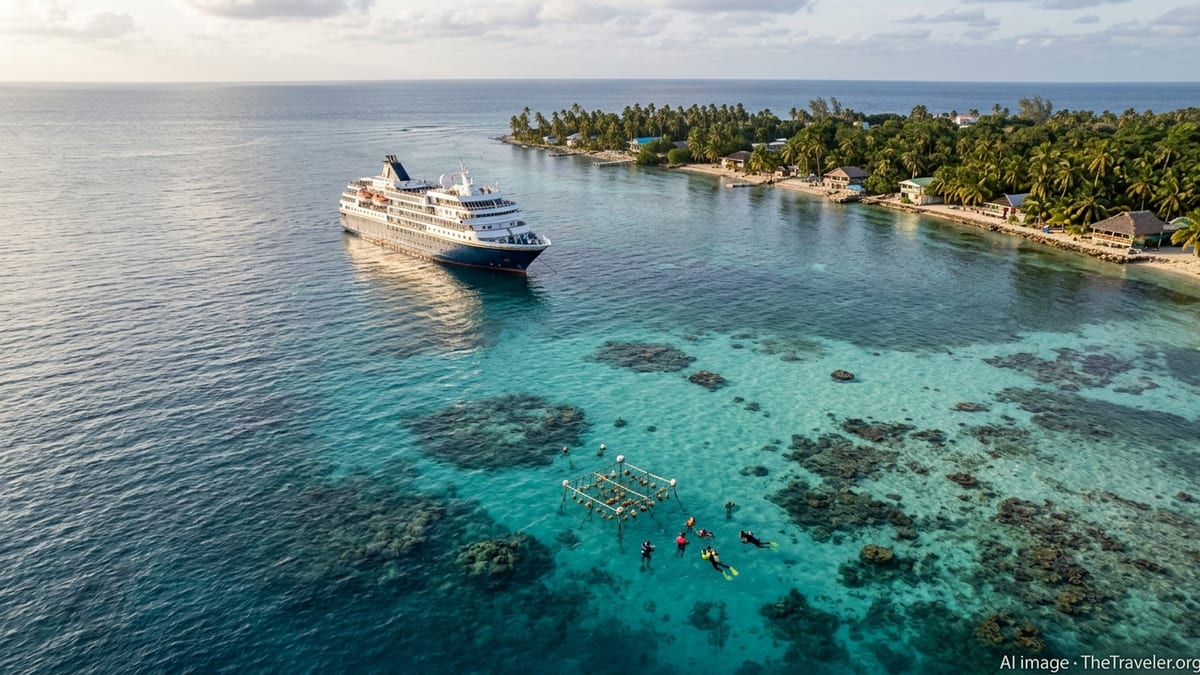
Local organizations and resorts are increasingly integrating these tools into their own restoration work. Coral nurseries and frame-based transplant projects, many of them sited around tourism properties, are using standardized photo-monitoring and automated analysis to track growth and survival rates over time. By combining digital records with on-the-ground expertise from Maldivian marine biologists, operators are refining which coral species and locations deliver the most resilient outcomes.
The emphasis on data-rich monitoring is a response to decades of warming-related coral loss in the Maldives. Long-term scientific surveys have recorded major bleaching episodes and structural damage to reefs, with direct implications for fisheries, tourism and coastal protection. High-tech restoration is seen as a way to scale up efforts while learning more quickly from both successes and failures.
Listening to Reefs: Passive Acoustics and Digital Twins
Alongside visual mapping, Maldivian agencies are testing passive acoustic monitoring as a new way of listening to reef health. A recent pilot project used underwater microphones and specialized analysis software to record the soundscape of damaged and relatively intact reef sites. By comparing the intensity and diversity of natural reef sounds, such as fish calls and invertebrate activity, researchers created a baseline that can guide restoration priorities and track recovery.
The pilot, supported by international partners and national environment authorities, focused on building local capacity to deploy and interpret these technologies. Training sessions on equipment handling, data retrieval and statistical analysis were paired with efforts to integrate results into environmental decision-making. The approach positions sound as an additional metric alongside more familiar indicators like coral cover and water quality.
Looking ahead, researchers and tourism planners are exploring how techniques such as digital twinning could further transform reef management. In principle, high-resolution models of selected reef systems, continuously updated with data from robots, divers and acoustic sensors, could simulate the impact of storms, warming events or different restoration strategies. For a destination where coral health underpins much of the tourism economy, such virtual testbeds could become critical planning tools.
The concept also opens possibilities for visitor engagement. Resorts and visitor centers can use interactive visualizations derived from monitoring programs to show guests how reefs are changing over time, turning scientific datasets into compelling narratives about local conservation.
Tourism Industry Aligns Guest Experience With Ocean Recovery
Across the private sector, many Maldivian resorts now frame their sustainability strategies around direct contributions to reef health, positioning marine restoration as part of the guest experience. Corporate reports and tourism board materials describe coral gardening activities, citizen science dives and educational snorkeling tours that invite visitors to see transplanted corals and restored sites first-hand.
Technology sits at the core of these offerings. Some operators are adopting online dashboards and in-room apps to display live metrics from their conservation initiatives, such as the number of coral frames deployed, estimated fish biomass on house reefs or the progress of sea turtle rehabilitation programs. Others rely on digital registration and tracking systems to manage volunteer activities and ensure that guest participation does not unintentionally damage sensitive habitats.
Regional hospitality media suggest that resorts are increasingly investing in data analytics to understand how eco-focused experiences influence booking patterns, length of stay and guest satisfaction. As environmental awareness grows among travelers, this information is expected to shape marketing strategies and capital improvement plans, directing more resources toward projects that protect the very seascapes visitors come to enjoy.
This convergence of smart tourism infrastructure and deep marine restoration represents a new phase in the Maldives’ development as a destination. By linking visitor journeys to the health of surrounding reefs through technology, the country is testing whether a luxury travel economy can help drive, and transparently measure, large-scale recovery of its most fragile natural assets.