


Getting from Manila’s Ninoy Aquino International Airport (NAIA) to Quezon City can be anything from a smooth 35-minute drive on clear roads to a frustrating two-hour crawl in heavy traffic. The distance is not huge, but Metro Manila’s congestion, toll expressways, and late-night arrival patterns make this one of the trickiest airport transfers to predict. This guide focuses on real-world routes, realistic travel times, and concrete tips for arriving travelers who want to avoid surprises.
Get the latest updates straight to your inbox!
Understanding the NAIA to Quezon City Journey
Most international visitors land at NAIA Terminals 1 or 3, in the southern part of Metro Manila. Quezon City sits to the north, past central Manila and Makati. On a map it looks close, roughly 18 to 22 kilometers from the airport to common Quezon City areas like Cubao, North Avenue, or Diliman, depending on the exact route. In practice, that short distance crosses some of the busiest corridors in the country.
The main reason travel time is so unpredictable is that there is no single “best” path that always works. Your driver can choose between surface roads such as EDSA, C-5, and Aurora Boulevard, or a combination of toll expressways like NAIA Expressway, Skyway, and NLEX Connector. At 2 a.m. on a weekday, you might cruise from NAIA Terminal 3 to Cubao in 35 to 45 minutes using Skyway and Quezon Avenue. At 6 p.m. on a rainy Friday, the same trip can stretch past 90 minutes, even when you pay extra for tolls.
For first-time visitors, it is helpful to think in bands rather than exact estimates. For example, many transfer providers and ride-hailing estimates suggest typical NAIA to Quezon City times of about 45 to 90 minutes if traffic is not at its absolute worst. That range is realistic for mid-mornings, late evenings, and most weekends. During peak rush hours or when there are major events or rain, it is safer to expect 60 to 120 minutes door to door.
Where exactly you are going in Quezon City matters. A hotel near Cubao’s Gateway Mall or the Araneta City bus terminals will usually be reached slightly faster than addresses deep inside residential areas like Fairview or Novaliches. A run from NAIA to SM North EDSA, Trinoma, or government offices along East Avenue might involve an extra 15 to 20 minutes beyond what you would need to reach Cubao, simply because you stay on EDSA or Skyway a bit longer before turning off.
Key Routes: EDSA vs Skyway and Expressway Options
Historically, many drivers used Epifanio de los Santos Avenue, better known as EDSA, for airport transfers. This long arterial road links the south of Metro Manila with Quezon City and the North Luzon Expressway. EDSA passes Makati, Mandaluyong, Ortigas, and then into Quezon City near Cubao and SM North EDSA. It is straightforward, avoids tolls, and drivers know it by heart. The downside is that EDSA is notorious for gridlock, particularly on weekday mornings from about 7 a.m. to 10 a.m. and evenings from about 4 p.m. to 8 p.m.
The newer combination of NAIA Expressway and Metro Manila Skyway offers a faster but tolled alternative. A common pattern is NAIA to NAIA Expressway, then to Skyway heading north. From Skyway, the driver can exit at points like Nagtahan to reach Magsaysay Boulevard and Aurora Boulevard toward Cubao, or continue toward the Quezon Avenue interchange to drop into Quezon City’s government and commercial district. On very good days, this NAIA to Skyway to Quezon Avenue route can deliver you from Terminal 3 to Quezon City Hall or nearby hotels in approximately 35 to 50 minutes.
There is also the option to pair Skyway with the NLEX Connector and the northern end of EDSA when the destination is in the far north of Quezon City, near Balintawak or suburban subdivisions close to NLEX. This tends to be more relevant for residents or repeat visitors heading home rather than tourists staying in Cubao or near Quezon Avenue. Still, it illustrates how drivers often weave together several expressways to shorten surface-road time, especially late at night when toll roads are clear.
Many Grab and taxi drivers will check live traffic apps and then decide whether to pay tolls or stick to city roads. It is not unusual for a driver to say, for example, that using NAIA Expressway and Skyway to Quezon Avenue will save 20 to 30 minutes at 6 p.m., but they will remind you that tolls will be passed on to you. As a traveler, you can politely insist on the faster expressway route if you value time over a few hundred pesos, or choose to save money if your arrival is at a quiet hour with light traffic.
Grab, Airport Taxis, and Private Transfers: What to Expect
For most visitors, the three most practical options from NAIA to Quezon City are Grab, airport-accredited taxis, and pre-booked private transfers. All are readily available at Terminals 1 and 3, though the experience, pricing, and predictability can feel quite different.
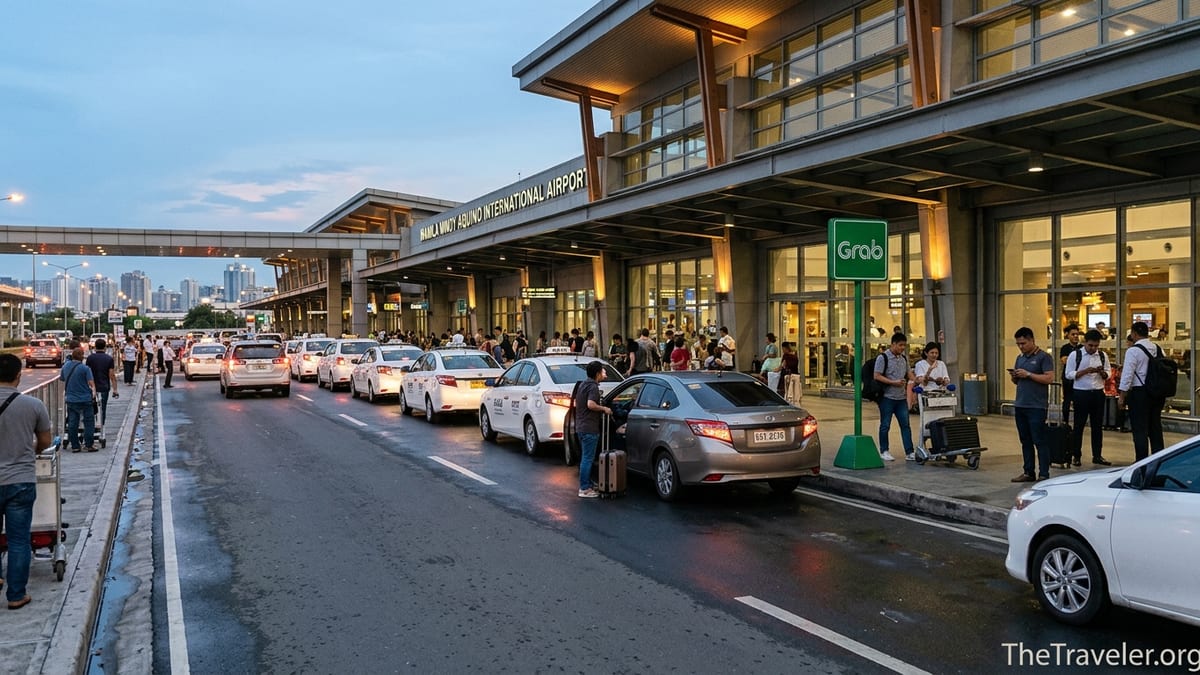
Grab is the dominant ride-hailing app in Metro Manila. At the airport, there are Grab booths where staff can help you book a GrabCar or GrabTaxi if you do not have mobile data yet. A typical GrabCar 4-seater fare from NAIA to central Quezon City might be in the range of roughly 500 to 900 pesos, depending on the time of day, demand surcharges, and whether the route uses Skyway. At busy arrival waves, such as early evening international banks, you may open the app and see estimated fares well over 1,000 pesos when demand is high. The advantage with Grab is transparency: you see the fare estimate up front, can pay by card, and the driver’s route is tracked in the app.
Airport-accredited coupon taxis charge fixed fares based on a printed matrix, with different rates for destinations like Cubao, Diliman, or Fairview. For example, some travelers report paying a coupon taxi rate to Quezon City that came out roughly similar to a high-demand Grab fare, somewhere in the several hundred to just over one thousand pesos bracket. You pay at the small booth inside the arrivals area, receive a coupon with the destination and fare, then hand it to your driver outside. This can feel more reassuring for passengers who prefer cash and want to avoid negotiating with a meter-based taxi.
Metered white taxis, including some that queue at official ranks, often give the lowest fare, though not always by a wide margin. A metered run from NAIA to Cubao or North Avenue might land in the general area of about 350 to 700 pesos in normal traffic, plus any tolls. However, Manila has a long history of taxi overcharging at airports, such as drivers refusing to use the meter, padding tolls, or offering an inflated “fixed price.” Many locals still prefer Grab or coupon taxis precisely to avoid having to argue about the meter with a tired driver after a long-haul flight.
Pre-booked private transfers, such as those arranged through hotels or airport transfer platforms, offer a set price in advance. For a sedan covering NAIA to a Quezon City hotel, prices often fall somewhere in the 1,000 to 1,800 peso range, depending on vehicle size, whether tolls are included, and the provider’s markup. For example, an executive car booked through a transfer service to a North EDSA hotel might cost 1,500 pesos, which is higher than a typical Grab but guarantees a driver waiting with a sign, assistance with luggage, and no queuing. For families arriving late or business travelers on tight schedules, the premium can be worthwhile.
Realistic Travel Times by Time of Day and Week
Travel time between NAIA and Quezon City can swing dramatically depending on the clock and the calendar. A simple way to understand it is to break days into broad bands: early morning, daytime off-peak, rush hours, and late night. Each band behaves differently, and heavy rain can stretch any of them by another 15 to 30 minutes.
In the very early hours, roughly from midnight to 5 a.m., roads are generally at their quietest. A GrabCar leaving Terminal 3 at 2:30 a.m. for a hotel in Cubao using NAIA Expressway and Skyway to Nagtahan might complete the trip in about 35 to 45 minutes if there are no lane closures. If the driver sticks to non-toll roads, the same trip may be closer to 45 to 55 minutes, still much faster than daytime. Many red-eye passengers are pleasantly surprised at how quickly they reach Quezon City during these hours.
From around 5:30 a.m. to 10 a.m. on weekdays, traffic builds sharply. Office workers and students converge on EDSA, C-5, and major bridges. A 7:30 a.m. departure from NAIA to Quezon Avenue can easily reach 60 to 90 minutes, even when you pay for Skyway. If a heavy downpour coincides with this window, it is not unusual to see journeys approach or slightly exceed two hours, especially if your hotel is north of Cubao and requires extra time on EDSA or side streets.
Midday and early afternoon, roughly 10 a.m. to 3 p.m., often provide the most reliable transfer window. A GrabCar from NAIA to SM North EDSA using expressways might average 45 to 70 minutes, with less variance than the peaks. However, you should still allow some buffer for security lines at the airport exit, queuing at the ride-hailing pick-up zones, and the occasional accident or stalled vehicle on Skyway or EDSA.
Evening rush, from about 4 p.m. to 8 p.m., is typically the worst. International arrivals often cluster around this time, which is why lines at Grab booths and taxi ranks can grow long. A realistic expectation for NAIA to Quezon City at 6 p.m. is 70 to 120 minutes door to door, with 90 minutes a very common outcome if rain or road works are in play. After 9 p.m., traffic gradually eases again; by 11 p.m., many runs fall back into the 45 to 70 minute band, especially if you choose the expressways.
Luggage, Group Size, and Vehicle Choice
The type of vehicle you choose matters, particularly if you are carrying multiple large suitcases or traveling as a group. Standard GrabCar 4-seater vehicles are often compact sedans such as Toyota Vios or Hyundai Accent models. These cars can comfortably take two passengers with two to three large checked suitcases, but they quickly become cramped with three or four adults plus several pieces of luggage. In practice, local commuters often book a GrabCar 6-seater or a van to ensure there is enough cargo space.
Some travelers report that even when a 6-seater vehicle is available, the rear-most row is sometimes folded down to accommodate large checked bags and sports equipment. This means that a notional six-seater might effectively carry only three passengers if all are arriving with big suitcases. It is best, when booking, to assume that you need at least one row of seats for luggage if you have bulky items like large roller bags, dive gear, or musical instruments.
Certain airport-accredited taxis and private transfer services operate larger vehicles such as Toyota Innovas or Hiace vans. These are better suited for families of four or five with multiple bags. A private van transfer for a family from NAIA to a Quezon City condo might cost more than a sedan, perhaps 1,500 to 2,000 pesos, but reduces the stress of squeezing children and suitcases into a small sedan while navigating bumpy city streets.
If you are landing late at night with oversized luggage, it can be wise to pre-book a private transfer or at least plan to request a GrabCar 6-seater from the start, even if the app suggests that a 4-seater is technically sufficient. It is stressful to discover at 1 a.m. that your chosen car cannot take all of you and your bags, especially if the driver must refuse the ride and you need to rebook from the back of the queue.
Why Travel Time Varies So Much
Many visitors are surprised by how wildly travel times can change between the same two points in Metro Manila. The NAIA to Quezon City route demonstrates several of the key reasons: unpredictable congestion, weather, incidents, roadworks, and the way different routes intersect. Understanding these factors helps you set better expectations and plan smarter.
Rain is one of the biggest wildcards. A sudden tropical downpour in the late afternoon can slow traffic to a crawl within 20 minutes. Even if the rain stops quickly, lingering surface water, cautious driving, and minor collisions keep speeds low for an hour or more. A journey that would have taken 50 minutes on a dry Thursday at 5 p.m. can stretch to 90 minutes simply because of a heavy shower near EDSA or a flooded underpass.
Incidents and road closures add another layer. A stalled bus or a fender-bender on a key flyover like EDSA-Ortigas or an off-ramp from Skyway can jam traffic for kilometers in both directions. Because so many NAIA to Quezon City routes converge on a few chokepoints, a single incident can ripple across multiple options at once. Drivers may exit Skyway earlier than planned, divert through side streets in Manila or San Juan, or choose a longer but moving path via C-5 or Magsaysay Boulevard.
Events and holidays also matter. On the weekends leading into Christmas, for example, shopping malls such as SM North EDSA, Trinoma, and Gateway Cubao draw huge crowds, parking queues spill onto the roads, and travel times surge. Conversely, early on certain major holidays like Christmas Day itself, Metro Manila roads can be eerily quiet, and airport transfers become surprisingly quick. Because of these swings, it is wise to consult your hotel or local contacts about any local festivals, concerts, or rallies on the day you travel.
Late Arrivals, Safety, and Practical Tips
Many long-haul flights from North America, Europe, and the Middle East land in Manila late at night or very early in the morning. The good news is that late arrivals often enjoy lighter traffic, especially after 11 p.m. The trade-off is that some public transport options are reduced, and you will depend more on Grab, airport taxis, or pre-booked private cars.
From a safety perspective, NAIA’s official taxi queues, coupon taxi booths, and Grab pick-up areas are staffed and reasonably well lit. It is sensible to avoid unmarked vehicles or drivers approaching you inside the terminal offering cheap rides. A realistic pattern for a midnight arrival is to collect your luggage, clear customs by around 1 a.m., and then either cue for a coupon taxi or open the Grab app once you are in the public arrivals hall. Assuming you head to a hotel in Cubao or North EDSA, you might reach your room between 2 a.m. and 2:30 a.m. in typical conditions.
Travelers concerned about scams often follow a few simple practices. They stick to official queues and booths, refuse to board taxis that will not use the meter unless a fixed airport coupon is involved, and photograph the taxi’s plate number or Grab car details before boarding. Many locals also prefer to walk short distances to nearby commercial areas such as Newport City opposite Terminal 3 when heading away from the airport, in order to hail regular metered taxis at more typical city rates, though this is usually more relevant for short trips to Makati or Pasay than for the longer run to Quezon City.
If you are arriving with very young children, elderly family members, or significant luggage after midnight, a pre-booked private car can be worth the peace of mind. Your driver waits in the arrivals area with a sign, helps push your trolley, and escorts you directly to the vehicle. You avoid queuing, language confusion, and fare negotiations at a time when everyone is exhausted from the flight.
The Takeaway
The journey from Manila’s Ninoy Aquino International Airport to Quezon City is short on the map but long on variables. The same ride can feel quick and efficient or slow and frustrating depending on when you arrive, which route your driver uses, whether it is raining, and how much you are willing to spend on tolls and vehicle comfort. Thinking in realistic time bands and planning for the worst case, rather than assuming an optimistic best, is the most reliable way to avoid stress.
As a rule of thumb, plan on 45 to 90 minutes for most airport-to-Quezon City journeys when traffic is moderate, and be prepared for up to two hours in heavy rush-hour or bad-weather conditions. Choose between Grab, coupon taxis, and private transfers based on your budget, group size, and tolerance for queuing. When in doubt, paying a little more for an expressway route and a vehicle that fits your luggage comfortably is often the simplest way to start or end your Manila visit on a calmer note.
FAQ
Q1. How long does it usually take to travel from NAIA to Quezon City?
The travel time typically ranges from about 45 to 90 minutes in normal conditions, but during peak rush hours or heavy rain it can stretch up to two hours.
Q2. What is the fastest route from Manila Airport to Quezon City?
The quickest option is usually via NAIA Expressway and Skyway, exiting near Nagtahan or Quezon Avenue and then continuing into Quezon City, especially late at night or outside rush hour.
Q3. How much should I expect to pay for a Grab from NAIA to Quezon City?
GrabCar fares often fall somewhere in the 500 to 900 peso range for central Quezon City, though prices can go higher during peak demand or when using expressways with tolls.
Q4. Are airport taxis from NAIA to Quezon City safe?
Airport-accredited coupon and metered taxis are generally safe, but stick to official queues, avoid unmarked vehicles, and make sure either the meter is on or the fixed coupon fare is clearly agreed.
Q5. Is it worth paying tolls for Skyway when going to Quezon City?
Often yes. Tolls add to the fare but can shave 20 to 30 minutes off the journey during busy times, which many travelers find worthwhile after a long flight.
Q6. What is the best option if my flight arrives around midnight?
Late at night, Grab and airport coupon taxis are both practical. Traffic is lighter, so you may reach Quezon City in 35 to 60 minutes. A pre-booked private car is ideal if you want a driver waiting with a sign.
Q7. Can I take public transport from NAIA to Quezon City?
There is no direct rail link. While it is possible to use a mix of airport buses or jeepneys and then the EDSA busway or MRT, it is slow and cumbersome with luggage, so most visitors choose cars or taxis.
Q8. What kind of vehicle should I book if I have a lot of luggage?
If you have several large suitcases or are in a group of three or more, consider a GrabCar 6-seater, an airport van taxi, or a pre-booked van so that one full row of seats can be reserved for bags.
Q9. How much extra time should I allow for traffic when heading back to NAIA from Quezon City?
For international flights, aim to leave Quezon City at least three to three and a half hours before departure, especially during weekday rush hours, to allow for both road traffic and airport queues.
Q10. Are there any days when traffic between NAIA and Quezon City is lighter?
Traffic is often a bit lighter early on Sunday mornings and on certain public holidays, while weekends leading up to Christmas or major sales at big malls tend to be busier than usual.