


For budget minded travelers landing at Sir Seewoosagur Ramgoolam International Airport in Mauritius, the public bus network can be a cheap and surprisingly practical way to reach Mahebourg, Curepipe or Port Louis. The catch is that information on airport bus routes 09, 10 and 198 is scattered or out of date, and small details like luggage rules or evening frequencies can make or break your plan. This guide brings together the latest on these three key routes, so you can decide when the bus makes sense and when you are better off booking a taxi or transfer.
Get the latest updates straight to your inbox!
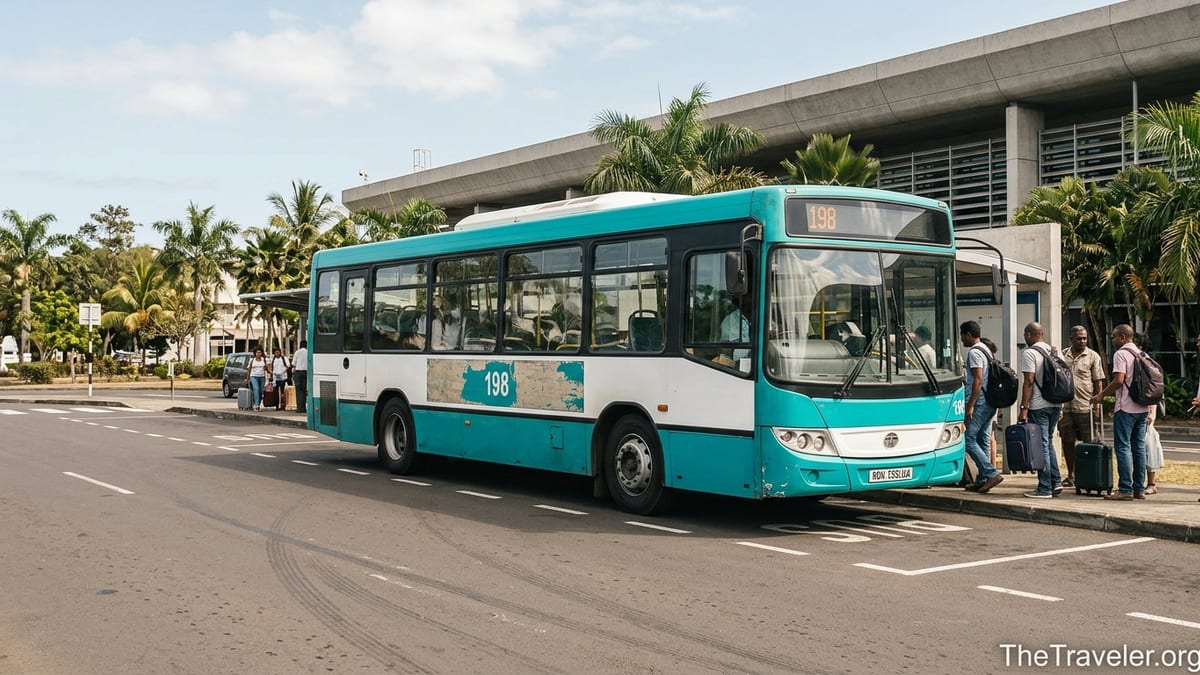
How the Mauritius Airport Bus System Works
Sir Seewoosagur Ramgoolam International Airport (MRU) sits in the southeast of Mauritius, about 8 km from Mahebourg and roughly 48 km from Port Louis. Unlike many large hubs, MRU has a modest but functional public bus setup rather than a dedicated airport express. Regular, licensed public buses simply divert into the airport on their normal routes, picking up and dropping off at the terminal forecourt.
At the time of writing, three numbered routes regularly serve the airport: 09 between Mahebourg and Curepipe via the airport, 10 between Mahebourg and Curepipe with some trips running into the airport, and 198 linking Mahebourg and Port Louis via the airport. Together they give reasonable coverage between early morning and early evening for anyone heading to Mahebourg, towns along the central plateau, or the capital.
Buses are operated by different companies under the supervision of the National Land Transport Authority. Vehicles are a mix of older non air conditioned buses and newer semi low floor models. Do not expect air conditioning on every departure, and be prepared for standing room at peak hours. Tickets are sold on board by a conductor who walks through the bus after departure.
Fares are low by international standards. As a rough example, travelers in 2025 and 2026 typically report paying the equivalent of around 35 to 60 Mauritian rupees for trips like airport to Mahebourg or airport to Port Louis, depending on distance and operator. You pay cash in rupees, and conductors usually prefer small notes and coins. Cards are generally not accepted.
Route 09: Mahebourg to Curepipe via the Airport
Route 09 is the backbone of bus service at MRU. It runs between Mahebourg Bus Station and Curepipe Jan Palach South Bus Station, entering the airport along the way. Airport information and recent local guides indicate that route 09 operates daily, with buses roughly every 10 minutes during busy periods between early morning and early evening. In practice, frequency can thin out in the late evening, and exact timing may vary with traffic and operator schedules.
For new arrivals, route 09 is the most straightforward option to reach Mahebourg on a budget. From the airport, the ride to Mahebourg usually takes around 15 to 20 minutes, depending on traffic near the town. Many visitors choose to stay their first night in a guesthouse near the Mahebourg waterfront or in Blue Bay. In that case, you can ride route 09 from the airport to Mahebourg Bus Station, then either walk or take a short taxi ride to your accommodation.
In the other direction, route 09 is useful if you are staying on the cooler central plateau, for example in Curepipe or near towns like Mare d’Albert or near the Jawaharlal Nehru Hospital zone. The full ride from the airport up to Curepipe can take around 45 to 60 minutes, as the bus climbs steadily and makes intermediate stops. This route is most attractive for independent travelers with light luggage and plenty of time, for instance a long term visitor returning to a rented room in Curepipe after a trip off island.
A concrete example: imagine you land around 09:00 on a weekday with only a small carry on backpack and a daypack. After clearing customs by 09:45, you step out to the bus area and board a route 09 bus at around 10:00. By about 10:20 you are at Mahebourg Bus Station, and by 10:35 you are checking into a local guesthouse. Your total transport cost is a small fraction of what a private transfer would cost, at the expense of a little extra waiting and crowding.
Route 10: Supplementary Mahebourg – Curepipe Service
Route 10 also links Mahebourg and Curepipe, but it is less consistently airport focused than route 09. Official airport documents mention route 10 among the buses serving MRU, and some locally published timetables show route 10 journeys that either pass near the airport access road or occasionally enter the terminal area. In practice, visitors should treat route 10 as a useful backup rather than the primary airport bus.
If you are waiting at the airport and see a bus marked 10 with Mahebourg as the destination, the simplest approach is to confirm with the conductor or driver that the bus will enter the terminal or pick up at your stop. English and French are widely understood, and a basic question such as “Mahebourg bus station?” combined with a gesture at your luggage is usually enough. If the driver indicates that the bus will stop on the main road outside the airport rather than inside the forecourt, consider whether you are comfortable walking with your bags in the heat.
On the Mahebourg side, route 10 can make sense if you are starting at Mahebourg Bus Station and the next route 09 is not due for a while. In that case, a route 10 bus that confirms it is going through the airport can save a short wait. This might be useful for a budget traveler whose flight leaves around midday and who wants to avoid paying for a taxi from Mahebourg, provided they allow generous time in case of delays.
However, route 10’s more variable routing and frequency compared with route 09 mean that you would not normally plan a tight airport connection around it. If you have a morning long haul departure and a heavy suitcase, it is safer to rely on route 09 from Mahebourg to the airport or book a taxi from your guesthouse rather than risking a rare or indirect route 10 bus.
Route 198: Port Louis to Mahebourg via the Airport
Route 198 is the key link between the airport area and Port Louis. Recent local bus guides and airport transport resources describe route 198 as running between Mahebourg and Port Louis, typically starting from the Mahebourg traffic centre or bus station, passing the airport, and continuing north to Port Louis via major urban corridors. The first buses leave around sunrise, with services generally operating until early evening, and daytime headways are often quoted at roughly every 15 minutes, though this can vary.
From the airport to Port Louis, route 198 is the only direct budget option. The journey can take between 60 and 90 minutes depending on traffic, with buses weaving through the south and central plateau before descending into the capital. At peak hours in the morning and late afternoon, traffic queues near towns like Curepipe, Phoenix or around Port Louis can add noticeable delays. Travelers on tight schedules should build in a generous buffer and avoid planning this route immediately before a check in cutoff.
A common real world use case is a solo traveler arriving on a daytime regional flight who has booked a guesthouse in central Port Louis near the bus terminals. Instead of paying for an airport taxi, they board route 198 at the airport, pay the modest fare in rupees, and ride all the way to the Port Louis terminal area, which is a short walk from central hotels and guesthouses. Even if the trip stretches to 80 or 90 minutes in traffic, the savings relative to a private transfer can be significant.
Another example is an early morning departure from Port Louis to catch a late morning international flight. A traveler staying overnight in the capital might walk to the bus station at sunrise, catch one of the first route 198 buses headed toward Mahebourg and the airport, and arrive several hours before departure. This strategy works best travel wise in dry season with light luggage. In rainy or hot humid weather, or for journeys involving children and multiple bags, many visitors find a shared or private taxi to be a better value.
Luggage Limits, Comfort and Safety on Airport Buses
Mauritian public buses are designed for local commuters rather than airport travelers with suitcases. Official passenger information from the National Land Transport Authority highlights that luggage should not exceed around 10 kg and should not be bulky. The expectation is that passengers carry small bags that can be placed on their lap or by their feet without blocking the aisle or extra seats.
In practice, conductors often accept a medium suitcase or a large backpack, especially on airport bound buses where staff are used to travelers. However, if your bag is very large, extremely heavy or likely to obstruct movement, the conductor may refuse you or ask you to move to a less crowded area. A traveler with one 20 to 23 kg checked bag and a carry on will probably be tolerated in off peak hours, but two large suitcases plus sports equipment would be pushing local norms.
Comfort varies considerably between buses and times of day. Many vehicles are non air conditioned, with open windows for ventilation. On a humid afternoon departure from the airport, you may find yourself standing in a packed bus as it climbs to the central plateau. For this reason, travelers with mobility issues, heat sensitivity or small children should think carefully before committing to an hour or more on route 198 or the full 09 route with luggage.
Safety is generally good, with most incidents limited to petty pickpocketing risks in crowded buses, especially around Port Louis. As anywhere, keep valuables close, avoid displaying large amounts of cash, and stay alert in bus terminals. On late afternoon or early evening services, stay near other passengers at stops and avoid dozing off with bags unattended. Public buses are widely used by locals of all ages, and foreign visitors riding them in daytime is common.
Port Louis and Mahebourg Connections in Real Life
Understanding how these buses plug into the wider network helps you plan multi leg journeys. In Port Louis, route 198 typically serves the main urban terminal area near Victoria Square, where you can connect to buses for almost any point on the island. That includes west coast resorts near Flic en Flac, northern hubs like Grand Baie, and residential areas across the central plateau. However, most of those onward journeys require either an extra hour or two on the road or at least one more change of bus.
For example, to reach Flic en Flac purely by bus from the airport, one common low cost sequence is airport to Port Louis on route 198, then a Flic en Flac bus from the Port Louis terminal. This operation can easily take 2.5 to 3.5 hours door to door, depending on waits and traffic, which many vacationers consider too long after a long flight. Some budget backpackers are comfortable with the trade off; others decide that a prebooked shared transfer or taxi from the airport to a Flic en Flac hotel is worth the extra cost.
Mahebourg Bus Station is a smaller but important hub for the southeast. From the airport, routes 09, 10 and 198 all make it easy to reach Mahebourg, where you can change for local buses to Blue Bay, Pointe d’Esny and other coastal villages. For example, a traveler staying in a guesthouse near Blue Bay may ride route 09 from the airport to Mahebourg, then catch a short local bus or small taxi for the final few kilometers. This combination keeps costs low while avoiding a long walk with bags.
The flip side is that late in the evening Mahebourg and Port Louis connections become more limited. While services may still run, frequencies drop, and onward connections to resort areas thin out significantly. If your flight lands after dark, you may manage a bus to Mahebourg or Port Louis but then find that the last onward bus to your resort has already left, forcing you into an expensive last minute taxi. For late flights, many accommodations outside Mahebourg explicitly recommend arranging a car in advance.
When the Bus Is Not Practical
Despite the savings, buses 09, 10 and 198 are not always the right solution. One obvious red flag is arrival or departure time. Very late night or pre dawn flights do not match well with public bus schedules, which focus on daytime and early evening demand. If your flight lands after about 21:00 or departs before roughly 06:00, you should generally assume that buses will not be a reliable option.
Distance and route complexity are another factor. Resorts and villas on the west coast (Flic en Flac, Tamarin, Le Morne), far north (Grand Baie, Pereybere) or east coast often require at least two or three bus changes from the airport. A typical itinerary might be airport to Mahebourg, Mahebourg to Curepipe or Port Louis, then another bus to the coast, and sometimes a local village bus on top. For travelers with children, surfboards, diving equipment or multiple suitcases, these legs quickly become exhausting.
Weather matters too. During the hot and rainy season, standing in the open at a bus stop with full luggage while a tropical shower passes can be frustrating. Air conditioned airport taxis and private transfers look more appealing when humidity is high or when showers are frequent. Similarly, if you are arriving jet lagged after an overnight long haul flight, the additional hour or two on crowded buses can undermine the start of your holiday.
Finally, there is the question of your travel style and time value. A couple visiting Mauritius for a short one week stay at a beach resort might reasonably decide that saving the equivalent of a modest restaurant meal is not worth the extra 2 or 3 hours spent changing buses on arrival. On the other hand, a backpacker on a multi month trip who enjoys seeing local life and has flexible time may find those same hours on routes 09 and 198 part of the experience.
Practical Tips for Using Routes 09, 10 and 198
Planning ahead makes these airport buses much easier to use. Before you travel, check recent online resources that compile local bus timings for routes 09, 10 and 198, as well as any seasonal updates from airport or transport authorities. Schedules are not always perfectly accurate, but they give a sense of first and last departures. Have a backup plan in mind, such as a rough budget for a taxi from Mahebourg to your hotel if you miss a connecting bus.
When you land, withdraw some Mauritian rupees from an ATM in the arrivals hall so you have small bills for the bus. Conductors on airport routes are used to tourists but may not have change for large notes. Carry your hotel name and area written down in clear text, so you can ask the conductor which stop is best for you. Even if they are not fluent in your language, most staff will make an effort to alert you when your stop is coming.
Boarding etiquette is straightforward. Join the queue at the airport bus stop, let passengers off first, then get on and take any available seat. The conductor will come around after the bus starts moving, ask for your destination and quote the fare. Pay in cash and keep the small ticket stub. If you are unsure exactly where to get off in Port Louis or Mahebourg, saying the name of the main bus station usually works well.
Onboard, keep your luggage out of the aisle, and if seats are scarce, be prepared to stand for part of the journey, especially on route 198 closer to Port Louis. Avoid placing valuables in the overhead area or on the floor away from you. If at any point you feel uncertain about where the bus is headed, do not hesitate to ask the conductor again. Locals are generally friendly and quick to confirm that you are on the right route.
The Takeaway
Mauritius airport buses 09, 10 and 198 form a simple but effective low cost link between Sir Seewoosagur Ramgoolam International Airport, Mahebourg, Curepipe and Port Louis. Used thoughtfully, they can turn what might have been an expensive taxi ride into an inexpensive, authentic slice of local daily life, especially for travelers with light luggage arriving during the day.
Route 09 is the go to choice for budget trips between the airport and Mahebourg or the central plateau, route 10 is a useful but less predictable supplement on the same corridor, and route 198 is the only direct public bus from the airport to Port Louis. Together, they reward travelers who plan ahead, travel light and keep their schedules flexible.
Yet buses are not a universal solution. Early morning or late night flights, resort stays far from Mahebourg or Port Louis, and heavy luggage are clear signs that a taxi or prebooked transfer is the more practical option. Ultimately, the decision comes down to balancing savings against comfort, time and convenience.
If you arrive on a daytime flight, are carrying a backpack rather than multiple suitcases, and are heading to Mahebourg, Curepipe or Port Louis itself, these airport buses deserve a serious look. With basic preparation and realistic expectations, routes 09, 10 and 198 can be one of the most budget friendly ways to start or end your stay in Mauritius.
FAQ
Q1. Can I take bus 198 directly from Mauritius Airport to Port Louis?
Yes, route 198 normally runs between Mahebourg and Port Louis via the airport, giving a direct budget option. Expect around 60 to 90 minutes of travel time depending on traffic.
Q2. How often do airport buses 09 and 198 run during the day?
In typical daytime hours, route 09 can run roughly every 10 minutes on the Mahebourg to Curepipe corridor and route 198 around every 15 minutes, though exact timings vary and thin out later in the evening.
Q3. Is there a strict luggage limit on Mauritius public buses from the airport?
Official guidance suggests luggage should not exceed about 10 kg and must not be bulky or block aisles. In practice, one medium suitcase or large backpack is usually accepted, but very large or multiple bags can be refused.
Q4. Are the airport buses air conditioned?
Some newer buses may have air conditioning, but many vehicles on routes 09, 10 and 198 rely on open windows. Travelers should be prepared for warm and sometimes crowded conditions.
Q5. Can I use the bus at night for very late or very early flights?
Public bus services focus on daytime and early evening. For flights arriving very late at night or departing before dawn, buses are generally unreliable, and a taxi or private transfer is usually necessary.
Q6. Is it safe to take route 198 with a laptop and camera bag?
Many travelers do so without problems, but like any crowded urban bus, there is some risk of petty theft. Keep valuables close, avoid displaying expensive items unnecessarily and stay aware of your surroundings.
Q7. How do I pay for the bus from the airport?
You pay the conductor in cash after boarding. Fares are low, but you should carry Mauritian rupees in small notes and coins, as conductors may not have change for large bills.
Q8. Does route 10 always go into the airport terminal?
No. Route 10 serves the Mahebourg to Curepipe corridor but does not always enter the airport. Always confirm with the driver or conductor whether a particular bus 10 trip will serve the terminal stop.
Q9. What is the cheapest way to get from the airport to Blue Bay?
Commonly, travelers take route 09 from the airport to Mahebourg Bus Station and then a short local bus or taxi to Blue Bay. This combination is usually much cheaper than a direct taxi from the airport.
Q10. Should families with young children use the airport bus?
It is possible but can be uncomfortable in heat or crowds, especially on longer runs like route 198. Many families, particularly with multiple bags or after long flights, prefer the comfort and simplicity of a taxi or prearranged transfer.