


Landing at Sir Seewoosagur Ramgoolam International Airport in Mauritius is the easy part. The real question is how to reach your hotel, whether it is a boutique lodge near Mahebourg, a family resort in Flic en Flac, or a honeymoon hideaway in Grand Baie. Because the airport sits in the far southeast and resort areas are scattered around the island, your ideal transfer option will depend heavily on where you are staying, what time you land, and how much luggage you are carrying. This guide walks through every major transfer choice and suggests the best option by resort area so you can step off the plane knowing exactly what to do.
Get the latest updates straight to your inbox!
Understanding Mauritius Airport and Transfer Basics
Mauritius is compact, roughly 65 kilometres from north to south, and just over 40 kilometres across at its widest point. Sir Seewoosagur Ramgoolam International Airport (often called SSR or MRU) sits in the island’s southeast, near Mahebourg. Because most resort zones are on the coasts, transfers are usually straightforward highway journeys that take between 15 minutes and 90 minutes depending on distance and traffic. Typical driving times are about 25 to 40 minutes to the east coast around Belle Mare, 45 to 70 minutes to the west coast around Flic en Flac and Le Morne, and 60 to 80 minutes to the popular northern resorts around Grand Baie or Trou aux Biches.
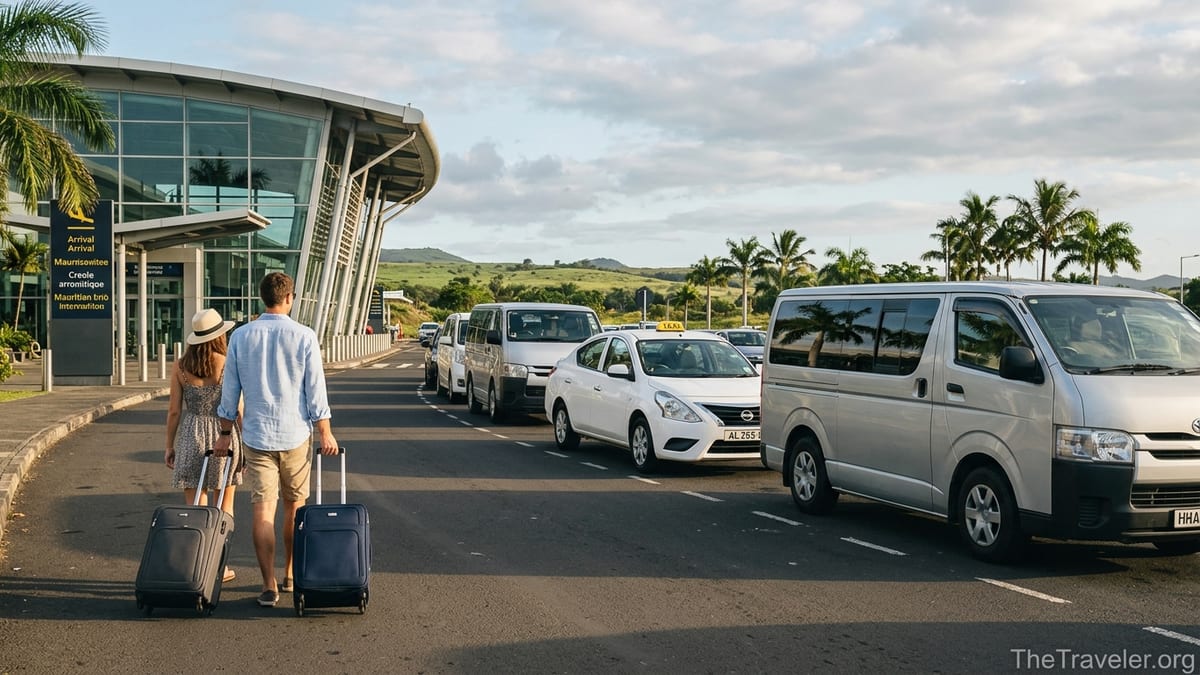
On arrival, you exit customs directly into a compact arrivals hall. Here you will see a line of official airport taxis, a cluster of desks for pre-booked transfer companies, and car rental counters. The official taxi rank is immediately outside the terminal. Public buses do serve the airport, but they primarily connect to towns such as Mahebourg, Curepipe and Port Louis rather than directly to beach resorts, so they are realistic only for light-packers and travellers comfortable with changes and local-style travel.
One important detail: Mauritius does not yet have app-based ride-hailing services operating like in many major cities. You will not be able to summon an Uber or similar at the airport. Instead, your choices are traditional taxis, private transfer companies, hotel-arranged cars, rental cars, or the regular bus system. Pre-booked private transfers and hotel cars operate at fixed rates per vehicle, not per person, which can make them good value for couples or families.
Airport taxi fares are set by zone and published by the airport authorities. While you should always check the most recent official fare table, as of 2026 the prices are typically on par with reputable private transfer firms for many routes. Because there is no meter, you agree the fare before departure. Late-night surcharges are common after roughly 21:00 or 22:00, and prices can be a little higher over Christmas, New Year and August school holidays, when demand peaks.
Private Transfers vs Airport Taxis: What You Really Get
The two most common ways to travel from the airport to a hotel in Mauritius are an official airport taxi or a pre-booked private transfer. On paper they may look similar: a driver with a car, a direct ride, and luggage in the boot. In practice, the experience can be quite different depending on when you land and where you are going.
Private transfer companies such as Taxis Mauritius, Taxi Service Mauritius, Island Transfer and Barefoot-style operators focus almost entirely on airport and hotel transport. A typical private transfer from SSR to a west coast resort like Paradis Beachcomber or a northern resort such as a Grand Baie hotel is advertised from around 50 euros per car for up to three passengers, with higher rates for minibuses or premium vehicles. The price is fixed at booking and usually includes a meet-and-greet in the arrivals hall, flight tracking in case of delays, help with luggage, and direct drop-off at your hotel or villa entrance.
Official airport taxis operate from the rank outside arrivals and are run under a regulated association. Instead of a meter, they work with a destination-based fare table. For example, rides to nearby Mahebourg and Blue Bay are among the least expensive because they are only 10 to 15 minutes away, while journeys to Grand Baie or Trou aux Biches at the far north coast command some of the highest fares. You will usually see laminated fare sheets at the taxi desk. Payment is typically in Mauritian rupees, though many drivers will accept major currencies at a rate they propose, which may not be as favourable as using an ATM inside the terminal and paying in local cash.
For daytime arrivals, especially if you are comfortable confirming the official fare and paying in rupees, airport taxis are a perfectly workable choice. For late-night landings after long-haul flights from Europe, however, many travellers prefer a pre-booked private transfer. Knowing a driver will be waiting with your name board, that the price is locked in, and that you will not need to negotiate at 23:00 can be reassuring, particularly for families or honeymooners heading to more remote resorts such as Le Morne or Belle Mare.
Hotel Shuttles, Rental Cars and Public Buses
Some upscale resorts and boutique hotels in Mauritius offer their own airport transfer services, branded as hotel taxis, limousines or personalised welcome services. For instance, a luxury property in the south has recently published a flat fee of around 60 euros each way for a private hotel car from the airport to their resort, using vehicles that meet the hotel’s own age and safety standards. Rates like these are common among five-star hotels on the south and east coasts that want to control the guest experience from the moment of arrival.
Hotel-arranged transfers are usually slightly more expensive than independent private transfer companies running equivalent vehicles, but they offer the advantage of being managed directly by the property. If your inbound flight is heavily delayed or you change rooms at the last minute, the front desk can coordinate with the driver. This type of service suits travellers who are happy to pay a small premium for the simplest possible logistics rather than hunting for the cheapest fare.
Car rental is another practical option, especially for guests staying on the west or north coasts who plan to explore the island independently. International brands and local agencies have desks in the arrivals area. A compact manual car often starts from a modest daily rate when booked in advance, rising for automatics, SUVs and peak periods. Driving is on the left, and most resort routes involve a section of the M2 motorway followed by coastal or village roads. For example, a couple staying in Flic en Flac for a week and planning day trips to Port Louis, Chamarel and Pamplemousses would often find that a rental car works out cheaper overall than multiple taxis and organised excursions.
Public buses are the lowest-cost way to leave the airport, but they are also the slowest and least direct. The airport is served by several regular routes, including services to Mahebourg, Curepipe and Port Louis. The bus stop is in the car park area just beyond the terminal. These buses are inexpensive, usually costing only small change in Mauritian rupees, and run throughout the day. To reach resort areas such as Flic en Flac or Grand Baie, however, you would need to change buses in towns like Curepipe, Quatre Bornes or Port Louis, and total journey times can easily stretch to two or three hours. Public transport makes sense mainly for budget-conscious solo travellers with light luggage who are comfortable asking for directions and dealing with potential crowding at peak times.
Best Transfer Option by Major Resort Area
Because Mauritius’ resort zones are spread around the island, the most efficient transfer method can vary significantly by location. On the nearby southeast coast around Mahebourg and Blue Bay, the airport is almost on your doorstep. A taxi to hotels in this area often takes only 10 to 15 minutes and is one of the least expensive options on the official fare list. Some local guesthouses may even arrange a short private transfer from around 30 US dollars or the equivalent, which undercuts the rates for longer cross-island journeys.
Along the east coast, resorts around Belle Mare, Palmar and Trou d’Eau Douce sit about 25 to 40 minutes’ drive from SSR. For guests staying at large beach resorts here, a pre-booked private transfer is usually the sweet spot between comfort and value. The drive uses secondary roads rather than the motorway, and having a driver who knows the specific hotel entrance is helpful in the dark. Larger five-star properties on this coast frequently sell their own transfers at a modest premium over independent providers, which some guests are happy to pay to keep everything on one hotel bill.
On the west coast, particularly Flic en Flac, Wolmar and Tamarin, the distance from the airport is longer but still manageable, generally 50 to 70 minutes depending on traffic through the centre of the island. Here, private transfers and airport taxis are in close competition on price. Many visitors choose a private transfer from roughly 50 euros per vehicle for peace of mind on arrival, and then use local taxis or buses during their stay. For family-friendly resorts such as those along Wolmar’s long beach strip, dedicated minivan transfers are common and can work out cost-effective for groups of four or more.
The far north, including Grand Baie, Pereybere, Trou aux Biches and Mont Choisy, is the one region where transfer times consistently push toward 75 to 90 minutes in typical daytime conditions. For this area, a pre-booked private transfer is generally recommended, particularly if your hotel is on a small side road or you are arriving late at night after a long-haul flight. Flat per-vehicle pricing from several transfer companies means that a couple or small family can often travel the full length of the island for the same or only slightly more than shorter routes, making the journey feel more manageable.
Late Arrivals, Luggage and Traveling With Kids
Flight schedules to Mauritius are heavily weighted toward overnight long-haul services from Europe, the Middle East and parts of Asia. That means many visitors land early in the morning or late in the evening, and some experience delays that push arrival to near midnight. At those hours, the official taxi rank still operates, but queues can form after multiple wide-body flights arrive together, and negotiating fares when you are jet-lagged and juggling children or surfboards is not ideal.
For arrivals after roughly 21:00, families and honeymooners bound for more distant resorts like Le Morne, Grand Baie or Belle Mare generally find that pre-booking a private transfer is worth the slight extra effort. The driver tracks your flight, waits even if passport control is slow, and walks you directly to the car. This can be particularly comforting for first-time visitors or those not used to driving on the left. If you are bringing bulky sports equipment, such as golf bags, kitesurfing gear or dive luggage, you can specify this at booking so that the company sends a suitable vehicle with enough boot space or a minivan configuration.
With young children, consider journey length and likely traffic. A transfer from SSR to a west coast resort like Flic en Flac is often easiest, balancing good beaches with an under-one-hour drive. If you are committed to a northern resort but land around midnight, you might pack a small overnight kit in your carry-on so you can quickly get little ones settled once you reach the room. Some private transfer firms offer child seats on request, sometimes at no extra charge, but they need to be reserved in advance. Airport taxis may or may not carry child seats as standard, so check with your hotel or a transfer company if this is important to you.
For couples or solo travellers with standard luggage arriving in daylight, luggage is generally not a constraint. Almost all transfer cars are mid-size sedans or larger, and resort staff are used to helping guests unload. The only time luggage becomes a real planning issue is if you are travelling with outsized items like bicycles or multiple dive tanks, in which case a privately arranged minibus or pickup with a known operator is essential. Hotels in dedicated watersports areas, such as Le Morne or Belle Mare, can typically recommend suitable partners.
Cost, Convenience and When a Rental Car Makes Sense
The price differences between taxis, private transfers, hotel cars and rental vehicles in Mauritius are less dramatic than in many large cities, so your decision often comes down to convenience and your plans during the stay. For a week in a single resort where you intend to relax on the beach and join a couple of organised day tours, a private transfer to and from the airport plus occasional local taxis will usually be the simplest and not significantly more expensive than renting a car for the entire stay.
If, on the other hand, you are planning a more active itinerary, a rental car can be a smart investment. Consider a pair staying in a west coast resort for seven nights with plans to visit Port Louis, Chamarel, the Black River Gorges area and the northern beaches. A small rental car for a week may work out at roughly the same cost as two airport transfers, several local taxi rides and a couple of organised excursions. You gain the flexibility to leave early for hikes, stop at viewpoints such as Macondé, and detour to smaller villages without watching the meter.
Driving standards on Mauritius’ main roads are generally reasonable, though local habits like overtaking on narrow stretches and sporadic speed bumps in villages require attention. Speed limits are enforced, and police checkpoints are not uncommon. Parking at large resorts is usually free for guests, and many properties on the west and north coasts have ample on-site spaces. If you are uncomfortable driving at night, one compromise is to take a private transfer on arrival and rent a car for only the middle portion of your stay from an agency that offers hotel delivery.
Budget-conscious travellers who still want door-to-door comfort may mix modes strategically. For example, a solo traveller arriving in the afternoon and staying in Mahebourg could take a low-cost local bus from the airport to the town and then a short taxi ride to a guesthouse. Another traveller might book a private transfer on arrival for peace of mind with luggage, then experiment with buses and the light rail between Curepipe, Quatre Bornes and Port Louis during the stay before taking a hotel-arranged car back to the airport.
The Takeaway
Planning your transfer from Mauritius’ SSR International Airport to your hotel is less about finding a single “best” option and more about matching the right mode to your resort area, arrival time and travel style. For the nearest southeast and east coast resorts, both official airport taxis and reasonably priced private transfers work well, with hotel cars adding a premium but frictionless option at the high end. For the west coast, private transfers are often the sweet spot on value and convenience, while those staying in the far north almost always benefit from pre-booking, especially on late arrivals.
Families, honeymooners and anyone arriving late at night will appreciate the reassurance of a named driver waiting just beyond customs, a fixed fare and a straightforward walk to the car. Independent travellers staying longer than a few days in the west or north may find that renting a car transforms the trip, turning the transfer into the first of many scenic drives around sugarcane fields and coastal viewpoints. Ultra-budget visitors, comfortable with slow journeys and changes, can make the regular bus system work for them, at the cost of time and simplicity.
Whatever your choice, it pays to decide on your transfer before you fly. Confirm your hotel’s exact location, check typical driving times, and compare at least one or two private transfer quotes with the latest official taxi fare list. That way, when the aircraft doors open and the warm Mauritian air hits, you can walk through arrivals knowing that the journey to your chosen corner of the island is already taken care of.
FAQ
Q1. How long does it take to get from Mauritius airport to Grand Baie?
The drive from Sir Seewoosagur Ramgoolam International Airport to Grand Baie in the north usually takes between 75 and 90 minutes in typical daytime traffic.
Q2. Is it better to book a private transfer or take a taxi on arrival?
For daytime arrivals and nearby resorts, taking an official airport taxi is fine if you confirm the fare. For late arrivals or long journeys to the north or far west, a pre-booked private transfer is usually more comfortable.
Q3. Are there hotel shuttles from the airport in Mauritius?
There is no shared public shuttle covering all hotels, but many individual resorts and upscale hotels offer their own private cars or hotel taxis that you can book in advance.
Q4. Can I use public buses from the airport to beach resorts?
Yes, but not directly. Airport buses mainly go to Mahebourg, Curepipe and Port Louis. To reach resorts like Flic en Flac or Grand Baie you must change buses, which can take several hours and is best for light-packers on a tight budget.
Q5. Do taxis at Mauritius airport use meters?
No, official airport taxis use fixed fares based on destination zones rather than meters. Always confirm the price to your hotel before starting the journey and pay in Mauritian rupees if possible.
Q6. Is renting a car at Mauritius airport a good idea?
Renting a car is a good option if you plan to explore the island independently, especially from west or north coast bases. Driving is on the left and main routes to resorts are straightforward, though you should be comfortable with local traffic conditions.
Q7. What is the best transfer option for families with young children?
For families, a pre-booked private transfer or hotel-arranged car is usually best. You can request child seats in advance, avoid queues at the taxi rank and go straight to the car after clearing customs.
Q8. How early should I leave my hotel for the airport?
Plan to be at the airport around two to three hours before departure, then add the usual driving time from your resort area. From the north coast, many hotels suggest leaving roughly four hours before your flight time to allow for traffic and check-in.
Q9. Can I pay for airport transfers by card?
Most private transfer companies and many hotel cars accept card payment, often processed online at booking. Official airport taxis are more likely to expect cash in rupees, so withdraw money at an airport ATM if you plan to use them.
Q10. Are late-night transfers in Mauritius safe?
Late-night transfers are common and generally considered safe when using licensed taxis, reputable private transfer companies or hotel cars. Pre-booked services that track your flight and meet you inside arrivals are particularly convenient for night-time landings.