


Sir Seewoosagur Ramgoolam International Airport in the south of Mauritius sits roughly 45 to 50 kilometres from the capital, Port Louis, and its modern cruise terminal. That distance can feel longer than it looks on the map, especially at rush hour, and choosing the right transfer can make or break a tight flight or cruise connection. This guide breaks down the real options, costs and travel times so city visitors and cruise passengers can plan airport to Port Louis journeys with confidence.
Get the latest updates straight to your inbox!
Understanding the Route: Airport, City and Cruise Terminal
Sir Seewoosagur Ramgoolam International Airport (MRU) lies near Plaine Magnien in the island’s southeast, while Port Louis and the Port Louis Cruise Terminal sit on the northwest coast. The road distance is about 45 to 50 kilometres depending on your exact hotel or pier, and most of the way is along the M1 motorway that runs south to north across Mauritius via Curepipe, Vacoas-Phoenix and Quatre Bornes.
In light traffic, a taxi or private transfer can cover the journey in about 45 to 55 minutes. That is a realistic time late in the evening or early on a Sunday morning. During weekday rush hours, especially between 07:30 and 09:30 heading into Port Louis, and 15:30 to 18:30 leaving the city, travel times can easily stretch to 75 to 90 minutes as traffic builds on the M1 and at the approaches to Port Louis.
The Port Louis Cruise Terminal and the adjacent Caudan Waterfront complex are a short hop from the city centre. Most cruise ships berth at the dedicated cruise jetty, and walking from the terminal to the shops and restaurants at Caudan typically takes 10 to 15 minutes at a relaxed pace. Taxis and prebooked transfers can drive right up to the terminal entrance, so cruise passengers with luggage rarely need to walk between ship and car.
For planning, it helps to treat “Port Louis” as three different zones: the central business district around Place D’Armes and government buildings; the Caudan Waterfront and cruise area; and the ring of business hotels in suburbs like Ebene and Cybercity, which sit roughly halfway between the airport and downtown. Knowing exactly where you are going will influence which transfer option makes the most sense and how long you should allow.
Bus 198: Cheapest Route from Airport to Port Louis
For budget-conscious travellers with light luggage, public bus 198 is the workhorse connection between the airport and central Port Louis. This route runs between Mahebourg in the southeast and Port Louis Victoria Square Bus Station, stopping directly outside the terminal on the main road. According to the airport operator and local timetables, bus 198 operates daily, with a typical daytime frequency of around 15 to 20 minutes.
The fare structure changes occasionally, but visitors can expect to pay the equivalent of only a few US dollars for the entire journey, often in the region of 40 to 60 Mauritian rupees per adult. Tickets are purchased on board from the conductor, who will walk through the bus shortly after departure. Payment is in cash, so arriving passengers should withdraw a small amount of local currency at an airport ATM before heading to the bus stop.
In terms of time, bus 198 is the slowest option. From the airport to Port Louis, the ride typically takes about 75 to 90 minutes in light to moderate traffic, and up to 2 hours during busy periods. The bus is a regular city bus, not an express airport coach, so it makes numerous stops in the towns along the M1 corridor such as Rose Belle, Phoenix and Reduit. Seats can fill up quickly during commuting hours, and the bus may be crowded and standing-room-only at times.
Bus 198 is best suited to solo travellers or couples with backpacks or small wheeled cases who are not under time pressure. For example, a backpacker arriving on a mid-morning flight with a guesthouse booking near Chinatown could comfortably take bus 198 to Port Louis, then walk or take a short taxi ride from Victoria Square Bus Station. On the other hand, a family of four with two large suitcases each and an afternoon cruise check-in time would be taking an unnecessary risk by relying solely on this bus.
Taxi and Ride-style Transfers: Flexibility at the Curb
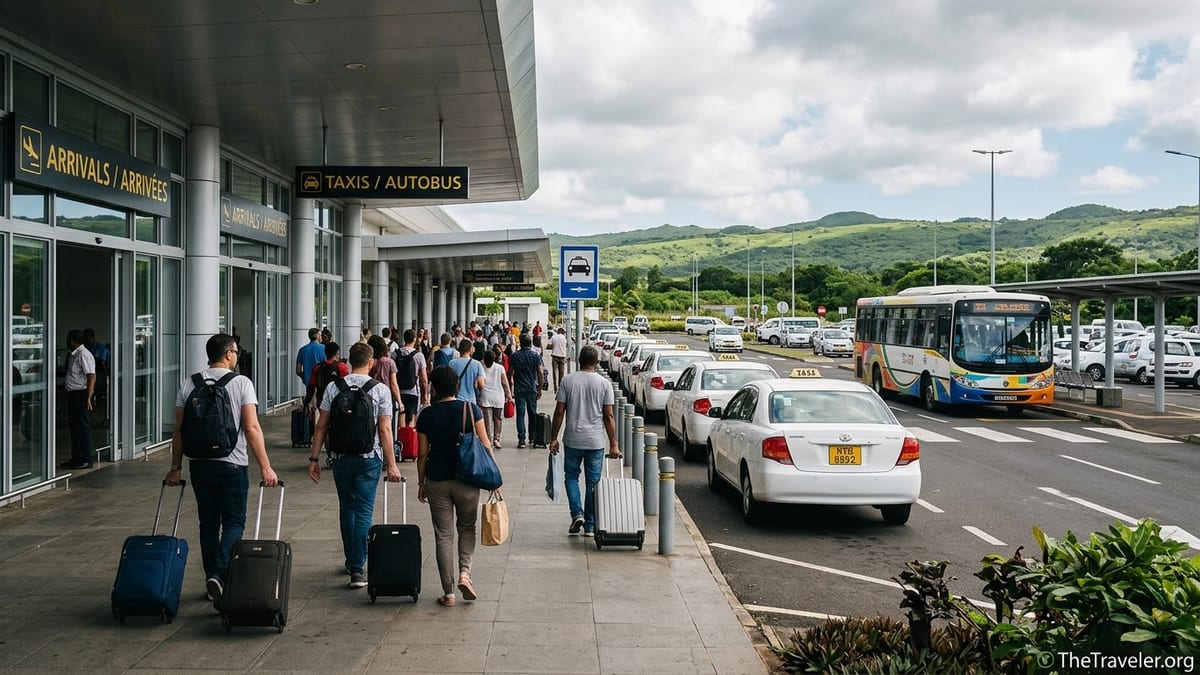
Airport taxis are the most straightforward door-to-door option and are easy to find just outside the arrivals hall. Official taxis are usually white or cream-coloured sedans with roof signs and are queued in a dedicated rank. For a standard daytime ride from MRU to a central Port Louis hotel, visitors commonly see quoted prices in the range of roughly 1,800 to 2,300 Mauritian rupees, depending on the size of the vehicle, time of day and negotiation.
Most taxis still work on fixed or negotiated fares rather than on a meter, so it is important to agree the price before getting in. As a rule of thumb, two or three adults sharing a taxi will usually find this option far more economical and comfortable than public transport. Even solo travellers on business often prefer the predictability of a taxi, particularly when heading straight to a meeting or checking into a city hotel like the Labourdonnais Waterfront Hotel or Le Suffren Hotel & Marina.
In addition to the classic rank taxis, several local operators now offer pre-arranged transfer services that work in a similar way to ride-hailing. Travellers can book online before arrival, receive a fixed quote, and meet a driver in the arrivals area holding a name sign. These services are particularly popular with cruise passengers who want a guaranteed pick-up time around ship embarkation, or with corporate travellers whose companies require prebooked ground transport.
During off-peak times, taxi transfers from airport to Port Louis can be as fast as 45 to 50 minutes. In the late afternoon when traffic exits the capital, the same trip can take well over an hour. For example, a business traveller landing at 16:00 on a weekday and heading to a meeting in the city at 18:00 should expect the drive to push close to 90 minutes if congestion is heavy, and may want to advise colleagues accordingly.
Private Transfers and Hotel Cars: Best for Cruise and Business Travelers
Private transfers offer the most controlled option for travellers with fixed deadlines, such as cruise embarkation or high-stakes business appointments. Many Mauritian ground operators and tour companies sell airport to Port Louis transfers with English- or French-speaking drivers, modern sedans or minibuses, and the possibility to add a brief sightseeing stop along the way. Prices fluctuate with fuel costs and demand, but a prebooked private car for two to three passengers typically costs from the low 2,000s of rupees upward for this route, with larger minivans priced higher.
For cruise passengers, pre-arranging a private transfer is strongly recommended if your ship is leaving or arriving the same day as your flight. On turnaround days, hundreds of travellers may need taxis at once outside the Port Louis Cruise Terminal, and relying on availability at the curb can be stressful. A realistic plan for a morning cruise embarkation would be to leave the airport by private transfer no later than 09:00 for an afternoon boarding window, or to depart Port Louis by 08:00 or 08:30 to comfortably check in for a midday or early afternoon flight.
Business and conference travellers often find it most efficient to use hotel-arranged cars. High-end properties in Port Louis and Ebene, such as Le Suffren, The Address Boutique Hotel in Port Chambly, or hotels in the Ebene Cybercity area, typically partner with reliable drivers and can add the fare to the room bill. While slightly more expensive than a street taxi negotiated on the spot, hotel cars add the assurance that the driver knows the exact property location, expected arrival posture and any corporate billing arrangements.
Private transfers are also the most realistic option when travelling with bulky luggage, sports equipment or mobility aids. A couple disembarking a cruise with two large suitcases and golf bags, for example, can request a station wagon or minivan rather than try to squeeze everything into the trunk of a compact taxi. Similarly, travellers bringing diving equipment to a resort near Port Louis or on the northwest coast may prefer the extra space and pre-arranged logistics.
Driving Yourself: Rental Car Considerations
Renting a car at MRU can be excellent value for travellers planning to explore Mauritius beyond Port Louis, but it is not ideal for everyone. Several international brands operate at the airport alongside reputable local companies. Daily rates vary by season and vehicle type, but compact cars are often available at competitive prices compared with two or three taxi rides. That said, visitors must be comfortable driving on the left-hand side of the road, adjusting to local driving styles, and navigating occasionally busy junctions near the capital.
From the airport, the route to Port Louis by rental car is relatively straightforward. After exiting the terminal area, drivers follow signs to the M1 motorway, heading north. The road is dual carriageway for most of the distance, with clear signage to intermediate towns like Curepipe, Phoenix and Quatre Bornes. Approaching Port Louis, traffic usually thickens, and drivers should stay alert for lane changes and slower vehicles. In normal conditions, the drive to central Port Louis hotels takes about 50 to 60 minutes in a rental car for someone new to the island.
Parking is the element many first-time visitors underestimate. Street parking in Port Louis is controlled by pay-and-display systems, and spaces in the central business district can be scarce during office hours. Car parks exist at Caudan Waterfront and around the harbour, but they can fill quickly, and fees apply. A traveller who plans to spend most of their time in the capital or on organized excursions from a hotel might find a rental car more of a burden than a benefit.
On the other hand, a couple staying in Port Louis for two nights before moving on to a west-coast resort in Flic en Flac, Grand Baie or Tamarin might use the airport to Port Louis leg as a comfortable introduction to driving in Mauritius. They could collect the car upon arrival, spend two days exploring the capital and nearby attractions like Pamplemousses Botanical Garden or the sugar museum, and then continue around the island without additional transfer costs.
Travel Time, Traffic Patterns and Metro Links
When planning any airport to Port Louis transfer, it is important to think in time windows, not just in kilometres. Traffic around the capital can be heavy on weekday mornings when commuters travel into the city and again in the late afternoon when they return home. Rainy weather can slow traffic further, especially in the central plateau where cloud and showers are more frequent than on the coasts.
A conservative guideline is to allow at least 90 minutes for a taxi or private transfer from Port Louis or the cruise terminal to the airport before an international flight, plus the airline’s recommended check-in time, especially if travelling during weekday peaks. For a morning departure around 09:00 or 10:00, this might mean leaving a city hotel at approximately 06:30 or 07:00. For late-night flights, such as red-eye departures to Europe, the roads are usually clearer, and an hour of driving time may be sufficient.
The development of the Metro Express light rail between Curepipe and Port Louis has improved local commuting but does not yet offer a seamless airport connection. Some travellers consider a hybrid route, taking bus 198 from the airport to a metro-linked town like Phoenix, then switching to the tram into Port Louis. In practice, this is only advisable for confident public transport users with light luggage and no time pressure, such as long-stay visitors or local residents returning from trips abroad.
For most holidaymakers, especially those arriving after an overnight flight, the priority is a single, predictable door-to-door journey. In these cases, bus 198 remains the best low-cost option, while taxis, private transfers and hotel cars deliver the comfort and reliability needed for tight schedules and business or cruise commitments.
Luggage, Accessibility and Choosing the Right City or Cruise Hotel
Luggage is a critical factor when choosing how to travel between MRU and Port Louis. The public bus system is not designed for very large suitcases, and luggage racks are limited or absent on many vehicles. Passengers are generally expected to keep bags on their laps or in the aisle, which can be awkward and unpopular at busy times. A solo traveller with a 40-litre backpack will blend in easily on bus 198, while a family with multiple checked suitcases could face a stressful ride.
Taxis and private transfers can usually fit two large cases and two cabin bags in the trunk of a standard sedan, but extra items like strollers, wheelchairs or sports equipment should be mentioned when booking. For cruise passengers disembarking with several weeks’ worth of luggage, requesting a minivan or people-carrier is wise. These vehicles can often handle four to six large suitcases without compromising passenger comfort.
Accessibility also varies. Some older buses and taxis have high steps, and wheelchair users may find them challenging. Private transfer companies are often better able to source vehicles with more space, ramp assistance or patient drivers for travellers with limited mobility. When booking through a hotel, guests should specify any requirements in advance, such as needing help at the cruise terminal or extra time for boarding.
Hotel location plays into this. Business travellers typically choose hotels within easy walking distance of Port Louis offices or a short taxi ride from the port, thereby minimizing time in traffic once they reach the city. Cruise passengers arriving a day early might opt for a hotel at Caudan Waterfront to enjoy harbour views and be within a few minutes’ drive of the cruise terminal. Others might prefer a business hotel in Ebene, roughly halfway between the airport and Port Louis, which can reduce the total driving time on arrival night while still keeping them close to the city for a pre-cruise dinner or meeting.
The Takeaway
The 45 to 50 kilometres between Mauritius SSR International Airport and Port Louis cover more than just distance: they encompass changes in traffic, comfort, cost and convenience that can heavily influence how a trip begins or ends. Understanding these variables allows travellers to choose the right tool for the job instead of defaulting to the first option seen outside arrivals.
Bus 198 is the clear winner on price and provides a perfectly workable solution for relaxed, light-luggage travellers who are not racing the clock. Taxis and prebooked private transfers offer faster, more comfortable journeys with predictable costs, making them the better choice for cruise passengers, business visitors and families. Rental cars make sense if the Port Louis leg is only the first stage of a wider island itinerary and the driver is comfortable with local conditions.
Whichever option you choose, build generous time buffers into your plan, particularly around weekday rush hours and on cruise turnaround days. Think not just about how to get from point A to point B, but also about luggage, mobility, hotel location and your energy level after a long flight. With a realistic understanding of transport options, it is entirely possible to step off a plane in the south and be checking in at a Port Louis hotel, boarding a cruise or strolling the Caudan Waterfront with minimum stress.
FAQ
Q1. How long does it really take to get from Mauritius airport to Port Louis?
In light traffic, a taxi or private transfer usually takes about 45 to 55 minutes. During weekday rush hours or in heavy rain, allow 75 to 90 minutes.
Q2. Is bus 198 from the airport to Port Louis reliable for tourists?
Yes, bus 198 is widely used and runs frequently during the day, but it is slower and can be crowded. It suits travellers with light luggage and flexible schedules.
Q3. How much should I expect to pay for a taxi from MRU to central Port Louis?
Typical taxi fares fall roughly in the 1,800 to 2,300 Mauritian rupee range for a standard car, depending on negotiation, time of day and exact destination.
Q4. Is it worth prebooking a private transfer instead of taking a taxi from the rank?
For cruise passengers, business travellers and anyone arriving at very busy times, prebooking is often worthwhile for the fixed price, meet-and-greet and guaranteed vehicle size.
Q5. Can I take public transport from the airport if I have large suitcases?
You can, but it is not ideal. Buses are not designed for very large luggage and can be crowded, so taxis or private transfers are more practical for big bags.
Q6. Are there direct transfers between the airport and the Port Louis Cruise Terminal?
Yes, taxis and private transfer companies will drive directly between MRU and the cruise terminal. It is best to prebook on embarkation or disembarkation days.
Q7. Is renting a car to drive from the airport to Port Louis a good idea?
It can be, especially if you plan to tour the island. However, you must be comfortable driving on the left and dealing with city traffic and parking.
Q8. Does the Metro Express connect the airport with Port Louis?
No, the Metro Express does not currently reach the airport. You could combine bus and metro, but most visitors prefer a single direct mode of transport.
Q9. How early should I leave Port Louis for the airport before an international flight?
Allow at least 90 minutes of road time plus your airline’s recommended check-in window, especially during weekday peaks. Leaving even earlier provides extra peace of mind.
Q10. Which area of Port Louis is best to stay in for easy airport and cruise access?
For cruise passengers, hotels near Caudan Waterfront work well. Business travellers often choose central city hotels or properties in Ebene, which sits roughly midway to the airport.