


Landing at Sir Seewoosagur Ramgoolam International Airport in Mauritius is exciting, but the first hour on the ground can feel chaotic if you are not sure how to get connected or pay for your taxi. This guide walks you step by step through SIM and eSIM options, ATMs, money exchange, card use and what to arrange before you walk out of the terminal, using concrete, up to date examples from the airport in 2026.
Get the latest updates straight to your inbox!
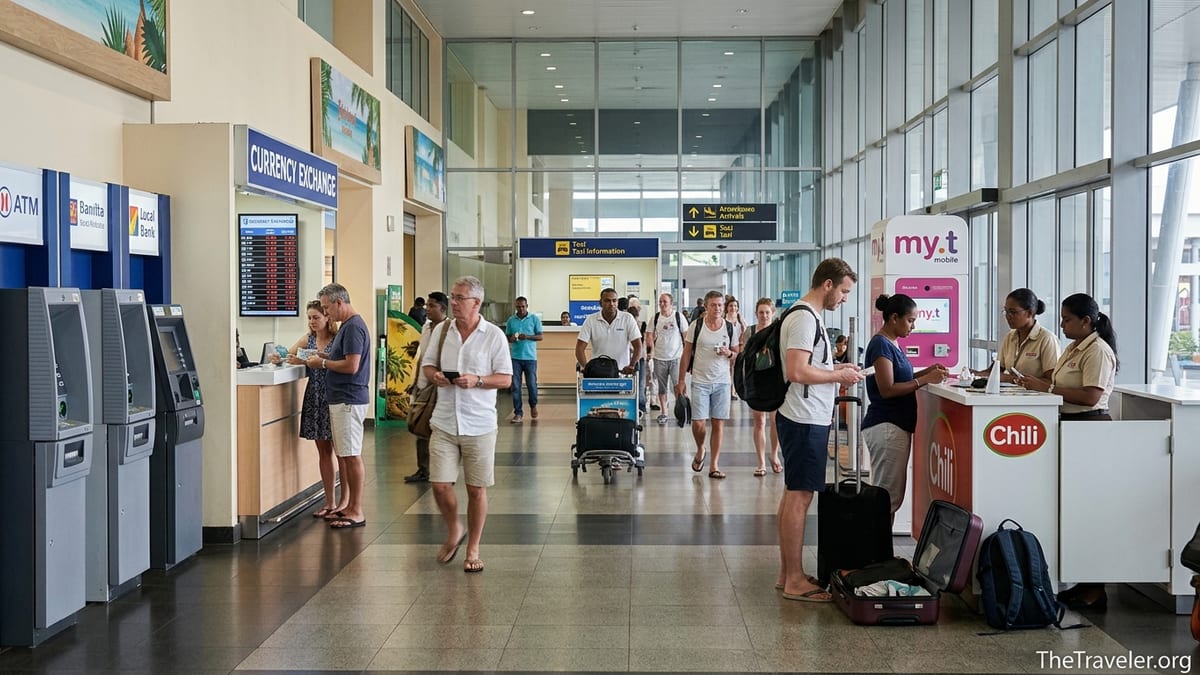
What to Expect on Arrival at Mauritius SSR Airport
Sir Seewoosagur Ramgoolam International Airport, usually shortened to SSR or "Plaisance," is the main gateway to Mauritius. International arrivals are handled in a single modern terminal, so you will find mobile operators, ATMs and exchange counters in the same broad arrivals hall after immigration and customs. Signage is in English and French, and staff at the main counters are used to dealing with tourists every day.
After passport control and baggage claim you will pass customs and enter the public arrivals area. This is where you will see the official airport taxi counter, tour desks, car rental booths and a row of bank and exchange counters, typically open for all scheduled international flights. Around this same area, local mobile operators have kiosks where visitors can buy tourist SIM cards or get help with eSIMs. You do not need to leave the secure area or change floors to find these services.
Unlike some large hubs, SSR is relatively compact. That means you can usually sort out your phone and cash in 20 to 30 minutes, even if there are a few people in line. However, flights from Europe, the Middle East and South Africa tend to cluster in the early morning and late evening, so expect short queues at SIM and exchange counters during those waves.
The local currency is the Mauritian rupee, often written as MUR or Rs. You will need rupees for taxis that do not accept cards, tips, small food purchases on the road and for any early stops before you reach your hotel. Foreign cash such as euros or US dollars is sometimes accepted in tourist areas, but it is less convenient and usually works at a poor rate.
Airport SIM Card Options: my.t, Chili and Others
Mauritius has three main mobile operators: my.t (Telecom Mauritius), Chili and Emtel. At SSR Airport, the two brands most visible to arriving tourists are usually my.t and Chili, each promoting dedicated tourist SIM packs at their branded counters just after customs. These packs are designed for short stays and are easier to set up than regular prepaid plans.
As of mid 2026, my.t advertises a 5G Tourist SIM or eSIM valid for 30 days with a bundle of local data, calls and SMS for about 30 euros or the equivalent in rupees. The exact quota changes from time to time, but a typical offer includes a substantial data allowance geared to navigation, ride-hailing and social apps rather than heavy video streaming. You will normally need your passport to register the SIM, and staff will configure the profile on your phone for you.
Chili promotes a Tourist SIM available both at its city outlets and at a dedicated Chili counter in the arrivals area. This pack positions itself as a budget option with an affordable upfront price and a combination of data and local call credit. Promotions vary, but in practice you are paying roughly the cost of a few airport coffees for enough data to navigate the island comfortably for a week or more, with top ups possible later at supermarkets, corner shops and Chili stores if you stay longer.
Activation at the airport is usually straightforward. Staff will either scan your passport and hand you a physical SIM, or in the case of compatible phones, help you download an eSIM profile. Allow 10 to 15 minutes per person in busy periods, especially if staff are also serving large tour groups arriving on long haul flights.
Using eSIMs: Arrive Connected or Top Up Locally
If your phone supports eSIM, buying a Mauritius data plan before you fly can be the most convenient option. Several international providers such as Airalo, Holafly and others now sell Mauritius specific eSIMs that can be activated via an app. Recent comparisons in 2026 show that fixed data plans often start at under 10 US dollars for a small allowance and increase to higher prices for larger or unlimited packages. The main advantage is that you can scan a QR code at home, land with data already working and skip the counter queues entirely.
These global eSIMs typically roam on one of the local networks such as my.t, Emtel or Chili in the background. In practice, that means coverage across the main coastal resort areas, the airport corridor, Port Louis and major inland towns is generally solid. However, independent user reports suggest that speeds and stability can differ by provider, especially at peak times or in more remote corners of the island. If you plan to work remotely or upload large media files, consider paying for a slightly larger plan than you think you need.
Many visitors now combine both options. A common pattern is to activate a small roaming eSIM before arrival to handle initial messaging and ride hailing, then buy a local tourist SIM or eSIM from my.t or Chili at the airport for the bulk of the trip. This way you are not dependent on a single vendor if you run into speed or support issues during your stay.
Remember that eSIMs on dual SIM phones still draw battery, and switching between them on arrival can be confusing if you are jet lagged. It helps to rename profiles inside your phone settings, for example "Home" and "Mauritius," before you land, so you can clearly see which line is active for mobile data and which is used for calls and SMS.
Cash, ATMs and Exchange Desks in the Arrivals Hall
Once you step into the public arrivals area, you will quickly see ATMs operated by major Mauritian banks such as Mauritius Commercial Bank and State Bank of Mauritius. These machines dispense Mauritian rupees and generally accept international cards on Visa and Mastercard networks. Some visitors report that their home bank charges a fee per withdrawal plus a currency conversion margin, so withdrawing a slightly larger amount once instead of many small withdrawals can reduce costs.
Next to or near the ATMs you will find money exchange counters run by banks and licensed currency dealers. They will typically buy major currencies such as euro, US dollar and pound sterling. The buy and sell rates are displayed on electronic boards or posters. Airport exchange rates are usually less favorable than those in town, but the difference is often acceptable if you only change a modest amount for immediate needs like a taxi, drinks or tolls.
As a concrete example, a couple arriving from Europe might withdraw the equivalent of 100 to 150 euros in rupees at an airport ATM. That amount is usually enough to cover a taxi from the airport to most coastal areas, a first meal and some tips, without locking in a large sum at airport rates. Later, they can use city ATMs or exchange offices in places like Grand Baie, Flic en Flac or Port Louis, where competition tends to produce slightly better spreads.
Queues at ATMs are common when several wide body flights arrive close together, especially in the evening. If one machine is out of service or out of cash, look a little further along the hall; SSR usually has more than one bank represented, including offsite ATMs located just outside the terminal building near the car park. As always, shield your PIN and check that the card slot looks secure before inserting your card, just as you would at home.
Paying for Taxis and Transfers: How Much Cash Do You Need
The official airport taxis at SSR operate from a dedicated counter in the arrivals hall. Fares are listed by destination on printed or digital boards, and for 2026 the airport taxi association publishes updated tariffs by zone. A ride to popular resort areas such as Flic en Flac, Grand Baie or Belle Mare can cost the equivalent of several tens of US dollars depending on distance, time of day and whether you are in a standard sedan or a larger vehicle for groups.
Cash remains the default payment method for many taxis in Mauritius. Although some operators have card terminals or accept mobile payments, visitors frequently report that machines are occasionally "not working" or that drivers prefer cash to avoid delays and fees. For a smooth experience, plan to have enough rupees on hand to pay your first ride in cash, even if your hotel stay itself will be settled by card.
As a working example, a family of four heading from the airport to a mid range hotel on the west coast might set aside the equivalent of 60 to 80 US dollars in rupees for their first day. That would cover the taxi fare, a snack stop plus a small buffer in case of minor detours or tolls. If you plan to rely on ride hailing apps or prebooked transfers that charge your card directly, you can reduce that initial amount, but it is still wise to have at least a few thousand rupees in notes and coins.
Many hotels and resorts also arrange private transfers with fixed prices billed to your room. In that case you can often walk past the taxi counter and meet a driver holding a sign with your name. However, if you have not arranged anything in advance and arrive at a peak time, the official taxi counter gives you a regulated price and avoids informal touts. Pay at the end of the ride in rupees, and keep some smaller notes for tipping if you wish.
Card Payments and Everyday Spending on the Island
Once you reach your accommodation, you will notice that card acceptance in Mauritius is mixed. Large beach resorts, international hotel brands and high end restaurants almost always accept major credit and debit cards. So do many supermarkets and shopping centers around Grand Baie, Tamarin, Cascavelle and Bagatelle. Card terminals are ubiquitous in those settings, and receipts are printed in rupees with clear conversion lines.
By contrast, smaller guesthouses, family run snack bars, roadside fruit stalls, temple or church donation boxes and taxi drivers in rural areas may prefer or insist on cash. Some businesses technically have card terminals but add surcharges for small payments or claim network issues at inconvenient moments. Travelers who try to run their entire stay cash free often find themselves walking to an ATM in the heat just to pay for a plate of street food or a sunset drink.
A practical compromise is to treat your card as the main payment method for accommodation and larger restaurant bills while keeping a modest envelope of rupees for day to day transactions. For a one week stay, many couples are comfortable withdrawing the rough equivalent of 150 to 250 US dollars in local currency, topping up only if needed. That level of cash usually covers taxis, snacks, local SIM top ups, small attraction fees and unplanned detours to beach bars or viewpoints.
Contactless payments and mobile wallets backed by Visa or Mastercard are slowly becoming more common, especially in urban clusters, but you should not rely on them yet in rural villages or independent guesthouses. Before ordering, it is sensible to ask "card ok?" or show your card with a questioning look, particularly at small eateries, so you can avoid awkward surprises when the bill arrives.
What to Arrange Before Leaving the Terminal
To avoid hassles later, it is worth pausing in the arrivals hall to tick off a short checklist before you walk out into the sun. First, decide how you will get online for the first day or two. If you have already activated an international eSIM and it is working well, you might simply confirm roaming is active and move on. Otherwise, stop at a my.t or Chili counter, compare their current tourist offers and choose one that roughly matches your data needs and length of stay.
Second, sort out your initial cash. Either withdraw a sensible sum at an ATM or exchange enough foreign banknotes at a counter to pay for your taxi and small incidentals. If you are traveling as a group, one person can stand in the ATM queue while another handles SIM registration to save time. Keep withdrawal receipts in case your bank asks about foreign transactions later.
Third, organize your transfer. If you have not prebooked a hotel shuttle or tour operator pickup, go directly to the official taxi desk inside the terminal rather than negotiating outside in the car park. Confirm the price in rupees for your specific destination before you accept the ride. If you prefer ride hailing, check that your chosen app works in Mauritius and that your new SIM or eSIM has data before you leave the building.
Finally, take a moment to stow your valuables. Put your passport, extra cards and any large bundles of foreign cash in an inside pocket or money belt, and keep only the rupees you need handy for the next couple of hours. Switching SIM cards at the curb next to your luggage trolley is an easy way to misplace something, so it is better to finish those adjustments while sitting in the relative calm of the arrivals hall.
Planning Ahead: Before You Fly to Mauritius
Good preparation before departure makes the on arrival process at SSR easier. A few days before you fly, check that your phone is unlocked so it can accept a local SIM or eSIM. If you are considering an international eSIM from providers such as Airalo or Holafly, compare plans by data allowance, duration and whether hotspot use is allowed. Prices shift over time, but independent reviewers in 2026 still find meaningful differences in cost per gigabyte between brands, especially on longer trips.
It is also sensible to tell your bank and card issuer that you are traveling to Mauritius. Many institutions offer a simple travel notice feature in their app. This reduces the risk that your first ATM withdrawal or hotel authorization in Plaine Magnien will be flagged as suspicious and declined. While you are in the app, check any foreign ATM or card usage fees so you are not surprised later by extra charges on your statement.
For currency, you generally do not need to obtain Mauritian rupees before you leave your home country, as they can be harder to source and buy back outside the region. Instead, plan to arrive with a mix of card options and at least some cash in a major currency like euros or US dollars that you are comfortable exchanging if your card does not work on arrival. If you are traveling from a country with its own less widely traded currency, research in advance whether your bank cards will function on international networks in Mauritius.
Finally, take screenshots of any important confirmations: your eSIM QR code, hotel booking with address, prebooked transfer details and travel insurance contacts. Save them on your phone and ideally in offline notes too. That way, even if your mobile data is slow in the first few minutes after landing, you will still have the essential information handy when speaking to SIM staff, taxi dispatchers or hotel drivers.
The Takeaway
Arriving at Mauritius SSR Airport does not have to involve guesswork about connectivity and money. With a little planning, you can move from immigration to a connected phone, cash in hand and a confirmed taxi in under an hour. Local tourist SIMs from brands like my.t and Chili offer simple, passport based activation in the arrivals hall, while international eSIMs let many visitors land with data already live.
On the money side, a quick stop at airport ATMs or exchange desks gives you enough rupees to cover your first taxi and small incidentals, even if you plan to pay for hotels and most restaurant meals by card later. Assuming that every taxi or snack bar will accept plastic is risky, especially outside the main resorts, so treating cash as a useful backup remains the most comfortable strategy in 2026.
Most importantly, do not rush to leave the terminal before you have arranged your connection, currency and transport. Taking ten extra minutes in the arrivals hall to compare SIM offers, withdraw cash and confirm your fare with the official taxi counter often makes the rest of your first day on the island feel far more relaxed. Once those basics are under control, you can focus on what you came for: lagoons, mountains and the slow rhythm of Mauritian life.
FAQ
Q1. Can I buy a SIM card directly at Mauritius SSR Airport?
Yes. Major operators such as my.t and Chili usually have dedicated counters in the arrivals hall where you can buy tourist SIM packs or get help with eSIM activation using your passport.
Q2. Is it better to use an eSIM or buy a local SIM in Mauritius?
It depends on your priorities. An international eSIM is convenient if you want to land with data already working, while a local tourist SIM from my.t or Chili often offers competitive value and local support once you arrive.
Q3. How much cash should I withdraw at the airport?
Many visitors withdraw the equivalent of 100 to 150 euros in rupees on arrival to cover a taxi, snacks and tips. You can then use ATMs or exchange offices in town later if you need more.
Q4. Do airport taxis in Mauritius accept card payments?
Some taxis have card terminals, but cash is still the most reliable option. To avoid problems with "broken" machines or extra fees, plan to pay your first ride in rupees.
Q5. Are there ATMs in the arrivals area at SSR Airport?
Yes. ATMs from major banks such as Mauritius Commercial Bank and State Bank of Mauritius are located in or near the arrivals hall and usually accept international Visa and Mastercard cards.
Q6. Is the exchange rate at the airport much worse than in town?
Airport exchange desks typically offer slightly less favorable rates than city banks or exchange offices, but for small amounts needed for taxis and initial expenses the difference is usually modest.
Q7. Can I rely on cards only during my stay in Mauritius?
Cards are widely accepted in large hotels, supermarkets and many restaurants, but smaller guesthouses, street food stalls and some taxis still prefer cash. Keeping a modest amount of rupees is strongly recommended.
Q8. Do I need my passport to buy a SIM card at the airport?
Yes. Local regulations require mobile numbers to be registered, so you will normally be asked to present your passport when purchasing and activating a tourist SIM or eSIM at SSR Airport.
Q9. Should I get Mauritian rupees before leaving my country?
In most cases it is not necessary. Mauritian rupees can be difficult to buy and resell abroad. It is usually easier to withdraw rupees from ATMs or exchange major currencies on arrival at the airport.
Q10. What is the single most important thing to arrange before leaving the terminal?
For most travelers, the priority is a working mobile connection and enough rupees to pay for the first taxi. Once you have those, the rest of the trip is much easier to manage.