


Mexico City International Airport (MEX) is one of Latin America’s busiest hubs and a common connection point between North America, South America, Europe, and the rest of Mexico. Its two-terminal layout, frequent congestion, and Mexico’s immigration rules can make even a simple connection feel complicated. This guide breaks down how to move between Terminal 1 and Terminal 2, what happens to your bags, how immigration works, and how much layover time you really need, with real-world examples drawn from recent traveler experience.
Get the latest updates straight to your inbox!
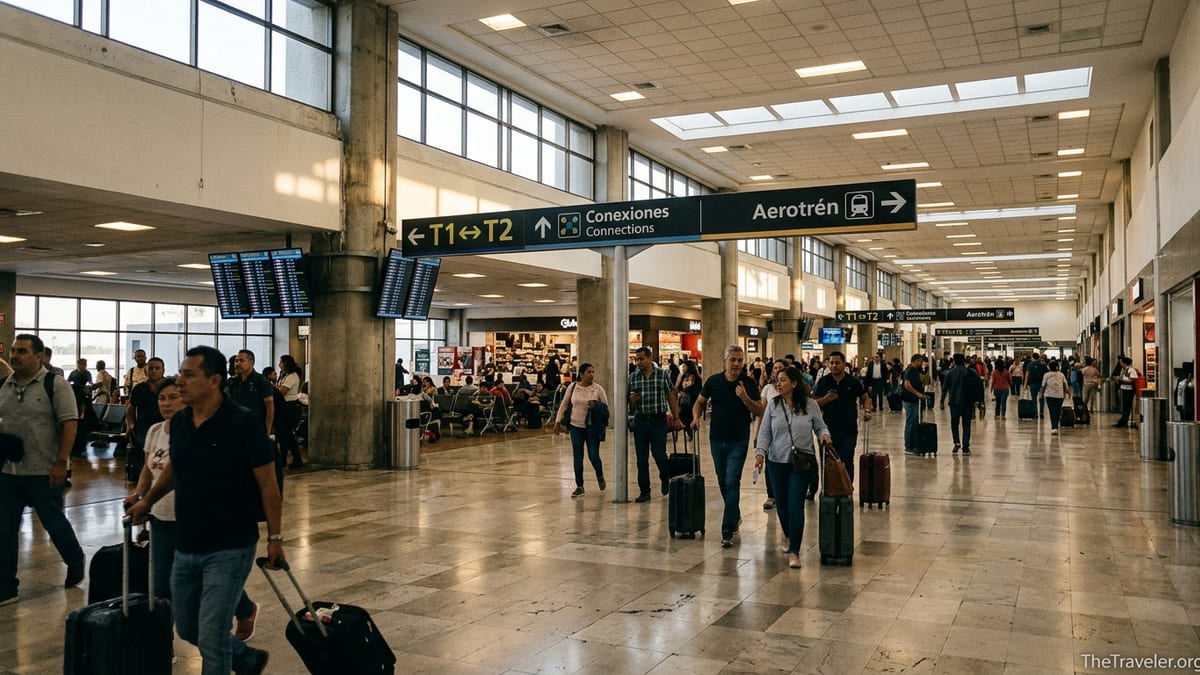
Understanding Terminals 1 and 2 at Mexico City Airport
MEX has two separate terminals: Terminal 1, the older and larger building used by a mix of Mexican and international carriers, and Terminal 2, the newer, more compact terminal that functions as the primary hub for Aeroméxico and many SkyTeam partners such as Delta and Air France. You cannot walk airside between the terminals. Any terminal change requires going landside, which adds time and a second security check.
In practice, most Aeroméxico domestic and international flights use Terminal 2, while many low-cost Mexican airlines and several foreign carriers use Terminal 1. For example, a traveler flying Viva Aerobus from Tijuana to Mexico City will typically arrive in Terminal 1, but if their onward long-haul flight to Madrid is on Aeroméxico, it will depart from Terminal 2. That means a terminal change, a key detail that is easy to miss when you book tickets through online travel agencies.
Both terminals are currently undergoing phased renovations ahead of the 2026 World Cup, with upgraded flooring, lighting, restrooms, baggage carousels, and additional security cameras. This work aims to improve passenger flow but can also mean temporary construction zones, rerouted walkways, and occasional crowding at peak times. Travelers connecting at busy periods like weekday mornings or Sunday evenings should assume slower movement and longer queues than what the airline’s schedule suggests.
Because the terminals operate independently, services such as lounges, restaurants, and duty-free shops are not interchangeable once you pass security. If your long layover is in Terminal 1 but your airline departs from Terminal 2, you cannot simply walk to a more appealing lounge airside. Your terminal assignment determines where you will spend most of your connection time, so knowing in advance which terminal each flight uses is crucial.
How the Aerotrén Works and Who Can Use It
The Aerotrén is a dedicated people mover linking Terminal 1 and Terminal 2. The ride itself is short, roughly six minutes, and trains run frequently during the day. It is designed to keep connecting passengers within the secure airport environment as much as possible, rather than sending them out to public transportation or taxis just to change terminals.
However, the Aerotrén is not a general airport shuttle for anyone who happens to be in the building. Access is restricted to passengers with a same-day, same-airport flight itinerary, typically checked in and holding a boarding pass for a departing flight in the other terminal. Staff at the Aerotrén entrance routinely ask to see your boarding pass and sometimes your passport. For example, a passenger arriving into T2 on an Aeroméxico domestic flight and connecting to a Delta long-haul flight out of T1 the same afternoon can usually ride the Aerotrén for free after clearing immigration and customs if applicable.
If you do not qualify for the Aerotrén, or if it is closed for overnight maintenance, the backup option is the landside terminal transfer by authorized taxis or app-based rides. In light traffic, this drive can take 10 to 15 minutes; in rush-hour or during severe congestion it may take 25 to 40 minutes from curb to curb. A typical airport taxi fare between terminals is modest by international standards, often comparable to a short city ride, but it adds complexity and potential delay when your connection time is tight.
Because you must clear security again after reaching the new terminal, the Aerotrén’s short ride time can be misleading. Travelers regularly underestimate the time it takes to walk from their arrival gate to the Aerotrén station, wait for the next train, ride to the other terminal, exit, and then navigate security and boarding in the new terminal. Building at least 45 minutes from “door of first terminal” to “gate-ready in second terminal” is more realistic than assuming the six-minute ride is the entire transfer.
Bags, Customs, and Immigration: What Actually Happens
How your baggage is handled at MEX depends largely on whether Mexico City is your first point of entry into Mexico and whether your flights are on one ticket. If you are arriving from abroad and Mexico City is your first stop in the country, you must clear Mexican immigration and customs here, even if your final destination is somewhere else. That usually means collecting your checked bags from the carousel, passing them through customs screening, and then either dropping them at a transfer belt or fully re-checking them at your airline’s counter.
For instance, a traveler flying Los Angeles to Mexico City to Cancún on a single Aeroméxico ticket will typically present their passport and immigration form on arrival at MEX, then collect their suitcase, walk through customs, and deposit the bag at the dedicated transfer conveyor just beyond customs. After that, they head back upstairs to security and proceed to the departure gate for the domestic flight. They do not have to go out to the public arrivals hall to re-check bags, but they still handle their luggage briefly at MEX.
By contrast, if you are transiting internationally with no domestic Mexican segment, such as New York to Mexico City to Bogotá on one ticket with the same airline, your checked bags are often tagged through to the final destination and you may not need to claim them in Mexico City. You still pass Mexican immigration and transit security, but your suitcase remains in the system and is moved by the airline. This pattern is common for same-airline connections on Aeroméxico or SkyTeam partners, although policies can vary by route and recent security requirements.
Self-connecting passengers need to be especially cautious. If you book two separate tickets, say Houston to Mexico City on United arriving into Terminal 1 and a separate low-cost ticket onward to Oaxaca from Terminal 2, you will almost certainly have to enter Mexico, collect your bags, exit into the public area, check in again with the second airline, and clear security a second time. In this scenario, the airline operating the second flight has no obligation to wait if your first flight is late, and your bags will not be interlined automatically, even if you ask at check-in.
Immigration Rules and Transit Visas in Mexico
Mexico does not operate a fully sterile international transit system in the way some Asian or European hubs do. Foreign nationals whose citizenship normally requires a visa to enter Mexico typically also need a visa even if they are only connecting through a Mexican airport. In practice, that means you must be legally admissible to Mexico in order to make an airside connection at MEX, regardless of whether you plan to leave the airport.
For many travelers from the United States, Canada, most of Western Europe, and several other countries, a separate Mexican visa is not required for short visits or transits, and entry is granted passport-on-arrival subject to immigration inspection. These passengers usually fill out an electronic or paper entry form if requested and receive permission to stay for a specified period. They may then proceed through immigration and re-clear security for their onward flight.
Travelers from countries that do require a Mexican visa should verify requirements well before travel. Airline agents at your departure airport are instructed to deny boarding to passengers who lack required Mexican visas, even if those passengers insist they will “just be in transit” at MEX. A common real-world example is a passenger flying from South America to Canada via Mexico City on a combination of separate tickets who is refused boarding because they lack a Mexican transit or visitor visa, despite having a valid Canadian visa.
Even visa-exempt travelers should account for variable processing times at immigration. At peak hours, especially early mornings when multiple long-haul flights arrive from Europe and overnight flights from South America, immigration queues can stretch to 30 to 60 minutes or more. At quieter midday windows, some passengers clear in under 15 minutes. This fluctuation is a major reason why a legal minimum connection time might be 90 minutes, yet many frequent travelers still aim for two to three hours when clearing immigration at MEX.
Minimum Connection Times: Published Numbers vs Reality
Airlines and scheduling systems publish official minimum connection times, known as MCTs, which represent the shortest connection they are allowed to sell on a single ticket at a given airport. For Mexico City, typical MCT values are around 45 to 60 minutes for domestic-to-domestic connections within the same terminal, and 90 to 120 minutes for international connections or terminal changes. These figures can differ slightly between carriers and are periodically updated.
On paper, this means that an Aeroméxico itinerary from Guadalajara to Mexico City to New York with a 65-minute layover in Terminal 2 may be perfectly valid as far as the system is concerned. In real life, that same itinerary can feel uncomfortably tight if your inbound flight is delayed, you park at a remote stand requiring a bus ride to the terminal, or security lines are unusually long. Regular travelers at MEX report that it is not uncommon for a checked bag to be the last one off the belt, adding 20 to 30 minutes alone to the process.
A more conservative approach treats the published MCT as the absolute minimum safety net, not the target. For domestic-to-international connections within Terminal 2, many experienced passengers now aim for at least 90 minutes and are happier with 2 hours, especially during busy seasons such as Christmas or Easter. For international-to-domestic connections where you must clear immigration, collect bags, pass customs, then re-check and possibly change terminals, 2.5 to 3 hours is often recommended if you want a margin for delays.
Self-connecting travelers should be even more cautious. If your first flight is on a separate ticket and you miss your onward flight at MEX, the second airline is under no obligation to rebook you for free. That risk changes the calculation. A traveler flying Dallas to Mexico City on an American Airlines ticket and then a separately booked Viva Aerobus flight to Mérida might decide that 4 to 5 hours at MEX is a reasonable buffer, especially if they are traveling with checked baggage and must change terminals.
Realistic Layover Scenarios and Timing
Consider a straightforward domestic-to-international connection within Terminal 2, such as Monterrey to Mexico City to Paris on Aeroméxico. If your domestic flight arrives on time at 15:00 and the international flight boards at 16:10, a 70-minute layover is technically valid. In an ideal scenario, you are at the gate for your Paris flight by 15:35 after a short walk and a quick passport check at the departure gate. In a less ideal scenario, your Monterrey flight parks at a remote stand, the bus transfer takes 15 minutes, and the Paris flight boards early; you might find yourself jogging through the terminal with no time to buy food or visit a lounge.
Now take a more complex international-to-domestic scenario, like Madrid to Mexico City on Iberia arriving into Terminal 1 at 17:00, and a separate 19:00 low-cost flight to Puerto Escondido from Terminal 2. After landing, you may spend 15 to 30 minutes taxiing and deplaning, another 20 to 40 minutes in immigration, and up to 30 minutes waiting for bags. Customs inspection can be quick or involve a secondary screening. At that point, it is entirely possible that it is already 18:30, with only 30 minutes remaining before the Puerto Escondido flight’s check-in cutoff. You would then need to cross to Terminal 2, find the check-in desk, drop bags, and clear security. This is why many travelers build at least 4 hours into such self-connection plans.
For terminal-to-terminal transfers using the Aerotrén, timing can also expand quickly. Imagine you arrive from Chicago in Terminal 2 at 10:00 and have a 12:00 departure on a partner airline from Terminal 1. After immigration and baggage claim, you follow signs to the Aerotrén, wait 5 to 10 minutes for the next train, ride 6 minutes, and then walk to your new check-in area or departure gate. With security and a brief stop for food, that 2-hour layover can feel comfortable but not luxurious. If any piece of the chain is slower than expected, your buffer shrinks rapidly.
Conversely, if all flights are on time, you travel carry-on only, and you remain within the same terminal, even a 75-minute layover can be painless. A common example is a business traveler flying Tijuana to Mexico City to Bogotá with no checked bags, both flights on Aeroméxico out of Terminal 2. In this case, they simply walk from one gate to the next and pass through outbound immigration at the international departure gate area. They may still prefer a longer layover, but the risk of misconnecting is significantly lower than in scenarios involving bags, immigration, and a terminal change.
Making the Most of Longer Layovers at MEX
Not all Mexico City layovers are tight. Many itineraries, especially to and from secondary cities or on mixed-carrier tickets, generate layovers of 4 to 8 hours or more. While MEX is crowded and occasionally chaotic, a long layover can be manageable and even relatively comfortable if you plan ahead and stay flexible about which terminal you will be in.
Both terminals offer a mix of Mexican and international chain restaurants, coffee shops, and bars, along with duty-free stores in the international zones. Prices are moderate by major-airport standards. Travelers commonly report paying the equivalent of a mid-range city restaurant price for a sit-down meal or slightly more than city-center prices for coffee and snacks. For those who value quiet, airline lounges in both terminals can be worth the cost of access during a long layover, providing more comfortable seating, Wi-Fi, and light food and drinks.
For passengers with heavy bags and a desire to explore the city or simply walk unencumbered around the terminals, luggage storage services are available in both Terminal 1 and Terminal 2 public areas. Pricing is typically per bag per 24-hour period, with smaller hand luggage costing less and larger suitcases more. Using storage can make a long layover far more pleasant, especially if you are considering a short excursion to nearby neighborhoods or hotels between flights.
That said, leaving the airport on a layover requires a cautious read of both time and risk. Traffic into central Mexico City can be extremely heavy, particularly in weekday rush hours and during major events. A 5-hour layover in theory might only allow a quick meal in a nearby district rather than a full sightseeing tour of the historic center. Always build in generous time to return to the airport, re-clear security, and reach your gate, and be mindful that returning to a different terminal than you departed adds another layer of complexity.
The Takeaway
Connecting at Mexico City International Airport is far from impossible, but it demands more forethought than many travelers expect. The split between Terminal 1 and Terminal 2, combined with Mexico’s immigration rules and the practical realities of baggage claim, customs, and security, means that a “legal” connection can still feel very tight in real life.
As a rule of thumb, treat published minimum connection times as the floor, not your target. Aim for at least 90 minutes for straightforward domestic-to-international connections in the same terminal and 2 to 3 hours or more when immigration, baggage claim, customs, and terminal changes are involved. If you are self-connecting on separate tickets, add at least another hour or two.
Know your terminals, confirm whether your bags are checked through, and understand whether you need a visa to transit Mexico before you fly. When in doubt, buy a longer layover, especially if rebooking would be expensive or missing a connection would disrupt an important trip. With realistic expectations and generous timing, Mexico City can function as an efficient bridge between regions rather than a stress test between flights.
FAQ
Q1: Is 1 hour enough for a domestic-to-international connection at Mexico City Airport?
For a same-terminal, same-ticket connection with no checked bags, 1 hour can work in ideal conditions, but many travelers prefer at least 90 minutes for a more comfortable margin.
Q2: Do I have to collect my checked bags in Mexico City on an international connection?
If Mexico City is your first point of entry into Mexico and you have a domestic onward flight, you almost always collect your bags, clear customs, and then drop them on a transfer belt before re-clearing security.
Q3: Can I stay airside when changing from Terminal 1 to Terminal 2?
No. Even when using the Aerotrén, you effectively leave the secure departure area, and you will need to clear security again in the second terminal before boarding your next flight.
Q4: Who can use the Aerotrén between terminals?
The Aerotrén is reserved for passengers with same-day flight itineraries and valid boarding passes; staff at the entrance typically check your documents before allowing access.
Q5: Do I need a visa if I am only transiting through Mexico City Airport?
Nationals who require a Mexican visa for entry usually need one even for transit. Visa-exempt travelers typically do not, but all passengers must pass through immigration checks.
Q6: How long should I allow for an international-to-domestic connection at MEX?
Allow at least 2 to 3 hours if you need to clear immigration, collect bags, pass customs, and possibly change terminals. More time is advisable during peak travel periods.
Q7: Is it safe to book separate tickets with a short layover in Mexico City?
Separate tickets carry higher risk because the second airline has no obligation to rebook you if you miss your flight. For self-connections, many travelers build in 4 hours or more.
Q8: Are there luggage storage facilities at Mexico City Airport during a long layover?
Yes. Both Terminal 1 and Terminal 2 have luggage storage services in the public areas where you can leave bags for a fee, typically charged per bag per 24 hours.
Q9: What happens if my incoming flight is delayed and I miss my connection at MEX?
If both flights are on one ticket, your airline will normally rebook you on the next available flight. On separate tickets, you may need to buy a new ticket at your own cost.
Q10: Is leaving the airport during a long layover in Mexico City a good idea?
It can be, but only with a generous buffer. Traffic can be heavy, and you must return in time to clear security and reach your gate, especially if you need to change terminals.