


For budget conscious travelers landing in Mexico City, the Metrobús Line 4 is one of the most convenient and affordable ways to reach the Historic Center and Reforma from the airport. It is not always well explained by airlines or hotels, and many first time visitors either miss it entirely or use it in a stressful, confusing way. This guide walks you through exactly how to ride Line 4 from Mexico City International Airport, what it costs, where to board at Terminal 1 and Terminal 2, how tickets and luggage work, and the most common mistakes tourists make on this route.
Get the latest updates straight to your inbox!
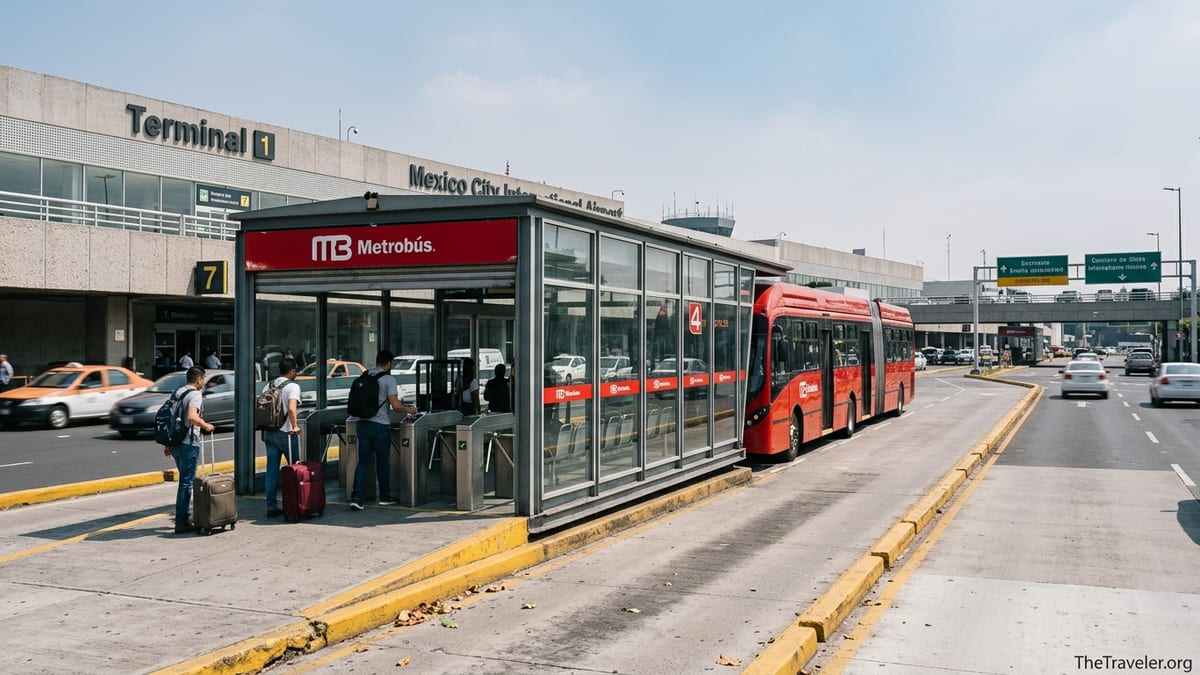
How Metrobús Line 4 Works From Mexico City Airport
Metrobús is Mexico City’s bus rapid transit system, running in dedicated lanes with station platforms and prepaid access. Line 4 is the route that connects Mexico City International Airport (AICM) with the Historic Center, Reforma corridor and bus hub at San Lázaro. It is designed as a practical airport link for people with luggage, with specific airport buses featuring luggage racks and more space near the doors.
Unlike regular city buses, you do not pay cash on board. You enter through fare gates at the station using the city’s Integrated Mobility card or a bank card, then board through level platforms. For airport passengers, this means you can move suitcases directly from the terminal sidewalk into the Metrobús station without climbing steep steps or negotiating tight doorways, something that makes Line 4 more comfortable than the regular Metro for people with rolling bags.
Line 4 has two main branches in the central area: one serving the Centro Histórico and one continuing along Paseo de la Reforma. Both stop at the key airport stations for Terminal 1 and Terminal 2, then weave through downtown before looping back. In practice, this means that from either terminal you can ride directly to places like San Lázaro, República de Uruguay and Bellas Artes for the Historic Center, or to stops like Reforma and Hamburgo for the Zona Rosa and hotel area.
The airport segment of Line 4 has a special fare of about 30 Mexican pesos per ride, higher than the standard Metrobús fare of around 6 pesos. That extra amount reflects the longer route and more spacious, luggage friendly buses. It is still far cheaper than official taxis, which typically start around several hundred pesos to downtown depending on company and traffic.
Finding the Metrobús at Terminal 1 and Terminal 2
At Terminal 1 the Metrobús stop is outside Gate 7 on the arrivals level. When you exit customs, follow the signs for “Transporte Público” and look for the red Metrobús logo. You will walk along the sidewalk past the taxi booths and airport hotel counters until you see a fenced station structure in the central road island. There are ticket machines and turnstiles before the elevated platform. If you reach the end of the terminal toward Gate 9 without seeing the station, you have likely walked too far and should backtrack a short distance.
At Terminal 2 the Metrobús stop is located near Gate 2, again on the arrivals side. After customs, follow the flow of arriving passengers and exit toward the main road. The Metrobús station is in the median, clearly marked but somewhat hidden behind other transport services. Many travelers report that ride share and hotel representatives cluster near the doors, so you may need to walk a little further along the sidewalk to spot the red Metrobús sign and the glass walled platform area in the center of the roadway.
In both terminals you do not board the bus directly from the curb. You must enter through the Metrobús station structure in the middle of the road. Cross at the designated pedestrian crossing, then use the ticket machines or contactless payment at the gate to access the platform. Security staff are usually present, and airport police are nearby, which provides an extra level of reassurance for first time visitors arriving late at night or early in the morning.
The service to and from the airport typically operates from around 4:30 in the morning until midnight on most days. In practice, buses are frequent in daytime, often every 8 to 12 minutes, and slightly less frequent late at night. If you land after midnight, you may find the station gates closed and will need to switch to taxis or ride hailing. Travelers with very early flights, for example a 6:00 a.m. departure, can often still catch Metrobús to the airport if they board downtown around 4:30 to 5:00 a.m.
Tickets, Cards and Paying the Airport Fare
The airport segment of Metrobús Line 4 uses the same Integrated Mobility card as the rest of the system, but charges a higher fare when you tap in at the airport stations. The standard citywide Metrobús fare is around 6 pesos per ride, while the airport section is set at roughly 30 pesos. The card itself costs an additional small amount to purchase the first time, usually in the range of 20 to 25 pesos, plus whatever balance you choose to load.
At both Terminal 1 and Terminal 2 you will find ticket machines inside the Metrobús station area. These sell the Integrated Mobility card and allow you to top up using cash. Many tourists buy a card at the airport for about 20 pesos then immediately add 100 to 150 pesos of credit, which is usually enough for several airport rides plus multiple city trips on Metrobús or the Metro during a short stay. The machines generally accept Mexican banknotes and coins, though they can occasionally be out of order or run short on change.
In recent years, Mexico City has rolled out contactless bank card and smartphone payments on Metrobús. On Line 4 this usually lets you tap a compatible credit or debit card directly on the reader at the station gate without buying a separate transit card. For example, a traveler from the United States arriving with a Visa or Mastercard that supports contactless payments might simply hold the card to the reader, wait for the green light and then push through the gate. The system charges the airport fare directly to the bank card. However, there are occasional glitches with foreign cards, and some visitors prefer the Integrated Mobility card so they are not making multiple small international transactions.
One practical example: a couple landing at Terminal 2 from a New York flight at 9:00 p.m. could walk to Gate 2, cross into the Metrobús station, buy one Integrated Mobility card for about 20 pesos, then load 120 pesos in cash. They would tap the card once for each of the two passengers, paying around 30 pesos each for Line 4 to the Historic Center, and still have approximately 60 pesos left on the card for later trips on Metrobús or the Metro during the next day or two.
Route Options: Historic Center, Reforma and Beyond
From the airport, Metrobús Line 4 offers a surprisingly comprehensive set of destinations for visitors. The most popular for tourists is the branch heading into the Historic Center. Buses on this branch display placards or electronic signs for key downtown stops such as San Lázaro, Teatro Blanquita or República de Uruguay. If you are staying near the Zócalo, Alameda Central or Bellas Artes, this is usually the right bus. Upon boarding, you can confirm with the driver by mentioning a central stop name and saying “Centro Histórico.” Drivers are used to answering quick questions from visitors and will typically nod or give a simple confirmation.
The Reforma branch of Line 4 is ideal for travelers staying in the Zona Rosa, Juárez or near the Angel of Independence monument. Buses on this branch often indicate “Reforma” on their front display. From the airport, they will pass through sections of the Historic Center before continuing along Paseo de la Reforma to stops like Hamburgo, Paris or La Palma. Many mid range and upscale hotels, including several international chains, are within a short walk of these Metrobús stations.
Line 4 also connects the airport with San Lázaro, one of the city’s major intercity bus terminals and Metro transfer points. This is very useful if you are connecting directly from an international flight to a bus toward Puebla, Veracruz or Oaxaca. In practice, many travelers ride Metrobús from Terminal 1 or 2 to San Lázaro, then walk a short distance into the TAPO bus terminal to catch their onward bus. The cost is a fraction of what an airport taxi might charge for the same connection, and journey times are often similar during busy hours thanks to Metrobús lanes.
It is important to check the direction of the bus before boarding at the airport. Line 4 runs in a loop, so some buses may be heading toward the airport rather than away from it. At Terminal 1 and Terminal 2, platforms are usually divided clearly between inbound and outbound. Look at the destination sign on the bus and the platform indicators. If you are unsure, ask staff, security or other passengers by saying, for example, “¿Este va al Centro Histórico?” Most locals are happy to point you to the right vehicle.
Luggage, Comfort and Safety on Line 4
The airport buses on Metrobús Line 4 are equipped with luggage racks or open standing zones where people can store suitcases and backpacks during the ride. You can roll your suitcase on board from the level platform without lifting it up high. As a practical example, a traveler with a 23 kilogram checked bag and a carry on roller can usually manage both alone, sliding the larger suitcase into the rack near the front and keeping the smaller bag close by.
At busy times, particularly weekday rush hours between roughly 7:00 a.m. and 9:00 a.m. and again around 5:00 p.m. to 8:00 p.m., the buses can become crowded and luggage space fills quickly. In those periods you may find yourself standing with your suitcase rather than placing it neatly in a rack. If you are arriving with very bulky sports equipment or multiple large suitcases, consider whether a taxi or ride share might be more comfortable, especially if you are arriving during the evening rush when commuters pack into Line 4.
In terms of safety, Metrobús Line 4 is generally considered one of the safer and more orderly public transport options in Mexico City. The route is entirely above ground, well lit, and the airport segment is closely monitored. That said, standard big city precautions apply. Keep your backpack zipped, do not display large amounts of cash or your passport unnecessarily, and keep a hand on your suitcase handle in crowded moments. Many travelers use a small crossbody bag worn in front and keep their main documents there while letting their larger suitcase rest in the rack.
One advantage of Metrobús compared with the Metro is that you do not have to carry luggage up and down multiple flights of stairs or through tight, underground corridors. The walk from the terminal doors to the stations is fully at street level. Travelers who have tried both frequently report that, while the Metro is cheaper, Line 4 Metrobús is significantly less stressful when hauling baggage after a long flight.
Common Tourist Mistakes and How to Avoid Them
One of the most frequent mistakes visitors make is looking for a cash fare on board the bus. On Metrobús, drivers do not handle money. Tourists sometimes walk directly up to the platform and try to board through the bus doors with coins in hand, only to be waved back by staff. To avoid this, always remember that you must pay at the station gates using an Integrated Mobility card or a contactless bank card before accessing the platform.
Another common error is buying multiple cards unnecessarily. A small group of two or three people can usually share a single Integrated Mobility card by tapping it once per person in quick succession at the gate, with the system deducting one airport fare for each tap. Many first time visitors assume each person needs their own card and spend extra money on plastic they do not need. Unless you specifically want separate cards, for example to keep track of expenses, you can save money and reduce waste by sharing one.
Visitors also regularly board the wrong branch or direction of Line 4. For example, someone staying near the Zócalo might accidentally get on a Reforma branch bus heading away from downtown, adding unnecessary time to the journey. You can prevent this by checking the final destination sign on the front of the bus and confirming the route name. If your hotel is in the Historic Center, look for buses that list central stops rather than Reforma. When in doubt, quickly confirm with the driver or station staff before boarding.
A subtler mistake is underestimating travel time during peak traffic. While Metrobús has dedicated lanes in many sections, it still runs on city streets and can be slowed by congestion at intersections. In normal conditions, the ride from the airport to the Historic Center takes roughly 40 to 60 minutes. Late at night it can be closer to 30 minutes, but in heavy afternoon traffic it may take longer. If you are heading to the airport for a flight, give yourself extra time, especially on weekday evenings when traffic toward the airport can be intense.
Comparing Line 4 With Other Airport Transport Options
When deciding whether to use Metrobús Line 4, it helps to compare it with other airport transport choices. Official airport taxis and authorized ride share pick ups are straightforward but considerably more expensive. For a typical journey from Terminal 1 to a mid range hotel in the Historic Center, a regulated taxi might cost several hundred pesos depending on distance and time of day. Ride hail services may be somewhat cheaper, but still several times the cost of the 30 peso Metrobús fare.
The Metro offers the lowest fare, with a flat price of around 5 pesos per ride when using the Integrated Mobility card. From Terminal 1, the Terminal Aérea station on Metro Line 5 is a short walk from the terminal doors. However, the Metro involves stairs, crowded platforms, narrow trains and often multiple transfers to reach central hotels. During peak hours it can be uncomfortably packed, and large suitcases are discouraged. Many experienced travelers use the Metro when carrying only a backpack, but opt for Line 4 Metrobús when carrying rolling luggage or arriving after a long international flight.
Airport shuttles arranged by hotels provide another option. Several chain hotels in the Historic Center and Reforma areas offer pre booked vans that meet guests at the arrival doors. These are convenient but can be slow if you have to wait for other passengers or if the shuttle makes multiple stops. Costs vary widely, but they are usually much higher than Metrobús. For solo travelers and couples comfortable with public transport, Line 4 often strikes the best balance between price, comfort and predictability.
For example, a solo traveler arriving on a midday flight and staying near Bellas Artes might choose Metrobús Line 4 for around 30 pesos and walk a few minutes from the closest station to the hotel. A family of four with several large bags, arriving late at night and staying in a residential neighborhood far from any Metrobús stop, might instead prefer a taxi or ride hail service for door to door convenience despite the higher cost.
The Takeaway
Metrobús Line 4 is one of Mexico City’s most useful tools for travelers landing at the international airport. It connects both Terminal 1 and Terminal 2 directly to the Historic Center, Reforma corridor and major transport hubs like San Lázaro at a fraction of taxi prices, with buses specifically configured for airport passengers and luggage. Once you understand where to find the stations at Gate 7 in Terminal 1 and Gate 2 in Terminal 2, buying or using an Integrated Mobility card, and choosing the correct branch, the journey becomes straightforward.
For many visitors, the key advantages are cost savings, relatively predictable travel times and the ability to start using Mexico City’s public transport network immediately upon arrival. By avoiding common mistakes such as looking for cash fares on the bus, buying unnecessary extra cards, or boarding the wrong branch, you can step off your flight and be in the heart of the city in under an hour for a price that leaves more of your budget for street food, museums and day trips.
Whether you are a backpacker heading to a hostel in Centro Histórico, a business traveler staying near Reforma, or a seasoned visitor connecting to long distance buses at San Lázaro, Metrobús Line 4 is worth considering as your default airport transfer. With a bit of preparation and an eye on the station signs, it can turn what might have been an expensive taxi ride into an easy, everyday local experience.
FAQ
Q1. How much does Metrobús Line 4 from the airport to downtown cost?
The airport section of Metrobús Line 4 costs about 30 Mexican pesos per person for a one way trip from either terminal to downtown or Reforma.
Q2. Do I need a special card to ride Line 4 from the airport?
You can pay with the city’s Integrated Mobility card, which you can buy and top up at machines inside the airport Metrobús stations, or use a compatible contactless bank card.
Q3. Can two people share one Integrated Mobility card on Metrobús?
Yes. One card can be tapped multiple times at the gate in quick succession, once for each person in your group, as long as it has enough balance.
Q4. Where exactly is the Metrobús stop at Terminal 1?
At Terminal 1 the Metrobús Line 4 station is located outside Gate 7 on the arrivals level, in the central road island reached by a marked pedestrian crossing.
Q5. Where do I find Metrobús Line 4 at Terminal 2?
At Terminal 2 the station is near Gate 2 on the arrivals side. Exit the terminal, walk along the sidewalk and cross to the glass walled station in the median.
Q6. Is Metrobús Line 4 safe to use with luggage?
Line 4 is generally considered safe and is monitored around the airport. Use normal big city precautions and keep bags close, especially during busy times.
Q7. How long does the trip from the airport to the Historic Center take?
In typical traffic the journey from either terminal to the Historic Center takes roughly 40 to 60 minutes, sometimes less late at night and longer at rush hour.
Q8. Does Metrobús Line 4 run all night from the airport?
No. Service normally runs from early morning until around midnight. If you arrive much later or earlier, you will likely need a taxi or ride hail instead.
Q9. Can I use the same card on the Metro and other Metrobús lines?
Yes. The Integrated Mobility card works on the Metro and all Metrobús lines, so one card can cover most of your transport in Mexico City.
Q10. What if the ticket machines at the airport station are not working?
If machines are out of order, look for staff in the station, try another machine, or use a contactless bank card at the gate if available and functioning.