


Mexico City’s Metro is famously cheap and fast, and on paper it looks like an easy win for getting into town from the airport. In reality, using the Metro from Mexico City International Airport (AICM) is a very specific tool: brilliant in some situations, uncomfortable or risky in others. This guide explains exactly when the Metro at Terminal Aérea makes sense, when to avoid it, and why so many visitors end up choosing Metrobus Line 4 or a taxi instead.
Get the latest updates straight to your inbox!
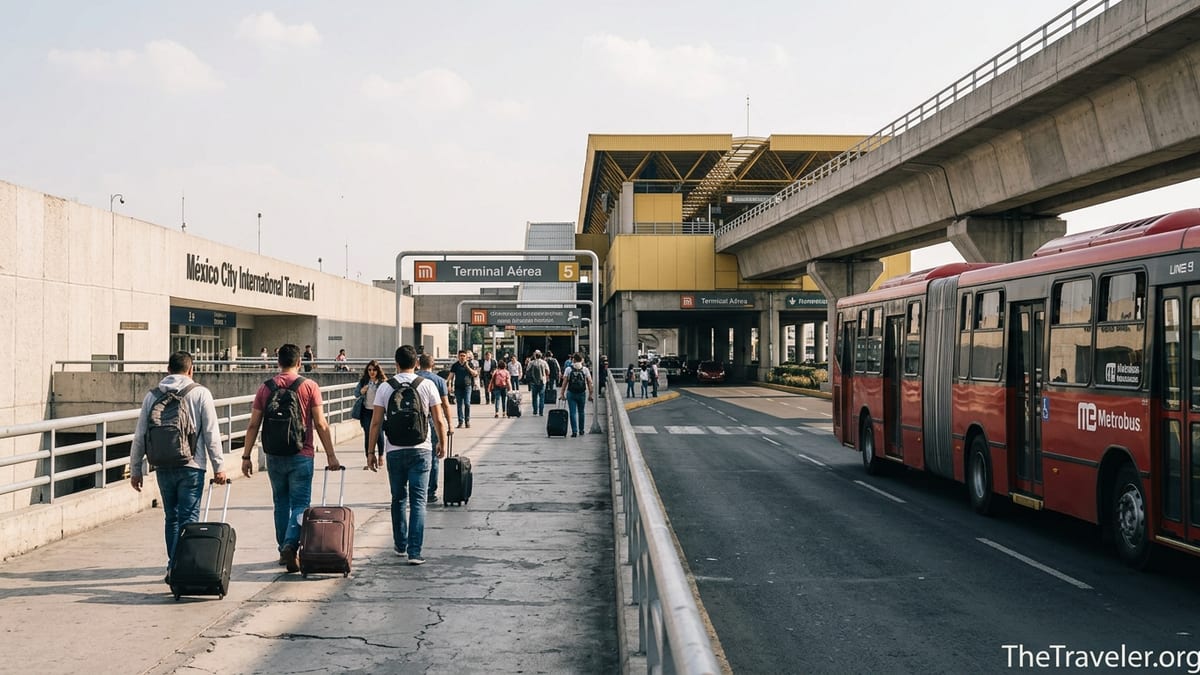
Metro From the Airport: The Basics
Mexico City International Airport sits on the east side of the city, with Terminal 1 directly connected to the Metro network via Terminal Aérea station on Line 5, the yellow line running between Pantitlán and Politécnico. The walk from the arrivals hall in Terminal 1 to the station is short by airport standards, usually around 5 to 10 minutes following overhead signs for “Metro” and “Terminal Aérea.” Travelers arriving at Terminal 2 can reach the Metro by taking the free internal Aerotrén shuttle to Terminal 1, or by using airport buses that drop you near the Terminal 1 access road and then walking to the station.
The Metro is part of the city’s integrated public transport system and is designed for daily commuters more than for travelers with luggage. Regular Metro fares are very low by international standards, and even after several rounds of adjustments, a single ride with transfers within the system typically costs only a small number of pesos per person, paid with the rechargeable Mobility Integrated (MI) card or, on some lines, a paper ticket. For budget travelers, that kind of pricing is extremely attractive compared to taxis or ride‑hails, which commonly range from a few hundred to well over a thousand pesos depending on distance and traffic.
Most first‑time visitors are surprised by how busy Line 5 can be during commuting hours and how local in feel. Unlike airport rail links in some European or Asian cities, this is not a dedicated airport train. The majority of riders are city residents going to work or school in neighborhoods like Oceanía, Aragón, and Azcapotzalco rather than tourists heading to Roma Norte or Condesa. That means the service is frequent and efficient, but everything from signage to station layouts is optimized for short urban trips, not rolling suitcases.
In practice, the Metro is best thought of as a powerful but blunt instrument. Used at the right time of day, with light baggage and a clear route, it can get you from the airport to an inner‑city station near your hotel in 30 to 45 minutes for a fraction of the cost of a car. Used at the wrong time, it can mean fighting your way onto crowded trains, managing multiple staircases with bags, and standing shoulder‑to‑shoulder with commuters while trying not to lose sight of your luggage.
When the Metro Makes Sense From AICM
The Metro is most useful when you are traveling very light, arriving or departing outside of rush hour, and staying near a station on a relatively simple route from Line 5. A classic example is a solo traveler landing at 11 a.m. in Terminal 1 with a single backpack and heading to a hotel in the historic center. From Terminal Aérea, that person can ride Line 5 a couple of stops to Oceanía or Pantitlán and then transfer toward the center on lines like 1 or 9, arriving near stations such as Pino Suárez, Isabel la Católica, or Balderas for a short walk or a quick taxi hop to the hotel.
Schedules can change, but Line 5 generally runs from early morning into the late night, roughly from around 5 a.m. on weekdays and slightly later on Sundays, until close to midnight. If you land around midday, immigration lines are reasonable, and you clear customs with just carry‑on, you can realistically be on a train by early afternoon, well clear of the heaviest commuter peaks. In those conditions, trains are still busy but not as intensely crowded as at 8 a.m. or 6 p.m., and it is easier to keep a bit of personal space.
Budget‑conscious long‑stay travelers also sometimes use the Metro from the airport to get a sense of the system and their neighborhood. Someone coming to study for a semester in the north of the city, for example, might ride Line 5 to Politécnico and then walk or take a short bus or taxi to student housing nearby. Others use the Metro as part of a hybrid strategy: taking a taxi or Metrobus to a major interchange like San Lázaro or Buenavista and then jumping on the Metro for the rest of the journey once they are away from the airport crowds.
A final situation where the Metro can make good sense is on your way back to the airport in the middle of the day with very light luggage and no tight schedule. If you are staying near a line that connects efficiently to Line 5, you might ride into Terminal Aérea well ahead of time, allowing for at least an hour of travel plus a comfortable buffer. Using the Metro outbound to the airport can be less stressful than using it inbound, because you are already familiar with the system and do not have to orient yourself after a long flight.
When to Avoid the Metro: Rush Hours, Luggage and Fatigue
There are also clear scenarios where using the Metro from the airport is simply not worth the savings. The biggest red flag is peak rush hour, roughly 7 a.m. to 9:30 a.m. and again around 5 p.m. to 8 p.m. on weekdays. During those windows, Line 5 and many of the transfer lines become extremely crowded. Trains arrive packed, platforms fill quickly, and it can take several trains before you find space to board, even without luggage. Adding suitcases to that mix is difficult both for you and for commuters around you.
Luggage is a second major factor. Mexico City’s Metro trains and stations are not set up with large suitcases in mind. There are no dedicated luggage racks, and space near the doors is usually occupied by standing passengers, vendors, or people boarding and exiting with backpacks and shopping bags. Escalators are present in some stations but not reliably at every transfer, and elevators can be out of service or hard to locate. If you are traveling with a large checked suitcase plus a carry‑on, you should assume multiple flights of stairs, tight turning spaces and narrow corridors where you must lift or drag your bag while keeping an eye on your belongings.
Travel fatigue matters too. Arriving after a long overnight flight, especially from Europe or Asia, many travelers underestimate how disorienting the combination of altitude, crowds, noise and unfamiliar signage can be. Navigating several line changes while jet‑lagged, hungrier than you realized, and still thinking in another time zone can make a cheap Metro ride feel much more stressful than it looked on the map the night before. In these circumstances, a door‑to‑door taxi, an authorized airport car or the more straightforward Metrobus Line 4 can be a better choice, even for budget travelers.
Finally, late‑night arrivals and departures require extra caution. While the Metro typically runs until close to midnight, frequencies drop in the late evening, some station entrances close earlier, and platforms can feel more isolated. If your airline has delays and you find yourself leaving the arrivals hall after 10 or 11 p.m., using the Metro from the airport means an almost empty station at the far eastern edge of the city plus several changes in less‑busy parts of the network. Many residents and frequent visitors in that situation choose a licensed taxi, app‑based ride, or staying on Metrobus Line 4 for as long as possible rather than relying on the Metro.
Terminal Aérea Station: Layout, Quirks and Nearby Options
Terminal Aérea is not inside the terminal building but across the airport access road, parallel to Terminal 1. From the arrivals level, you typically follow signs out to a pedestrian walkway and cross under or over the main vehicle lanes to reach the station entrance. The station itself is elevated, with platforms above street level and ticketing or card turnstiles on the concourse level. While signage is generally clear, it is almost entirely in Spanish, so it is worth familiarizing yourself with key words like “Andén” (platform) and “Dirección” followed by the terminus name (Pantitlán or Politécnico).
Once you tap in and reach the platform, you will notice that there are no special facilities for airport users. There is no extra baggage space, no separate airport fare zone, and no staffed tourist office. You are simply in a regular city station that happens to be next to the country’s busiest airport. During peak hours, locals will line up informally where the train doors are expected to be, and crowds can swell quickly as trains arrive. At quieter times, you might find enough room to stand with a backpack near the middle of the car or sit if you are traveling only a few stops.
Just outside Terminal Aérea station and the airport perimeter, there are also bus and microbus routes as well as taxi stands that serve nearby neighborhoods. Some long‑distance intercity buses leave from within the airport complex, taking passengers to other state capitals or satellite cities. Travelers on tight budgets sometimes combine these options, riding an intercity coach from their home state directly into the airport and then using the Metro only for the final few kilometers if they are staying in an eastern suburb. For most international visitors, however, the Metro, Metrobus Line 4 and licensed airport taxis are the main tools in play.
The presence of Terminal Aérea on Line 5 also means you can use it as a reference point later in your trip. If you are exploring the city and find yourself on Line 5 at Hangares, Oceanía, Aragón or another nearby stop, you will know that the airport terminal is only a few minutes away by train. This can be helpful for day trips or meetings near the airport, or if you decide partway through your stay to move to a hotel close to Terminal 1 for an early‑morning departure.
Safety and Pickpocketing: What Travelers Really Experience
Mexico City’s Metro is heavily used by locals of all backgrounds, including families, students and office workers, and for most riders it is a routine, uneventful part of daily life. Violent incidents involving tourists on the system are relatively rare compared to the sheer number of trips taken. That said, petty theft such as pickpocketing, distraction scams and opportunistic bag opening can occur, especially in crowded areas, and tired or overloaded travelers arriving from the airport can be easy targets if they are distracted.
The main risk is typically not dramatic crime but losing track of your possessions in the crush of crowds. On a packed train from Terminal Aérea to Pantitlán, for example, you may find yourself unable to see both your backpack and your wheelie bag at the same time. Doors open and close quickly, a street musician squeezes through with a speaker, someone presses past you to get off at the next station, and attention shifts for just a moment. In that time, zippers can be quietly opened, or a smaller bag set on the floor can be nudged away toward another passenger.
To reduce risk, experienced Metro users apply the same commonsense tactics they would in any large urban system. They keep all valuables in a money belt under clothing or in a small crossbody bag worn on the front of the body, with zippers closed and one hand lightly resting on the bag in crowded spaces. They avoid placing phones or wallets in back pockets, keep backpacks in front on their chest when standing in a crush of passengers and try to stand where they can see both their luggage and the train doors. Couples often divide responsibilities, with one person focused on reading signage and counting stations while the other keeps a close eye on bags.
Perception and comfort also matter. Some visitors feel uneasy with the noise levels, street vendors and sheer density of the Metro, especially if they are unused to large Latin American cities. If you are already anxious about safety in Mexico City, forcing yourself onto a packed rush‑hour train from the airport just to save money may not be the right choice for your first ride. In those cases, it can be smarter to use Metrobus Line 4 or a registered taxi on arrival, then experiment with the Metro later during daytime for short, low‑stakes trips once you have adjusted to the city.
Why Many Tourists Choose Metrobus Line 4 or Taxis Instead
Despite the Metro’s rock‑bottom fares, a significant share of visitors now opt for Metrobus Line 4 or authorized airport taxis when traveling between the airport and central neighborhoods. Metrobus Line 4 runs articulated buses between the airport terminals and key points such as San Lázaro, the historic center, and Paseo de la Reforma. The airport portion of the route carries a higher fare than regular segments and is paid with the same contactless card used across the city’s integrated transport system. For this premium, you get level boarding, luggage racks on the buses and a route designed with airport travelers in mind.
In practical terms, Metrobus Line 4 removes many of the pain points that make the Metro awkward for new arrivals. There are no underground station mazes to navigate, only surface‑level stops with clear signage. You roll your suitcase directly onto the bus, slide it into a rack and keep your hand luggage with you. You do not have to worry about multiple transfers or counting stations while tired, because the bus either takes you all the way to the historic center or to a single straightforward interchange like San Lázaro. For someone landing in the early afternoon and heading to a hotel near Alameda Central, the Metrobus ride can be a one‑seat journey of under an hour.
Taxis and app‑based rides also continue to be popular. Licensed airport taxi booths inside the terminal offer fixed‑price rides to zones across the city, which can be reassuring if you are unfamiliar with local pricing. App‑based services add the comfort of seeing the fare estimate beforehand and tracking your route on your phone. Prices fluctuate with demand, but even a more expensive ride can feel worth it after a ten‑hour flight or if you are traveling with older relatives or young children. Many travelers arriving late at night or very early in the morning consider the extra cost a reasonable trade‑off for a direct, monitored journey to their hotel door.
The choice between Metro, Metrobus and taxi often comes down to how much complexity you are willing to tolerate to save money. If riding Metrobus Line 4 to the historic center costs several times more than the Metro but still less than a private car, many visitors see it as a middle ground: significantly cheaper than a taxi, yet much easier with bags and jet lag. Those staying in neighborhoods not directly served by Line 4, such as Condesa or Roma Sur, sometimes ride Metrobus as far as a central hub like República de Uruguay or Hamburgo, then switch to a short taxi or app ride from there, blending budget and comfort.
Practical Route Examples for Common Neighborhoods
To see how this plays out in real life, it helps to walk through a few sample journeys. Suppose you land at Terminal 1 around noon with only a backpack and you are staying in a guesthouse near Zócalo in the historic center. You might choose Metrobus Line 4 from the airport to a stop near the central square, then walk five to ten minutes to your accommodation. The fare is higher than the Metro but still low compared with a taxi, and your only navigation task is getting off at the correct stop. If you insisted on using the Metro instead, you would likely ride Line 5 to Pantitlán and then Line 1 or Line 9 toward the center, making at least one transfer underground.
Now imagine you are a couple arriving in the late afternoon with two large checked bags and two smaller carry‑ons, heading to an apartment in Roma Norte. Using the Metro from Terminal Aérea would mean heavy luggage on Line 5 followed by one or two further lines, with multiple flights of stairs. In this scenario, many seasoned travelers would take Metrobus Line 4 toward the city center and either connect to another corridor or transfer to a taxi from a central stop such as Reforma. Others might skip public transport on arrival entirely and book a licensed airport taxi to their building, especially if it is close to major avenues like Avenida Álvaro Obregón or Avenida Insurgentes.
For budget backpackers traveling to the north of the city, the calculus can tilt back toward the Metro. A traveler staying near Politécnico or La Raza, for instance, may find that Line 5 from Terminal Aérea with a single transfer drops them within walking distance of a hostel or homestay. If they travel with one mid‑size backpack and arrive outside peak times, the low fare and reasonably direct route can outweigh the inconvenience. The key is knowing exactly where you are staying and which lines you need before you board at Terminal Aérea, so you are not trying to figure it out while wedged between commuters.
Finally, consider a traveler on a tight layover who wants to see a bit of the city center and then return to the airport. Metrobus Line 4 is again often the most practical choice because it links both airport terminals with the historic center without multiple transfers. The traveler can ride into town, walk around Alameda Central or the Zócalo for a couple of hours and then catch the same line back, budgeting plenty of time for security and boarding. While using the Metro in both directions would be cheaper, the extra line changes introduce more variables and can eat into precious time on a short stopover.
The Takeaway
Mexico City’s Metro is an impressive piece of urban infrastructure and, for many residents, the backbone of daily mobility. For airport travelers, however, it is a specialized tool that shines only under certain conditions. If you travel light, arrive outside rush hours, feel comfortable in busy urban systems and your accommodation lies near a straightforward route from Line 5, then riding from Terminal Aérea can be a smart, ultra‑budget move. In those circumstances, the Metro’s speed and low fare give you more money and time to spend on the city itself.
For everyone else, the comfort and clarity offered by Metrobus Line 4 and licensed taxis or app‑based rides make them the default choices. The airport Metrobus service is designed with luggage and visitors in mind, with clear routes to the historic center and Reforma, while taxis offer the simplicity of a direct trip to your door at any hour. If you are new to Mexico City, consider using one of these options on arrival, then explore the Metro later during the day when you are rested and better oriented. Treat the Metro as part of your experience of the city, rather than a test of endurance immediately after your flight, and it will likely feel like an asset rather than an obstacle.
FAQ
Q1. Is it safe to take the Metro from Mexico City airport during the day?
During daytime and early evening, many people use the Metro without problems, including from Terminal Aérea. The main concern is pickpocketing in crowded cars, so keep valuables in a secure front‑worn bag, stay aware of your surroundings and avoid taking out your phone or wallet near train doors.
Q2. How much money can I really save by using the Metro instead of Metrobus or a taxi?
The Metro usually costs only a small fraction of what a taxi or app‑based ride does, and the airport supplement on Metrobus Line 4 also makes that service more expensive than a standard Metro trip. In absolute terms, however, the difference is often the cost of a simple meal or two, so many travelers weigh the small savings against the extra effort of transfers and handling luggage.
Q3. Can I use the same transport card on the Metro, Metrobus and other systems?
Yes, Mexico City’s integrated mobility system uses a rechargeable contactless card that works on the Metro, Metrobus and several other modes. You can buy or top up this card at machines in many stations, including near the airport. Having one card loaded with a modest balance makes transfers between systems smoother and avoids dealing with individual paper tickets.
Q4. What if I arrive late at night, close to Metro closing time?
If your flight lands late and you are likely to reach the public area of the terminal after 10 or 11 p.m., the Metro may not be the best option. Frequencies drop and some station entrances close earlier, which can leave you with longer waits or unexpected walking. In these circumstances, most visitors are better off taking Metrobus Line 4 if it is still running frequently, or using an authorized airport taxi or app‑based ride for a direct trip to their accommodation.
Q5. Is it realistic to use the Metro with large suitcases?
It is technically allowed to bring large suitcases on the Metro, but it is rarely comfortable. There are limited elevators, staircases at many transfers, no dedicated baggage spaces and often dense crowds. If you have one large checked bag plus a smaller carry‑on, most travelers find Metrobus Line 4 or a taxi far more manageable, especially if they are unfamiliar with the city.
Q6. How do I get to popular neighborhoods like Roma or Condesa using public transport from the airport?
A common approach is to take Metrobus Line 4 from the airport to a central stop near Paseo de la Reforma, then transfer to another bus corridor or take a short taxi ride into Roma or Condesa. While it is possible to reach these neighborhoods entirely by Metro from Terminal Aérea, it usually requires at least one or two changes and handling luggage in busy transfer stations, which many visitors prefer to avoid.
Q7. Are weekends a better time to use the Metro from the airport?
Weekend daytime services are often less intensely crowded than weekday rush hours, which can make riding from Terminal Aérea more comfortable. However, major events, demonstrations, football matches or concerts can still cause crowded conditions on certain lines, and late‑night services may feel quieter and more isolated. It is still wise to avoid traveling with bulky luggage at the very start or end of service.
Q8. Can I combine Metro and taxi or ride‑hail to keep costs down?
Yes, many budget‑minded travelers do exactly that. For instance, you might take Metrobus Line 4 or the Metro to a busy, central area such as the historic center, Buenavista or San Lázaro, then switch to a short taxi or app‑based ride for the final stretch. This hybrid strategy reduces the fare compared with a door‑to‑door car while minimizing the amount of time you and your luggage spend on the Metro.
Q9. How much time should I allow if I use the Metro to catch a flight?
It is wise to be conservative. From central neighborhoods, allow at least an hour for Metro travel to Terminal Aérea, plus whatever time your airline recommends for check‑in and security, especially for international flights. Delays, crowded platforms or temporary service changes can add unexpected minutes, and giving yourself a generous buffer is far cheaper than missing a flight.
Q10. Should first‑time visitors to Mexico City use the Metro from the airport at all?
There is no single rule, but many first‑time visitors feel more comfortable using Metrobus Line 4 or a licensed taxi on arrival, then trying the Metro later in the trip. Once you have slept, learned a few words of Spanish, and had time to study a map, taking the Metro for shorter trips between sightseeing areas can be an enjoyable way to experience local life without the pressure of navigating multiple lines immediately after a long journey.