


Mexico City International Airport (MEX) can be confusing at first glance. There are only two terminals, but they sit on opposite sides of the runways, handle both domestic and international flights, and are linked by a train and buses that are not always intuitive to use. This guide breaks down Terminal 1 vs Terminal 2 in clear, practical terms so you know exactly where you need to go, how to move between terminals, and how much time to allow for real-world connections.
Get the latest updates straight to your inbox!
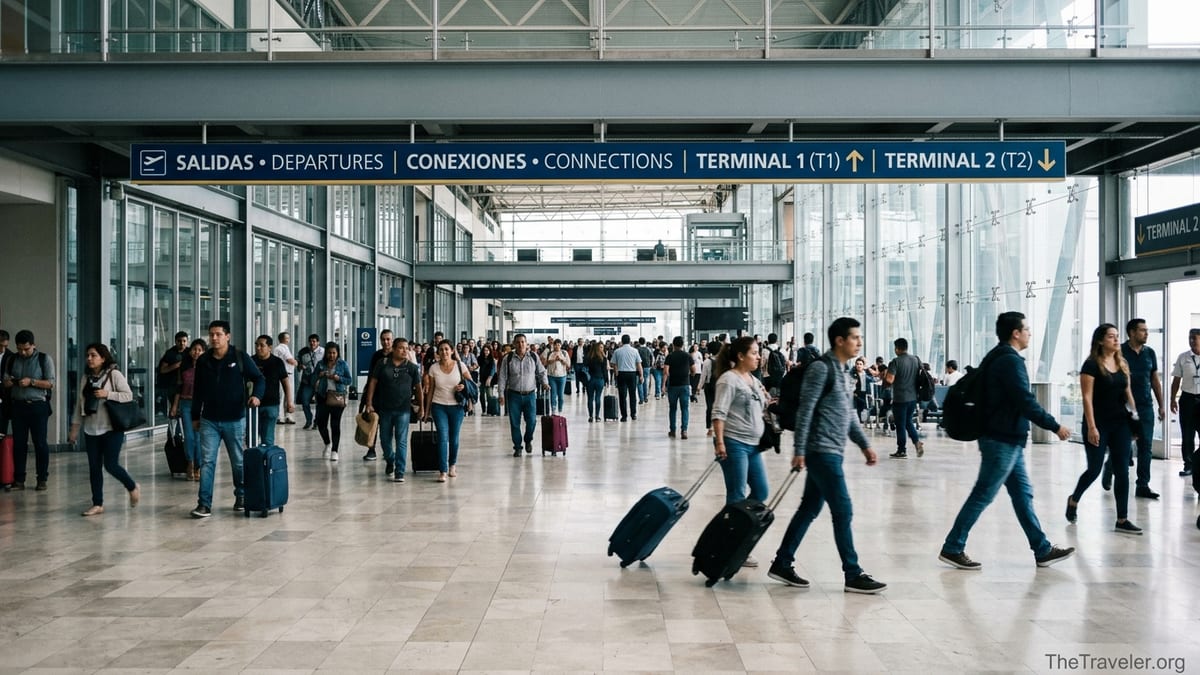
Mexico City Airport in a Nutshell
Mexico City International Airport, officially Aeropuerto Internacional Benito Juárez, has two passenger terminals: Terminal 1 and Terminal 2. Both handle domestic and international flights, and both are busy almost all day. Terminal 1 is the original, much larger building and hosts the majority of airlines and flights. Terminal 2 is newer, more compact, and functions primarily as the hub for Aeroméxico and its partners.
Physically, the two terminals face each other across the main runways, roughly 3 kilometers apart by road. You cannot walk between them. Transfers rely on the Aerotrén automated train for eligible passengers or interterminal buses and taxis on the public roads. In practice, that separation means that “which terminal you need” matters for everything from check in and baggage claim to how tight you can safely schedule a connection.
For context, the airport handles tens of millions of passengers a year, and it often feels like it. At peak times such as weekday mornings and Sunday evenings, both terminals can be crowded, with long lines at check in and security, and heavy road traffic approaching the airport. Building realistic time buffers into your plans is more important here than at many smaller airports.
Most travelers will interact with only one terminal on a given trip, but itineraries that mix Aeroméxico with foreign airlines or separate tickets often force a terminal change. Knowing in advance how MEX is laid out, and how the terminals differ, can turn a stressful sprint into a manageable connection.
Terminal 1 vs Terminal 2: Airline and Flight Differences
The simplest way to decide which terminal you need is to look at your airline. In broad terms, Aeroméxico and most SkyTeam partner flights use Terminal 2, while most other airlines, including low cost Mexican carriers and many major foreign airlines, use Terminal 1. There are occasional exceptions and seasonal changes, so always confirm on your booking or boarding pass, but this rule of thumb holds for the majority of flights.
Terminal 2 is home base for Aeroméxico, including most of its domestic network (for example, Mexico City to Cancún, Guadalajara, Monterrey, Oaxaca, Mérida) and many international routes, such as flights to Los Angeles, New York, Madrid or Bogotá. Delta codeshare flights sold under a Delta number but operated by Aeroméxico also typically use Terminal 2, as do some other SkyTeam partners operating jointly with Aeroméxico.
Terminal 1, by contrast, hosts most other airlines. Mexican low cost carriers such as Volaris and Viva Aerobus use Terminal 1 for their domestic and international routes. Major US carriers such as American Airlines and United Airlines, and many European and Latin American airlines including Iberia, Lufthansa and others, also operate from Terminal 1. That means a common pattern is arriving on an American or United flight from the United States into Terminal 1 and then connecting to an Aeroméxico domestic flight in Terminal 2, or vice versa.
Both terminals handle a mix of domestic and international flights. For example, Volaris flies domestic routes like Tijuana and Monterrey as well as international routes to US cities from Terminal 1, while Aeroméxico flies both short hops to León or Veracruz and long haul routes to Europe from Terminal 2. You cannot assume “domestic equals Terminal 1” or “international equals Terminal 2.” Always check the terminal based on the operating airline printed on your itinerary.
What to Expect in Each Terminal: Layout, Services and Atmosphere
Terminal 1 is the older, sprawling side of the airport. It has long concourses, a large central check in hall divided by airline groups, and a wide range of shops and services. Because it hosts many airlines and low cost carriers, it often feels more chaotic. Walking distances can be substantial: it can easily take 15 to 20 minutes to walk from a distant international gate to immigration or from one end of the concourse to another, especially at peak times.
Terminal 2 is more compact and modern. Most Aeroméxico flights, domestic and international, use a pair of main concourse areas that branch from a central security zone. While it can also be crowded at rush hours, passengers generally report slightly shorter walking distances and a more coherent layout. For example, a domestic arrival from Cancún might park at a gate just a 5 to 10 minute walk from the central departure area for an onward flight to Los Angeles.
Both terminals offer lounges, duty free shopping and food options ranging from fast food chains to sit down restaurants. In Terminal 1 you will find several international airline lounges and bank or card lounges clustered near the international gates, while Terminal 2 features Aeroméxico’s own lounges and partner spaces. In either terminal, plan on airport level pricing: a basic coffee may cost roughly double what you would pay in central Mexico City and a simple sit down meal can easily run the equivalent of 15 to 25 US dollars per person.
On the ground side, each terminal has separate road access, taxi ranks, app ride pickup areas and long distance bus counters. Long distance buses to destinations like Puebla, Querétaro or Pachuca depart from both terminals, which can be useful if your layover is long enough for an overnight or side trip. However, because the two terminals use different access roads, a taxi between them on the public streets can take 15 to 30 minutes in heavy traffic, even though they are close as the crow flies.
Domestic vs International Flows and Baggage Claim
At MEX, the terminal you use for arrivals and departures is driven by the operating airline rather than whether your flight is domestic or international. Both terminals have separate immigration and customs areas for international arrivals and separate security filters for domestic and international departures. For passengers, the main difference is what happens to your checked baggage during connections.
If Mexico City is your final destination, the process is straightforward. On a domestic arrival, you disembark and follow the “Baggage claim / Salida” signs to the domestic baggage hall in your terminal. Bags can take time to appear; reports of 20 to 30 minutes from arriving at the carousel to seeing the first bags are common, especially at busy times. On an international arrival, you follow signs for immigration, clear passport control, then collect your bags at baggage claim and clear customs before exiting into the public arrivals hall.
If you are connecting on a single ticket, bag handling depends on your route. On many international to domestic itineraries booked on one airline, for example Delta to Aeroméxico via MEX on a single reservation, your bags are tagged through to your final domestic destination. In that case, you still collect them after immigration in Mexico City to clear customs, but then you immediately drop them at a transfer belt or recheck counter just past customs instead of hauling them upstairs to check in again. For domestic to international or international to international connections on one ticket with the same airline group, bags are usually checked through and do not need to be collected in MEX.
Self connecting passengers on separate tickets should plan for more work. If you arrive on one airline and depart on another under a separate booking, you will typically need to collect your checked baggage at baggage claim, exit into arrivals, walk to the departure check in area of your next airline, recheck your bags and clear security again. If your flights are in different terminals, that also means transferring between terminals with luggage. For example, flying Viva Aerobus from Monterrey to Mexico City (Terminal 1) and then a separately booked Aeroméxico flight from Mexico City to Lima (Terminal 2) usually requires you to claim your luggage in Terminal 1, take the interterminal train or bus, and check in again in Terminal 2.
Moving Between Terminals: Aerotrén and Interterminal Buses
The main link between Terminal 1 and Terminal 2 is the Aerotrén, an elevated automated people mover that runs on a dedicated track across the airport. The ride itself only takes around 5 minutes, but you need to allow extra time for walking to and from the stations and for the waiting time between trains. Schedules can vary, but airport guidance suggests trains roughly every 10 to 15 minutes during operating hours, so a realistic door to door transfer time by Aerotrén is closer to 20 to 30 minutes.
The Aerotrén is located landside but within the airport secure perimeter, typically accessible from the check in level of each terminal. To use it, you must normally show a same day boarding pass or proof of travel, which is why it is especially convenient for passengers with through tickets or onward flights confirmed out of the other terminal. For example, if you arrive on United in Terminal 1 and are continuing on Aeroméxico from Terminal 2 on the same day, you can exit customs in Terminal 1, walk to the Aerotrén station with your boarding pass for the Aeroméxico flight, ride across, and then proceed to check in or security in Terminal 2.
For passengers who do not qualify for the Aerotrén or arrive outside its hours, there are also free interterminal shuttle buses that run on the public road system. These generally operate from the curbside outside each terminal. The ride can be 10 to 20 minutes depending on traffic, and you will need to factor in the wait time at the curb as well. In practice, travelers often report that the total time from arriving at baggage claim in one terminal, collecting bags, waiting for the shuttle, driving across and then checking in at the other terminal can easily reach 45 minutes to an hour during busy periods.
Taxis and app ride services are another fallback option. A licensed airport taxi between terminals is usually more than you would want to pay just to cross the airport, but it can be useful if you have large amounts of luggage or mobility issues and the shuttle line is long. Because traffic around MEX can back up at rush hour, the time advantage of a taxi over the shuttle is not always significant, but the comfort and direct drop off can make a difference if you are on a tight schedule.
Connection Timing: How Much Is Enough at MEX?
Official minimum connection times at Mexico City Airport are often in the range of about 45 minutes for domestic to domestic and around 2 hours for international to domestic, depending on the airline and booking. Airlines do sell legal connections at or near these thresholds, particularly for all Aeroméxico itineraries within Terminal 2, but passengers regularly describe them as stressful in real life, especially when there are delays or long lines.
For same terminal domestic to domestic connections on a single ticket, many experienced travelers aim for at least 60 to 75 minutes. For example, connecting from an Aeroméxico flight from Guadalajara into Terminal 2 to another Aeroméxico flight to Oaxaca in the same terminal is often manageable with about an hour, as long as the inbound flight is on time and you are traveling with carry on only. If you have checked bags and need to collect and recheck them due to a self transfer, adding at least another 30 minutes is sensible.
For connections involving immigration, customs or a terminal change, it is safer to budget more. International to domestic transfers, such as arriving from Los Angeles in Terminal 2 and continuing to Mérida in Terminal 2 on Aeroméxico, typically work well with 2 to 3 hours: one hour for passport control and customs in busy periods, plus time to recheck any bags and clear security. If you must change terminals on a self connection, for example from a US airline in Terminal 1 to an Aeroméxico flight in Terminal 2, many travelers are more comfortable with 3 hours or more, especially during morning and evening peaks.
At the tightest extreme, some itineraries sell domestic to international connections across terminals in as little as 90 minutes. These may be technically possible if everything runs smoothly and you are familiar with the airport, but they leave little margin for slow baggage delivery or queues. For a first time visitor, a more conservative approach is best: think in terms of at least 2 hours for same terminal international connections and closer to 3 hours when a terminal change is involved or when flying on separate tickets that require you to recheck bags manually.
Real-World Scenarios: Which Terminal Do You Need?
To make the differences more concrete, it helps to look at common itineraries. Imagine you are flying from Chicago to Mexico City on American Airlines, then connecting to a Viva Aerobus flight to Cancún that you booked separately. American operates from Terminal 1, and Viva Aerobus also uses Terminal 1, so you will arrive and depart from the same terminal. You will still need to clear immigration, collect your bags and clear customs in Mexico City, but after that you can walk directly from arrivals in Terminal 1 to the Viva Aerobus check in counters in the same building without using the Aerotrén.
In a different scenario, you might fly Delta from Atlanta to Mexico City and then connect to an Aeroméxico flight to Oaxaca on the same ticket. Delta’s flight is often operated by Aeroméxico and uses Terminal 2, and the onward Aeroméxico domestic flight also uses Terminal 2. In many cases, your bags are tagged through to Oaxaca. After landing in Mexico City, you disembark, clear immigration, pick up your checked bag to walk it through customs, then drop it at the transfer belt just outside customs and head back upstairs to security. With around 2 hours between flights, most passengers find this connection workable.
The most complicated cases involve self connections that cross terminals. For instance, flying Volaris from Tijuana to Mexico City (Terminal 1) and then switching to an Aeroméxico flight to Madrid (Terminal 2) on a separate ticket requires more steps. After arriving at Terminal 1, you collect your checked baggage, exit into arrivals, follow signs to the Aerotrén or shuttle bus, transfer to Terminal 2, then locate the Aeroméxico check in desks, recheck your bags and clear security for your international flight. If your layover is only around 2 hours, any delay on the inbound flight or a slow baggage carousel could put your onward flight at risk, which is why many independent travelers try to build in 3 hours or more, or even overnight, for cross terminal self connections.
Finally, some travelers deliberately build long layovers in Mexico City to visit the city center between flights. Because the airport is relatively close to downtown in straight line distance but affected by heavy traffic, reaching central areas like the Zócalo can take 45 minutes to 1.5 hours each way by taxi or ride share, depending on time of day. If your onward flight is out of a different terminal from your arrival, you need to factor in both the city commute and the terminal transfer time when deciding whether a city visit is realistic.
The Takeaway
Mexico City Airport’s two terminal layout is less complicated once you understand the basic division: Terminal 2 is primarily Aeroméxico and partners, Terminal 1 is almost everyone else, and both handle a mix of domestic and international flights. Your operating airline, not the type of flight, determines which terminal you need. That choice influences everything from where you check in and collect bags to which transport links and lounges you can access.
Transferring between terminals is entirely possible, but never instantaneous. The Aerotrén is efficient and free for eligible passengers, yet real door to door transfer times with walking and waiting are closer to 20 to 30 minutes, and the shuttle buses can be slower in heavy traffic. When planning connections, build in generous margins: around an hour for simple same terminal domestic connections on one ticket, about 2 hours for most same terminal international connections, and 2.5 to 3 hours or more when you need to change terminals or recheck bags on separate bookings.
If you remember three practical rules, you will be in good shape at MEX: always double check the terminal listed on your boarding pass, assume baggage claim and queues may be slower than you would like, and treat a cross terminal transfer as a meaningful piece of your itinerary, not an afterthought. With realistic expectations and a bit of extra time, Mexico City’s busy terminals become manageable gateways rather than stressful obstacles.
FAQ
Q1. How do I know if my flight uses Terminal 1 or Terminal 2?
Your terminal is determined by the operating airline printed on your booking or boarding pass. Aeroméxico and most of its SkyTeam partners typically use Terminal 2, while most other airlines, including low cost Mexican carriers and many US and European airlines, use Terminal 1. Always verify the terminal on your ticket or with your airline close to departure, as assignments can occasionally change.
Q2. Can I walk between Terminal 1 and Terminal 2 at Mexico City Airport?
No, you cannot realistically walk between the terminals. They are on opposite sides of the runways with road distance of several kilometers and separated by airport security areas. Transfers must be done using the Aerotrén people mover for eligible passengers, the free interterminal shuttle buses, or a licensed taxi or app based ride service.
Q3. How long does it take to transfer between terminals using the Aerotrén?
The Aerotrén ride itself is about 5 minutes, but you should allow 20 to 30 minutes total. That includes walking from arrivals to the station, waiting for the next train, riding across and then walking from the station to check in or security in the other terminal. During busy times or if you are unfamiliar with the layout, adding extra buffer is wise.
Q4. Is 1 hour enough for a domestic connection in the same terminal?
It can be enough on a single ticket in the same terminal, especially for domestic to domestic connections with carry on luggage only, but it leaves little margin if your inbound flight is delayed. Many regular travelers at MEX prefer 60 to 75 minutes for same terminal domestic connections and avoid very tight itineraries when possible, particularly during morning and evening peaks.
Q5. How much time do I need to connect from an international flight to a domestic flight?
For an international to domestic connection on one ticket in the same terminal, it is sensible to aim for at least 2 hours. That usually covers immigration, customs, any bag recheck and security. If your domestic flight departs from the other terminal, or if you are on separate tickets and must fully recheck bags, treating 2.5 to 3 hours as a safe minimum is more comfortable.
Q6. Do I always have to collect my bags in Mexico City when connecting?
If Mexico City is your first point of entry into Mexico on an international itinerary, you usually collect your checked bags after immigration to clear customs, even if they are tagged through to your final destination. After customs, you either drop them on a transfer belt or recheck them. On purely domestic or international to international connections within the same airline group, bags are often checked through and do not need to be collected in MEX, but you should confirm this when checking in for your first flight.
Q7. What happens if I miss my connection because of a slow terminal transfer?
If all segments are on one ticket and you miss a connection due to delays outside your control, the operating airline is normally responsible for rebooking you on the next available flight, subject to its policies and availability. If you are self connecting on separate tickets, the onward airline usually treats a missed flight as a no show, and any rebooking costs are at your expense. This is why longer buffers are recommended for self transfers, especially when changing terminals.
Q8. Are there lounges in both terminals at Mexico City Airport?
Yes, both Terminal 1 and Terminal 2 have lounges. Terminal 1 hosts lounges operated by various international airlines and financial institutions, while Terminal 2 includes Aeroméxico’s own lounges and partner spaces. Access rules depend on your ticket class, frequent flyer status, or whether you hold an eligible lounge membership or premium credit card.
Q9. Which terminal is better for layovers: Terminal 1 or Terminal 2?
Neither terminal is universally better; it depends on your airline and preferences. Terminal 1 is larger, offers more airlines and a wider variety of shops and restaurants, but can feel more hectic with longer walks. Terminal 2 is more compact and organized around Aeroméxico and its partners, which can make connections smoother if all your flights use that terminal.
Q10. Is it realistic to leave the airport between flights in Mexico City?
It can be, but only with a long layover and careful planning. Road traffic between the airport and central neighborhoods can range from around 45 minutes to well over an hour each way. If you also need to change terminals or recheck bags, you must factor that time in as well. Many travelers consider leaving the airport only when they have at least 6 hours or more between flights, especially if the next leg is international.