


More news on this day
Fresh rounds of flight suspensions and rerouting across the Middle East are fueling new anxiety among international travelers, as renewed security concerns tighten restrictions on some of the world’s busiest long haul corridors just ahead of the peak summer season.
Get the latest news straight to your inbox!
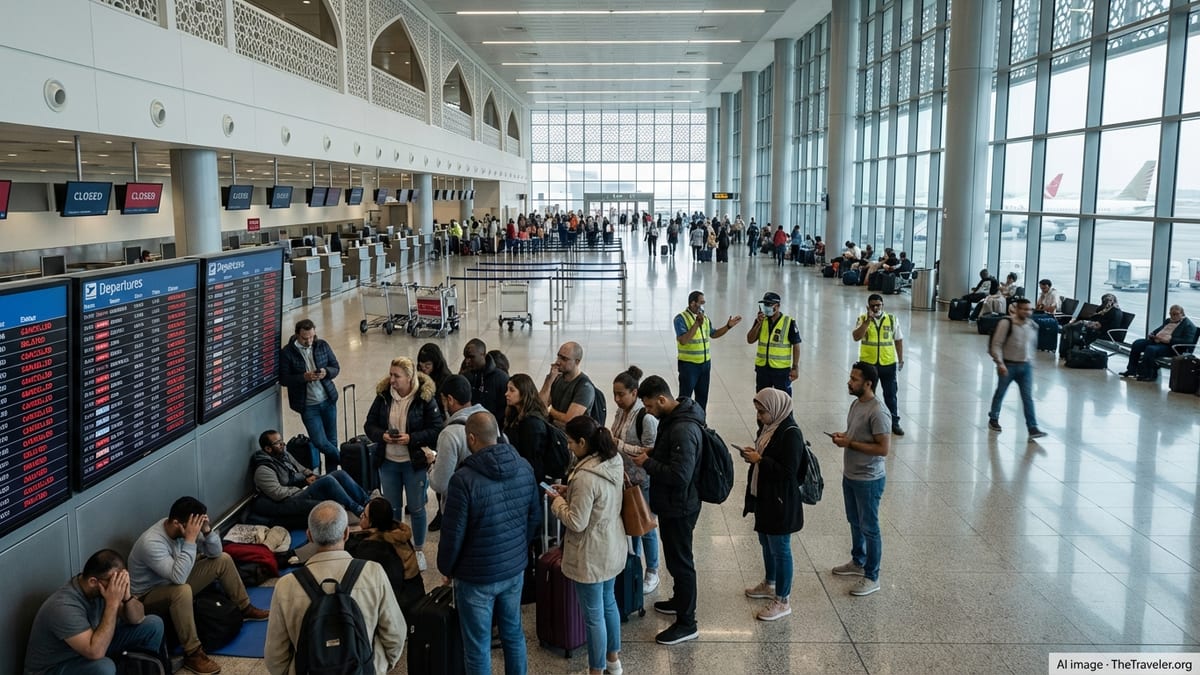
Conflict-Linked Airspace Closures Reshape Key Corridors
Recent conflict-related airspace closures across Iran, Iraq, Israel and several Gulf states have disrupted a core segment of the global aviation map, affecting routes that link Europe with Asia, Africa and Australasia. Publicly available flight-tracking data and news coverage show large swathes of regional skies periodically cleared of civilian traffic following missile and drone activity, forcing airlines to cancel services outright or detour thousands of kilometers around potential conflict zones.
According to published coverage of the late February and early March escalation, Israel, Iran, Iraq, Bahrain, Qatar, Kuwait and Jordan temporarily halted or sharply curtailed civilian flights at various points, leading to near-empty traffic maps over parts of the Gulf and Levant. Hubs such as Dubai, Doha, Abu Dhabi and Tel Aviv experienced waves of cancellations and temporary suspensions, interrupting their role as essential waypoints for passengers traveling between Europe and Asia.
Although some airspace has since reopened on a limited basis, analysis from aviation consultancies indicates that conflict zone risks remain elevated, particularly for overflight at cruising altitudes that were historically considered safer. As a result, many operators are keeping conservative routings in place, accepting longer flight times and higher fuel costs rather than resuming the shortest paths over sensitive areas.
Industry assessments suggest these changes are now reshaping global traffic flows in ways not seen since the peak of the pandemic, with the Middle East’s traditional position as a central bridge between continents temporarily weakened by security-driven flight suspensions.
Major Carriers Extend Suspensions and Reroute Around Hotspots
Airlines across Europe, Asia and North America have responded by extending suspensions to select Middle Eastern destinations and redrawing long haul flight paths. Reports from regional outlets describe Turkish Airlines cancelling services to Lebanon, Syria, Iraq, Iran and Jordan for several days in early March, citing regional airspace closures and the need to continually reassess operational risk.
Coverage from international aviation media shows that carriers such as Emirates, flydubai, Qatar Airways, Lufthansa, Air France–KLM and several Asian airlines have at times paused flights to hubs including Dubai, Doha, Riyadh, Tel Aviv and Beirut, or rerouted services to avoid specific flight information regions. In some cases, routes that once crossed Iran or Iraq have been shifted south over Egypt and the Red Sea, or north via the Caucasus and Central Asia, adding hours to journey times.
European aviation bulletins highlight that some airlines have prolonged suspensions into late spring and early summer for destinations perceived as high risk. Other carriers have opted for partial resumptions with reduced frequencies, daytime-only operations or contingency fuel reserves to handle last minute diversions if airspace is closed with little warning.
Industry data compiled in April suggests that passenger traffic originating in or transiting through the Middle East has fallen sharply compared with 2025 levels, with long haul connectivity particularly affected. Analysts note that the region’s role as a global transfer hub magnifies the impact, since cancellations at one Middle Eastern gateway can ripple across networks in Europe, Asia, Africa and Oceania.
Regulators Tighten Guidance as Travelers Confront Uncertainty
Regulatory bodies have reinforced the cautious approach. Public guidance from the European Union Aviation Safety Agency extends conflict zone advisories for a broad list of Middle Eastern states, recommending that EU-based airlines avoid or severely limit operations over certain territories at any altitude for specified periods. These bulletins, regularly updated as the situation evolves, underline that threats to civil aviation are not confined to low-level approaches and departures.
Regional civil aviation authorities have also imposed temporary closures, altitude caps and tightly defined corridors, sometimes with only hours of notice. Published situation reports describe partial reopenings of airspace over Iraq, Syria, Bahrain, the United Arab Emirates and Qatar under strict routing rules, while some airports that sustained damage during missile and drone strikes continue to operate at reduced capacity.
For travelers, the patchwork of restrictions translates into elevated uncertainty around departures, connections and baggage handling. Passenger-rights summaries circulated by consumer advocates emphasize that while extraordinary security events can limit compensation obligations under some regimes, airlines remain responsible for rerouting or refunding affected customers and for providing assistance when travelers are stranded at airports.
Travel-industry analysts note that the perception of risk, amplified by dramatic maps of empty skies and images of crowded terminals, can deter bookings even on routes and airports that remain fully operational. This sentiment-driven drag on demand adds a further layer of volatility to airline scheduling decisions already constrained by regulatory and insurance considerations.
Longer Routes, Higher Costs and Pressure on Alternate Hubs
The operational impact of avoiding key Middle Eastern airspace is being felt far beyond the region. Reports from aviation research groups indicate that reconfigured Europe–Asia flights are burning significantly more fuel and incurring higher crew and maintenance costs, as airlines stretch aircraft to their range limits or schedule technical refueling stops in secondary hubs.
With traditional Gulf megahubs operating below normal capacity or under intermittent restrictions, traffic has spilled over to airports in Turkey, Egypt, Saudi Arabia and parts of Central Asia and East Africa. These alternative gateways are seeing increased demand for both passenger and cargo services, along with pressure on ground infrastructure and slot availability.
Industry outlook papers published in April and May warn that if tensions and airspace constraints persist, higher operating costs could feed through into fares on many long haul routes, particularly for last minute bookings and premium cabins. Airlines are facing a delicate balance between preserving network connectivity, protecting margins and keeping prices at levels that do not suppress demand.
The freight sector faces similar challenges, with cargo operators reporting detours of four to six hours on some Europe–Asia lanes when the shortest paths over the Gulf and Iran are unavailable. This additional time and fuel burden arrives amid already fragile global supply chains, raising concerns about schedule reliability for high value, time sensitive shipments.
Travelers Weigh Alternatives as Peak Season Approaches
As the Northern Hemisphere summer approaches, individual travelers and corporate travel planners are reassessing itineraries that traditionally relied on Middle Eastern hubs. Travel forums and booking data point to growing interest in routings via Istanbul, major European gateways and East Asian hubs as passengers look to reduce the perceived risk of sudden cancellations and overnight airport closures.
Consumer-facing travel guides now routinely advise passengers to build extra buffer time into long haul connections, monitor airline status pages closely and consider flexible tickets or travel insurance policies that explicitly cover conflict-related disruption. Some travelers are also splitting journeys into separate legs, allowing for route changes at short notice if particular airspace corridors tighten again.
Despite the headwinds, analysts note that demand for intercontinental travel remains robust compared with the pandemic era, suggesting that many travelers are willing to accept longer routes and more complex journeys in exchange for reaching their destinations. However, the latest wave of Middle East flight suspensions is a reminder that geopolitical shocks can still upend carefully planned itineraries, particularly along the strategic corridors linking Europe and Asia.
For now, the outlook for flights through and over the region depends heavily on the trajectory of regional tensions and the willingness of regulators, insurers and airlines to relax restrictions. Until those variables stabilize, travelers on key routes that once seamlessly threaded the Middle East are likely to remain in a heightened state of vigilance, watching their booking screens for the next unexpected cancellation or schedule change.