


More news on this day
Air travel across the Middle East has endured another bruising operational day, with data from flight-tracking and disruption dashboards indicating 1,142 delays and 66 cancellations across major regional hubs, underscoring how fragile aviation networks remain amid ongoing airspace constraints and geopolitical tension.
Get the latest news straight to your inbox!
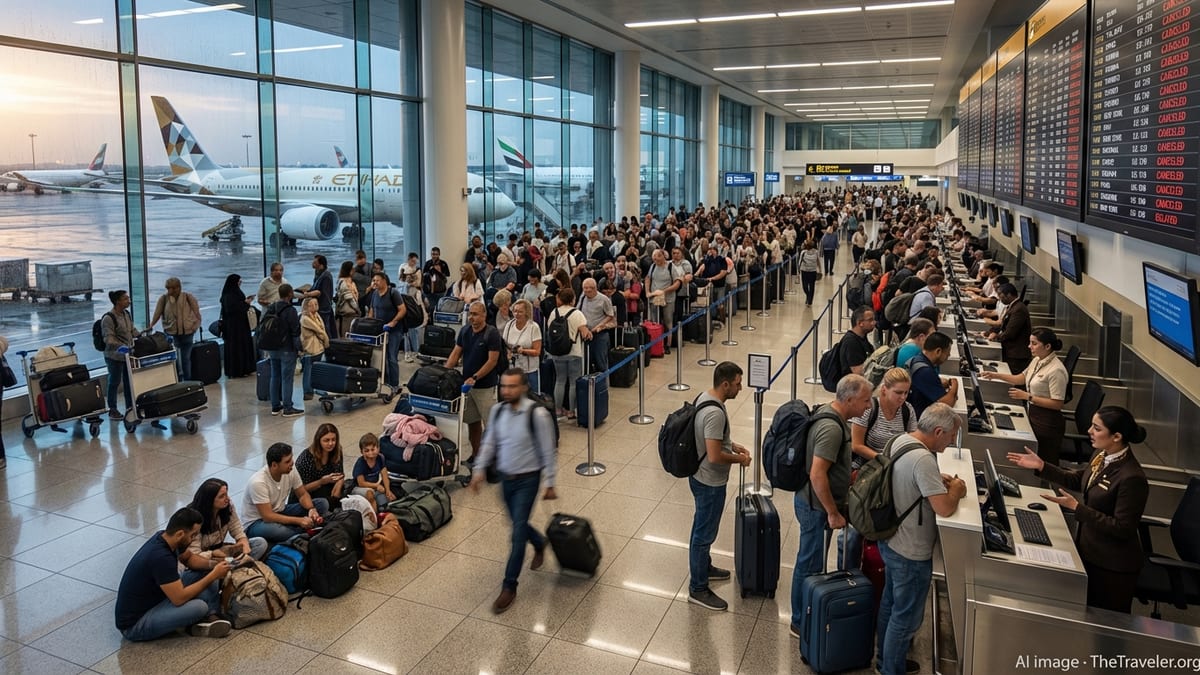
Major Gulf and regional hubs absorb the brunt
Publicly available disruption snapshots point to the largest share of delays clustering around the Gulf’s principal connecting hubs, including Dubai International, Abu Dhabi International, and Doha’s Hamad International Airport. These airports handle a high volume of transfer traffic linking Europe, Asia, and Africa, so any operational strain or rerouting in the wider region rapidly multiplies across their schedules.
Recent analyses of Middle East flight performance show that Dubai alone has, on multiple days, logged several hundred delayed departures and arrivals in a 24-hour window, along with dozens of cancellations, particularly when regional airspace restrictions tighten. One published breakdown cited more than 600 delays and 66 cancellations at Dubai International on a single day, illustrating how quickly disruption can concentrate at one mega-hub when routings are constrained.
Other Gulf gateways such as Abu Dhabi and Doha have also reported elevated delay rates as airlines re-time services, swap aircraft and crews, or add schedule buffers to accommodate longer routings. Even when outright cancellations remain limited at these airports, rolling delays on connecting waves create missed connections and overnight misalignments that ripple across subsequent days.
Beyond the Gulf, major airports in Saudi Arabia, Egypt, Türkiye, and Iraq continue to experience intermittent spikes in disruption. Data compiled in recent weeks highlights Riyadh, Jeddah, Cairo, and Istanbul among the airports where delay counts can swing sharply higher on days when airspace or operational constraints tighten elsewhere in the region.
Airspace closures and conflict-related detours drive longer routes
The elevated delay totals across Middle East airports are closely linked to a patchwork of airspace restrictions that has reshaped key corridors between Europe and Asia. Reports from aviation analytics providers describe closures or heavy constraints over parts of Iran, Iraq, Israel, Jordan, Kuwait, Syria, and neighboring flight information regions, forcing airlines to redesign routings around high-risk zones.
These diversions lengthen sector times on many intercontinental routes, particularly those bridging Western Europe with South and Southeast Asia. Longer flight paths increase fuel burn and compress turnaround windows on the ground, leaving less margin for routine operational hiccups. When knock-on effects accumulate across multiple rotations in a day, the result is a visible build-up of delayed arrivals and departures at regional hubs.
Coverage of the wider aviation impact of the 2026 Iran war highlights how the closure or restriction of critical airspace has affected up to 15 percent of global air traffic by volume, with some Middle East airports temporarily closing and others operating under significant constraint. Even as some restrictions have eased, airlines have largely retained more conservative routings, which continue to add minutes to block times and pressure schedules.
These structural factors mean that even localized triggers, such as short-lived weather disruptions, staffing bottlenecks, or aircraft maintenance issues, can now cascade more quickly into broader network disruption. The 1,142 delays and 66 cancellations recorded across major Middle East airports reflect not only day-specific incidents but also an underlying system under sustained strain.
Impact on airlines and passenger journeys
Regional and global carriers operating across the Middle East have been juggling schedule adjustments, aircraft rotations, and crew planning to mitigate the disruption. Recent published breakdowns of delay and cancellation data from previous waves of disruption show that large network airlines based in the Gulf, along with key regional carriers in Saudi Arabia, Qatar, Egypt, and Türkiye, have all absorbed days with triple-digit delay counts.
These delays translate into extended journey times for passengers, missed connections at hub airports, and in some cases enforced overnight stays when onward flights cannot be rebooked the same day. Reports from traveler forums and passenger-rights platforms describe long queues at transfer desks in Dubai, Doha, Riyadh, and Istanbul when multiple inbound flights arrive behind schedule.
For airlines, the operational and financial implications are significant. Additional fuel costs from longer routings, repositioning aircraft to rebalance networks, and accommodating disrupted passengers in hotels or on alternative flights all add to the cost base. When cancellations spike, lost revenue from high-yield long-haul sectors compounds the pressure.
Published analyses also point to the difficulty of restoring normal patterns quickly once a disruption wave crests. When a hub logs hundreds of delayed movements in a 24-hour period, aircraft and crew increasingly end up out of position, making it harder to re-establish tightly timed banks of connecting flights on subsequent days.
Passenger rights and what travelers can do
The scale of flight disruption across the Middle East has drawn renewed attention to passenger protections and compensation frameworks. Guidance from passenger-rights organizations notes that travelers flying to, from, or within the region may have different levels of protection depending on the operating airline, the departure or arrival country, and the applicable regulations.
On routes touching the European Union or the United Kingdom, EU261 and similar UK legislation can, in some circumstances, provide entitlement to compensation, care, and rerouting when significant delays or cancellations are not caused by extraordinary circumstances. Passenger advocacy platforms have specifically encouraged travelers connecting through Middle East hubs on European or UK carriers to check whether their itineraries may qualify under these rules when disruption occurs.
For other itineraries, contract-of-carriage terms and local consumer-protection rules determine what support passengers can expect, such as meal vouchers, hotel accommodation, or rebooking assistance. Publicly available advice emphasizes the importance of retaining boarding passes, booking confirmations, and written records of delays or cancellations, as this documentation can be crucial when submitting claims or seeking reimbursement later.
Travel specialists also encourage passengers transiting Middle East hubs to allow more generous connection times, monitor flight status through airline apps and flight-tracking tools, and consider flexible tickets where possible. In an environment where more than a thousand flights across the region can be delayed in a single day, conservative planning can reduce the risk of missed onward connections.
Outlook for regional aviation networks
Industry commentary suggests that elevated disruption levels in the Middle East may persist as long as regional security tensions and associated airspace advisories remain in place. Even on days when the number of cancellations is relatively modest compared with the scale of overall traffic, high delay counts indicate a system functioning with limited slack.
Airlines continue to refine their schedules by adding buffer time to critical sectors, adjusting departure waves at hubs, and deploying additional widebody capacity on routes where longer detours are now standard. Airport operators, meanwhile, are expanding use of data-driven tools to anticipate congestion peaks, allocate gates more flexibly, and coordinate turnaround resources to reduce ground delays.
Analysts caution that while these measures can mitigate the worst effects, they cannot fully offset structural pressures created by closed or constrained airspace corridors. For the foreseeable future, passengers traveling through the Middle East’s major hubs are likely to face a higher baseline risk of delay compared with historical norms, particularly on long-haul journeys that rely on the region’s connecting banks.
The tally of 1,142 delays and 66 cancellations across major Middle East airports provides a snapshot of that new reality. It reflects both the resilience of regional aviation in maintaining core connectivity despite geopolitical headwinds and the fragility of a network where even minor shocks can reverberate across thousands of kilometers of sky.
Sources: AviNews Dubai disruption analysis; AviNews Middle East delay snapshot; NomadLawyer Middle East flight disruption report; AirHelp guidance on Middle East flight disruptions; Overview of aviation impact from regional conflict