


Aavasaksa is a modest 242‑metre hill above the Torne River in Ylitornio, Finnish Lapland, but its views and atmosphere feel far larger than the map suggests. Long known as one of Finland’s classic lookout points and a historic place to watch the midnight sun, it offers sweeping panoramas, easy nature trails, quiet Arctic forests and a surprisingly rich sense of history. This guide explains how to visit Aavasaksa today for scenic viewpoints, nature walks and year‑round Arctic experiences, with practical, on‑the‑ground detail for planning your trip.
Get the latest updates straight to your inbox!
Where Aavasaksa Is and Why It Matters
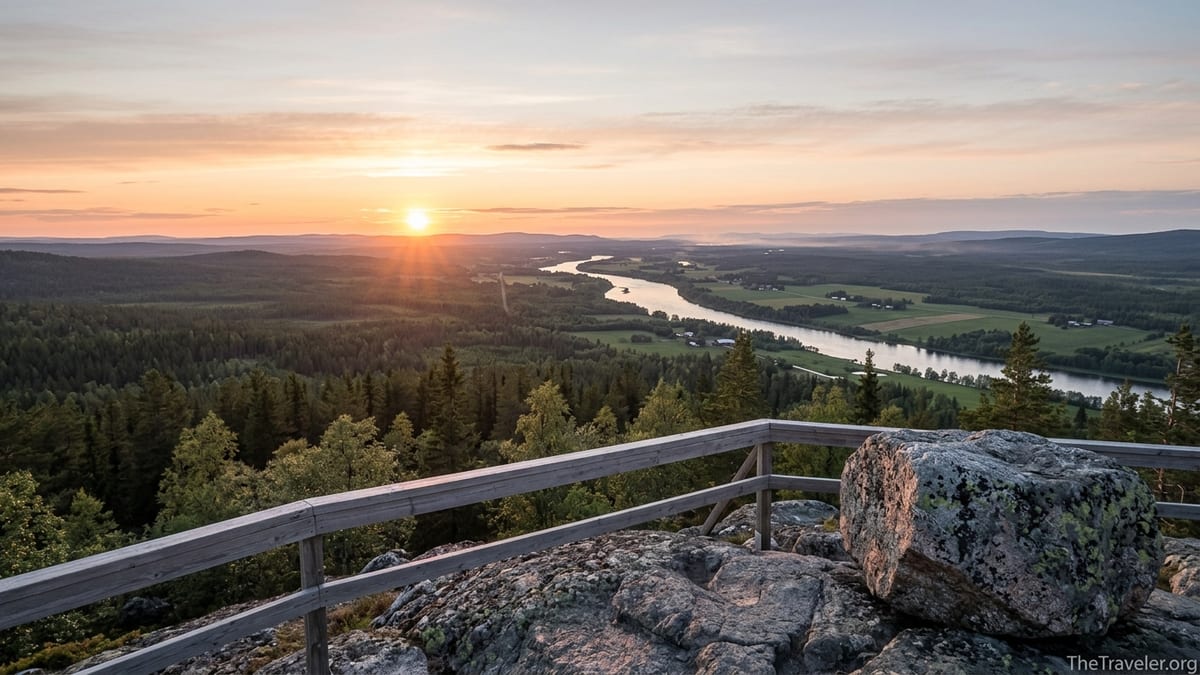
Aavasaksa sits in the municipality of Ylitornio in Finnish Lapland, close to the Swedish border and roughly on the Arctic Circle. The hill rises above the Torne River valley, with open views toward both Finland and Sweden. Its summit is part of one of Finland’s official national landscapes, which reflects how strongly Finns associate this particular view with Lapland and the far north.
The hill itself is not especially high at about 242 metres above sea level, but it stands distinctly above the surrounding lowlands. That elevation, combined with its northerly latitude, makes Aavasaksa one of the southernmost places in Finland where the midnight sun is considered truly visible around the summer solstice. On clear nights in late June, visitors watch the sun skim along the horizon without dropping fully below it, bathing the Torne River and forests in soft, golden light.
Aavasaksa has been drawing visitors since at least the 18th century. French scientists came here in the 1730s as part of a geodetic mission to measure the shape of the Earth, and their work later became part of the Struve Geodetic Arc, now a UNESCO World Heritage Site. In the 19th century it evolved into one of Finland’s earliest tourist destinations, with travellers arriving by riverboat and later by train to climb the hill and celebrate Midsummer on the summit.
Today, Aavasaksa remains quieter than headline Lapland destinations such as Rovaniemi or Levi. There are no big resort complexes or crowds. Instead, you find a compact network of trails, an observation area, small local accommodation options and wide horizons of river, forest and sky. It is a place to feel the Arctic environment more than to tick off attractions.
Getting to Aavasaksa and Moving Around
The nearest service centre is Ylitornio, about 13 kilometres south of Aavasaksa by road. Many visitors pair Aavasaksa with a broader Lapland itinerary that includes Rovaniemi, roughly a 90‑minute drive to the south, or Tornio and Haparanda on the Gulf of Bothnia, about two hours away by car. In practice, the easiest way to reach Aavasaksa is to drive, either with a rental car from Rovaniemi airport or from Oulu further south.
From Ylitornio, the road to Aavasaksa is clearly signed. You follow the E8 highway briefly, then turn toward the hill on local roads that climb gradually through forest. In summer, the drive from the village centre to the main parking area below the summit typically takes around 15 to 20 minutes. Road surfaces are paved or well‑maintained gravel, and a typical compact rental car is sufficient. In winter and spring, snowploughing is regular but conditions can still be icy, so visitors should allow more time and consider studded winter tyres, which are standard on Finnish rental vehicles in the cold season.
There is no regular public bus right to the top. Some regional buses stop in Ylitornio along the E8, but from there you would need to arrange a taxi to the hill, or cycle if you are prepared for the climb. A one‑way taxi trip from Ylitornio centre to the Aavasaksa car park may cost in the region of 25 to 40 euros depending on time of day and local operator, so visitors without a car often try to coordinate with accommodation providers for transfers.
Once on the hill, distances are manageable on foot. Short paths connect the main parking area, viewpoint platforms, the historic Imperial Lodge pavilion and nearby lean‑to shelters. In winter, groomed ski tracks loop around the hill, and snowmobile routes pass through the wider area. Visitors who want to explore beyond the summit, such as along the longer Miekojärvi–Vietonen hiking trail network, should come prepared with proper footwear, a local trail map and a realistic sense of their fitness in Arctic conditions.
Scenic Viewpoints and Historic Landmarks
The primary reason to come to Aavasaksa is to stand at the summit and look out across the Tornio River valley. On clear days, you can see the broad river meandering north and south, patches of cultivated fields along the banks, and low forested hills stretching into Sweden on the opposite side. The view is especially impressive at midsummer when the low‑angled sun paints the landscape in shades of orange and pink close to midnight.
Near the highest point of the hill, an observation tower and viewing platforms provide safe vantage points for photography. These structures mark, or stand near, historical measurement points from the Struve Geodetic Arc, which was used in the 19th century to calculate the size and shape of the Earth. A small monument commemorates the scientific work carried out here, and simple interpretive signs explain the role of Aavasaksa within that trans‑European chain of survey stations.
Another distinctive feature is the wooden Imperial Lodge, or Keisarinmaja, a decorative hunting cabin built in the late 19th century with a visit by Tsar Alexander II of Russia in mind. The imperial visit never happened, but the lodge remains as a reminder of that era. It is typically open in summer, when visitors can peek inside the simple wooden interior and get a sense of how early tourists and dignitaries experienced the hill. The building itself is relatively small but photogenic, with a classic dark‑timber exterior framed by birch and pine trees.
Around the summit, picnic tables and lean‑to shelters invite you to linger. Many visitors bring simple supplies from Ylitornio, such as grilled sausages, bread, cheese and thermos coffee, and cook over the open fire pits provided at some shelters when conditions and fire regulations allow. In the quiet of late evening, you might hear almost nothing except the soft wind in the trees and the occasional call of a bird from the valley below.
Nature Walks, Trails and Outdoor Activities
Aavasaksa is compact enough that most visitors can explore the main viewpoints with short walks, yet the surrounding area offers longer routes for those who want more time in the forest. Family‑friendly paths lead from the main car park up to the summit in about 15 to 30 minutes depending on pace. Surfaces are a mix of gravel tracks, wooden steps and natural forest paths, and most people with a basic level of fitness will manage them comfortably in summer.
Local route information highlights an approximately 8‑kilometre exercise loop around the hill that doubles as a lighted ski track in winter. In summer and early autumn, this loop is used by walkers and runners who want a longer outing without technical terrain. The trail weaves through mixed conifer and birch forest with occasional openings where you glimpse the river valley below. For many visitors staying multiple nights, a circuit of this loop at different times of day, such as early morning and late in the bright summer night, becomes a quiet ritual.
Beyond the immediate hill, the Miekojärvi–Vietonen hiking trail network extends for roughly 23 kilometres, broken into shorter sections that pass lakes, wetlands and forest viewpoints. Travellers who enjoy more substantial hiking often arrange transport to start or end points along this route, combining a day on the longer trail with an evening at Aavasaksa’s summit. In winter, snowshoeing is a straightforward way to explore the same gentle terrain; local guides occasionally offer small‑group midnight sun walks in early summer or snowshoe excursions under the aurora later in the year.
Because the Torne River is close by, some visitors combine a hilltop visit with activities on the water. In summer, local operators occasionally offer canoe or kayak trips on calm stretches of the river, sometimes timed to coincide with the late‑night light around midsummer. In winter, snowmobile routes in the wider Ylitornio area link lakes such as Miekojärvi and Vietonen with the Tornio border region, allowing those with experience or guided support to move between open lake ice, forests and the viewpoints around Aavasaksa.
Midnight Sun, Northern Lights and Arctic Seasons
The most famous time to visit Aavasaksa is around Midsummer, typically in the days surrounding the summer solstice in late June. At this time of year, locals and visitors have been coming to the hill for generations to watch the midnight sun. On clear nights, the sun hovers just above the horizon around midnight, and the sky glows a soft gold and pink. Even in years when clouds hang low, the almost continuous twilight creates a distinctive sense of time stretching out.
The midnight sun period in this part of Lapland is shorter than in far northern communities, but nights remain very bright from roughly early June through early July. Travellers planning a midnight sun visit should keep schedules flexible, ideally allowing two or three nights in the area so that at least one is likely to offer clear skies. A typical pattern for visitors is to rest during the afternoon, then drive or hike up to the summit around 10 or 11 in the evening with a picnic, blankets and extra layers, staying on the hill until after midnight before returning to accommodation in the small hours.
In autumn and winter, attention shifts from the midnight sun to the northern lights. Aavasaksa’s location away from major towns means there is relatively little light pollution, and the open views to the north are helpful for aurora watching. From roughly late August through March, on dark, clear nights with active geomagnetic conditions, visitors may see curtains or arcs of green and occasional pink light rippling above the horizon. Many people choose to stay in cabins or cottages with clear northern views specifically to watch for auroras without leaving their accommodation.
Other seasons have their own character. Early autumn brings ruska, the Finnish term for the weeks when birch and other foliage turn bright yellow and orange. The river valley below the hill becomes a patchwork of colour, and days are still mild enough for comfortable hiking. In late winter and early spring, sunny days with snow still on the ground create strong contrasts of blue sky and white forest, with temperatures often hovering just below freezing. For travellers who enjoy skiing or snowshoeing, this can be one of the most rewarding periods to visit.
Where to Stay and Eat Around Aavasaksa
Although Aavasaksa feels remote, there are several small‑scale places to stay in and around the hill. One of the closest options is a local holiday village on the slopes of Aavasaksa, with simple cabins and cottages designed to showcase the surrounding landscape. Depending on season, a modest self‑catering cabin for two or three people might cost in the approximate range of 80 to 150 euros per night, with higher prices around peak summer dates and winter holidays.
On the lower slopes and by the river you will find camping and caravan areas sometimes branded around the midnight sun theme. These typically offer tent sites, powered pitches for campervans and a basic service building with showers, shared kitchen facilities and a sauna. A tent pitch might cost somewhere in the region of 20 to 35 euros per night for two adults, while powered caravan spots can be slightly more. For travellers road‑tripping through Lapland in summer, these campgrounds offer a cost‑effective way to stay close to the hill and enjoy the outdoors almost around the clock.
In Ylitornio itself, small hotels and guesthouses provide another layer of accommodation. Rooms in these properties often fall in the general range of 100 to 170 euros per night including breakfast, depending on room size and season. Many have in‑house saunas, and some riverfront options offer views over the Torne toward Sweden. Travellers wanting more amenities, such as larger supermarkets and a wider choice of restaurants, sometimes base themselves in Tornio or Rovaniemi and visit Aavasaksa as a long day trip by car.
Dining options on and around the hill focus on simple, hearty Lapland fare rather than fine dining. In peak summer there may be a café or small restaurant near the summit or nearby holiday village serving salmon soup, reindeer stew, grilled sausages, pastries and coffee. Outside the busiest weeks, most visitors bring food from Ylitornio’s supermarkets and prepare their own meals in cabins, cottages or campsite kitchens. Carrying snacks and hot drinks in a thermos to the viewpoint is recommended, especially in the shoulder seasons when wind and temperature can shift quickly.
Practical Tips for a Safe and Rewarding Visit
Weather in Lapland can be changeable even in high summer, and Aavasaksa’s summit is exposed to wind. Visitors should bring layered clothing, including a light windproof shell, warm mid‑layer and hat, even on evenings that feel mild in the village below. In early summer, mosquitoes can be active in forested areas, so long sleeves, long trousers and an effective repellent help make walks more pleasant. Good walking shoes or light hiking boots are recommended, as some paths include roots, rocks and wooden steps that can become slippery in rain or when covered with early frost.
In winter, the combination of low temperatures, windchill and limited daylight requires more planning. Proper winter boots, insulated trousers, a warm jacket, hat and gloves are essential, and visitors should carry a headlamp even if they plan to be back before full darkness. Local daylight hours shrink significantly from November through January, so many winter visitors time summit visits for midday twilight and save aurora watching for evenings from cabin windows or nearby clearings where distances to shelter are short.
Safety awareness in this part of Lapland is mostly about respecting the elements and understanding how remote you are, rather than worrying about wildlife. Large animals such as bears are very rarely seen and generally avoid people. Reindeer are common along roads and on the hill, especially in summer, so drivers should slow down and give them plenty of space. Mobile phone coverage around Aavasaksa is generally good, but batteries drain more quickly in cold weather, so carrying a small power bank is wise.
For visitors unfamiliar with Lapland, local customs around nature are straightforward. Allemansrätten, the traditional right to roam, allows people to move freely in forests and on uncultivated land, but fires are only allowed in designated fire pits and must always follow local restrictions during dry periods. Rubbish should be carried out, and lean‑to shelters or huts should be left tidy for the next person. If you are uncertain about current rules, staff at accommodation or the local tourist information point in Ylitornio can explain seasonal guidance in clear terms.
The Takeaway
Aavasaksa is not a grand, high mountain, and it does not come with the extensive infrastructure of larger Lapland resorts. Its appeal lies in something quieter: the feeling of standing above an old river valley on a light summer night or crisp winter evening, watching the sky change colour as time seems to slow down. The combination of history, easy access, modest but satisfying trails and the chance to experience both midnight sun and northern lights in a relatively uncrowded setting gives the hill a particular character.
For travellers who appreciate scenic viewpoints, gentle nature walks and authentic Arctic seasons rather than packed activity schedules, Aavasaksa is a rewarding stop on a Lapland journey. With a bit of planning around transport, clothing and timing, it is straightforward to include as a two‑ or three‑night stay or as a carefully timed day trip from Rovaniemi or the Tornio region. Whether you come for a single midnight sun picnic or a full week of forest walks and sauna evenings, the hill has a way of lingering in memory long after the journey home.
FAQ
Q1. Where exactly is Aavasaksa located?
Aavasaksa is in the municipality of Ylitornio in Finnish Lapland, close to the Swedish border and roughly on the Arctic Circle above the Torne River valley.
Q2. When is the best time to visit Aavasaksa for the midnight sun?
The most reliable period for the midnight sun is around the summer solstice in late June, though nights remain very bright from roughly early June to early July.
Q3. Can I see the northern lights from Aavasaksa?
Yes, Aavasaksa is well placed for aurora viewing from about late August to March, especially on clear, dark nights with low light pollution and active solar conditions.
Q4. How difficult are the walks to the Aavasaksa viewpoints?
The main paths to the viewpoints are short and suitable for most visitors with basic fitness, though they include some steps and uneven forest sections that require sturdy footwear.
Q5. Do I need a car to visit Aavasaksa?
A car is the most practical way to reach Aavasaksa, as public transport does not run to the summit and taxis from Ylitornio can be relatively expensive for repeated trips.
Q6. What kind of accommodation is available near Aavasaksa?
Options include cabins and cottages on or near the hill, camping and caravan areas branded around the midnight sun theme, and small hotels or guesthouses in Ylitornio.
Q7. Is Aavasaksa suitable for families with children?
Yes, many families visit; the short summit walks, picnic areas and gentle forest trails work well for children who are used to walking and supervised on steps and viewpoints.
Q8. What should I wear for a summer evening visit to the summit?
Even in summer, bring layered clothing with a windproof jacket, long trousers, closed shoes or light hiking boots, and consider insect repellent for forested sections.
Q9. Are there restaurants or cafés on the hill itself?
Seasonal cafés or small restaurants sometimes operate near the summit or in nearby holiday villages in peak summer, but many visitors bring food from Ylitornio and self‑cater.
Q10. Is it possible to visit Aavasaksa as a day trip from Rovaniemi?
Yes, many travellers drive from Rovaniemi to Aavasaksa in about 90 minutes each way, often timing their visit for an evening or late‑night midnight sun or aurora outing.