


For most visitors landing at Milan Malpensa Airport, the Malpensa Express is the fastest and most reliable way to reach the city. This dedicated airport train connects both terminals with key Milan stations like Centrale and Cadorna, and it runs far more predictably than road traffic on the A8 motorway. Understanding how it works before you land can save you money, time, and stress on arrival.
Get the latest updates straight to your inbox!
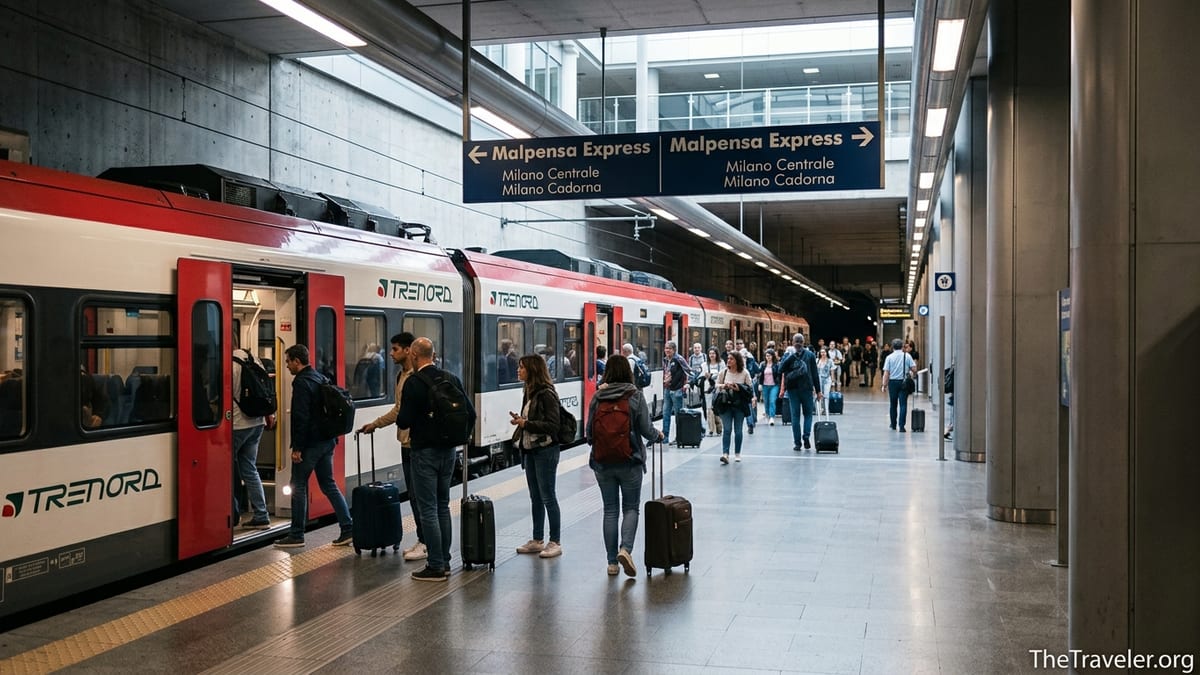
What the Malpensa Express Is and When It Makes Sense
The Malpensa Express is a dedicated airport rail service operated by Trenord that links Malpensa Airport with Milan city. Trains run between both airport terminals and several Milan stations, including Milano Centrale, Milano Cadorna, Porta Garibaldi, and Bovisa. For a typical visitor staying near the Duomo, Centrale, or along the M1 or M2 metro lines, this train is usually the most efficient first step into the city compared with taxis or airport buses.
On the main Malpensa Airport to Milano Centrale route, the journey takes about 51 minutes from Terminal 1 to Centrale under the current timetable, which is competitive with a taxi in normal traffic and often faster during rush hour. To and from Milano Cadorna, the ride is slightly shorter, around 37 to 43 minutes depending on the departure. Trains are air conditioned, have luggage racks, and feel similar to regional European trains rather than a metro or high speed service.
The Malpensa Express is particularly attractive for solo travelers and couples, because the fixed ticket price is much lower than a taxi. A one way adult ticket from Malpensa to Milano Centrale or Cadorna is around 15 euros in standard class as of the current tariff, while an official taxi to central Milan is normally a flat rate that is several times higher. For a family of four with heavy luggage, the price gap narrows, but many still prefer the predictability of the train and then use a short taxi ride from Centrale or Cadorna to their hotel.
There are situations where the train may not be ideal. If you arrive very late at night when frequencies are sparser, are staying in a suburb with no easy rail or metro connection, or have mobility issues that make stairs and station transfers inconvenient, a taxi or pre booked car might still be better. In most other cases, especially for visitors heading to central Milan or to cities like Verona, Venice, or Florence via high speed trains from Centrale, the Malpensa Express is the logical first leg of the journey.
Routes: Centrale, Cadorna, and Other Key Stops
The Malpensa Express operates on three main patterns. The most popular for international visitors is the Malpensa Airport to Milano Centrale route. Trains run between Terminal 2, Terminal 1, and Milano Centrale via intermediate stops such as Busto Arsizio, Saronno, Bovisa, and Porta Garibaldi. If your hotel is near Stazione Centrale or if you have a connecting high speed train to cities like Bologna, Florence, Rome, or Venice, choose this route as it delivers you directly into the main long distance hub.
The second important route is the Malpensa Airport to Milano Cadorna line. Cadorna is a central station close to Parco Sempione and the Sforza Castle, and it connects directly to metro lines M1 and M2. Travelers staying around the Duomo, Brera, or the Navigli district often find Cadorna more convenient than Centrale because it requires fewer metro changes. From Cadorna you can walk to parts of the historic center in 15 to 20 minutes, or change to the M1 red line for a quick hop to Duomo, San Babila, or Porta Venezia.
A third pattern serves intermediate stops in northwest Milan such as Bovisa and Porta Garibaldi. Porta Garibaldi is particularly useful if you are staying in the modern Porta Nuova district, near Piazza Gae Aulenti, or if you are connecting to some regional or suburban lines. Many business travelers heading to offices near Corso Como prefer getting off at Porta Garibaldi rather than going all the way to Centrale and then doubling back by metro or taxi.
In practice, this means you should choose your Malpensa Express route based on your final destination in the city. Someone staying at a business hotel on Piazza Duca d’Aosta right in front of Milano Centrale should take the Centrale train. A couple with an apartment rental near Cadorna may find the direct Cadorna train worth a few extra minutes of planning. If you are continuing to Lake Como via Trenord from Cadorna or Porta Garibaldi, that may also influence which line you choose.
Terminals, Platforms, and How to Board the Train
Malpensa Express trains stop at both Terminal 1 (T1) and Terminal 2 (T2). Terminal 1 is the main terminal used by many full service airlines and intercontinental flights. Here, the Malpensa Express station is directly under the terminal on level minus one. After exiting customs, you follow the clear “Trains” signs down via escalator or elevator. The station has ticket machines, a small ticket office, and electronic departure boards showing the next trains to Centrale and Cadorna.
Terminal 2 is used heavily by low cost carriers and also has its own Malpensa Express station. This station is directly connected to the terminal building at ground or underground level depending on the access corridor. If you land at Terminal 2 but your Malpensa Express train starts from Terminal 1, do not worry. All airport trains shuttle between T2 and T1 in both directions, so you can simply board at your arrival terminal.
On the platforms, trains are clearly marked with their destination, usually “Milano Centrale” or “Milano Cadorna” on the front and side displays. In a typical scenario, a traveler landing from New York at 9:30 in the morning, clearing passport control by 10:15, and reaching the T1 station by 10:25 will find a Malpensa Express to Centrale or Cadorna leaving within the next 15 to 30 minutes. Doors open automatically or at the push button and there is level or near level boarding, though with a small gap that passengers with strollers or wheelchairs should take care over.
Inside the train, luggage storage is mostly in overhead racks and in open spaces near the doors rather than in closed lockers. Seats are usually in a 2 plus 2 configuration with modest recline. There is no seat reservation system and you can sit anywhere in the appropriate class. Traveling with large checked suitcases is normal, but it is wise to keep valuables under close watch and avoid leaving bags by the doors where people pass frequently.
Tickets, Prices, and How to Buy
The Malpensa Express uses a simple point to point fare system. As of the latest tariff update, a standard second class one way adult ticket between Malpensa Airport and Milano Centrale or Milano Cadorna costs approximately 15 euros. Children and young people often benefit from discounted fares, and there are sometimes family tickets or promotional offers, although the details can vary by season and current Trenord policies. Unlike urban metro tickets, Malpensa Express fares are not part of the standard city transport fare cap, so you pay a separate airport train price even if you hold a Milan transit pass.
You can buy tickets in several ways. At both airport terminals and at Milan stations served by the Malpensa Express, there are Trenord branded ticket machines with English language options that accept major credit cards and sometimes cash. There is also usually a staffed ticket counter during the day. Many travelers now prefer to buy digital tickets in advance on the Trenord or Malpensa Express websites or via ticketing apps. These app based tickets are particularly handy if you land with no euros in cash or want to avoid queuing at machines after a long flight.
Tickets bought for a specific train departure generally do not require validation in the traditional sense because the date and time are printed on the ticket or encoded digitally. If you purchase an open ticket that is valid within a time window, you may need to validate it in the green or yellow trackside machines before boarding, depending on the instructions printed on the ticket. On board, roving conductors check tickets and may issue fines to passengers without a valid ticket or with unvalidated paper tickets where required.
For a concrete example, imagine a visitor arriving from London late afternoon who has pre booked a high speed train from Milano Centrale to Florence at 20:00. They might buy a Malpensa Express ticket for a 17:25 departure from Terminal 1, scheduled to reach Centrale at around 18:16. That connection leaves them a comfortable buffer to walk from the Malpensa Express arrival platform upstairs into the main concourse, find their Frecciarossa platform, and perhaps grab a quick espresso before boarding.
Timetables, Frequency, and Journey Times
The Malpensa Express runs frequently throughout most of the day. On the Milano Centrale route, there are dozens of trains in each direction daily, with typical departures from Centrale towards the airport at about 25 and 55 minutes past the hour starting early in the morning and running into late evening. The exact times can change with the seasonal timetable, but a roughly half hourly pattern is a good working assumption for daytime and early evening. Overnight and very early morning services are less frequent, so travelers on late arrivals or very early departures should check the current timetable for their specific date.
From Malpensa Airport Terminal 1 to Milano Centrale, the published journey time is around 51 minutes under the current schedule. From Terminal 2, you add just a few extra minutes because the train calls at T2 before T1 when heading toward Milan. The Malpensa to Cadorna line is slightly shorter. From Terminal 1 to Cadorna, travel times are typically in the high 30s or low 40s in minutes depending on the pattern of intermediate stops at Bovisa and other suburban stations.
In real world conditions, trains usually keep close to the timetable, but minor delays of a few minutes are not unusual. During major rail works or disruptions, services can be altered, replaced by buses on part of the route, or temporarily suspended at certain hours. The Trenord and Malpensa Express websites and apps are the best source of real time information on the day. At stations, electronic boards will show delays and platform changes, so always double check the screen even if you have a printed schedule.
If you have tight onward connections, for example a high speed train or a pre booked airport shuttle at another location, it is wise to build in a buffer of at least one full Malpensa Express frequency. That means assuming that if you miss the 15:25 train or if it is unexpectedly canceled, you can still catch the 15:55 and arrive in time. This approach helps avoid undue stress and is especially important during busy periods like Milan Fashion Week or major trade fairs when both trains and stations are crowded.
How to Choose the Best Station for Your Trip
For many travelers, the main choice is whether to aim for Milano Centrale or Milano Cadorna. Milano Centrale is the better choice if you are continuing by long distance train to another Italian city, staying in a hotel directly around Piazza Duca d’Aosta, or planning to use metro lines M2 or M3 to reach districts like Porta Romana, Lambrate, or the eastern parts of Milan. Centrale is also a good starting point if you are joining organized tours that meet near the station or if you prefer the wider range of services there, including left luggage, larger supermarkets, and more dining options.
Milano Cadorna is often more convenient if your accommodation is in the historic center west of the Duomo, in Brera, or near Sforza Castle and Parco Sempione. From Cadorna, the M1 red metro line takes you directly to Duomo in just a couple of stops, while the M2 green line connects you to the Navigli canal district at Porta Genova. For example, a traveler staying at a small boutique hotel on Via Dante might find the Cadorna train easiest, as they can either walk 10 to 15 minutes or ride a short metro hop without having to navigate the much larger Centrale complex.
If you are heading to the Porta Nuova business district, near Piazzale Gae Aulenti and the Unicredit Tower, the Malpensa Express arrival at Porta Garibaldi or at Bovisa may be more sensible. From Garibaldi you can walk to many offices and hotels in less than 10 minutes or use the metro. Students or visitors with business at the Bovisa Politecnico campus might opt to get off at Bovisa, which is an intermediate stop on many Malpensa Express services.
It is also common for travelers headed to the lakes to use the Malpensa Express as a feeder. Those going to Lake Como might ride from Malpensa to Cadorna or Porta Garibaldi and then transfer to a Trenord train to Como Lago or Como San Giovanni. In such cases, think of the airport train as the first leg of a two part journey and leave at least 20 to 30 minutes between trains to account for walking time between platforms.
Common Mistakes and How to Avoid Them
One of the most frequent mistakes visitors make is confusing Malpensa with Milan’s other airports and their respective transport options. Malpensa is served by the Malpensa Express train. Linate Airport, closer to the city, does not have a Malpensa Express connection and uses buses and the metro. Bergamo Orio al Serio, often sold as “Milan Bergamo,” is another separate airport that is reached mainly by coach. Booking a hotel near Centrale and then accidentally researching transport from Bergamo or Linate can lead to misunderstandings. Always confirm that you are looking at Malpensa Express information specifically for Malpensa Airport.
Another common error is not allowing enough time between a long haul flight and a booked onward train from Milano Centrale. While passport control and baggage claim at Malpensa can be efficient, occasional delays at immigration or security checks are not unusual. If you land at 13:00, it is risky to book a high speed train out of Centrale for 14:30 and assume that a perfectly timed Malpensa Express will line up. A safer pattern would be to target an onward train at 15:30 or later, giving you time for delays at any stage and reducing the stress of a tight connection.
Travelers used to metro systems sometimes assume they can buy a standard Milan urban ticket for the Malpensa Express. This is mistaken. Malpensa Express tickets are separate and more expensive, and urban transport passes do not cover the airport train. Others forget to check whether their paper ticket needs validation. While many Malpensa Express tickets issued for a specific time do not need extra stamping, open date tickets and some integrated tickets do. If in doubt, ask at the ticket office or look for clear English instructions on the ticket face and at the platform.
Finally, it is easy to board the wrong train if you arrive at Milano Centrale or Cadorna in a rush on your way back to the airport. Several regional and suburban trains depart from neighboring platforms and not all go to Malpensa. Always check that the train you board is explicitly labeled Malpensa Aeroporto and verify the terminal, especially at times when some services may terminate at T1 while others continue to T2. Taking a moment to match the train number and departure time on the board with your ticket can prevent a costly detour.
The Takeaway
The Malpensa Express is one of the most practical tools in a traveler’s Milan toolkit. It offers a fixed price, predictable journey from both airport terminals to key city stations, largely independent of road congestion. For solo travelers and couples heading to central hotels or onward trains, it usually represents the best balance of speed, comfort, and cost. Families, groups, and those with heavy luggage may still consider taxis or private transfers, but even they often find the train plus a short cab ride to be a smooth and economical combination.
Planning ahead is the key to getting the most out of the Malpensa Express. Decide which station suits your plans best, check a recent timetable for your arrival or departure window, and consider buying tickets in advance or via an app for peace of mind. Build in some buffer time for connections and read platform boards carefully to avoid boarding the wrong service. With a modest amount of preparation, the Malpensa Express turns what could be a stressful airport transfer into a straightforward introduction to traveling in and out of Milan.
FAQ
Q1. How much does the Malpensa Express cost from the airport to Milan?
The standard adult one way fare between Malpensa Airport and Milano Centrale or Milano Cadorna is around 15 euros in second class, with some discounts for children and occasional promotional offers.
Q2. How long does the Malpensa Express take to reach Milano Centrale?
Under the current timetable, trains from Malpensa Terminal 1 to Milano Centrale take roughly 51 minutes, with just a few extra minutes if you board at Terminal 2.
Q3. How often do Malpensa Express trains run?
During most of the day, Malpensa Express trains run about every 30 minutes on the main routes between the airport and Milano Centrale or Milano Cadorna, with reduced frequency very early in the morning and late at night.
Q4. Do I need to book Malpensa Express tickets in advance?
Advance booking is not strictly necessary because seats are not reserved, but buying in advance online or via app can be convenient and saves time at the station.
Q5. Are Malpensa Express tickets included in Milan metro passes?
No. Malpensa Express tickets are separate from standard Milan urban transport passes and must be purchased specifically for the airport train route.
Q6. Which station is better: Milano Centrale or Milano Cadorna?
Choose Centrale if you are catching long distance trains or staying by the main station, and Cadorna if you are heading to the Duomo area, Brera, or districts best served by metro lines M1 and M2.
Q7. Does the Malpensa Express run at night?
There are early morning and late evening services, but overnight hours have fewer trains or none at certain times, so travelers on very late or very early flights should always check the specific timetable for their date.
Q8. Can I take large luggage on the Malpensa Express?
Yes. The trains are designed for air travelers and accommodate large suitcases, which you can place in overhead racks or in open spaces near the doors, keeping valuables close to you.
Q9. Do I need to validate my Malpensa Express ticket?
If your ticket shows a specific date and departure time and is issued electronically, it may not need validation. Open tickets and some paper tickets do, so check the instructions on the ticket and look for platform validation machines.
Q10. How early should I leave Milan for a flight from Malpensa?
A common rule of thumb is to arrive at the airport about two hours before a European flight and around three hours before a long haul flight, adding the Malpensa Express journey time and a buffer in case of minor delays.