


Milan Malpensa (MXP) is the main gateway to northern Italy, but its two passenger terminals can easily trip up first-time visitors. Airlines are split between Terminal 1 and Terminal 2, transport options differ, and connections can be tight if you do not know how the airport is laid out. This guide walks you through which terminal you actually need, how to move between them, and what to expect at check-in, departures, and arrivals with real-world examples based on how Malpensa operates today.
Get the latest updates straight to your inbox!
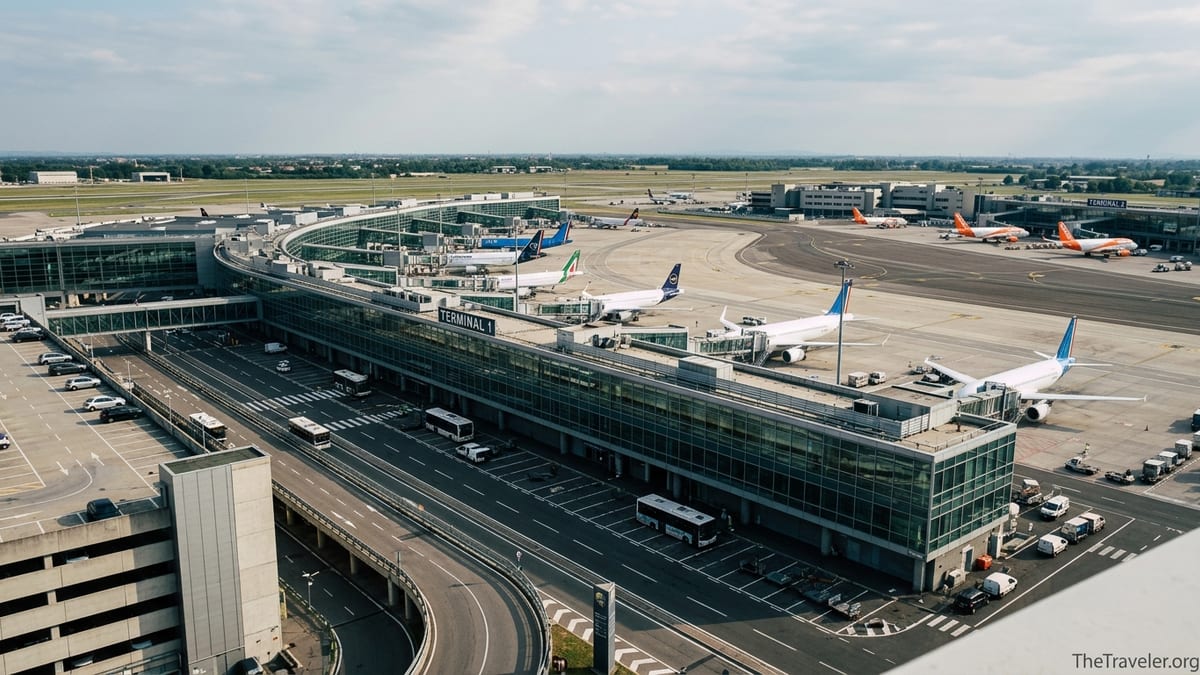
Terminal 1 vs Terminal 2: The Big Picture
Malpensa has two main passenger terminals with distinct roles. Terminal 1 is the large intercontinental and main international terminal, handling the vast majority of full-service and long-haul airlines. Terminal 2 is effectively a specialist base dedicated to easyJet, handling the carrier’s short and medium-haul network to and from Milan. The airport operator itself describes Terminal 1 as Malpensa’s intercontinental terminal and Terminal 2 as the international terminal dedicated to easyJet, which matches how traffic is actually distributed on a day-to-day basis.
For most travelers this means a simple rule of thumb: if you are flying easyJet, you go to Terminal 2. Almost all other airlines use Terminal 1. This includes big names such as Lufthansa, Air France, KLM, British Airways, Emirates, Qatar Airways, Singapore Airlines, Delta, American Airlines and ITA Airways. Regional and leisure carriers serving northern Italy, like Wizz Air, Neos and many others, also operate from Terminal 1. When in doubt, always double-check your booking confirmation and boarding pass, which will explicitly say “T1” or “T2” for Malpensa.
Although the two terminals are several minutes apart by road, they function as parts of a single airport. Both are connected to Milan city by the Malpensa Express train and by airport coaches, and both have security, shops and food options. However, Terminal 1 is significantly larger, with three concourses (A, B and C) and the broadest range of services, while Terminal 2 is simpler and more compact, optimized around easyJet’s point-to-point traffic and quick turnarounds.
Understanding this high-level split is crucial when planning connections. A traveler flying New York to Milan on Emirates, landing at Terminal 1, and then continuing on an easyJet flight to Naples from Terminal 2 cannot count on an airside connection. They must clear arrivals in Terminal 1 and physically transfer to Terminal 2 landside, which has time and logistics implications that we will explore below.
Which Airlines Use Each Terminal Today
The simplest part first: Terminal 2 is almost entirely the domain of easyJet. The low-cost airline has built a major base at Malpensa and uses Terminal 2 as its dedicated hub for departures and arrivals. If you are flying easyJet to or from cities such as London Gatwick, Paris Orly, Amsterdam, Lisbon, Athens or domestic Italian routes like Catania, Naples and Palermo, you should expect to use Terminal 2 unless your ticket or airline communication specifically says otherwise.
Terminal 1 hosts virtually all other scheduled passenger airlines serving Malpensa. This includes legacy European carriers such as Lufthansa, SWISS, Austrian, Air France, KLM and British Airways, as well as ITA Airways and a long list of European low-cost and leisure operators apart from easyJet. On the long-haul side, airlines like Emirates (Dubai), Qatar Airways (Doha), Etihad (Abu Dhabi when operating), Singapore Airlines (Singapore via some routings), Delta and American Airlines (to US hubs), plus various seasonal services, generally use Terminal 1’s non-Schengen concourses.
Within Terminal 1 there is a further split by concourse that often appears on boarding passes. Concourse A mainly serves Schengen destinations, such as flights to Rome, Frankfurt or Barcelona. Concourses B and C focus heavily on non-Schengen and long-haul destinations such as New York, Dubai or Singapore. For example, if you are flying Milan to Dubai on Emirates in economy, your flight will typically depart from a B or C gate in Terminal 1. Even so, check the departure screens on the day as gate assignments can change close to departure.
Because airline assignments do occasionally shift across seasons or due to operational changes, travelers should not rely on memory or past experience alone. Someone who last visited Malpensa in 2019 might remember that some low-cost carriers were in Terminal 2, but the airport has since consolidated Terminal 2’s role around easyJet. To avoid surprises, confirm the terminal on your airline’s app or email notifications 24 hours before departure, especially if you are arranging a taxi or booking a coach that may drop at a specific terminal.
Getting Between Terminal 1 and Terminal 2
The distance between Terminal 1 and Terminal 2 is short enough that they are effectively on the same airport campus, but far enough that walking is not practical for passengers with luggage. The airport operates a free shuttle bus running between Terminal 1 and Terminal 2, with services typically every 15 to 20 minutes during the day and often slightly less frequent at night. The ride takes around 8 to 10 minutes depending on traffic and intermediate stops, which means that even a simple terminal change can add at least 30 minutes to your total connection time once you factor in waiting for the bus and walking to and from stops.
In practice, a traveler arriving at Terminal 1 and connecting to easyJet at Terminal 2 will follow this sequence: deplane, proceed through passport control and baggage claim at Terminal 1, exit into the public arrivals hall, follow signs for the inter-terminal shuttle or buses, wait for the free shuttle to Terminal 2, ride for roughly 10 minutes, then walk into Terminal 2 and go through security again. Even with everything running smoothly, the process can easily take 50 to 70 minutes. If you add a delay at passport control or baggage delivery, a 90-minute self-connection can quickly start to feel tight.
There is also a Malpensa Express train station at both terminals, which is useful if you arrive at one terminal and later need to depart from the other on a different day. For example, someone flying in on Lufthansa to Terminal 1 and spending three nights in Milan might take the Malpensa Express from the Terminal 1 station to Milano Centrale. On the day of their return easyJet flight from Terminal 2, they can simply board a Malpensa Express service that runs directly to the Terminal 2 station. Train tickets from central Milan to either terminal are usually in the mid-teens of euros, and journey time from Milano Centrale is about 50 minutes, so rail is generally more predictable than road during rush hours.
If you are tight on time and traveling with family or heavy luggage, a taxi between terminals is technically possible but usually unnecessary, given the free shuttle. Local passengers sometimes consider a taxi late at night when shuttle frequencies are lower, but for most visitors the signed shuttle is the most cost-effective and straightforward choice. Just remember to step outside the terminal, follow the “Shuttle T1–T2” signage, and allow room in your schedule for potential waits.
Check-in Areas and Security: What To Expect
Terminal 1 has a large, modern departures hall with multiple check-in islands labeled with letters and numbers. Airlines are grouped in zones, and the allocation can shift during the day. When you walk in, electronic boards list airlines against row numbers, so the first step is to check the nearest screen for your carrier, for example “Emirates – Row 10–12” or “Lufthansa – Row 5–7.” Travelers on full-service airlines with checked baggage should plan to arrive at least two hours before European flights and three hours before long-haul departures, especially during peak summer months when lines for check-in and security can lengthen.
Once check-in is complete in Terminal 1, passengers proceed upstairs to security and, if applicable, passport control. The main security checkpoint sits roughly in the middle of the terminal and feeds into a central shopping and dining area. From there, long corridors lead out to the A, B, and C satellite piers. Because these walking distances can be longer than they look on the map, a traveler at a distant B-gate long-haul boarding area may find that it takes 10 to 15 minutes of brisk walking from the central plaza. It is wise to buy water or snacks before heading to the gate, especially if you are traveling with children or older relatives who may prefer to move slowly.
Terminal 2’s departures area is smaller and more linear, reflecting its focus on easyJet’s high-turnover operation. Check-in counters for easyJet are grouped in a few banks, and many passengers use bag-drop after online check-in. It is common to see large crowds in front of the bag-drop area at peak times, such as early morning waves of flights to London, Paris and domestic Italian cities. Travelers should not underestimate the time needed: even with hand luggage only, queues at security can build quickly when several flights are called around the same departure window.
Security at both terminals uses standard European procedures, with laptops, large electronics and liquids separated according to current regulations. Malpensa has gradually improved its queuing layouts, but the airport can still be congested when multiple long-haul departures are scheduled close together in Terminal 1, or when easyJet has a cluster of departures in Terminal 2. If you are connecting from a regional Italian flight in Terminal 1 to a long-haul flight on the same ticket, your luggage is usually through-checked and you will follow the dedicated “transit” signage, but you should still be prepared for additional security or passport checks depending on your arrival and departure zones.
Arrivals, Baggage Claim and Ground Transport
On arrival into Terminal 1, international passengers first clear passport control, then descend to the baggage claim hall, where belts are arranged in long rows. Overhead screens list flight numbers and belt assignments. Baggage delivery times can vary, but many travelers report waiting 20 to 40 minutes when the terminal is busy and several wide-body flights land around the same time. Once you have your luggage, you exit into the public arrivals hall, where you can find car rental desks, taxi ranks, and signs to buses and the Malpensa Express train station on the lower level.
For example, if you arrive at 07:00 from New York in Terminal 1, clear passport control, and collect your bag by around 07:45, you can realistically aim for a Malpensa Express train around 08:15 to Milano Centrale. That puts you in downtown Milan just after 09:00, which is usually quicker and less stressful than battling morning traffic by road. Airport coaches to central Milan or other cities such as Turin and Genoa also depart from bays outside Terminal 1’s arrivals area, and tickets can often be bought from kiosks or directly from staff near the buses.
Arrivals in Terminal 2 follow a similar landside pattern, but with a smaller footprint. Passengers disembark, pass through passport control if arriving from non-Schengen destinations, and reach a compact baggage hall. Outside, you will find bus stops for services to Milan and other cities, as well as a dedicated Malpensa Express station just beyond the terminal building. If you are arriving late at night on easyJet and staying in Milan, it is worth checking in advance whether your chosen bus line or train still operates at your arrival time, as late-evening frequencies can be reduced and you may prefer to pre-book a taxi.
If you are collecting a rental car, most of the major brands have desks and parking lots at Terminal 1, although many also accommodate Terminal 2 passengers by shuttle. For instance, a family arriving on easyJet at Terminal 2 and renting a car from a company based at Terminal 1 will typically exit the terminal, board a courtesy shuttle provided by the rental firm or use the airport’s free inter-terminal shuttle, and then complete paperwork in the main car rental center near Terminal 1’s parking structures. Building a 45-minute buffer between scheduled arrival and planned road departure is sensible in these cases.
Connecting Flights and Self-Transfer Strategies
Malpensa is not a mega-hub like Frankfurt or Amsterdam, but many travelers still connect here, especially between long-haul flights in Terminal 1 and regional flights within Europe or Italy. If your flights are on a single ticket with one airline or alliance, your connection will usually be protected. For example, a passenger flying from Tokyo to Milan and onward to Rome on the same full-service carrier ticket will typically have their baggage checked through to the final destination, follow transit signage in Terminal 1, and be re-screened airside without needing to exit and re-check.
By contrast, self-transfers between airlines, especially those involving Terminal 2, require much more caution. Imagine a traveler arriving at Terminal 1 on a transatlantic flight at 09:00, holding a separate easyJet ticket from Terminal 2 at 11:00. On paper that appears to be a two-hour connection, but in reality they must deplane, clear passport control, wait for and collect luggage, navigate to the shuttle stop, wait for the next bus, ride to Terminal 2, check in or drop bags with easyJet, then clear security again. Any delay in the inbound flight or at border control could turn the connection into a race.
In practice, experienced travelers often recommend allowing at least three, and preferably four, hours for self-transfers between terminals at Malpensa, particularly when one of the flights is long-haul and the other is on easyJet from Terminal 2. This buffer helps absorb typical minor delays such as a late inbound arrival, a long queue at passport control, or a slower-than-expected baggage belt. If you are traveling only with hand luggage and have already checked in online for your onward flight, you may be comfortable with a shorter margin, but you should still factor in shuttle waiting time and potential congestion at security.
For connections fully within Terminal 1 on a single ticket, such as Milan to Frankfurt to New York on a Star Alliance carrier, minimum connection times can be shorter. However, Malpensa’s satellite layout means that a gate change from one end of the A concourse to a distant B or C gate may still involve a substantial walk. If you are traveling with reduced mobility, it is advisable to request assistance in advance so that airport staff can provide wheelchairs or electric carts where available, and guide you through any additional passport control points between Schengen and non-Schengen zones.
On-the-Day Tips for Departures and Arrivals
When departing from Terminal 1, plan your journey with both airport processes and transport into account. For a 10:30 long-haul departure to the United States, you might aim to arrive at the terminal by 07:30. If you are staying in central Milan, this usually means catching a Malpensa Express train around 06:30 to 06:40 or a coach slightly earlier, giving you a cushion in case of unexpected delays on the way. Once at the airport, head straight to your check-in row, drop bags, then move through security and passport control without lingering too long in the check-in hall.
At Terminal 2, easyJet’s model of clustering departures means early mornings can be particularly busy. A 07:00 flight to London or Paris may see long security lines forming from 05:30 onward. Even if you have only hand luggage, arriving 2 hours before departure is prudent, and 2.5 hours is safer in high season. Many travelers use this time to buy a coffee and breakfast at one of the terminal cafes after clearing security. If you are connecting from central Milan by train, choose a Malpensa Express arrival that gets you to Terminal 2 no later than 90 minutes before scheduled departure when possible.
For arrivals, a few habits can make life smoother. Before you land, check on your airline’s app or the in-flight entertainment system which terminal you are arriving into, then mentally plan your onward route. If you are meeting a pre-booked driver, ensure your confirmation states the correct terminal and arrivals door. At Terminal 1, the arrivals hall is large and can be confusing, so agreeing on a specific landmark, such as a particular cafe or car rental cluster, can help you find each other more quickly.
If you are heading directly to another Italian city by train after landing, consider using the Malpensa Express to Milano Centrale and then transferring to a high-speed Trenitalia or Italo service. For example, a traveler landing at 13:00 in Terminal 1 and ultimately bound for Florence could realistically be on a Malpensa Express by 14:00, arrive at Milano Centrale shortly before 15:00, and catch a mid-afternoon high-speed train to Florence that arrives early evening. This sequence is often more reliable than booking a tight connection with a domestic flight, especially when you factor in the need to change terminals for easyJet services.
The Takeaway
Using Milan Malpensa effectively starts with one key decision point: knowing whether you need Terminal 1 or Terminal 2. Terminal 1 is the main hub for full-service and long-haul carriers, with three concourses and the broadest facilities. Terminal 2 is dedicated almost entirely to easyJet and is optimized for quick, point-to-point travel within Europe. Once you identify your terminal from your booking or airline app, you can plan your transport, arrival time and any connections with far greater confidence.
Transfers between terminals are straightforward but not instant. The free shuttle bus typically runs every 15 to 20 minutes and the ride takes under 10 minutes, yet the full door-to-door process, including walking and waiting, can easily add 30 minutes or more. If you are self-connecting between a long-haul flight at Terminal 1 and an easyJet flight at Terminal 2, allowing at least three hours and ideally four gives you a realistic buffer against ordinary airport delays.
On the ground, both terminals provide the core essentials: check-in, security, food and drink, duty-free and access to trains and buses. Terminal 1 has the edge in variety of services and lounges, while Terminal 2 benefits from a simpler layout tailored to one airline. By understanding how airlines are distributed, how the terminals connect, and what to expect at check-in and arrivals, you can turn what might otherwise be a confusing airport into a manageable, even efficient, gateway to Milan and the rest of Italy.
FAQ
Q1. How do I know if I should go to Terminal 1 or Terminal 2 at Malpensa?
Check your booking confirmation, boarding pass or airline app, which will show “T1” or “T2.” As a general guide, easyJet uses Terminal 2 and almost all other airlines use Terminal 1, but always rely on the information from your airline on the day of travel.
Q2. How long does it take to transfer between Terminal 1 and Terminal 2?
The free shuttle bus ride itself takes around 8 to 10 minutes, but once you add walking to and from stops and waiting for the next bus, you should allow at least 30 minutes, and more if you also need to collect baggage and go through security again.
Q3. Is there an airside connection between Terminal 1 and Terminal 2?
No, passengers cannot move airside between the two terminals. If you need to switch terminals, you must go landside, use the shuttle or other ground transport, and then re-clear security in the new terminal, so plan extra time.
Q4. Can I make a two-hour self-connection from a long-haul flight in Terminal 1 to an easyJet flight in Terminal 2?
A two-hour self-connection is risky, especially if you have checked baggage. You must clear passport control, wait for bags, transfer by shuttle, check in or drop bags, and pass security again. A buffer of three to four hours is much safer.
Q5. Does the Malpensa Express train serve both terminals?
Yes, the Malpensa Express stops at dedicated stations for both Terminal 1 and Terminal 2. When buying your ticket or checking the timetable, make sure you select the correct terminal as your origin or destination to avoid unnecessary terminal changes.
Q6. Are check-in and security faster at Terminal 2 since it only serves easyJet?
Not necessarily. While Terminal 2 is smaller, easyJet operates many flights in concentrated waves, which can produce long queues at bag-drop and security during peak times. Arriving 2 to 2.5 hours before departure is still recommended, especially in summer and around holidays.
Q7. Where do long-haul flights usually depart from at Malpensa?
Most long-haul and non-Schengen flights depart from the B and C concourses of Terminal 1. After check-in and security, follow signs to your assigned gate, and allow extra walking time as the satellite piers can be farther from the central shopping area than they appear.
Q8. What is the best way to get from Malpensa to central Milan?
For most travelers the Malpensa Express train is the most predictable option, with regular services from both terminals to Milano Centrale and other city stations in about 50 minutes. Airport coach buses and taxis are alternatives, but can be more affected by traffic, especially during rush hours.
Q9. I am arriving at Terminal 2 and renting a car based at Terminal 1. What should I do?
After you exit Terminal 2, follow signs to the free shuttle or your rental company’s courtesy bus to reach Terminal 1 and the main car rental area. Build at least 45 minutes between scheduled flight arrival and your planned departure by car to allow for baggage claim and the transfer.
Q10. Are facilities like lounges, shops and restaurants better in Terminal 1 or Terminal 2?
Terminal 1 generally offers a wider choice of shops, restaurants and airline or independent lounges, reflecting its role as the primary intercontinental terminal. Terminal 2 has a more limited but adequate selection geared toward short-haul leisure and business travelers using easyJet.