


More news on this day
Newly surfaced reports indicate that an erroneous flight plan filed by a UK military aircraft may have triggered the air traffic control outage that disrupted thousands of flights in and out of the United Kingdom earlier this week, raising fresh questions over how robust the country’s aviation systems are to unusual data and how much detail passengers are entitled to know when journeys unravel.
Get the latest news straight to your inbox!
Report points to “spurious” data from military flight
According to coverage in UK and international media, the outage has been linked to a flight plan submitted for a UK military aircraft that entered what has been described as “spurious” or anomalous data into systems used by National Air Traffic Services, the country’s main air navigation provider. Initial accounts suggest that the problematic data caused automatic safeguards to halt normal processing of flight plans, forcing controllers to restrict traffic while systems were reset and checked.
The Financial Times was cited in multiple outlets as reporting that several people briefed on the incident attributed the shutdown to the military flight plan. Those accounts indicate that the data field combination was technically valid but unusual, echoing findings from earlier investigations into a major National Air Traffic Services incident in August 2023, when a single anomalous flight plan triggered a nationwide reduction in capacity.
Publicly available information from previous technical reports on the 2023 failure shows that the flight planning subsystem is designed to enter a fail-safe mode if it encounters data it cannot reliably interpret. When that happens, capacity can drop sharply as controllers revert to slower manual processes to ensure separation between aircraft. The latest disruption appears to have followed a similar pattern, with no suggestion of an underlying hardware failure or cyberattack.
Fresh disruption for passengers during busy travel period
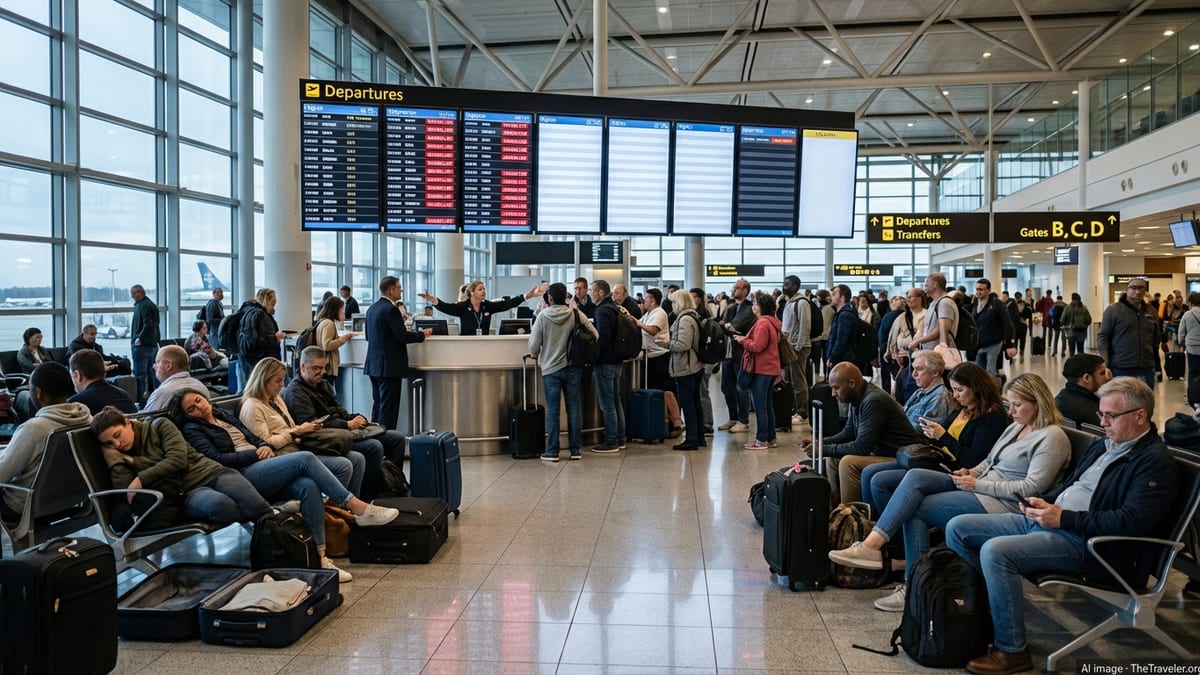
The outage led to widespread delays and cancellations across UK airports, affecting both domestic services and international links to Europe, North America and beyond. Airlines cut frequencies, turned aircraft back to base and diverted some flights to nearby hubs while traffic flow restrictions were in place, leaving passengers facing missed connections and overnight stays.
For many travelers, the event recalled the chaos of late August 2023, when a separate air traffic control problem cascaded into several days of disruption and a prolonged backlog of stranded passengers. Industry analysts note that the latest malfunction occurred during another peak travel period, magnifying its impact as load factors remained high and spare aircraft and crew were limited.
Published reports indicate that normal operations were restored within hours, but that residual delays continued into the following day as aircraft and crews were repositioned. Airlines have begun assessing the financial hit from compensation, duty of care and lost revenue, while consumer groups are again questioning whether existing rules offer sufficient protection when critical infrastructure fails for reasons beyond carriers’ direct control.
Links to earlier investigations into NATS systems
The emerging narrative around a military flight plan containing unusual but valid data closely mirrors the conclusions of official investigations into the 28 August 2023 air traffic control disruption. In that case, technical documentation published by the UK Civil Aviation Authority and National Air Traffic Services described how an uncommon combination of duplicate waypoint information in a single flight plan caused both a primary system and its backup to suspend automatic processing.
The independent review commissioned by the regulator after the 2023 event highlighted the vulnerability of complex, safety-related IT systems to rare data combinations. It recommended dozens of measures, including changes to how flight plans are validated, improvements in contingency capacity and closer coordination with airlines and other stakeholders on incident response and passenger care.
Commentary on the latest outage notes that, while the specific flight in question appears to involve a military aircraft rather than a commercial service, the underlying technical theme is similar: a valid but atypical route description that exposed edge cases in software logic. Observers suggest that this raises questions about how comprehensively previous fixes were tested against non-standard scenarios, particularly those involving state or military flights that may follow more complex or sensitive routings.
Military and civilian traffic integration under renewed scrutiny
The suggestion that a military aircraft’s flight plan precipitated a civilian air traffic control shutdown is likely to intensify scrutiny of how military and commercial operations share crowded European airspace. In the UK, as in much of Europe, civil and military controllers rely on interconnected planning and surveillance systems so that training missions, routine transport flights and commercial traffic can coexist safely.
Policy papers and regulatory consultations on UK combat air training airspace have previously acknowledged that dynamic military requirements can add complexity to the airspace structure. While safety cases assume robust coordination and clear data exchange between military and civil units, the latest reports suggest that unexpected combinations of route data from non-commercial flights may require more rigorous testing against civilian systems’ edge cases.
Aviation specialists point out that the sheer volume of flight plans handled each day means that unusual combinations will occasionally arise, whether from military sorties, long-haul diversions or complex multi-sector routes. The challenge for system designers is to ensure that such edge cases are handled gracefully without triggering cascading shutdowns that affect unrelated flights and passengers far from the original cause.
Calls grow for transparency and passenger-focused reforms
While investigations into the latest outage are still emerging, industry and consumer advocates are already focused on what it means for passenger rights and communication. After the 2023 incident, the independent review urged clearer messaging to travelers and recommended stronger consumer protections, including enhanced dispute resolution mechanisms and expanded enforcement powers for the regulator in cases of systemic failure.
Publicly available government statements following that earlier failure emphasised the importance of learning lessons across the aviation ecosystem, from National Air Traffic Services and the Civil Aviation Authority to airlines, airports and policymakers. The new disruption is likely to revive those debates, particularly if it is ultimately confirmed that a non-commercial flight operating under state control triggered wide-scale disruption for fee-paying passengers.
For travelers, the key questions remain practical. They revolve around how quickly systems can recover when rare faults occur, how transparently causes are communicated and how consistently airlines apply compensation and care obligations when delays are rooted in external infrastructure. As more detail emerges about the role of the military flight plan in the latest outage, UK and European regulators may face renewed pressure to demonstrate that recommendations from past reviews are being turned into concrete improvements rather than left on paper.
Military aircraft reportedly blamed for UK air traffic control outage – The Guardian
Civil Aviation Authority: Independent review of NATS August 2023 failure
UK government statement on publication of NATS technical failure report