


Mirabellplatz is one of those places in Salzburg where everyday life and sightseeing collide. Buses pull in from the suburbs, students hurry into the Mozarteum, wedding parties drift toward Mirabell Palace, and commuters cut through the gardens to reach the river. For travelers, this compact square is the ideal starting point for exploring Salzburg on foot: central yet less overwhelming than the Old Town, beautiful yet still used by locals, and surrounded by a surprising number of hidden corners if you know where to look. This guide walks you step by step through Mirabellplatz and its surroundings, with practical details, quiet detours, and small local spots that most visitors miss.
Get the latest updates straight to your inbox!
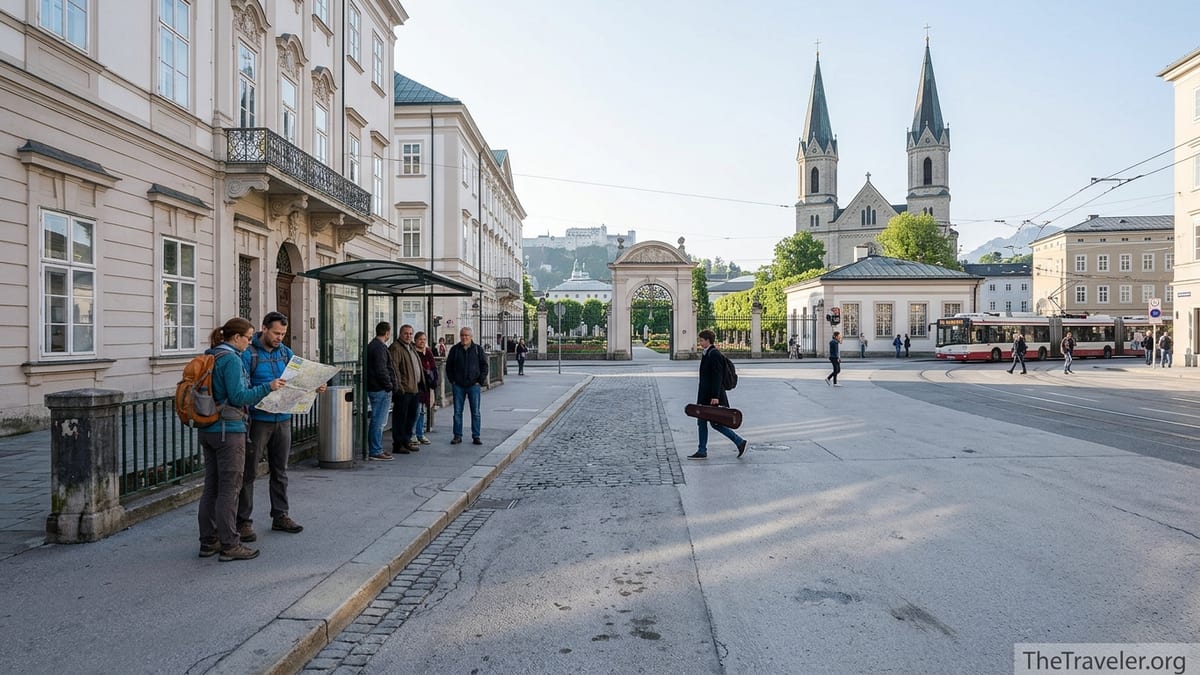
Getting Oriented: What Exactly Is Mirabellplatz?
Mirabellplatz is a broad, rectangular square on the right bank of the Salzach River, just north of Salzburg’s historic Old Town. It stretches in front of the grand façade of Schloss Mirabell at Mirabellplatz 4 and links several key city landmarks: Mirabell Palace and Gardens on one side, the twin-towered Andräkirche on the other, and the Mozarteum University’s main building at Mirabellplatz 1 anchoring the southern end. The square belongs to Salzburg’s “right-hand” old town district, so you are within a 10 to 12 minute walk of Residenzplatz and the cathedral, but with more breathing space and fewer tour groups.
Today Mirabellplatz works as a transport hub as much as a postcard scene. Multiple city bus lines stop here, including routes that run to the main station and out toward Gaisberg, making it one of the first places many commuters step into every morning. Regional Postbus services from surrounding villages also drop passengers at Mirabellplatz, which explains the flow of locals with shopping bags and briefcases even in the height of summer. For travelers, this means you can easily arrive by bus from the train station in under 10 minutes and start exploring on foot right away.
The square itself is wrapped in architecture that ranges from ornate Baroque to sober 19th century façades. On the palace side, arcades and stone balustrades frame views into Mirabell Gardens, while on the opposite side you see the slender spires and pale façade of St. Andrä church rising over tram-era townhouses. The atmosphere is practical rather than museum-like: there are traffic lights, bus shelters, and a steady hum of everyday noise. Yet within a one-minute walk you can be standing by a baroque fountain, surrounded by flowers and mountain views.
If you arrive with a printed city map from the tourist office or your hotel, you will usually see Mirabellplatz marked as a reference point for walking tours and sightseeing buses. Some hop-on, hop-off tours begin near the square, and local sightseeing buses to attractions outside town often advertise Mirabellplatz as a pick-up point. Treat it as your compass: from here, riverside paths, the Linzergasse shopping street, hilltop viewpoints and quiet residential lanes all branch out within a short, easily manageable walk.
Starting Your Walk: Practical Tips on Timing and Transport
For a relaxed walking exploration of Mirabellplatz and its surroundings, aim to start between 8:30 and 9:00 in the morning. At this time, the commuting rush begins to taper off, the gardens open and light in the square is usually soft, especially on clear days when the sun rises over the eastern hills. By 10:00, tour buses and larger groups begin to concentrate around Mirabell, so those first 60 to 90 minutes are perfect for photos and quiet impressions.
If you are coming from Salzburg Hauptbahnhof, you can reach Mirabellplatz on foot in about 15 minutes, following Rainerstrasse straight toward the palace. Many visitors, however, prefer to hop on one of the frequent city buses that stop outside the station; routes that serve Mirabellplatz usually take less than 10 minutes and tickets can be bought from machines or via mobile app for a modest price. From the airport, trolleybus services run directly toward the city and stop a few minutes’ walk from Mirabellplatz, making the square an easy first stop if you arrive early and cannot yet check into your hotel.
Once at Mirabellplatz, it is worth pausing at the bus stop shelters for a minute to note the line numbers and direction boards. Even if you plan to walk everywhere, knowing that you can catch a bus back here later in the day encourages you to wander farther along the river or into the hills. Locals often use Mirabellplatz as a transfer point between buses, and you will see secondary school students switching lines in the afternoon or older Salzburgers waiting here with shopping trolleys after the weekly market.
Wear comfortable shoes with good grip; although Mirabellplatz itself is flat and paved, many of the nearby streets still use cobblestones and the paths in Mirabell Gardens can be slightly uneven, especially after rain or in early spring. In winter, the city clears main routes quickly, but ice patches can remain in shaded corners along the garden steps and side alleys. A small folding umbrella is useful year-round. Salzburg’s weather changes quickly and a brief shower passing over the Alps can transform the light on the palace and gardens in minutes, bringing dramatic clouds and reflections that make for memorable photographs.
Mirabell Gardens From the Mirabellplatz Side: Classic Views and Quieter Corners
Most visitors enter Mirabell Gardens from the river side, walking up the central alleyway with the Hohensalzburg Fortress framed perfectly in the distance. If you start from Mirabellplatz, however, you approach from the palace side, slipping into the gardens through side gates or stairways that offer a much gentler introduction. From the bus stops, cross to the palace and look for the archways leading into the courtyard. From here, a short walk brings you to the terrace above the main parterre, where you can look down over the flower beds and fountains instead of marching straight through them.
This elevated terrace is one of the best early-morning spots near Mirabellplatz. Before 9:30, you will often share it only with a few dog walkers, joggers cutting through to the river, or a couple taking wedding photos. On clear days, the fortress appears almost suspended above the Old Town roofs, with the geometry of the parterre and its flower beds leading your eye toward it. Step to the balustrade on the left-hand side and you can frame a photograph that includes the Pegasus fountain, the fortress and the palace façade, without needing to elbow for position among tour groups.
From this terrace, take one of the small side paths that run along the palace wall, rather than heading straight down the central steps. These paths are usually quieter and bring you past sculpted vases, clipped hedges and a few benches used mainly by locals on their lunch breaks. You might notice office workers from city hall walking here with takeaway coffee, or students from the Mozarteum carrying instrument cases as they cut across to rehearsal. This is one of the places where you can feel the gardens as part of everyday Salzburg life rather than just a sightseeing attraction.
Continue along the path toward the northern end of the gardens and you will gradually leave much of the noise of Mirabellplatz behind. The traffic becomes a distant hum, replaced by the trickle of fountains and birdsong from the rows of linden trees. When you eventually loop back toward the main parterre, you arrive with a better sense of orientation, and the central perspectives feel like a reward rather than a starting point. Later in the day you can exit again toward Mirabellplatz, using the square as a pivot to head either deeper into the city or back to your accommodation.
Hidden Corners Around Mirabellplatz: Dwarfs, Roses and Quiet Staircases
One of the pleasures of beginning your walk at Mirabellplatz is how quickly you can find yourself in lesser-known corners of Mirabell Gardens that many visitors rush past. A few minutes’ walk from the square, tucked behind hedges and across side paths, lie zones that feel far removed from the crowds around the main fountain, even at busy times of year.
From Mirabellplatz, enter the gardens on the northwest side and follow signs or small paths toward the Zwergelgarten, or Dwarf Garden. This quirky enclosure contains a collection of baroque dwarf sculptures, each with exaggerated features and different poses. Many day-trippers who focus only on the central alley never see them. Locals like to bring children here, and you will sometimes see Salzburg families encouraging kids to choose a “favorite” dwarf, or couples photographing each other imitating the funniest poses. Because the garden is slightly off the main axis, it often remains pleasantly quiet even in peak season.
Another often-overlooked corner is the Rose Garden above the main terrace. To reach it from Mirabellplatz, walk along the palace façade toward the garden side and look for staircases leading up rather than down. At the top, a small, symmetrical garden opens up, laid out with rose beds, gravel paths and benches tucked beneath pergolas. Office workers from nearby buildings and older locals use this space as a genuine lunchtime refuge, reading newspapers or chatting quietly over sandwiches. If you are visiting in late spring or early summer, the air here carries a noticeable sweet scent, and you may find it far more peaceful than the beds around the Pegasus fountain.
Perhaps the most atmospheric hidden feature near Mirabellplatz is the Engelsstiege, or Angels’ Staircase, inside Mirabell Palace itself. While some parts of the palace are used for city administration and not generally open for exploration, this Baroque marble staircase is accessible when the building is open for official functions and registry office hours. Its balustrades are lined with sculpted putti and small angels that seem to lean over the stairwell. Walking up or down here between errands, you might pass a bridal couple on the way to the registry office or musicians heading to a chamber concert in the Marble Hall. Entering via the Mirabellplatz side gives you a practical view of a building that might otherwise feel like a distant monument.
Local Life on the Square: Churches, Students and Everyday Errands
Although Mirabellplatz sits across from one of Salzburg’s most photographed gardens, the square itself remains rooted in local rhythms. At the northern side stands the neo-Gothic Andräkirche, a parish church with distinctive twin spires that shape the skyline of the right-bank Old Town. On weekday mornings, you might see parishioners slipping in for a short mass or lighting candles before work. At lunchtime, office workers sometimes use the church steps as an impromptu bench, eating a quick snack while watching the parade of traffic and pedestrians crossing the square.
On the southern side of Mirabellplatz rises the main building of the Mozarteum University, Salzburg’s renowned music and arts institution. Students carrying violins, cellos and scores are a constant presence in the area during term time. It is not uncommon to hear snatches of singing exercises or instrumental scales drifting from open practice-room windows into the square. If you are visiting during the academic year, check posters or information boards near the entrance: the Mozarteum hosts many student recitals and faculty concerts, some of them free or at modest prices, and attending one in a small hall nearby can be a memorable, low-key evening activity.
The square also functions as an everyday service center. Around Mirabellplatz you will find banks, small offices and a scattering of shops, as well as kiosks or bakeries within a short walk where locals pick up coffee and sandwiches on their break. In the morning you will see delivery vans pulling up on side streets and couriers wheeling trolleys into administrative buildings. During the run-up to the Salzburg Festival, the square becomes slightly more formal, with black-clad musicians and stage staff weaving through the usual flow of commuters and tourists.
For travelers, paying attention to these local patterns adds depth to a simple stroll. Instead of treating Mirabellplatz purely as the forecourt to Mirabell Palace, notice how pensioners claim a specific bench near the bus stop every afternoon, how teenagers gather on the low walls around the square, or how cyclists line up at the traffic lights ready to sprint toward the river. This sense of daily repetition gives the square a lived-in character, which contrasts nicely with the more carefully staged atmosphere of the gardens just behind it.
Cafes and Food Stops Within a Short Walk
While Mirabellplatz itself is dominated by traffic, buses and formal architecture, you do not need to go far to find food and coffee. Within a three to five minute walk you can reach several cafes, bakeries and simple eateries that locals actually use, as well as a few more tourist-oriented spots with garden views. For a quick morning start before exploring the gardens, many Salzburg residents pick up pastries and coffee to go from bakeries along neighbouring streets leading toward Linzergasse or the river.
Because this is an administrative area as well as a tourist zone, lunch options tend to lean toward practical rather than glamorous. Expect to find small bistros, sushi counters or Italian-style lunch menus where office workers order daily specials. Prices are often more reasonable than directly in the Old Town across the river. You might, for example, get a plate of pasta or a simple schnitzel lunch for a moderate price, including a soft drink, if you head one or two blocks away from the palace façades toward the quieter side streets.
In the afternoon, cafes with outdoor seating become more relaxed, especially on sunny days from late spring to early autumn. Sit at a small table with a melange coffee and a slice of cake, and you will likely be surrounded by a mix of visitors comparing maps, students chatting about rehearsals, and locals simply watching people pass across Mirabellplatz. Rather than hunting for the “perfect view,” embrace these ordinary perspectives: the sight of trolleybuses gliding past, the bells from nearby churches, and glimpses of the fortress between rooftops all combine to form the everyday soundtrack of this part of Salzburg.
If you prefer to picnic, there are supermarkets and delicatessens within walking distance where you can assemble supplies, then carry them back to Mirabell Gardens. Many locals do exactly this on warm evenings: they stop for bread, cheese and fruit after work, then settle on a bench or a patch of lawn in the gardens just beyond the palace. Returning to Mirabellplatz afterward in the fading light, you will see the square transition from its daytime work face into a quieter, softer space as bus frequencies drop and the last commuters head home.
Linking Mirabellplatz to the Rest of Salzburg on Foot
One of Mirabellplatz’s strengths is how easily it connects, on foot, to many other key parts of Salzburg. From the square, the Salzach riverbank is only a few minutes away. Walk along the gardens toward the river, then descend toward the pedestrian bridges that lead to the Old Town. Within roughly 10 to 12 minutes of leaving Mirabellplatz, you can be standing in front of the cathedral or browsing the arcades of Getreidegasse. This short distance makes it realistic to base yourself on the Mirabell side of town and still experience the historic center multiple times a day without feeling rushed.
In the other direction, Mirabellplatz acts as an entry point to more residential quarters of the right bank. Walking away from the palace and gardens, you soon find narrower streets, local shops and smaller parks that barely register on tourist maps. This is where you are more likely to pass children on scooters, people walking dogs, or residents heading home with grocery bags. Because buses converge on Mirabellplatz, you can always wander until your feet grow tired, then follow signs back to the square and catch a ride to your hotel or the station.
For those looking for a more active outing, Mirabellplatz also appears frequently as a starting or reference point on city walking tour maps and self-guided routes. Some printed guides suggest walking circuits that loop from the square through Mirabell Gardens, cross the river into the Old Town, climb to one of the nearby hills for a viewpoint, then return via a different bridge. By using Mirabellplatz as your mental anchor, you can improvise your own variation of these loops, ducking into back lanes or pausing at unexpected viewpoints as you discover them.
If you are staying multiple days, it can be pleasant to return to Mirabellplatz at different times of day. Early morning offers soft light and relative calm. Lunchtime provides a glimpse of the square at maximum busyness, buzzing with commuters and students. Late evening, especially outside the height of festival season, can feel unexpectedly tranquil, with dim streetlights, the silhouette of the Andräkirche towers and only occasional buses rolling through. Observing this daily cycle is one of the subtle pleasures of basing part of your Salzburg stay around Mirabellplatz rather than only dipping in once for a quick photo.
The Takeaway
Mirabellplatz is much more than a square in front of a famous palace. It is a compact crossroads where Salzburg’s roles as working city, festival stage and romantic backdrop all overlap. Starting your walk here allows you to slide almost unnoticed from the practical world of buses and municipal offices into the crafted beauty of Mirabell Gardens and out again toward residential lanes or the river.
By approaching Mirabell from the Mirabellplatz side, you gain access to vantage points, quiet corners and local routines that many visitors who rush in from the river never see. You can watch students hurry into the Mozarteum, slip up to the Rose Garden for a moment of calm, detour into the eccentric Dwarf Garden, or simply sit at a cafe observing how locals use the square as a matter of daily habit.
Think of Mirabellplatz not as a single sight to be checked off, but as a starting point for exploring Salzburg on human scale. With comfortable shoes, a flexible schedule and an eye for small details, a morning or afternoon spent orbiting around this square can yield far more than a handful of predictable photos. It can offer an authentic impression of how history, everyday life and quiet pockets of beauty coexist in one of Austria’s most visited cities.
FAQ
Q1. How do I get to Mirabellplatz from Salzburg Hauptbahnhof?
From the main station, Mirabellplatz is about a 15 minute walk along Rainerstrasse, or a short ride on several city bus lines that stop directly at the square. Many travelers choose the bus with luggage and then return on foot later to get their bearings.
Q2. Is Mirabellplatz a good area to stay in Salzburg?
Yes, Mirabellplatz and the surrounding streets are a convenient base. You are within easy walking distance of the Old Town and the river, while also having quick access to bus lines, everyday shops and quieter residential streets than in the very center.
Q3. What time of day is best for visiting Mirabellplatz and Mirabell Gardens?
Early morning, roughly between 8:30 and 10:00, usually offers the calmest atmosphere and softer light for photos. Late afternoon and early evening can also be pleasant, particularly in summer, although paths may be busier with locals commuting home.
Q4. Are Mirabell Gardens free to visit from the Mirabellplatz side?
Yes, entry to Mirabell Gardens is free, regardless of which side you use to enter. Coming from Mirabellplatz simply means you approach via the palace and terrace rather than the main riverside entrance.
Q5. Can I access the Marble Hall or Angels’ Staircase from Mirabellplatz?
You can enter Mirabell Palace from the Mirabellplatz side and, during opening hours, walk the Angels’ Staircase on your way to the upper floors. The Marble Hall is used for weddings and concerts, so access can be limited to event times and official functions.
Q6. Is Mirabellplatz suitable for travelers with limited mobility?
Mirabellplatz itself is flat and paved, and there are level entrances into Mirabell Gardens and the palace from the square. Some garden paths and staircases are uneven or stepped, but with a bit of planning it is possible to enjoy many viewpoints without tackling steep climbs.
Q7. Are there public restrooms near Mirabellplatz?
There are facilities within the Mirabell Palace and Gardens area, and some nearby cafes will allow paying customers to use their restrooms. For reliability, many visitors plan brief cafe stops during their walk.
Q8. What should I wear when walking from Mirabellplatz, especially outside summer?
Comfortable walking shoes with good grip are recommended year-round, as cobblestones and garden paths can be uneven. In spring and autumn, bring a light jacket and compact umbrella, as Salzburg weather often changes quickly.
Q9. Are there any regular events or markets on Mirabellplatz?
The exact schedule varies by season, but Mirabellplatz and its surroundings occasionally host smaller markets or event-related activities, especially around festival periods. Even when nothing special is scheduled, the daily flow of buses, students and office workers gives the square a lively feel.
Q10. Can I use Mirabellplatz as a starting point for hikes or trips outside the city?
Yes, several bus lines to outlying areas and nearby hills pass through or start near Mirabellplatz. Many visitors use the square as a practical departure point for excursions, then return here to continue exploring Salzburg on foot.