


Ramadan in Morocco will almost certainly fall across February and early March 2027, creating a very particular rhythm for travel. For some visitors it is the most atmospheric and rewarding time to be in the country; for others, the slower days, altered opening hours and quieter lunchtime streets can be frustrating. This guide explains what February–March 2027 is likely to look like on the ground, so you can decide whether a Ramadan trip matches your style of travel.
Get the latest updates straight to your inbox!
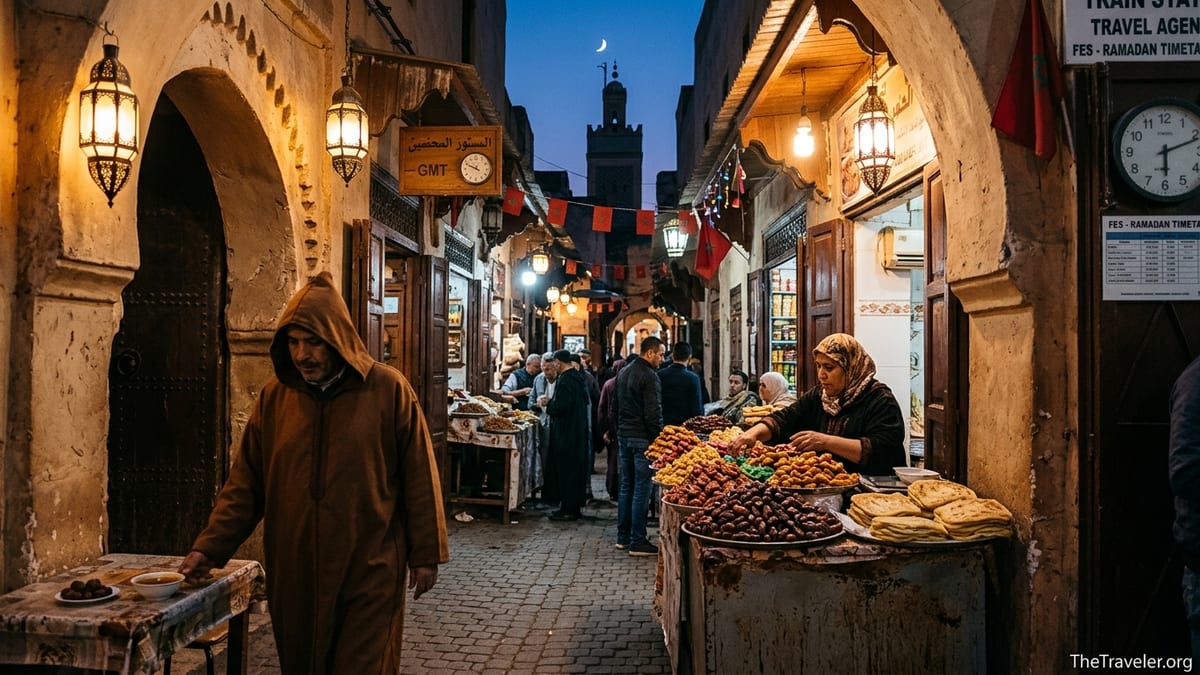
Ramadan 2027 in Morocco: Dates, Moon Sighting and Time Changes
Astronomical forecasts indicate that Ramadan 1448 in Morocco is expected to begin around Monday 8 February 2027, with Eid al-Fitr likely in the first half of March 2027. These dates remain projections, not official religious announcements. In Morocco, only the Ministry of Habous and Islamic Affairs confirms the start and end of Ramadan, typically on the evening before, after nationwide moon-sighting efforts coordinated with regional religious authorities.
For travelers, this distinction matters. Booking flights or hotels around 8 February and the probable Eid period a month later is reasonable, but you should still allow some flexibility because the official start could shift by one day either side of the predicted date. Airlines and hotels will continue to use the civil Gregorian calendar, but local media and mosque announcements will frame life around the lunar calendar.
Ramadan has also historically affected Morocco’s clocks. For several years the country shifted from GMT+1 back to GMT during the fasting month, then returned to GMT+1 afterward. In 2026 the government decided to restore GMT as the year-round legal time, effectively ending the old Ramadan-specific time change. That means in 2027 you should expect Morocco to remain on GMT throughout Ramadan, avoiding the confusing clock moves that travelers once had to track.
Even without a clock change, Ramadan still reshapes the daily timetable. Official working hours for many public offices and schools are usually reduced and shifted earlier, and public transport operators such as the ONCF rail company have a recent pattern of publishing special Ramadan timetables that cluster departures around the compressed workday and avoid the sunset iftar period. These adjustments are normally announced a week or two before Ramadan begins, so February 2027 travelers should check again shortly before departure.
How Ramadan Changes Daily Life and Visitor Experience
From roughly dawn to sunset, many Moroccan Muslims fast from food, drink and smoking, and try to devote more time to prayer and community. This affects the pace of life you will feel as a visitor. Mornings tend to be quiet, with some shops opening late. Midday heat feels more languid than usual, as people conserve energy. Close to sunset, streets and roads may briefly thin out as people rush home for iftar, then fill rapidly again once the evening meal is over.
Travelers often notice that bureaucracy slows down. While essential services continue, it can be harder to accomplish many small errands in a single day. A post office in Rabat or a bank branch in Casablanca might open later than usual and shut by mid-afternoon; obtaining cash, fixing a SIM card issue or posting parcels is still perfectly possible, but it requires planning around shortened working windows and a more relaxed general tempo.
Evenings, by contrast, are vibrant. After sunset prayer and the main iftar meal, families stroll in boulevards, seaside promenades and medina lanes. Parks and main squares such as Marrakech’s Jemaa el Fna or Casablanca’s Place des Nations Unies come to life with food stalls, juice stands, children’s games and street performers. Many cafés and pastry shops reopen late into the night, sometimes staying busy until after midnight as people enjoy sweets like chebakia, sellou and fresh msemen pancakes with honey.
For visitors who enjoy people-watching and night photography, Ramadan’s evenings are a highlight. The trade-off is quieter afternoons and a more fragmented daytime schedule, especially outside the most tourist-dependent districts. Understanding that pattern helps you design your days around early sightseeing, long mid-afternoon breaks and culturally rich nights.
Opening Hours: Monuments, Markets, Museums and Services
In major destinations such as Marrakech, Fes, Casablanca, Rabat and Essaouira, most key historic sites and museums continue to open during Ramadan, but many adjust their hours. For example, in previous years sites such as the Bahia Palace and Badi Palace in Marrakech have maintained morning openings while closing earlier than usual in the late afternoon to allow staff to go home before iftar. Comparable patterns have been seen at the Chellah necropolis in Rabat and the Bou Inania Madrasa in Fes.
Souks and medina markets remain open but shift their peak activity. In Fes el Bali or Marrakech’s central souks, you can still browse leatherwork, carpets and spices in the late morning and early afternoon, though some stalls may shutter for a break around mid-afternoon. After iftar, certain lanes come alive again with evening shoppers, especially for food and clothing. Smaller towns often follow a more pronounced pause, with whole streets going quiet in the hour before sunset.
Banks, government offices and many private companies adopt special Ramadan hours. A typical pattern is opening from around 9:00 to 15:00 Monday to Friday, sometimes with a short internal break for noon prayer. For a February–March 2027 trip, you should plan to withdraw cash, exchange money, handle rental car contracts or visit ticket offices in the late morning rather than late afternoon. Where an attraction is run by a public body, its Ramadan hours are often aligned with this curtailed schedule.
Because each museum or monument can choose its precise hours, some individual sites may introduce shorter schedules than others. For instance, a small regional museum in a town like Tétouan or Taroudant may close completely on certain afternoons, whereas flagship institutions such as the Mohammed VI Museum of Modern and Contemporary Art in Rabat typically publish specific Ramadan hours and remain open, albeit with earlier closing. Before a 2027 visit, it is sensible to confirm opening times a few days ahead via phone or hotel reception, since printed or pre-Ramadan information can quickly become outdated.
Eating and Drinking: Daytime Options, Iftar Culture and Evening Life
Contrary to common myths, non-Muslims are not universally forbidden from eating or drinking in public during Ramadan in Morocco, but sensitivity is expected. The criminal law that restricts Muslims from publicly breaking the fast does not apply to foreign visitors in hotels and tourist restaurants, yet openly walking through a residential neighborhood sipping water or smoking at midday will feel disrespectful and attract disapproving looks.
In practice, food availability strongly depends on location. In tourist-heavy areas such as Marrakech’s Gueliz district, the surroundings of Jemaa el Fna, the Ville Nouvelle of Fes, Casablanca’s central business district and seaside Corniche, and the medina of Essaouira, many restaurants and international coffee chains stay open during the day to serve visitors and non-fasting locals. Hotel restaurants and riad kitchens normally offer breakfast and lunch as usual, and large supermarkets sell takeaway salads, rotisserie chicken and snacks throughout the day.
In predominantly residential areas and small towns, the picture is different. Neighborhood cafés that would usually be full of men drinking coffee and smoking in the afternoon are often closed until shortly before sunset. Simple lunchtime eateries known for set menus or grilled brochettes may choose not to open at all before iftar, or might only operate for takeaway orders. If you plan to explore inland towns along the Fez–Meknes–Azrou corridor or cross the High Atlas by bus, carrying snacks and water purchased discreetly from a supermarket beforehand is wise.
Iftar, the sunset meal that breaks the fast, is a major cultural moment you can often share in. Many hotels and restaurants in Marrakech, Fes and Casablanca offer special iftar menus that begin with dates, milk or juice and harira soup, followed by briouate pastries, boiled eggs with cumin, and then tagines or grilled meats. Prices in 2026 for hotel iftar buffets in large cities have commonly ranged from the equivalent of 150 to 300 Moroccan dirhams per person, depending on the venue’s level. In Jemaa el Fna, street stalls may start serving harira and chebakia shortly before sunset; some will invite travelers to join long communal tables, creating a convivial atmosphere if you are happy with crowds.
Transport in Ramadan: ONCF Trains, CTM Buses, Flights and Taxis
National rail operator ONCF traditionally adapts its services to Ramadan working hours. In recent years it has released special Ramadan timetables for flagship Al Boraq high-speed trains and intercity services, often reducing frequency in the quiet midday slot and adding departures that better match the shorter office day. Trains usually operate across the entire day, but there may be fewer late-afternoon departures and a lull that coincides with iftar when staff and passengers prefer to be home. For February–March 2027, expect standard services on routes like Casablanca–Tangier, Casablanca–Marrakech and Fes–Rabat to continue, with modest timing shifts rather than major cuts.
CTM and other long-distance bus companies also keep running during Ramadan, although demand can spike on certain days. The evenings leading into weekends and the approach to Eid al-Fitr are particularly busy as students and workers return to their family homes. For example, routes such as Casablanca to Agadir or Marrakech to Fes see heavier traffic in the last ten days of Ramadan. Buying tickets a few days in advance, either online or from the station in person, is advisable if you are traveling between major cities in late February or early March 2027.
Airlines serving Morocco, including the national carrier Royal Air Maroc and major European low-cost airlines flying into Marrakech, Casablanca and Agadir, maintain normal flight schedules through Ramadan. What sometimes changes is traveler behavior around specific times of day. Early-morning and late-night flights can be attractive for fasting passengers who prefer to travel when temperatures are lower and meals can be aligned with suhoor or iftar. At airports, some food outlets in landside areas may be closed in the daytime, but international terminal cafés and lounges almost always operate with at least a limited menu for travelers.
Local taxis and ride-hailing services keep operating, but you will feel distinct peaks and troughs. In Marrakech and Casablanca about an hour before sunset it can become harder to find a free petit taxi as drivers head home, and journey times may lengthen in pre-iftar traffic. Immediately after sunset streets calm down as families eat, then pick up again with evening social life. Around Eid al-Fitr, particularly on the eve of Eid and the day itself, public transport is busy and some small-town taxi ranks operate on reduced staffing. If you must catch a train or flight around these dates, give yourself more buffer time than usual.
City by City: Marrakech, Fes, Casablanca, Rabat, Essaouira and Small Towns
Marrakech is often considered the most forgiving city for first-time visitors during Ramadan. Its heavy reliance on tourism means many riads, cafés around Jemaa el Fna, rooftop restaurants overlooking the Koutoubia and venues in Gueliz stay open during the day, although some adopt shorter afternoon hours. Main sights such as the Bahia Palace, Saadian Tombs and the Majorelle Garden usually remain accessible in the mornings. The square itself can be quieter at lunchtime, then transforms into a spectacle of food stalls, juice vendors and storytellers after iftar.
Fes is more conservative and its old medina is deeply shaped by Ramadan rhythms. Many craft workshops and souk stalls function in the morning but pause mid-afternoon; some may not reopen until after Taraweeh prayers at night. Lunchtime options are more limited inside Fes el Bali than in Marrakech’s central districts, although cafés and restaurants in the Ville Nouvelle and near Bab Bou Jeloud often keep some daytime service for visitors. The reward for adjusting your schedule is the magical atmosphere of lantern-lit lanes and late-night pastry shops once the fast is broken.
Casablanca and Rabat, as political and economic centers, blend modern business routines with religious observance. Office towers and government ministries adopt official Ramadan hours, which shape traffic patterns and public transport schedules. In central Casablanca, international hotel chains along the Corniche and in the downtown area continue to serve food throughout the day and often mount elaborate iftar buffets in their restaurants. In Rabat, the medina and Oudaya kasbah area become lively after dark, while the new tram system and ONCF services continue to link the capital with neighboring cities on slightly adapted timetables.
Essaouira and smaller coastal or inland towns feel more tranquil. In Essaouira’s medina, some daytime cafés remain open for tourists, especially around the main square and along the ramparts, but family-run eateries may stay shuttered until just before sunset. In smaller towns such as Chefchaouen, Azrou or Tiznit, many inexpensive eateries close during the day and reopen only for iftar and an evening rush. Travel through these areas during Ramadan is still enjoyable, but it requires more advance thought about lunch and snacks.
Costs, Booking Patterns and Sample Daily Budgets
Hotel and riad rates during Ramadan often soften slightly compared with equivalent winter and early-spring dates outside the fasting month, especially in cities that rely on European city-break traffic. In Marrakech and Fes, many mid-range riads have in recent years offered promotions to fill rooms that might otherwise sit empty during Ramadan, with discounts appearing a few weeks before. However, the picture is not uniform: some high-end desert camps or boutique properties, particularly those focused on Gulf or domestic guests who enjoy visiting during Ramadan, can remain at full price.
Flights into Morocco for February and early March 2027 will reflect broader seasonal and airline trends rather than Ramadan alone. On shorter-haul routes from European hubs such as Paris, Madrid or London, fares can be relatively attractive outside school holidays. The main price spikes usually cluster around Western Easter and European spring breaks rather than Ramadan dates. Around Eid al-Fitr, one-way tickets departing Morocco can rise as residents return to work or study abroad, so booking early for early- or mid-March departures is wise.
For budgeting, a mid-range traveler in Marrakech or Fes during Ramadan 2027 might plan roughly for three price tiers. A lower-budget day staying in a basic guesthouse, eating simple meals and often using petit taxis can come to somewhere in the low hundreds of dirhams, especially if you rely on market snacks and one restaurant meal. A comfortable mid-range day with a well-rated riad room, café lunches in tourist districts, an iftar buffet once or twice during the stay and a few paid museum entries is likely to land in the middle hundreds of dirhams. A higher-comfort day that includes a stylish riad or international hotel, guided tours and multiple sit-down meals in fashionable restaurants can easily run to the upper hundreds or more.
These figures are indicative rather than fixed and depend heavily on exchange rates and inflation in early 2027. What consistently holds true is that eating where locals eat, walking rather than relying on taxis for short distances, and booking train or bus tickets directly with operators rather than via intermediaries keeps costs under control regardless of Ramadan.
Ramadan-Friendly Itineraries: Marrakech, Fes or Rabat, and the Coast
In Marrakech, a two-day Ramadan itinerary works best if you emphasize early starts and long evening walks. On day one you might eat breakfast in your riad at first light, be at the Bahia Palace when it opens, continue to the nearby Badi Palace and Saadian Tombs, then retreat to a shaded café in Gueliz for a late lunch where daytime service is more reliable. After a rest, you could head to Jemaa el Fna about an hour before sunset to watch food stalls set up and witness the call to prayer and iftar. Once the crowds thin, stroll the medina and perhaps join a rooftop restaurant for tea and pastries.
Day two could focus on the Majorelle Garden and the Yves Saint Laurent Museum in the cool of the morning, then the palm groves or a half-day excursion to the Agafay desert in the afternoon. Returning before sunset allows you to experience a second iftar in a different setting, perhaps in a hotel restaurant offering a buffet. Late in the evening, explore modern Marrakech’s bars and lounges; many well-known venues adjust their service but continue to welcome guests, serving mocktails and sometimes live music after the main prayer times.
For Fes or Rabat, a three-day plan allows you to sync with Ramadan’s rhythm. In Fes, spend the first morning with a local guide exploring Fes el Bali’s tanneries, madrasas and artisan quarters while businesses are open. Reserve lunch in a medina guesthouse that explicitly confirms daytime service. Use the afternoon for rest or a hammam visit, then head out after iftar to enjoy the medina’s lantern-lit alleys. The second day can cover the royal palace area and mellah in the morning, with a quieter afternoon in the Ville Nouvelle, and a final day set aside for an excursion to nearby Meknes or Volubilis, returning to Fes in time for sunset.
In Rabat, three days during Ramadan could include the Oudaya kasbah and medina on the first morning, the Mohammed V Mausoleum and Hassan Tower early on the second, and the modern museum quarter on the third. Because Rabat is a capital, you will find reasonably consistent daytime dining near the main boulevards, embassies and business hotels. Evenings on the Bouregreg riverfront and in the medina become animated after iftar, giving a good window into local family life without overwhelming crowds.
An optional coastal alternative might base you in Essaouira for three or four nights. Plan mornings wandering the ramparts, fishing port and medina workshops when light is best and shops are open, then relax in a café that stays open for visitors or on the beach in the afternoon. Many seafront restaurants delay opening until late afternoon, then remain busy into the night with families sharing grilled fish after the fast. If you want an even quieter break, consider combining Essaouira with nearby beach villages, understanding that daytime cafés there may be sparse during Ramadan.
Respect, Prayer Times, Photography and Safety in Crowds
Ramadan is a devotional month, and small gestures of respect go a long way. Dress modestly, avoiding very short shorts or revealing tops, especially in conservative cities and small towns. Refrain from eating, drinking or smoking in front of visibly fasting people whenever you can; discreet sips of water or snacks in a quiet corner, inside a parked car or in your riad are more considerate than open consumption on a crowded street. If a local invites you to share iftar, accepting with gratitude is generally welcomed.
Prayer times shape the day more distinctly during Ramadan. The five daily calls to prayer structure work breaks and family routines. For planning, the key anchors are the pre-dawn suhoor period, the sunset Maghrib prayer when the fast breaks, and the later-night Taraweeh prayers held in mosques. Expect many shops to shut briefly around sunset and for some to stay closed through Taraweeh. As a visitor, it is sensible to avoid planning tight transport connections or must-see visits at the exact moment of Maghrib, particularly on Fridays.
Photography etiquette deserves extra attention. Mosques that are normally open to non-Muslim visitors may be more protective of their spaces during Ramadan prayer times, and people engaged in worship or breaking the fast generally do not appreciate cameras pointed at them. Asking permission with a simple gesture or short phrase before taking portraits, and accepting a refusal gracefully, preserves goodwill. In busy night markets, be mindful of blocking paths or standing in the way of families heading to or from iftar tables.
Evening streets and squares can become very crowded, especially in the last ten days of Ramadan and around Eid. Petty theft is not rampant but can occur in dense crowds, so keep valuables in money belts or zipped interior pockets and avoid displaying expensive cameras or phones unnecessarily. Traffic around major squares can be chaotic just before sunset as drivers rush home; crossing roads cautiously and allowing extra time to reach stations or restaurants will keep stress levels down.
Is Ramadan a Good Time to Visit Morocco?
Whether February–March 2027 during Ramadan is a good time for you to visit Morocco depends on your expectations. If you are drawn to cultural immersion, enjoy evening activity and do not mind planning meals and sightseeing more carefully, Ramadan can be a richly rewarding window. You will see Moroccan family life at its most communal, taste special seasonal dishes that rarely appear outside the fasting month, and witness medinas and squares transform in mood between quiet afternoons and buzzing nights.
Travelers who may struggle more are those who require predictable daytime dining, have very limited time and want to “tick off” a long list of sights each day, or dislike any disruption to standard opening hours. Strict dietary routines, medical conditions that require frequent daytime meals or a strong preference for alcohol with dinner can be harder to accommodate, especially in conservative cities and smaller towns where daytime restaurants are sparse and many venues do not serve alcohol during Ramadan.
If you fall into this latter group, you might still enjoy a short stay in Casablanca, Marrakech or Agadir during Ramadan, where international hotels and many tourist restaurants maintain daytime service, but you should consider scheduling more ambitious itineraries for late March or April 2027, after Eid al-Fitr, when full hours resume. Families with young children or anyone particularly sensitive to crowds may also prefer traveling just before or after the fasting month.
For many others, however, Ramadan offers a memorable, often moving introduction to Morocco. As long as you arrive with realistic expectations, build in rest time, confirm opening hours locally and approach the month with patience and respect, a February–March 2027 journey can be one of the most distinctive ways to experience the country.