


More news on this day
Russia is promising to keep civil aviation operating normally after Ukrainian President Volodymyr Zelenskiy urged airlines and insurers to treat Russian airspace as unsafe because of expanding long-range drone strikes.
Get the latest news straight to your inbox!
Ukraine warns carriers as drone campaign expands
Zelenskiy used a public address on September 1 to urge airlines, insurers and other aviation stakeholders to reconsider using Russian routes, arguing that increased Ukrainian drone operations inside Russia have fundamentally changed the risk profile of the skies above the country. He said Ukraine does not intend to target civilian aircraft, but that the growing number and range of unmanned systems would need to be taken into account by the industry.
According to published coverage, Kyiv has also formally notified the International Civil Aviation Organization that it considers Russian airspace unsafe, reinforcing the message that commercial operators should avoid overflights and services to major Russian hubs. Reports indicate that Ukraine’s position is that the danger stems from Russia’s own decision to launch and continue the war, which has prompted intensified long-range strikes on military, energy and logistics assets deep inside the country.
Analysts note that most European Union and United States carriers already avoid Russian airspace under existing sanctions and company policies introduced after the full-scale invasion in February 2022. The latest warning therefore focuses largely on airlines from Asia, the Middle East and other regions that still use Russian corridors to link Europe with destinations in China, South Asia and the Gulf.
Aviation risk advisory firm Osprey Flight Solutions is cited in recent coverage as telling clients that while the bulk of drone and missile activity is likely within 300 kilometers of the border, daily attacks deeper into Russia, including near Moscow and St Petersburg, are likely through 2026. That assessment has sharpened attention on route planning and overflight exposure for carriers that continue to serve Russian destinations or traverse its airspace.
Moscow’s message: no “significant disruption” to civil aviation
In response, Russian officials are publicly stressing continuity of air travel. Transport Minister Andrei Nikitin has been quoted in Russian and international media as saying that aviation authorities are constantly upgrading flight safety and airport security requirements and that there are solutions in place to address the evolving threat environment. He expressed confidence that the country would not permit any “significant disruption” to civil aviation operations.
Reports indicate that Moscow is emphasizing close coordination between civil aviation agencies, the Defense Ministry and the National Guard to manage the risk posed by Ukrainian drones. Russian statements frame the issue as one of technical and security adaptation, suggesting that existing procedures can be adjusted to maintain scheduled traffic to and from major hubs even as air-defense activity intensifies.
Russian outlets further highlight that domestic aviation has remained largely operational throughout the conflict, despite periodic shutdowns of airports and rerouting of flights during previous waves of drone and missile attacks. This narrative aims to reassure passengers and foreign carriers still serving Russia that, from Moscow’s perspective, the system can absorb additional pressure without a systemic breakdown.
The competing messages from Kyiv and Moscow leave airlines and passengers weighing two sharply different portrayals of risk. While Ukraine frames Russian skies as “effectively closing” in practical terms, Russia presents a picture of a managed security situation in which disruption can be contained.
Early signs of disruption at Moscow’s main airports
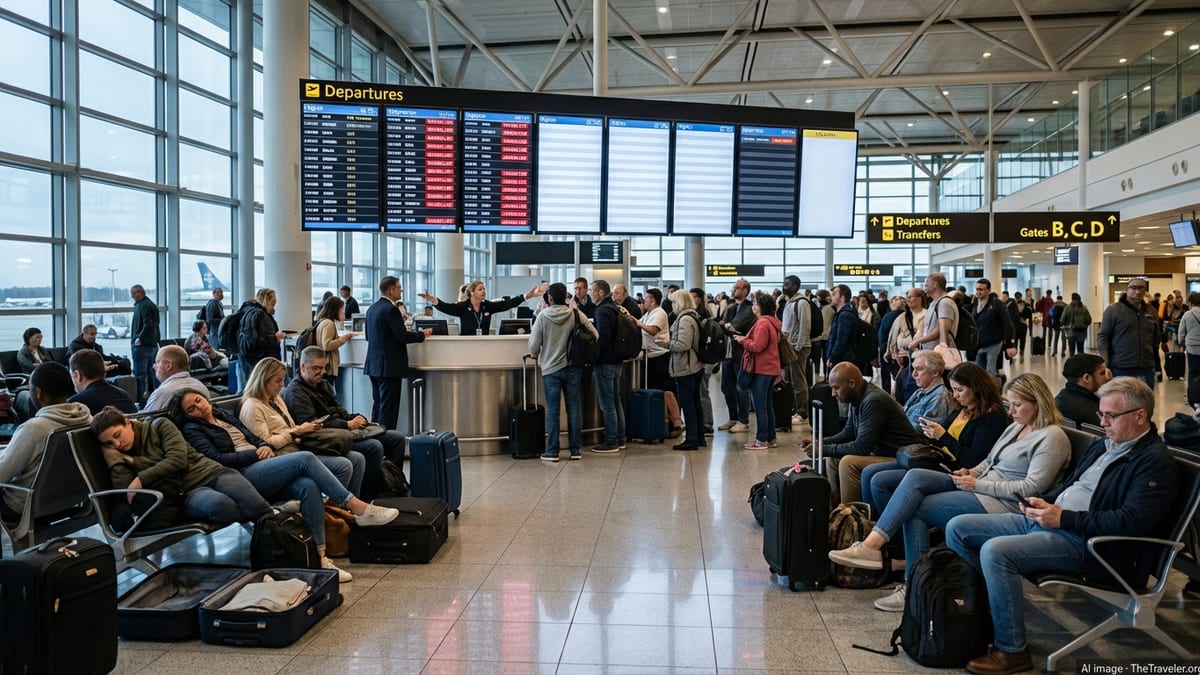
Despite official assurances, flight-tracking data and airline statements point to emerging operational turbulence. Information compiled by services such as Flightradar24 and cited in media reports shows dozens of cancellations and delays at Moscow’s primary international gateways, Sheremetyevo and Vnukovo, in the hours after Ukraine’s latest warning circulated.
Low-cost Turkish carrier Pegasus Airlines confirmed the cancellation of several services to Russia, describing the decision in public remarks as related to “technical and operational” reasons without further detail. Industry observers suggest such language can sometimes reflect underlying security or insurance concerns, particularly in fast-moving conflict environments where risk assessments are being updated daily.
Dubai-based flydubai, which runs an extensive network into Russia, stated that it is closely monitoring the situation, adjusting schedules and routings as necessary, and anticipates that some delays and diversions may occur. Public information from the airline underscores that passenger and crew safety remains its overriding priority, signalling that further changes could be made if the threat picture worsens.
Other large carriers from Turkey, Qatar and the United Arab Emirates, which have maintained services to Russian destinations throughout the war, have not publicly detailed any immediate changes. However, the pattern of selective cancellations and rising delay counts suggests that operators are reviewing risk thresholds, insurance implications and alternative routings that avoid the most exposed areas.
Global airlines weigh routes, costs and safety
The latest developments underscore how the war in Ukraine continues to reshape global aviation networks more than two years after Russia’s full-scale invasion. For carriers that still overfly Russia, the choice is increasingly between shorter, more fuel-efficient routes across Russian territory and longer detours through Central Asia or the Middle East that bypass contested airspace but raise operating costs.
For travelers, particularly those on long-haul journeys between Europe and Asia, that trade-off can translate into longer flight times, missed connections and higher ticket prices as airlines adjust schedules or reduce capacity. Travel industry analysts note that itineraries routing via hubs in the Gulf, Turkey or Central Asia may continue to shift as carriers react to regulatory guidance, insurance conditions and their own internal safety assessments.
Specialist risk firms advise that even in the absence of an outright airspace closure, conflict-driven hazards such as drone activity, electronic warfare interference and the proximity of military operations to civilian flight paths can increase the complexity of flight planning. Some insurers may respond with higher premiums or stricter conditions for flights entering designated risk zones, influencing which routes remain commercially viable.
For now, the situation remains fluid. Russia maintains that its airports and skies are safe for civil aviation, while Ukraine is intensifying a campaign to persuade the global industry that continued use of Russian airspace carries mounting danger. Airlines and passengers will be watching closely to see whether the current wave of warnings and reassurances settles into a new status quo or leads to a more substantial redrawing of international flight paths over Eurasia.
What travelers should monitor in the weeks ahead
For passengers with upcoming itineraries involving Russia, industry experts recommend monitoring airline communications and booking platforms for schedule changes rather than making assumptions based solely on headlines. Many carriers have experience adjusting to conflict-driven airspace restrictions, and significant diversions or cancellations are typically reflected quickly in reservation systems once decisions are made.
Travelers connecting via hubs that frequently overfly Russia to reach Asia or the Middle East may see airlines quietly shift routings while keeping departure and arrival times as close as possible to original plans. In some cases, aircraft may take more southerly tracks that add time in the air but keep flights well clear of the highest-risk regions identified by aviation risk assessments.
Consumer advocates highlight that standard passenger rights rules, including those in the European Union and other jurisdictions, still apply where relevant, though conflict-related disruptions can fall into complex legal categories. In practice, most major airlines provide options such as rebooking on alternative dates or routes when significant schedule changes occur due to security considerations.
As both Ukraine and Russia signal their determination to continue respective military and air-defense campaigns, the prospect of a quick return to prewar overflight patterns appears remote. The coming weeks will show whether Moscow’s pledge to avoid major airspace disruption can be squared with Ukraine’s message that, for global aviation, the “safe moments” over Russia are ending.
Reuters: Moscow vows to avoid airspace disruption despite Zelenskiy’s aviation warning
The Guardian: Russian airspace becoming unsafe for commercial airlines, Zelenskyy says
Euronews: Ukraine formally warns airlines that Russian airspace is unsafe