


Linking Mumbai’s busy Chhatrapati Shivaji Maharaj International Airport (CSMIA) with Navi Mumbai has never been more important. With the new Navi Mumbai International Airport (NMIA) now operating and more metro and bus links on the way, the corridor between the two hubs is rapidly evolving. This guide explains the best current routes from Mumbai Airport to Navi Mumbai, what they cost in real life, typical travel times, and how upcoming changes may soon reshape the journey completely.
Get the latest updates straight to your inbox!
Understanding the Route: Mumbai Airport to Navi Mumbai Today
When people say “Mumbai Airport,” they usually mean Chhatrapati Shivaji Maharaj International Airport in Andheri, which has Terminal 2 for most international and many domestic flights and Terminal 1 for several low-cost carriers. Navi Mumbai, by contrast, is a large satellite city stretching from Vashi and Nerul through CBD Belapur, Kharghar and Panvel, and now includes the new Navi Mumbai International Airport located near Ulwe and Panvel. Depending on where in Navi Mumbai you are headed, your route and travel time will vary substantially.
For central Navi Mumbai locations such as Vashi, Nerul or CBD Belapur, the most direct road route from CSMIA usually runs via the Eastern Express Highway, then the Sion Panvel Highway, and over to the Thane Belapur or Palm Beach Road corridors. In normal off-peak conditions, that can take around 45 to 70 minutes from Terminal 2 to Vashi or Nerul. A taxi booking site that tracks 2026 fares lists the airport to Vashi distance at roughly 30 kilometers, with typical travel times of 40 to 60 minutes depending on traffic.
Travel to more southern parts like Kharghar or Panvel typically follows the Sion Panvel Highway further south, sometimes using the elevated sections near Kamothe. In light traffic late at night, CSMIA to Kharghar can be done in about an hour. At rush hour, especially when there are bottlenecks near Sion, Mankhurd or Vashi Toll Naka, the same trip can stretch to 90 minutes or more. Travellers heading onward to the new Navi Mumbai International Airport need to add another 20 to 40 minutes beyond Kharghar or Panvel, depending on whether they use the coastal Atal Setu bridge or interior roads.
Traffic in Mumbai is highly variable, so it is safer to think in ranges rather than precise numbers. Rule of thumb: if you are connecting from a flight at CSMIA to a flight at NMIA, assume you will need up to three hours door to door in peak hours and about two hours in very early morning off-peak periods. Real-world traveler reports in 2026 describe journeys from CSMIA to the NMIA catchment near Uran or Ulwe taking around 75 to 90 minutes in light traffic but note that missing an expressway exit or facing a jam around Mankhurd or Nerul can easily add 20 minutes or more.
Taxi and App Cabs: Fastest and Most Flexible
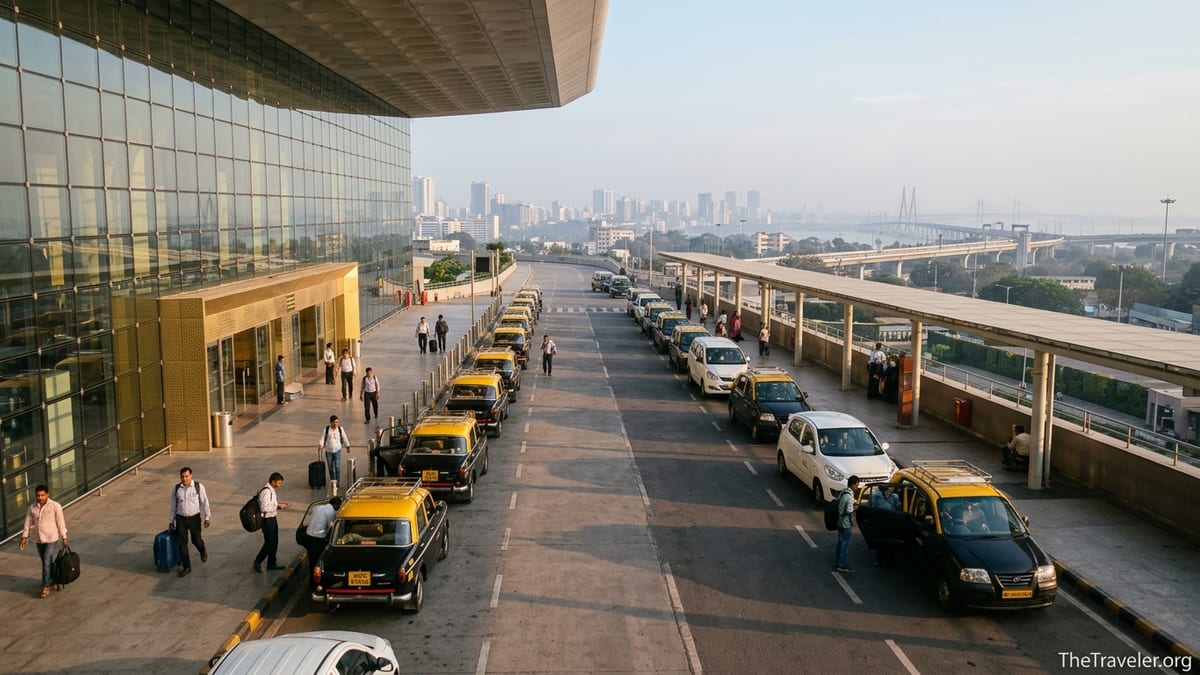
For most visitors, especially those with luggage or travelling at odd hours, a taxi or app cab remains the simplest way to get from Mumbai Airport to Navi Mumbai. At CSMIA, you will find official prepaid taxi counters inside the arrivals area, city black-and-yellow metered taxis just outside, and designated pick-up zones for Uber and Ola in the multi-level car park and forecourt. The prepaid booths offer fixed fares by zone, while app cabs fluctuate with demand.
Recent fare tables from airport-focused taxi aggregators in 2026 suggest that a prepaid or city taxi from CSMIA to Vashi usually costs in the region of 800 to 1,000 rupees, with Uber or Ola often quoting around 600 to 1,000 rupees for the same trip in an economy sedan when there is no heavy surge. To Kharghar or Panvel, taxis may quote closer to 1,200 to 1,600 rupees, while app cabs can range widely depending on time of day and rain conditions. One airport transfer comparison site in 2026 estimated that rides from CSMIA to a generic Navi Mumbai destination of around 35 kilometers tend to cost roughly the same as a mid-range European city airport transfer, with private pre-booked cars priced in the 35 to 60 euro band equivalent.
Travellers on forums in 2026 report that an off-platform driver at CSMIA recently charged about 2,000 rupees for a late-night trip from the airport to near Uran, on Navi Mumbai’s coastal edge, taking around 75 minutes via interior roads. Others complain of being quoted 3,000 to 4,000 rupees for app cabs between NMIA and central Mumbai suburbs such as Dadar or Mulund at peak hours or during heavy rain. These anecdotes underline two practical tips: avoid accepting unsolicited taxi offers outside the arrivals hall and always check the live fare on Uber or Ola before negotiating with a driver.
If you have multiple large bags or are travelling as a family of three or four, taxis and app cabs are usually the best balance of comfort, time and cost. Opt for a larger category such as Uber Premier or Ola Sedan if you have two full-size suitcases plus carry-ons. For a same-day airport-to-airport connection, many travellers now choose to pre-book an outstation-style sedan or SUV through specialized airport transfer companies, because they provide guaranteed pick-up, space for luggage and a driver experienced with Navi Mumbai routes and the Atal Setu bridge approaches.
Budget Options: BEST and NMMT Buses from the Airport
For cost-conscious travellers or solo visitors without heavy baggage, buses provide the cheapest way to reach Navi Mumbai from CSMIA, at the cost of slower trips and one or two changes. Mumbai’s red BEST buses and Navi Mumbai’s blue-and-grey NMMT buses together cover a dense network linking the airport area with Vashi, Nerul, CBD Belapur, Kharghar and beyond. Several air-conditioned BEST routes serving CSMIA connect with points on the Eastern Express Highway and Sion Panvel Highway, where you can change to NMMT services heading deeper into Navi Mumbai.
In 2026, various bus guides list air-conditioned BEST routes from the airport with fares starting around 75 to 100 rupees for longer city journeys. One route from Vile Parle near the airport to Vashi is shown with journey times of about 40 minutes in light traffic. Buses specifically marked for Thane and Navi Mumbai often pass key junctions such as Mankhurd, Vashi and CBD Belapur, allowing connections to NMMT services. On the Navi Mumbai side, the municipal transport undertaking reports a network of routes totalling approximately 2,000 route-kilometres, with average route lengths around 26 kilometres, indicating a fine-grained grid that can get you quite close to residential and office pockets.
At the new Navi Mumbai International Airport, bus connectivity is already emerging as a critical lifeline. Several premium airport bus routes, including air-conditioned services branded under the Chalo technology platform, now run from the airport to nodes such as Nerul, CBD Belapur, Bandra Kurla Complex and the traditional business district near Cuffe Parade. Travellers on social platforms in mid 2026 describe taking a local A-series AC bus from NMIA to Nerul station for as little as 10 rupees, then onward by auto-rickshaw or taxi, reducing door-to-door costs from around 1,000 rupees by taxi alone to under 200 rupees total.
These bus options are especially useful if you arrive at CSMIA, travel into Navi Mumbai by bus and suburban train for a few days, and then fly out of NMIA. However, they require a bit of advance planning. Since route numbers, stops and schedules can change frequently, particularly around new hubs like NMIA, it is wise to check a live transit app or the latest notices from BEST and NMMT on the day you travel rather than relying on an older printed list.
Train and Metro Combinations: When They Make Sense
Trains and metro lines can significantly reduce both costs and, at times, travel time, especially if you are not travelling with heavy luggage. From CSMIA, the closest Mumbai Metro Line 1 stations are Airport Road and Marol Naka, just a short auto-rickshaw or app-cab ride from the terminals. Metro Line 1 runs east to Ghatkopar, where you can connect to the Central Railway suburban line, or west to Andheri, where you can access the Western Railway. The airport is also relatively close to Andheri railway station by auto or taxi.
A popular budget route in 2026 for those heading to Navi Mumbai from CSMIA is to take an auto-rickshaw from the terminal to either Airport Road metro station or directly to Ghatkopar station. From there, you catch a Central Railway local toward Kurla and change for a Harbour line train to Vashi, Nerul, Seawoods or Panvel. Total fare for the train segments can be under 100 rupees in second class, and even in first class the combined cost is usually far below an app cab. Travellers report that this routing is realistic if you are carrying a backpack or a single rolling suitcase and are comfortable climbing footbridges and navigating crowded platforms.
On the Navi Mumbai side, the Navi Mumbai Metro Line 1 between CBD Belapur and Pendhar is now operational, and planning documents highlight an eventual extension toward NMIA. For the moment, the most practical use of the Navi Mumbai Metro for air travellers is for those staying in residential or office areas along the line and connecting by road or bus to NMIA or to the traditional highway network. As of mid 2026, official materials from the regional development authority still describe Mumbai Metro Line 8 as a proposed “Airport Metro” line that would directly connect CSMIA with NMIA over roughly 35 kilometres, but work on this line is still in the planning and early approval stages.
Looking ahead a few years, once more of Mumbai’s metro corridors and the Navi Mumbai Metro extensions are complete, a multi-leg airport journey that stays mostly on rail may become feasible. Documents from transport planners for the Mumbai Metropolitan Region refer to a vision where metro Line 8, the Red Line, and other routes ultimately create a grid in which a traveller arriving at CSMIA could simply walk to a metro station, ride the “Airport Line” and disembark directly at NMIA without touching road traffic. Until that happens, trains and metro will remain most useful as feeder modes: you might, for example, take a local train from Vashi to Kurla, connect via Metro Line 1 to Airport Road, then take a short taxi into CSMIA.
Travel Time, Luggage and Timing Your Journey
The single biggest variable in any Mumbai Airport to Navi Mumbai trip is time of day. Between roughly 8:00 and 11:30 in the morning and 5:30 and 9:30 in the evening on weekdays, the Eastern Express Highway, Sion Panvel Highway and approaches to Vashi and Mankhurd can be clogged. A ride that takes 45 minutes at 11:00 at night can easily take 90 minutes at 8:30 on a rainy Tuesday morning. If you have a flight to catch from NMIA and are coming from CSMIA or the Andheri area, adding at least one “extra” hour to the travel time estimate is generally prudent in peak or monsoon conditions.
Luggage is another decisive factor. With one backpack or cabin trolley, combining metro and train is perfectly manageable, especially if you are comfortable in crowds and do not mind stairs. With one full-size suitcase and one cabin bag, a metro plus suburban train combination is possible but will be tiring in peak hours. With two large suitcases or any bulky sports equipment, road-based options are almost always the better choice. In 2026, several real-world travellers recount struggling to board packed Harbour line trains at Kurla with even a single large suitcase, while others praise the convenience of door-to-door app cab rides that allowed them to keep their luggage secured in the boot without lifting it through stations.
Consider also your flight timing. For an early morning domestic departure from NMIA around 8:00, travellers in 2026 often report leaving central Mumbai or Andheri by 3:30 or 4:00 to allow 90 minutes for the road journey plus check-in and any unexpected snags with taxi availability. Some people trying to connect from a 4:20 arrival at CSMIA to an 8:20 departure at NMIA debate online whether four hours is enough. The general consensus is that it is feasible in off-peak hours, but only with careful planning, a contingency budget for surge-priced taxis, and minimal checked luggage to avoid delays at baggage claim.
If you are arriving at NMIA and heading into Navi Mumbai itself, your timing considerations are slightly different. Bus riders have noted that airport bus services can bunch up, meaning you might wait 15 to 25 minutes for the next bus to Nerul or CBD Belapur. App cab availability at NMIA also spikes and dips, and there have been many reports in early 2026 of long waits or very high fares for short journeys to nearby nodes like Kharghar, with drivers canceling trips or demanding off-app payments. In these cases, the most time-reliable option is often to take whatever bus is leaving soonest to the nearest major node, such as Nerul or CBD Belapur station, and only then hail a taxi or rickshaw for the last few kilometres.
New Navi Mumbai International Airport: Changing the Map
The opening of Navi Mumbai International Airport marks a major shift for air travel to and from India’s financial capital. Official information from the airport developer and aviation authorities indicates that NMIA lies roughly 35 kilometres southeast of CSMIA, near Ulwe in Panvel taluka, and about 40 kilometres east of South Mumbai. High-level government announcements in late 2025 and 2026 framed NMIA as the city’s long-awaited second international airport, intended to ease congestion at CSMIA and serve as a new gateway for both domestic and international traffic.
On the ground, however, the early months of NMIA operations have been a mix of convenience and frustration. On the positive side, passengers praise the modern terminal, quick check-in and shorter taxi times on the runway compared with CSMIA. On the negative side, there are repeated complaints of patchy mobile network coverage near parts of the terminal, a lack of clearly marked prepaid taxi counters, and very expensive app cab fares for relatively short journeys within Navi Mumbai. Travellers report Ola and Uber quotes of 1,000 rupees or more for a 5 to 6 kilometre ride to Kharghar at certain times, with some rides to Mumbai’s central suburbs quoted above 3,000 rupees when demand is high.
In response, many local commuters have already adapted with creative multi-modal hacks. One frequently cited real-world example involves walking to the airport bus bays, boarding a low-fare A-series bus to Nerul station for around 10 rupees, and then transferring to an auto-rickshaw or local taxi for the final few kilometres home, bringing the total cost down to under 200 rupees compared with more than 1,000 rupees by direct app cab. Others route themselves via CBD Belapur or Belapur station, where suburban trains, Navi Mumbai Metro services and a larger pool of taxis and rickshaws make it easier to complete the journey without extortionate surge pricing.
As NMIA ramps up flights through 2026, the balance between these options may change quickly. Governments and agencies such as the City and Industrial Development Corporation of Maharashtra and the Mumbai Metropolitan Region Development Authority have long planned for dedicated high-capacity connections, including road improvements, new bridges and metro lines. For now, travellers should treat NMIA as a work in progress on the access front, expect that taxi and app-cab conditions may be volatile, and build in extra time and budget when using the new airport.
What May Change Soon: Metro Line 8, Atal Setu and Better Buses
The biggest game-changer on the horizon is Mumbai Metro Line 8, often referred to in planning documents as the “Airport Metro” or “Gold Line,” which is designed to link CSMIA and NMIA directly over approximately 35 kilometres. Regional planning reports for the Mumbai Metropolitan Region and metro influence zone documents describe this line as part of a wider network that, once built, would allow metro capacity to rival that of the existing suburban railway. Feasibility and alignment work has been progressing, and state authorities have signalled that connecting the two airports is a high priority, but as of mid 2026 there is no firm opening date. When it does arrive, an all-metro CSMIA to NMIA trip in under an hour could become realistic, dramatically reducing the need for airport-to-airport taxis.
Another structural change already reshaping some trips is the Atal Bhashantar Setu, popularly shortened to Atal Setu, the long sea bridge linking Mumbai’s mainland side with Navi Mumbai and beyond. While this bridge primarily connects areas like Sewri and Shivaji Nagar with the Nhava Sheva and Uran region, it shortens road travel times to parts of Navi Mumbai and the NMIA hinterland. At off-peak hours, a taxi from South Mumbai using Atal Setu to reach Ulwe, Kharghar or even the environs of NMIA can cut journey times that previously approached two hours down to around an hour, at the cost of tolls added to the taxi fare.
Bus connectivity is also improving rapidly. Tech-enabled operators and public bodies have launched new airport-focused bus routes in 2026, including premium Chalo-branded AC services from NMIA to Andheri’s Marol depot and to business districts like Bandra Kurla Complex and Cuffe Parade. Similar premium routes are expected to strengthen links between CSMIA and Navi Mumbai nodes as demand patterns become clearer. Over time, a network of frequent, limited-stop, air-conditioned buses running along the main corridors between the two airports and through Vashi, Nerul and CBD Belapur could offer a compelling alternative for travellers who do not want to pay taxi rates but still value some comfort and luggage space.
Finally, on the Navi Mumbai side, the planned extension of Navi Mumbai Metro Line 1 from CBD Belapur and Pendhar toward NMIA will steadily increase the share of the city’s residents who can reach the new airport predominantly by rail. Current metro documents describe the system as having one operational line, with further lines and airport extensions under planning. Once completed, residents of areas like Kharghar, Taloja and beyond may be able to ride the metro straight to the airport, then transfer to bus or metro line 8 for CSMIA, creating a very different mental map of the Mumbai–Navi Mumbai air travel corridor from the taxi-dominated reality of today.
The Takeaway
For now, the most straightforward way to travel from Mumbai Airport to Navi Mumbai remains a taxi or app cab, especially if you are carrying significant luggage or travelling during off-peak hours when fares are moderate and traffic manageable. Expect to pay somewhere around 600 to 1,600 rupees for typical point-to-point journeys between CSMIA and core Navi Mumbai neighbourhoods such as Vashi, Nerul, CBD Belapur or Kharghar, and more if you are travelling deeper into the Ulwe and Uran region or facing heavy rain and peak-hour surge pricing.
If you are on a tighter budget, the combination of a short auto-rickshaw to the nearest metro or railway station, followed by suburban trains on the Central and Harbour lines and then a final NMMT bus or rickshaw, can bring your total costs down below 200 rupees at the expense of comfort and simplicity. This works best if you travel light and are familiar with Mumbai’s public transport etiquette. At the new Navi Mumbai International Airport, be prepared for growing pains in surface access: bus services are becoming more useful every month, while app cab fares remain volatile and can be strikingly high for short hops.
Looking ahead, the picture will change dramatically. Metro Line 8, better integration between Mumbai Metro and Navi Mumbai Metro, and stronger premium bus networks are all in the pipeline. Combined with the Atal Setu bridge and ongoing road upgrades, they promise a future in which a visitor could land at either airport and reach the other, or any major node in Navi Mumbai, by a fast, mostly rail-based journey with predictable timing. Until that future arrives, planning ahead, checking live traffic and fare conditions, and having a backup route in mind are the best tools for making the Mumbai Airport to Navi Mumbai trip smooth and stress-free.
FAQ
Q1. How long does it usually take to travel from Mumbai Airport to Navi Mumbai?
In light traffic late at night, CSMIA to Vashi or Nerul can take about 45 to 60 minutes. In peak hours or heavy rain, the same trip can stretch to 90 minutes or more, and journeys to Kharghar, Panvel or the Navi Mumbai International Airport may require up to two hours.
Q2. What is the typical taxi or Uber cost from Mumbai Airport to Vashi or Nerul?
As of 2026, most travellers pay roughly 600 to 1,000 rupees for an app cab like Uber or Ola from CSMIA to Vashi or Nerul, and around 800 to 1,000 rupees for a prepaid or city taxi, depending on exact location, time of day and surge pricing.
Q3. Is it realistic to connect between Mumbai Airport and Navi Mumbai International Airport in four hours?
It can be realistic in off-peak hours if your flights are on time, you travel with light luggage and you secure a taxi or fast bus quickly. However, during peak traffic or bad weather, four hours can become tight, so allowing more buffer time is advisable whenever possible.
Q4. What is the cheapest way to get from Mumbai Airport to Navi Mumbai?
The cheapest options usually combine a short auto-rickshaw ride from the airport to a metro or train station, then a suburban train to Vashi, Nerul, Seawoods or Panvel, followed by a local NMMT bus or rickshaw. Total fares can be under 200 rupees if you use second-class train tickets and regular buses.
Q5. Are there direct buses from Mumbai Airport to Navi Mumbai?
There are air-conditioned BEST buses that serve the airport area and travel toward Thane and Navi Mumbai, and some premium routes link the airports with key nodes. However, you will often need at least one change, for example at a junction like Mankhurd, Vashi or CBD Belapur, rather than a single direct bus for every Navi Mumbai destination.
Q6. How safe is it to take a taxi or app cab late at night between the airports?
Late-night taxi and app cab travel between CSMIA, Navi Mumbai and NMIA is common, and main highways remain busy. For safety, use official prepaid taxis or reputable app cabs, avoid accepting unsolicited offers outside terminals, share your trip details with a contact, and check that the driver follows the route shown in your navigation app.
Q7. Can I use the Mumbai Metro all the way from Mumbai Airport to Navi Mumbai?
At present you cannot complete the entire journey only by metro. You can use Metro Line 1 from Airport Road or Marol Naka to reach Ghatkopar or Andheri, then change to suburban trains and onward buses. A dedicated “Airport Metro” line connecting CSMIA and NMIA is planned but not yet operational as of mid 2026.
Q8. Is the new Navi Mumbai International Airport well connected by public transport?
Public transport links to NMIA are improving but still developing. There are airport buses to hubs like Nerul, CBD Belapur and central Mumbai, and more routes are being added. However, app cabs can be expensive and train or metro access is not yet seamless, so allow extra time and check the latest bus options before you travel.
Q9. What should I consider if I have a lot of luggage?
If you have multiple large suitcases or bulky items, road-based options such as prepaid taxis, Uber or Ola, or pre-booked private transfers are usually best. Trains and buses involve steps, crowded platforms and limited luggage space, which can be difficult to manage with heavy bags, especially in peak hours.
Q10. Will future metro lines really make it easier to move between Mumbai and Navi Mumbai airports?
Planning documents for the region envision Metro Line 8 directly linking CSMIA and NMIA, plus extensions of Navi Mumbai Metro and stronger feeder lines. Once these are built, travel between the two airports and across Navi Mumbai should become faster, more predictable and less dependent on taxis and traffic, though this transformation will take several more years.