


Mumbai’s Chhatrapati Shivaji Maharaj International Airport (BOM) is busy, sprawling and often confusing, especially when your domestic and international flights use different terminals. With airlines split between Terminal 1 and Terminal 2, many itineraries now require an inter-terminal transfer on public roads. This guide explains, in practical detail, how to move between T1 and T2 in 2026, what the complimentary shuttle does and does not cover, how long the journey really takes at different times of day, and how much connection time you should allow.
Get the latest updates straight to your inbox!
Understanding Mumbai Airport’s Terminals in 2026
Mumbai Airport operates two main passenger terminals: Terminal 1 for most low-cost domestic flights and Terminal 2 for all international services plus a growing share of full-service domestic flights. Terminal 1 is in Santacruz on the Western side of the airfield and is used primarily by domestic carriers such as IndiGo, SpiceJet and Akasa on selected routes. Terminal 2, at Sahar in Andheri, is the larger integrated terminal that handles all international airlines alongside Air India and many other domestic flights. The two terminals are not connected airside, so any transfer between them involves exiting one terminal and traveling on city roads to the other.
For example, a typical pattern in 2026 might see you arriving into Mumbai on an IndiGo domestic flight at Terminal 1 from Goa, then connecting to an Emirates or Qatar Airways long haul flight out of Terminal 2. Conversely, you might land from London or Dubai at Terminal 2 with British Airways or Emirates and then connect onward on a low-cost domestic flight from Terminal 1 to cities like Jaipur, Kochi or Ahmedabad. In both cases you must budget time for immigration or security, baggage collection where applicable, and the surface transfer between terminals.
The physical distance between the two buildings is not huge on a map, but road access winds around the perimeter of the airfield and passes through some of Mumbai’s busiest traffic corridors. In free-flowing traffic very late at night or early morning, a taxi can sometimes cover the distance in about 10 minutes. In daytime peak or during monsoon downpours, the same journey can easily stretch to 25 minutes or more. Understanding this variability is essential when planning connections.
It is also important to recognize that airline terminal allocations can change, particularly during ongoing consolidation of Indian carriers. Before you travel, check your booking or boarding pass to confirm which terminal each flight uses, and verify again the day before departure on the airline or airport’s official channels. Do not assume that all flights of a given airline depart from the same terminal; for instance, some IndiGo domestic flights operate from Terminal 1 while their international flights use Terminal 2.
The Complimentary T1–T2 Shuttle: Who Can Use It and From Where
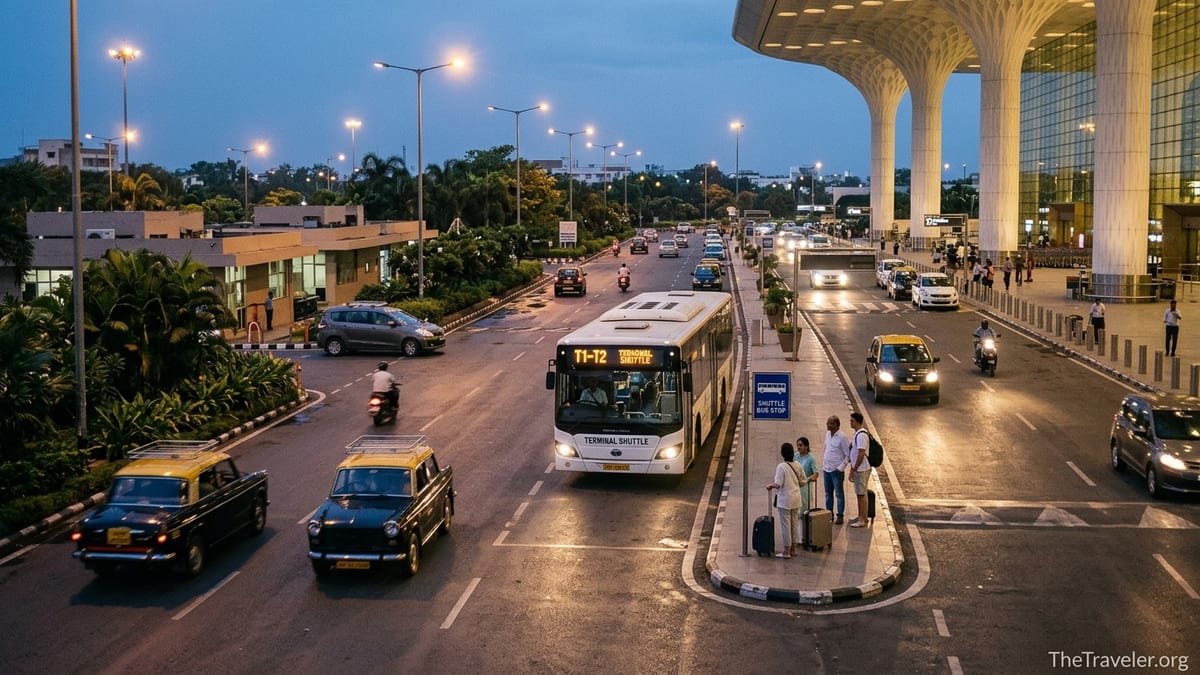
Mumbai Airport now operates a complimentary inter-terminal coach service between Terminal 1 and Terminal 2 for eligible passengers. This service runs 24 hours a day and is primarily designed for travelers who hold a valid onward booking from the other terminal on the same day. In practice, staff typically look for a same-day boarding pass or e-ticket for a departing flight from the opposite terminal before allowing you to board. The shuttle uses standard city roads and is not an airside connection; you still exit the secure zone and re-clear security or immigration at your next terminal.
At Terminal 1, the shuttle pickup point is usually located near the arrivals area outside the building, toward the side where departures vehicle lanes begin. Signage may refer to it as the inter-terminal coach or T1–T2 shuttle. In concrete terms, if you arrive into T1, collect your bags and walk out through the main exit, you will typically turn toward the departures canopy and look for a small coach with airport branding and a board indicating T1–T2 shuttle. During busy periods staff with high-visibility vests often direct passengers and may check your onward flight details before boarding.
At Terminal 2, the shuttle generally departs from the ground transportation level, close to the taxi and app-cab pickup lanes. If you land internationally into T2, you will clear immigration and customs, exit into the arrivals hall, then follow signs to ground transport on Level 1, where you will find a lane designated for inter-terminal coaches. A common real-world example is an arrival at 03:00 on a long-haul international flight: once you exit customs, you head down to the coach lane at Level 1 and join the queue for the shuttle to Terminal 1, along with other domestic transfer passengers.
Because the service is complimentary and relatively new, processes and signage can evolve. When in doubt, ask at an airport information desk inside the terminal before exiting. Staff are accustomed to questions about transfers and can point you to the current shuttle stop location, or, if the shuttle would cut it too close for your next flight, may suggest using a taxi instead.
Shuttle Frequency, Operating Hours and Realistic Transfer Times
The inter-terminal coach is advertised as a 24/7 service, with buses typically departing every 20 to 30 minutes. In practice, the exact headway can vary depending on time of day, traffic and operational constraints. Travelers in early 2026 frequently report shuttle waits of around 15 to 25 minutes, but you should not assume best-case timing; especially if you are connecting to an international departure, it is safer to mentally budget a full 30 minutes as potential waiting time for the next bus.
Once onboard, the actual road journey between Terminals 1 and 2 usually takes around 10 to 15 minutes at quiet times, such as between midnight and 05:00. For example, a passenger traveling from a 01:30 arrival at T1 to a 04:30 departure at T2 might wait 15 minutes for a shuttle, then ride 12 minutes on nearly empty roads, arriving with ample time to clear security and immigration. During daytime peaks, roughly 08:00 to 11:00 and 17:00 to 21:00, traffic around the airport can be heavy, and the same shuttle ride may stretch to 20 or 25 minutes, particularly if monsoon rains or local construction slow traffic.
Combining waiting and travel time, a realistic door-to-door transfer window using the complimentary shuttle is usually around 35 to 45 minutes, but can occasionally exceed 60 minutes in poor traffic. This does not include time to clear immigration, customs or security checks at either terminal, which can add anywhere from 10 minutes in the smallest domestic queues to 60 minutes or more in peak international arrival waves. For example, arriving from Europe at 21:30 on a busy evening might mean 30 to 45 minutes at immigration, 15 minutes to collect luggage, 15 to 25 minutes to reach the shuttle and wait, and 20 minutes on the road, totaling more than 90 minutes before you even reach the check in counters at Terminal 1.
Because of this variability, the shuttle works well for passengers with generous layovers but can feel tight for those with short self-planned connections. If your itinerary has less than three hours between an international arrival and a domestic departure in the other terminal, it is often better to plan on using a taxi or app-based cab rather than waiting for the next shuttle, especially in daytime or early evening. The difference in cost is modest compared with the risk of missing a flight.
Alternative Ways to Travel Between T1 and T2
While the complimentary shuttle is convenient, it is not your only option. Regular city taxis, app-based cabs and, for light travelers, even auto rickshaws ply the roads between Santacruz and Sahar. A metered black and yellow taxi or a ride-hailing cab booked through a popular app will typically cost the equivalent of a few hundred Indian rupees for the short hop between terminals, depending on time of day, surge pricing and tolls if any. For many travelers, especially those carrying large suitcases or traveling with children, this relatively small cost is a fair trade-off for having a direct, private transfer that leaves when you are ready.
In practice, a solo traveler landing at Terminal 2 at 18:00 with only cabin baggage and a 21:30 domestic connection from Terminal 1 might decide to skip the shuttle line entirely. Instead, they can exit to the taxi area at T2, request an app-based cab, and be on the road within 5 to 10 minutes. Travel time in evening traffic could be 20 to 30 minutes, but they remain in control of departure time and route, and do not need to wait for the next shuttle’s scheduled departure.
Auto rickshaws are commonly seen just outside the airport’s immediate perimeter and can be a cheaper, more nimble option, especially in heavy traffic where smaller vehicles can sometimes weave through congestion more effectively. However, autos may not be allowed into certain inner airport lanes, and they are less comfortable and secure for passengers with large amounts of luggage. As a result, they are better suited to experienced travelers or locals who are familiar with Mumbai and comfortable negotiating fares or enforcing meter use.
Prepaid taxi counters are available at the terminals as well. These allow you to pay a fixed fare in advance based on the standard tariff for a ride between terminals, then present a slip to the driver. This can be reassuring for first-time visitors who are uneasy about haggling or using ride-hailing apps on arrival. In all cases, factor in time for finding the stand, queuing during busy periods and possible short waits as drivers are assigned, particularly late at night when the number of available cars is lower.
Luggage, Check In and What Happens to Your Bags
Whether your luggage is checked through or needs to be collected and rechecked is one of the most important questions when transferring between terminals in Mumbai. If both of your flights are on a single ticket, such as an Air India domestic sector connecting to an Air India or Star Alliance long haul from Terminal 2, your bags are often checked straight through to your final destination. In that scenario, you may receive both boarding passes at your first check in and can follow the transit or transfer signs without reclaiming luggage, although you still must change terminals using the shuttle or a taxi.
However, many passengers transit Mumbai on separate tickets, especially where a low-cost domestic connection is involved. For example, you might buy a budget IndiGo flight from Bengaluru to Mumbai arriving at Terminal 1, then a separate Emirates ticket from Mumbai to Dubai departing Terminal 2. In this case, your first airline will usually tag bags only to Mumbai. You must collect them from the belt, clear customs if arriving internationally, then transport them yourself to the other terminal and check them in again. The airport shuttle is not a baggage-transfer service; you and your bags ride together.
For travelers with heavy or multiple bags, the lack of porters on the shuttle route can be a practical constraint. While there are porter services inside both terminals to help you bring luggage from the arrivals belt to the vehicle lanes or from the drop-off area to the check in counters, these services do not generally accompany you between terminals. This means that if you rely on physical assistance for your bags, you may find it easier to hire a taxi or private car where the driver can assist you loading and unloading baggage directly at each terminal curb.
Carry-on-only travelers have a simpler experience. Consider a passenger landing from Singapore at Terminal 2 with only a cabin bag, then connecting to a domestic Air India flight departing from the same terminal. They may be able to use airside transfer channels without leaving the building at all. By contrast, the same traveler connecting from a Terminal 2 arrival to a low-cost domestic airline at Terminal 1 with hand luggage only still needs to exit T2 and change terminals, but they can move much faster and are less dependent on shuttle luggage space. In all cases, pack with transfers in mind: keep essential items, including medications and a change of clothes, in your cabin baggage in case a tight transfer forces you to rebook onward travel.
How Much Time to Allow for T1–T2 Connections
Because there is no guaranteed airside transfer and road traffic is unpredictable, choosing a safe connection time at Mumbai requires some conservatism. For domestic to domestic transfers where both flights use different terminals, many seasoned travelers aim for a minimum of 3 hours between scheduled arrival and departure. This typically allows 20 to 30 minutes for taxiing, disembarkation and baggage delivery, 45 minutes for shuttle wait and ride or a cab trip, and at least 60 to 90 minutes for check in and security, plus a buffer for delays. For instance, a Bengaluru to Mumbai flight that lands at 08:00 at Terminal 1 connecting to a 11:10 departure from Terminal 2 is generally comfortable, though delays in peak morning traffic can still compress that margin.
International to domestic transfers between terminals are more complex, largely because of immigration and customs. As a cautious rule for separate tickets, plan at least 4 to 5 hours between a scheduled international arrival at Terminal 2 and a domestic departure from Terminal 1. A 03:00 arrival from Europe with a 07:00 domestic flight from T1 can work if the inbound plane is on time and queues are short, but leaves little cushion if your flight is delayed, immigration lines stretch to 45 minutes, or the shuttle waits and traffic add another 40 minutes on top.
On a single through-ticket where both segments are under one booking and ticketing agreement, airlines may sell shorter legal connection times, sometimes as low as 90 minutes for domestic to domestic, or 2 to 3 hours for international to domestic. When you accept such a connection, the airline is generally responsible for reaccommodating you if a delay in their own operations causes a misconnection. However, even on a single ticket, many experienced travelers prefer slightly longer layovers in Mumbai given the potential for weather disruptions and traffic snarls around the airport access roads.
For domestic to international transfers between terminals on separate tickets, err on the side of a longer gap. Aim for at least 4 hours, and 5 or more during the monsoon season or if your domestic flight is among the first of the day after overnight parking. This allows for check in cut-off times of many international carriers, which can close desks 60 minutes or more before departure. Missing that cut off because your taxi from Terminal 1 was stuck in traffic is a costly mistake, especially when long-haul tickets from airlines like Lufthansa, Singapore Airlines or United are involved.
Practical Tips for Stress-Free Inter-Terminal Transfers
A few simple habits can make the T1–T2 connection much less stressful. First, always verify your terminals and flight times before you travel. Use your airline’s official communication channels or Mumbai Airport’s official passenger information pages on the day of travel to confirm which terminal handles your departure. Terminal allocations can change for operational reasons, and an assumption based on a previous trip may no longer be correct. If you discover that both flights now use the same terminal, you can relax and skip the inter-terminal logistics entirely.
Second, budget time according to the higher-risk segments of your journey. Evening arrivals, monsoon months, and public holidays in India can all increase congestion on the roads leading to and from the airport. If you know you are arriving at 18:30 on a Friday in July, treat connection time estimates conservatively. Similarly, if your inbound domestic flight is on a carrier known for tight scheduling and occasional delays, such as a low-cost airline with many daily rotations, avoid booking an onward flight from the other terminal with a very short layover, even if online tools show the bare minimum as technically possible.
Third, keep necessary documents and some local cash or a functioning digital payment method easily accessible for taxis, porters and incidentals. While the shuttle is free, having a quick alternative can save a connection if you come out of customs to find a full shuttle just departing. Being able to pay for an app-based ride within minutes gives you an extra layer of resilience. Likewise, if you are traveling with family, assigning one adult to lead and the other to manage documents and small children can make the transit smoother in Mumbai’s sometimes crowded curbside areas.
Finally, remember that once you change terminals you still need to pass through security and, for international departures, exit immigration. Security at both terminals can be thorough, with separate lines for men and women and hand-baggage screening that sometimes moves slowly during surges. Plan to be at your departure terminal with at least 2 hours to spare for domestic flights and 3 hours for international flights, after accounting for shuttle or taxi transfer time. That way, even if traffic or queues are worse than expected, you remain ahead of critical cut offs.
FAQ
Q1. Is there a free shuttle between Mumbai Airport Terminal 1 and Terminal 2?
Yes, Mumbai Airport operates a complimentary inter-terminal coach between T1 and T2. It runs 24 hours a day and is primarily for passengers with same-day onward flights from the other terminal.
Q2. Where do I catch the shuttle at Terminal 1 and Terminal 2?
At Terminal 1, the shuttle usually boards near the arrivals exit close to the departures vehicle lanes. At Terminal 2, it typically leaves from the ground transportation level near the taxi and cab pickup area on Level 1.
Q3. How often does the T1–T2 shuttle run and how long does the ride take?
The shuttle generally runs every 20 to 30 minutes. The road journey itself can take 10 to 25 minutes depending on traffic, so you should allow around 35 to 45 minutes in total for waiting and travel.
Q4. Can I use the shuttle if I am on separate tickets?
In most cases, yes, as long as you have a same-day onward boarding pass or e-ticket from the other terminal. Staff may ask to see proof of your connecting flight before allowing you to board.
Q5. What if I am short on time between flights?
If your layover is tight, particularly for an international connection, consider taking a regular taxi or app-based cab instead of waiting for the shuttle. This gives you control over departure time and can be faster when every minute counts.
Q6. Do I need to collect my checked bags when transferring between terminals?
If your flights are on one ticket and your baggage is tagged to your final destination, you may not need to reclaim it. On separate tickets, or when traveling between a low-cost domestic carrier and an international airline, you usually must collect your bags and recheck them at the other terminal.
Q7. How much connection time should I plan between T1 and T2?
For domestic to domestic transfers between terminals, aim for about 3 hours. For international to domestic or domestic to international on separate tickets, 4 to 5 hours is a safer minimum, especially during busy periods or monsoon season.
Q8. Are there porters to help with luggage during the terminal transfer?
Porters are available inside each terminal to assist between baggage belts, entrances and vehicle lanes, but they generally do not accompany you on the inter-terminal shuttle. If you need continuous help with heavy luggage, a taxi is usually easier.
Q9. Is it safe to transfer between terminals late at night or early morning?
Yes, the airport area is active around the clock, and both the shuttle and licensed taxis operate through the night. Many long-haul flights arrive or depart at night, so late-hour transfers are common and generally considered safe.
Q10. What happens if I miss my connection because of traffic between terminals?
If both flights are on a single ticket, contact the airline’s transit desk or check in counters; they are usually responsible for rebooking you. If you arranged separate tickets, you may need to buy a new ticket for the missed sector, so planning generous transfer time is essential.