


More news on this day
Munich Airport has activated its new Terminal 1 pier, a 95,000 square meter non‑Schengen complex designed to absorb surging long‑haul demand and protect travelers from the schedule disruptions and overcrowding that have dogged international air travel in recent seasons.
Get the latest news straight to your inbox!
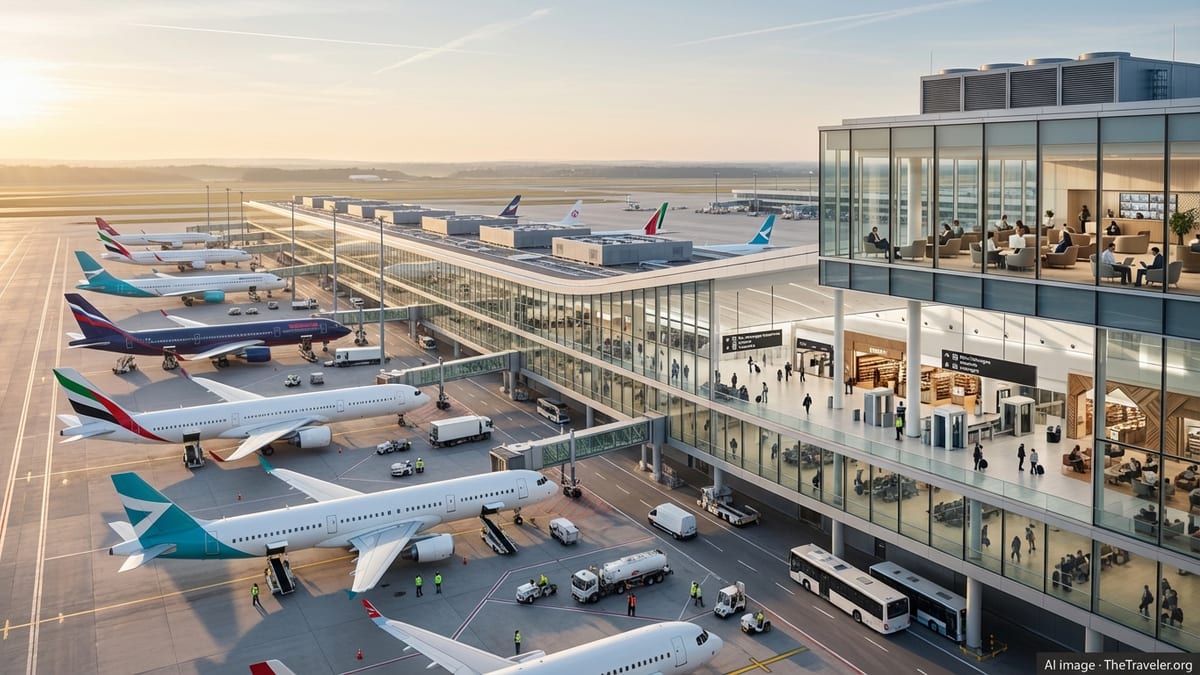
A 95,000 Sqm Buffer Against Long‑Haul Turbulence
Publicly available information shows that the Terminal 1 pier entered regular operation in April 2026, after several years as Munich Airport’s largest expansion project. The structure extends roughly 360 meters into the western apron and connects to the existing Terminal 1 complex via the B arrivals module.
The newly opened area is dedicated primarily to non‑Schengen and long‑haul services, with stand capacity for up to 12 short and medium haul aircraft or six widebody jets at the same time. Airport publications indicate that the pier is engineered to handle up to six million passengers annually, effectively creating a pressure valve for one of Europe’s busiest transfer hubs.
By separating much of the intercontinental flow from older T1 facilities and from the Star Alliance dominated Terminal 2, the project is intended to smooth passenger movements during peak waves and reduce the risk of cascading delays affecting connections across Europe, North America, Asia and the Middle East.
Engineered to Tackle Bottlenecks and Missed Connections
The pier’s opening comes at a time when tight connections, security bottlenecks and last minute gate changes have become a persistent concern for travelers using major European hubs. Industry reports over recent summers have highlighted how strained infrastructure, combined with crew shortages and volatile weather, can quickly spiral into long lines and missed flights.
The revamped Terminal 1 layout is designed to counter those vulnerabilities. Centralized security screening zones, more predictable queuing areas and direct boarding via multiple contact gates are intended to cut transfer times and give airlines more resilience when schedules slip. The new layout also reduces reliance on remote stands and bus transfers for many long‑haul operations, historically a source of delay and confusion for connecting passengers.
According to trade coverage, the project was scoped not only for today’s traffic but for anticipated growth in non‑Schengen flows through southern Germany. That future proofing is particularly relevant as carriers shift capacity back to long‑haul routes and add new destinations in North America and Asia, restoring networks that were heavily cut earlier in the decade.
Integrated Retail and Services Aim to Calm the Chaos
Beyond aircraft stands and circulation space, the Terminal 1 pier introduces an expansive mix of retail, food and beverage and passenger services. Airport communications describe a walk through duty free concept at the heart of the pier, framed by a blend of international brands and Bavarian themed outlets intended to give the space a distinct regional identity.
The commercial strategy is to integrate shopping and dining into the natural passenger flow rather than dispersing travelers through a series of separate corridors and cul de sacs. This approach, widely adopted at newer terminals worldwide, is meant to keep passengers oriented and occupied if flights are delayed, while also reducing crowding in narrow gate waiting areas.
Additional seating zones, workspaces and redesigned waiting areas are positioned close to key junctions, with visibility to departure information screens and staff desks. Industry observers note that such “soft” elements can significantly change the experience when irregular operations strike, making the difference between an airport that feels gridlocked and one that absorbs disruption with less visible stress.
New Non‑Schengen Hub, Old Terminal Complaints
For years, traveler anecdotes have painted a mixed picture of Munich’s original Terminal 1, with some passengers praising fast processing while others reported long walks, scattered security checkpoints and dated gate areas compared with the newer Terminal 2. The new pier is intended as a visible reset of that reputation for the airport’s non‑Schengen segment.
Publicly accessible commentary from frequent flyers already points to the pier’s upgraded security technology and fresher design, while also noting the distance involved in walking the full length of the new structure. That trade off between compactness and capacity is a familiar challenge at large hubs, especially when they seek to add widebody contact gates without building an entirely new terminal.
Airport documents indicate that the pier has been planned as an integral part of the broader Terminal 1 ecosystem, rather than as a stand alone satellite. Over time, additional wayfinding tweaks, landside improvements and transport links between T1 and T2 are expected to determine how well the new infrastructure actually shields travelers from the sort of long‑haul travel chaos seen elsewhere in Europe.
Strategic Play in the Battle of Europe’s Hubs
Munich Airport’s investment in the Terminal 1 pier also has a wider competitive dimension. As airlines consolidate long‑haul operations at a limited number of European gateways, the ability to promise smoother connections and fewer operational meltdowns has become a key selling point for both carriers and airports.
The airport’s integrated reports and media materials frame the pier as a central pillar of its growth strategy in premium long‑haul markets. By expanding non‑Schengen capacity and upgrading the overall experience, Munich is positioning itself as an alternative to more congested hubs when airlines decide where to base aircraft or route new intercontinental services.
Whether the 95,000 square meter expansion fully delivers on its promise to shield passengers from disruption will be tested during peak summer travel and winter weather seasons. For now, the activation of the Terminal 1 pier marks a significant attempt to get ahead of long‑haul turbulence on the ground, giving travelers more space, more options and, potentially, a calmer connection through southern Germany.