


I arrived in southern Italy expecting one coherent “south” defined by sun, sea, and long lunches. After a few weeks moving from Naples to Matera, from the cliffs of the Amalfi Coast to the olive groves of Puglia and the dusty toe of Calabria, that idea quietly fell apart. What surprised me most was not the shared love of coffee or family, but how dramatically each region felt from the next, often separated by no more than a two hour train ride.
Get the latest updates straight to your inbox!
Campania: Chaotic Naples and the Drama of the Amalfi Coast
My introduction to the south was Naples, a city that hits all five senses at once. Step out of Napoli Centrale station and the energy feels closer to a crowded market in a port city than a polished museum town. Scooters weave through impossibly narrow lanes, vendors sell fried pizza from small storefronts, and laundry hangs overhead like improvised bunting. A quick espresso at a standing bar costs about one euro, and locals knock it back in a single sip before disappearing into the crowd. In the Spanish Quarter, balconies are stacked so tightly that neighbors easily talk across the street, giving the city an almost vertical social life.
Yet less than ninety minutes away, still in Campania, the mood changes entirely on the Amalfi Coast. Positano and Amalfi feel more curated, with pastel houses clinging to cliffs and designer boutiques lined up along narrow pedestrian lanes. A simple plate of spaghetti alle vongole here might cost three times what you would pay in a Naples trattoria, and dinner often comes with a side of Instagram shoots on the terrace. The drama is in the landscape rather than the human energy: buses edge around hairpin bends while terraces of lemons cascade down towards a calm blue sea.
What struck me in Campania was this dual identity. Naples is unapologetically lived-in, soot-stained, and noisy, with centuries of history layered into its decaying palaces and vibrant street life. Down the coast, the same region sells a fantasy of Mediterranean perfection, where hotels offer infinity pools and private boat tours to Capri. Travelers who rush straight to the Amalfi Coast sometimes miss that Campania’s heart beats loudest in Naples’ alleyways, where a family-run pizzeria can still serve a margherita that costs under six euros and tastes like a culinary manifesto.
Basilicata: Matera’s Stone Silence After the Coast
Leaving Campania for Basilicata felt like stepping behind the stage set. When my bus climbed the final hill into Matera, I looked out over something that barely resembled a modern city. The Sassi districts are carved into a canyon, a tangle of stone houses and cave churches that have been inhabited in various forms since prehistory. Walking there at dusk, with the warm light catching the pale rock, the noise of Naples felt a world away even though the regions share a border.
Matera’s silence is what surprised me most. In the Sassi, traffic is limited and the soundscape is mostly footsteps on ancient stone and the distant echo of church bells across the ravine. Many of the old cave dwellings have been turned into boutique hotels and restaurants, where you can sleep in a centuries-old grotto with underfloor heating and crisp linen. A typical aperitivo might be a glass of local Aglianico wine and a board of Lucanian cheese and cured meats served at a small bar dug into the rock, the walls still bearing the marks of hand tools.
Outside Matera, Basilicata quickly becomes rural and spare. The hills are dotted with small towns where lunch menus rarely change for tourists, partly because there are not many tourists at all. In one village near the Apennines, I was served a plate of handmade orecchiette with cime di rapa for a price that would barely buy a coffee in a northern capital. The region feels introspective and a touch austere, shaped more by agriculture and emigration than mass tourism. After the theatrical coastlines of Campania, Basilicata’s landscapes feel like a quiet, powerful backstory the rest of Italy often forgets.
Puglia: Whitewashed Villages and the Easy Rhythm of the Heel
Cross from Basilicata into Puglia and the scenery shifts again. Olive trees appear in disciplined rows, the land flattens, and the Adriatic glints on the horizon. Towns like Ostuni, Locorotondo, and Cisternino rise from the plain in clusters of whitewashed houses that glow at sunset. In Ostuni, the “white city,” wandering the lanes at golden hour feels almost Greek: white walls, cobalt doors, pots of geraniums, and glimpses of sea between rooftops.
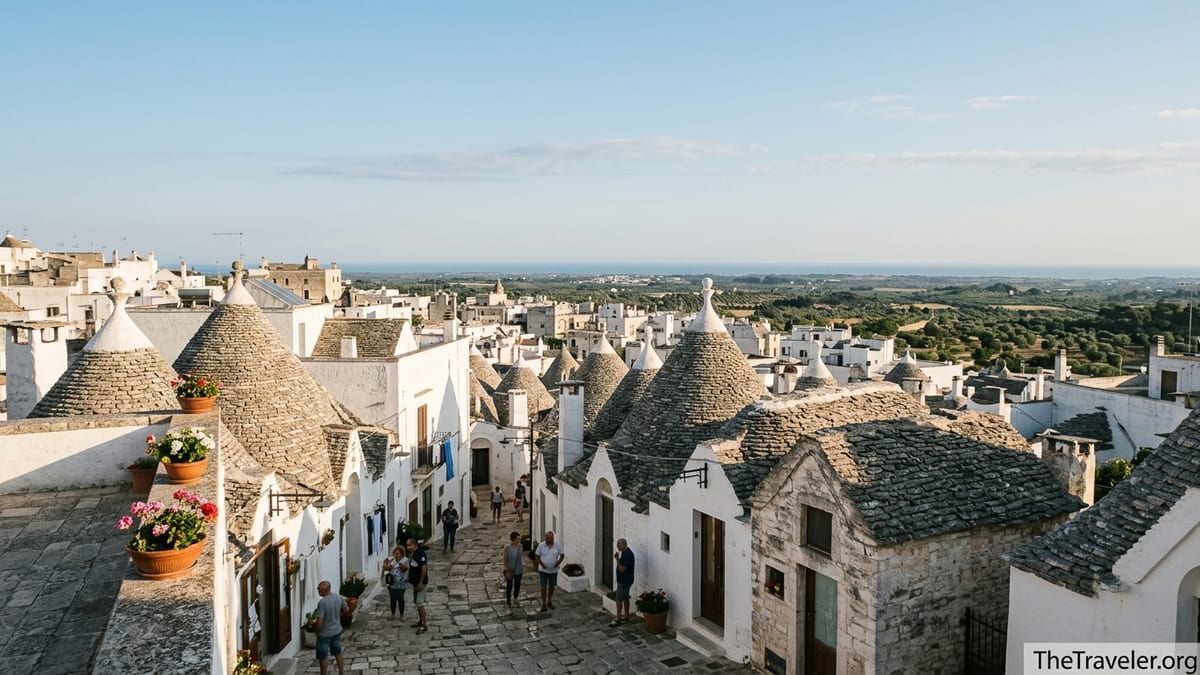
At the center of Puglia’s distinctiveness are the trulli, the conical limestone houses that turn Alberobello and the Valle d’Itria into something that looks, at first glance, almost unreal. These small dwellings, built in dry stone without mortar and whitewashed for protection, are now protected as a UNESCO World Heritage site and form entire neighborhoods of cone-shaped roofs clustered along sloping streets. Many have been converted into guesthouses, so you can sleep under a stone dome where peasants once lived, now with modern showers discreetly tucked into alcoves. Even in smaller towns nearby, isolated trulli dot the countryside between low stone walls and ancient olive trees.
Puglia’s food culture feels as open and generous as its landscape. On the coast in towns like Polignano a Mare or Monopoli, dinner often starts with raw seafood: plates of just-shucked oysters, marinated anchovies, or tiny raw shrimp sold by the weight, often for surprisingly accessible prices compared to more famous resort areas. Inland, bakeries sell focaccia barese topped with tomatoes and olives for a couple of euros, the kind of affordable, filling street food that makes long travel days easier. People linger outside bars over glasses of local primitivo or negroamaro wine, and even in peak summer the vibe feels more laid back than showy.
Compared with Campania’s drama and Basilicata’s reserve, Puglia feels quietly confident and practical. Train lines run along much of the coast, so you can step off in Bari, hop a local train to Lecce or Otranto, and be surrounded by baroque facades or medieval fortifications within a couple of hours. The region’s identity seems rooted in agriculture and seafaring rather than spectacle, and you feel that stability in the food portions, the fair prices, and the almost ritual evening strolls through town squares where families of three generations mix easily.
Calabria: The Rugged Toe of the Boot
Southwest from Puglia, across the instep of the Italian boot, Calabria announces itself with mountains. Trains skirt a coastline of long, sometimes wild beaches, but behind the tracks the land rises quickly into rugged ridges that have historically made this region feel remote. Towns perch on hilltops rather than spread along the shore, a defensive habit from centuries of invasions that still shapes the skyline. Arriving in places like Tropea or Scilla, the first impression is of rock and fortress-like old towns facing an open sea.
Calabria’s tourism profile is much lower than that of Puglia or Campania, and you feel that difference in the way businesses operate. Many coastal towns still cater primarily to Italian families who return year after year, booking the same umbrellas on the same beach clubs every August. Outside the peak season, some restaurants may open only on weekends, and bus timetables can be sparse. For independent travelers accustomed to frequent trains and a wide choice of tours, this can feel challenging, but it is also part of the region’s charm. You are more likely to find yourself at a family-run trattoria where the day’s menu is recited verbally, with prices that reflect local rather than international demand.
The food reflects Calabria’s harsher landscape and history of poverty. Peperoncino, the local chili, finds its way into many dishes, from spicy ‘nduja spreadable salami to fiery pasta sauces. Street food near seaside promenades can include fried seafood cones, arancini stuffed with ragu, and thick slices of focaccia, eaten while families stroll the lungomare at sunset. The sea is crystalline, particularly along the so-called Costa degli Dei near Tropea, where transparent water laps against pale sand. Yet even there, compared with the Amalfi Coast, you will find more modest pensions and rented apartments than five-star hotels, which changes the entire feel of the place.
What surprised me about Calabria was the sense of being almost outside mainstream Italian tourism. The region feels rugged, proud, and slightly guarded, shaped by emigration and economic struggles. Conversations with locals often involve stories of relatives in Germany, Canada, or northern Italy, and a realism about the region’s challenges. For a traveler willing to slow down and adapt to local rhythms, Calabria offers some of the most authentic everyday scenes in the south: kids playing late in piazzas, fishermen mending nets on small boats, elderly men debating football on shaded benches.
Sicily: A World of Its Own Beyond the Strait
Crossing the Strait of Messina into Sicily feels less like changing regions and more like arriving in another country with its own gravitational pull. The island has been shaped by Greeks, Romans, Arabs, Normans, and Spanish rulers, and that layered history is visible in almost every town. In Palermo, the Arab-Norman cathedrals sit near lively street markets where vendors fry panelle chickpea fritters and arancine rice balls to order. The language shifts subtly, the accent softening and new words slipping into everyday conversation.
What sets Sicily apart is the intensity of its contrasts. In the east, Catania lies under the gaze of Mount Etna, which occasionally dusts the city with ash. Nearby Taormina offers dramatically placed Greek theater ruins with sweeping views of the sea, yet just inland you can drive into rural villages where the main commerce still revolves around local produce markets. In the southeast, towns like Noto and Ragusa showcase golden baroque facades that glow at sunset, while the western coast near Marsala opens onto salt pans and scattered windmills.
The food in Sicily is a geography lesson on a plate. In coastal towns, swordfish, sardines, and tuna appear in countless preparations, from grilled steaks served simply with lemon to pasta con le sarde enriched with wild fennel and pine nuts. Inland, you encounter hearty dishes featuring lamb, ricotta-filled ravioli, and pistachio sauces made from nuts grown on the slopes of Etna. Street food is a full-fledged culture: in Palermo, late-night stalls serve sfincione, a spongy pizza-like bread, alongside grilled meat skewers and the more adventurous pani ca meusa made with calf’s spleen and lung.
For travelers who have moved south through the mainland, Sicily can feel almost overwhelming in its distinctiveness. Prices vary widely between destinations: a simple espresso in a neighborhood bar of a working-class Palermo district might cost only a little more than in Naples, but a gelato with a view in Taormina or an aperitivo facing the sea in Ortigia usually lands at a distinctly tourist-oriented price point. The island’s public transport is improving but still patchy, which nudges many visitors toward renting a car if they want to explore smaller villages and archaeological sites. All of these realities add up to a region that operates on its own terms, rewarding time and curiosity with a sense of depth that is hard to match elsewhere in southern Italy.
How These Differences Change Your Trip
Experiencing these regions back to back made it clear that “southern Italy” is less a single destination and more a collection of very different worlds. In Campania, especially around Naples and the Amalfi Coast, you deal with intense crowds in high season, higher prices, and a dense public transport network that allows you to hop between archaeological sites like Pompeii, chic coastal towns, and chaotic urban neighborhoods in a single day. It can be exhilarating but also exhausting.
Shift to Basilicata and the pace slows drastically. Matera’s Sassi districts encourage walking rather than rushing, and outside the city you may need to plan carefully around limited bus times or the availability of rental cars. The trade-off is space and silence: cave hotels that feel carved out of time, viewpoints where you might be alone at sunrise, and conversations with locals less accustomed to the constant flow of visitors seen in more famous regions.
In Puglia, infrastructure and relaxation strike a different balance. The regional rail network links many of the main towns, from Bari down to Lecce and across to Taranto, which means you can base yourself in one town and day trip easily to others. Accommodation ranges from converted farmhouses surrounded by olive groves to small family-run hotels in whitewashed hill towns. Prices for meals and lodging tend to be more moderate than in the celebrity corners of the Amalfi Coast or Taormina, which makes longer stays more feasible for many travelers.
Calabria and parts of Sicily, meanwhile, reward flexibility and patience. You may find that some of the most memorable meals happen in unassuming places with no printed menu, or that a planned beach day turns into a conversation with a local family who share their umbrella and pass around homemade biscuits. Public transport can be less predictable, and English is less widely spoken outside major cities and resort towns, but this also lowers the sense of being on a well-trodden tourist track. The differences in infrastructure, pricing, and rhythm of daily life between each region can significantly shape your experience, from what you eat to how spontaneous your days can be.
The Takeaway
Before this journey, I thought of southern Italy as a single idea: slower, warmer, more relaxed than the north. On the ground, those assumptions fragmented into a mosaic. Campania was noise, drama, and tight urban streets giving way to glamorous cliffs. Basilicata was stone and silence, an interior world where history feels very close to the surface. Puglia offered white towns and open horizons, grounded in agriculture and everyday rituals rather than spectacle. Calabria felt rugged and proud, less polished yet rich in unfiltered local life. Sicily stood slightly apart, shaped by centuries of outside influence yet unmistakably its own universe.
For travelers, recognizing these differences matters. It can help you decide where to spend limited days, whether you want intense urban energy, quiet landscapes, or long evenings in seaside towns that still belong more to locals than to visitors. It can also nudge you to travel a little slower, to move beyond one famous coastline or one island and see how varied the Italian south really is. The biggest surprise is that within a few hundred kilometers, you can cross from dramatic volcanic vistas to flat olive plains, from cone-roofed stone cottages to cave cities and baroque hill towns, all while staying in what maps label as the same part of one country. That variety is the real luxury of southern Italy.
FAQ
Q1. How many days do I need to experience the main regions of southern Italy?
For a first trip that includes Campania, Basilicata, Puglia, and Sicily, about three weeks allows you to see key highlights without rushing, though even ten to fourteen days can offer a good introduction if you focus on fewer bases.
Q2. Is it easy to travel between these regions by public transport?
Major cities and coastal towns in Campania, Puglia, and parts of Sicily are linked by trains and long distance buses, but connections in Basilicata and Calabria can be limited, so you may need to combine trains with regional buses or consider renting a car for more remote areas.
Q3. Which region is best if I want a mix of beaches and historic towns?
Puglia and Sicily offer particularly strong combinations of sandy beaches and atmospheric old towns, while Campania combines coastal scenery with major archaeological sites such as those near Naples.
Q4. Are prices very different from one southern region to another?
Yes, coastal hot spots like the Amalfi Coast and Taormina tend to be significantly more expensive for accommodation and dining than inland areas of Basilicata, much of Calabria, or smaller towns in Puglia.
Q5. Do I need to rent a car to explore southern Italy properly?
You can manage without a car in well-connected areas like Naples, the Amalfi Coast, Bari, and some parts of Sicily, but a car becomes very useful in rural Basilicata, much of Calabria, and for reaching smaller coastal villages or countryside stays.
Q6. When is the best time of year to visit these regions?
Late spring and early autumn usually offer warm weather, swimmable seas, and fewer crowds than peak summer, making them ideal times to experience regional differences without intense heat or heavy traffic.
Q7. Is English widely spoken in southern Italy?
In major tourist centers and many hotels, staff usually speak some English, but in smaller towns and rural areas you will encounter more Italian only, so learning a few basic phrases can greatly improve interactions.
Q8. How safe is it to travel between and within these regions?
Most travelers find southern Italy generally safe, with the usual big city precautions in busier places like Naples and Palermo, and a need to watch belongings on public transport and in crowded areas.
Q9. Which region should I choose if I prefer quieter, less touristy places?
Calabria, much of inland Basilicata, and smaller Puglian towns away from the busiest coastal hubs tend to receive fewer international visitors and can feel more low-key.
Q10. Can I visit multiple regions using only trains and buses if I do not drive?
Yes, with careful planning you can link major hubs like Naples, Salerno, Matera, Bari, and Palermo by train and bus, but you may need to adjust your itinerary to follow the strongest transport corridors rather than visiting every small village on your wish list.