


Vatican City is one of those places that many travelers feel they "should" see when they visit Rome. Yet the reality on the ground can be very different from the postcard image: heavy crowds, strict security, timed tickets that sell out weeks ahead, and a confusing tangle of options for museums, domes and tours. So is Vatican City actually worth visiting, and what should travelers know before they go in 2026?
Get the latest updates straight to your inbox!
Is Vatican City Really Worth Visiting?
For most visitors, Vatican City is worth seeing at least once, but not in the same way for everyone. Art lovers crossing continents to see Michelangelo’s Sistine Chapel ceiling usually consider it a must. So do many Catholic pilgrims who want to attend a papal audience or Mass in St Peter’s Basilica. Others, especially those who dislike crowds and tight security checks, sometimes leave feeling overwhelmed and say they would skip the museums on a future trip and enjoy the basilica from the square instead.
The Vatican Museums and Sistine Chapel are the main draw, attracting well over six million visitors a year. A standard adult ticket currently costs around 20 euros at the official ticket office, or about 25 euros with online pre-booking that includes the mandatory 5 euro reservation fee. In peak months like May, June and October, these advance tickets can sell out weeks ahead, which means many last-minute travelers either pay much more for a third-party tour or miss out entirely. For some, the extra cost and crowding are worth it for a once-in-a-lifetime look at the Sistine Chapel. Others decide that an equally world-class but quieter museum in Rome, such as the Capitoline Museums, offers better value.
St Peter’s Basilica itself remains free to enter, which surprises many people who have just paid to visit the Vatican Museums. However, that “free” access comes with a price in time: at busy hours, travelers regularly report 45 to 90 minutes in line for security, especially between 9 am and early afternoon. If you arrive very early, around opening time, or later in the late afternoon, the wait can shrink to 10 to 20 minutes.
Ultimately, whether Vatican City is worth visiting depends on your interests and tolerance for crowds and logistics. If you are moved by Renaissance art, religious history or iconic city views, a well-planned visit that targets a few highlights can be unforgettable. If you mainly prefer relaxed strolling, café time and less intense sightseeing, you may be happier admiring St Peter’s Square, stepping briefly into the basilica and spending the rest of your day elsewhere in Rome.
Key Sights: What You Actually See
Most travelers experience Vatican City in three parts: the Vatican Museums (including the Sistine Chapel), St Peter’s Basilica, and St Peter’s Square. Understanding what each one offers in practice makes planning much easier.
The Vatican Museums are an enormous complex of galleries and collections, from ancient Roman sculptures and Egyptian artifacts to Renaissance frescoes and modern religious art. Even on a “short” route, you will walk several kilometers. Popular highlights include the Raphael Rooms with their vivid frescoes, the Gallery of Maps with its long corridor of painted Italian regions, and finally the Sistine Chapel. The chapel is usually crowded and strictly monitored: you cannot take photos, you must remain relatively quiet, and you are often shoulder to shoulder with other visitors. Many people find the experience powerful despite the crowd; others find the noise and crush distracting and stay only a few minutes.
St Peter’s Basilica is a separate visit from the museums and does not require a ticket for basic entry. Once you pass security, you step into one of the largest churches in the world. Inside, visitors typically spend 30 to 60 minutes walking the main nave, visiting Michelangelo’s Pietà near the entrance, and exploring side chapels and the papal tombs. Guided audio devices are available at the entrance for a small fee, which many travelers use instead of a full guided tour.
St Peter’s Dome, which crowns the basilica, is optional but often remembered as the highlight. To climb, you buy a separate ticket once inside the basilica. Current prices are roughly 10 euros to take the stairs the whole way and a few euros more to use the elevator for the first part of the ascent before continuing up several hundred narrow steps. From the dome, you look down into the basilica from the interior gallery and then out over Rome’s rooftops, the Tiber River and the perfect ellipse of St Peter’s Square.
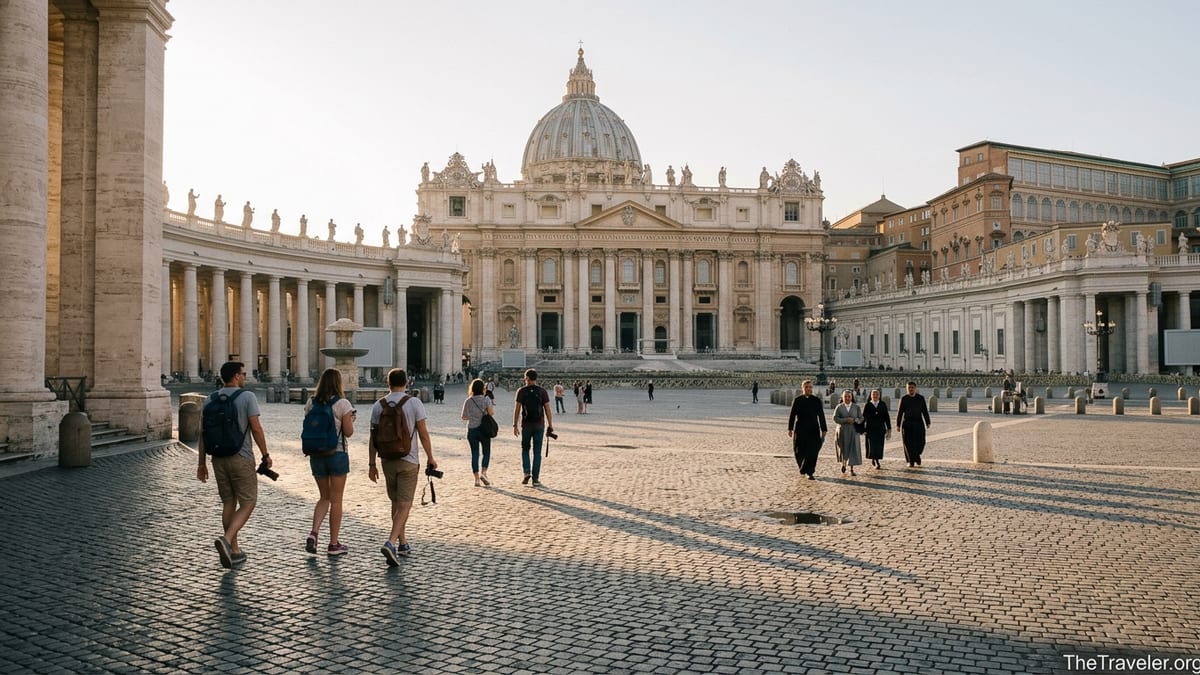
Outside, St Peter’s Square itself is free and open, with security checks only if you enter the basilica or attend events. The vast oval colonnades, the central obelisk and the regular movements of Swiss Guards and Vatican gendarmes create an atmosphere unlike anywhere else. On Wednesday mornings when the pope is in Rome, papal audiences fill the square with thousands of pilgrims and visitors who have applied for free tickets through church organizations or Vatican offices weeks in advance.
Practical Costs, Tickets and Time Management
Visiting Vatican City in 2026 requires more planning than simply turning up. For the Vatican Museums and Sistine Chapel, the official ticket price for adults is currently about 20 euros on-site or 25 euros online with the reservation fee. Reduced prices are available for children and some students, but travelers should check eligibility carefully, as staff can require proof at entry. If you book a reduced ticket and cannot prove you qualify, you will need to buy a full-price ticket at the door.
In high season and on many Saturdays year-round, the basic timed-entry tickets on the official website can sell out weeks in advance. When that happens, travelers often turn to third-party companies selling “skip the line” admission or guided tours. These can cost anywhere from 60 to more than 200 euros per person, depending on whether they include a small-group guide, early entry or combined visits to the basilica and dome. Several recent visitors have reported paying around 80 to 90 euros for a simple “ticket plus escorted entry” option that essentially replaces the standard 25 euro ticket with a higher-priced package. For some, the markup is worth it on a once-in-a-lifetime trip; others prefer to save that money and visit different attractions if official tickets are gone.
St Peter’s Basilica remains technically free, but some companies sell “priority entry” or “audioguide plus hosted entry” products that can confuse people. These paid options can be useful at very busy times, as they allow you to join a shorter security queue and include an audio guide. However, if you are comfortable arriving early, many independent travelers still manage to enter for no extra cost by joining the standard line at or shortly after opening time.
Time is just as much a currency as money. A typical combined visit to museums, Sistine Chapel and basilica usually takes between five and seven hours, counting security lines, walks between entrances and short breaks. If you plan a 9 am museum entry, you might not exit until early afternoon, and then you still need to walk around the outside walls to reach St Peter’s security checks, as the shortcut exit from the Sistine Chapel into the basilica is often reserved for group tours. Many travelers therefore dedicate an entire day to the Vatican area, including a midday break at a café or restaurant on nearby streets such as Via Cola di Rienzo on the Rome side of the river.
To get the most out of your ticket money and your limited time, it helps to set priorities in advance. If your top goal is the Sistine Chapel and a broad overview of the collections, a self-guided visit with an audio guide may be enough. If you want in-depth context on papal history or Christian art, a small-group tour that focuses on fewer rooms can be a better investment than a larger, cheaper group that rushes past everything in three hours.
Crowds, Security and Dress Code Realities
Security and dress code rules at Vatican City catch many first-time visitors off guard. To enter the Vatican Museums, the Sistine Chapel and St Peter’s Basilica, your shoulders and knees must be covered. This usually means no sleeveless tops, short shorts or very short skirts. On hot summer days, a common solution is to carry a light scarf or shawl to cover bare shoulders and to wear knee-length shorts or a long skirt. Travelers who arrive in beachwear or very revealing outfits can be turned away at the door, regardless of having timed tickets.
Security screening is similar to airport-style checks. You pass through metal detectors, and your bag goes through an X-ray machine. Prohibited items include pocketknives, scissors, glass bottles and sometimes even tripods or large camera gear. There are cloakrooms where some items can be stored temporarily, but heavy restrictions can change without much notice if there is a special event or heightened alert. Travelers have reported delays at security of up to an hour or more on peak days from late spring through early autumn, particularly mid-morning when organized tour groups arrive.
The crowds inside can also be intense. In the Vatican Museums, popular corridors such as the Gallery of Maps can feel like a slow-moving river of people, especially when multiple tours converge. Air conditioning has improved in some areas but can still feel weak on the hottest days, which can be uncomfortable for older visitors or those with mobility or health issues. If you are sensitive to heat or crowding, consider booking the earliest available morning slot or a late-afternoon entry and keeping your route short, heading directly for your must-see rooms rather than trying to cover everything.
In St Peter’s Basilica, crowding is most severe around major artworks like the Pietà and during religious services. Visitors are usually allowed in during Mass, but parts of the nave may be roped off, and you are expected to behave quietly and respectfully. Photography is generally allowed in the basilica except where signs say otherwise, but selfie sticks are often discouraged or banned by security. In the Sistine Chapel, photography is completely prohibited, and staff frequently remind people to be silent or at least speak in hushed tones, though in practice the noise level can be high.
When to Go and How Long to Stay
Timing can make the difference between a memorable visit and an exhausting slog. In general, Tuesdays and Thursdays tend to be slightly less crowded than Mondays and Saturdays, when many people schedule their Vatican day. The museums are closed on most Sundays and certain church holidays, and the day after a closure can be particularly busy as demand builds up. Checking the Vatican Museums’ official calendar shortly before your trip will help you avoid surprise closures or special evening openings.
For weather, late March through early May and late September through early November often offer the most comfortable temperatures in Rome, which helps when you are queuing outside or walking long corridors inside. July and August can be very hot and humid, with some travelers arriving at the museums already tired after a hot metro or bus ride. In those months, an early morning ticket can be especially valuable, allowing you to finish the densest parts of the museums by midday and retreat to shade or air conditioning for lunch.
The average first-time visitor spends three to four hours inside the Vatican Museums and Sistine Chapel, not counting security and waiting time. If you attempt to see “everything,” you can easily double that. St Peter’s Basilica usually takes at least an hour for a simple walk-through, plus time for the dome if you choose to climb. Expect another 1.5 to 2 hours for the dome climb, including ticket purchase, the queue for the lift or stairs, and time at the top.
If you only have one full day in Rome and are trying to decide whether to devote it to the Vatican, consider your broader itinerary. Travelers spending three or more days in Rome can often afford a half or full day for Vatican City without feeling rushed elsewhere. Those on a tight schedule sometimes decide to walk through St Peter’s Square at night, when the dome is beautifully lit and the crowds have thinned, and save the interiors for a future trip.
Common Pitfalls and How to Avoid Them
Several recurring issues affect visitors to Vatican City, and knowing them ahead of time can save you money and stress. One of the most common is confusion between official and unofficial ticket sellers. The only official online platform for Vatican Museums tickets is operated directly by the Vatican, with prices clearly listed and a standard 5 euro booking fee. Other websites often use similar colors or layouts and advertise “official” style branding, but charge significantly more or fail to deliver tickets reliably. Travelers occasionally report paying more than double the standard price for what turned out to be a basic timed-entry ticket.
Another pitfall is relying on the idea that you can always buy tickets on-site. While there was once a time when lining up at the museum entrance early in the morning could reliably secure same-day entry, demand has increased. In busy months, same-day tickets may be scarce, and those who do not have a booking can face multi-hour lines in the sun. Some recent travelers have been able to secure last-minute spots through official guided tours offered on the Vatican’s own system when regular admission is sold out, but these options are limited and more expensive than a standard ticket.
Inside the museums, the biggest mistake is trying to see everything in one go. The collections are vast, and information overload is real. Many experienced visitors now recommend choosing a focused route: for example, spending an hour in the Pinacoteca (painting gallery), moving through the classics like the Raphael Rooms and then heading straight to the Sistine Chapel without detouring into every minor collection. This way, you retain more of what you see and are less exhausted by the time you reach the chapel.
Finally, underestimating the physical demands of the visit can lead to disappointment. Even without climbing the dome, you will likely spend several hours on your feet, often on hard marble floors. Comfortable shoes, a refillable water bottle for use in permitted areas, and a small snack for after your visit all make a difference. Those with mobility issues may want to look into accessibility routes and elevator options in advance, as not every area is step-free.
Who Will Love Vatican City, and Who Might Skip It
Vatican City rewards certain types of travelers more than others. If you are deeply interested in art history, Christian heritage or architecture, you will likely find the investment in time and tickets worthwhile. Seeing Michelangelo’s frescoes in person, standing under the great dome of St Peter’s, and walking through spaces that have shaped church history for centuries can be profoundly moving for those who have read about them for years.
Religious pilgrims may plan their entire trip around Vatican events, such as attending a Wednesday papal audience or a major Mass at Christmas or Easter. For them, waiting in long lines or navigating security is part of a meaningful spiritual journey, and many choose to spend two different days in the area: one focused on the museums and another on liturgical events in the basilica or square.
On the other hand, travelers who dislike crowds, noise and rigid schedules often find the experience draining. If your idea of a perfect day in Rome is wandering side streets, lingering in small churches and enjoying long lunches, you may feel that half a day in a packed museum complex is not how you want to use your time. Families with very young children sometimes decide to delay a Vatican Museum visit until a later trip, instead enjoying the open spaces of St Peter’s Square and a brief look inside the basilica, which is visually impressive even for kids with short attention spans.
Budget-conscious travelers should also weigh the cost. Between pre-booked tickets, potential tour fees and extras like audio guides, two adults can easily spend 70 to 150 euros on a full Vatican day. Some choose instead to allocate that money to other experiences, such as a food tour in Rome’s Testaccio district, day trips to Ostia Antica or Tivoli, or a guided visit to less crowded museums that still offer superb art without Vatican-level prices.
The Takeaway
Vatican City is undeniably one of the world’s most significant religious and cultural sites, but it is not a simple, casual stop. In 2026, visiting means dealing with high demand, timed tickets, security lines and some hard choices about time and budget. For many travelers, careful planning pays off with unforgettable memories of the Sistine Chapel, the scale of St Peter’s Basilica and the sweeping views from the dome.
The key is to match your visit to your interests and limits. If the art, history and spiritual significance speak to you, book your tickets early on the official channels, choose a realistic route through the museums, dress for both the weather and the dress code, and allow a full half day or more. If you are unsure, consider a lighter version of the visit: enjoy St Peter’s Square, step briefly inside the basilica at a quiet time, and decide on a future trip whether the full museum experience is something you want.
Vatican City is worth visiting when you know what you are getting into. With clear expectations and a practical plan, it can be a powerful highlight of a stay in Rome. Without that preparation, even the world’s greatest masterpieces can be overshadowed by queues, confusion and fatigue.
FAQ
Q1. Do I need to buy Vatican Museums tickets in advance?
In most cases it is wise to buy Vatican Museums tickets in advance, especially between spring and autumn, as same-day tickets can be limited and lines long.
Q2. Is St Peter’s Basilica really free to visit?
Yes, basic entry to St Peter’s Basilica is free, but you must pass through security, and you pay separately if you want to climb the dome or use certain audio guides.
Q3. How much time should I plan for a Vatican visit?
For the museums, Sistine Chapel and basilica together, plan at least five to seven hours including lines and walking; for just the basilica and dome, allow two to three hours.
Q4. What should I wear to meet the Vatican dress code?
Wear clothing that covers shoulders and knees, such as a T-shirt with light trousers or a knee-length skirt, and carry a scarf or shawl if you are wearing a sleeveless top.
Q5. Can I visit the Sistine Chapel without touring the entire museums?
No, access to the Sistine Chapel is through the Vatican Museums, so you must enter via a museum ticket or tour and follow the signposted route to the chapel.
Q6. Are children likely to enjoy a Vatican Museums visit?
Some older children enjoy the art and stories, but younger kids may find the long walks and crowds tiring, so consider a shorter route and breaks, or focus on the basilica instead.
Q7. Is the St Peter’s Dome climb safe if I am afraid of heights or tight spaces?
The dome climb is generally safe but involves narrow stairways, some small spaces and significant height, so those with claustrophobia or vertigo may be uncomfortable.
Q8. Can I take photos inside the Vatican?
You can usually take photos in most parts of the Vatican Museums and St Peter’s Basilica, but photography is not allowed inside the Sistine Chapel, and flash may be restricted elsewhere.
Q9. Are there good alternatives if Vatican tickets are sold out?
If Vatican Museum tickets are unavailable, many travelers visit other outstanding sites such as the Capitoline Museums, Galleria Borghese or major churches around Rome instead.
Q10. Is a guided tour worth paying extra for?
A good small-group or private tour can help you navigate crowds and understand what you are seeing, which many first-time visitors find worth the extra cost, especially for the museums.