


If you are planning time in Tuscany and debating whether to stay in Pisa or Lucca, you are not alone. These two cities sit just 30 to 35 minutes apart by regional train, yet offer strikingly different moods: Pisa is bold, crowded and iconic, while Lucca is quiet, lived-in and slow-burning. Understanding which one better matches your travel style can make the difference between a good trip and a great one.
Get the latest updates straight to your inbox!
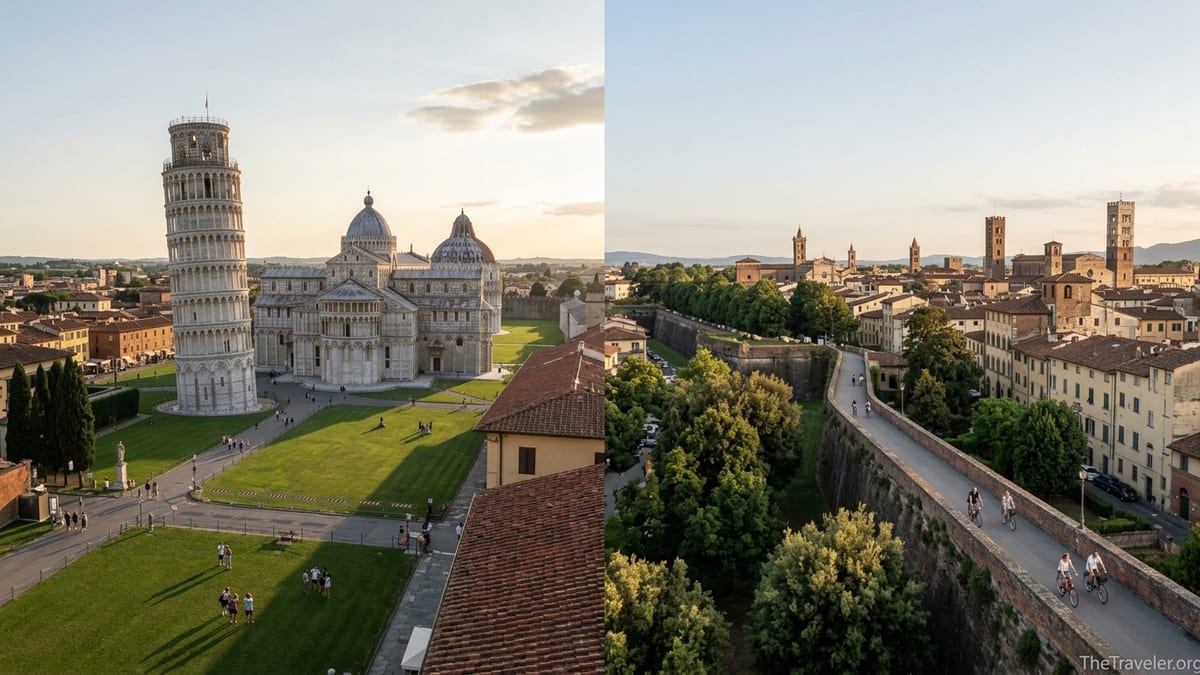
First Impressions: Big Sights vs Subtle Charms
The strongest first impression of Pisa is the shock of seeing the Leaning Tower suddenly appear at the edge of Piazza dei Miracoli. Even if you have seen it in countless photos, standing in front of the tower and the white marble cathedral feels surreal. Around you, tour groups line up for the classic "holding up the tower" photo and street vendors sell phone stands and magnet sets. For many visitors, this is the mental image of Pisa: a few intensely crowded blocks wrapped around one of the world’s most famous landmarks.
Walk ten minutes beyond the tower, however, and Pisa shifts character. Along the Arno River, pastel palazzi lean into the water and students from the University of Pisa linger over cheap aperitivo on Borgo Stretto. In the evening, the crowds around the tower thin and Pisa feels more like a compact college town with one superstar attraction attached.
Lucca’s first impression is quieter. Arriving by train, you cross a broad avenue, pass through a gate in the Renaissance walls and suddenly step into a city that feels comfortably self-contained. There is no single must-see monument; instead, the whole historic center is the attraction. Narrow streets open onto small squares like Piazza dell’Anfiteatro, where families eat gelato and locals ride by on upright bicycles with shopping baskets. You notice laundry hanging between stone houses, tiny delicatessens selling focaccia by the slice, and locals chatting in the shade of medieval towers.
In short, Pisa strikes immediately with spectacle, while Lucca wins you over slowly with atmosphere. If you crave a bucket-list moment, Pisa delivers in minutes. If you are looking for a place that feels like a lived-in Tuscan town, Lucca usually leaves the deeper impression.
What You Will Actually See and Do
In Pisa, the core experience centers on the Piazza dei Miracoli complex. Many travelers buy a ticket to climb the Leaning Tower, which currently costs about 20 euros for an adult timed entry slot. Only around 30 people are allowed up every 30 minutes, so it feels controlled rather than chaotic inside. You spiral up worn stone steps, feel the tilt under your feet, then step out onto the top level to see the city’s terracotta roofs and the Arno beyond. Most visitors also peek into the cathedral and baptistery, whose access can be bundled with tower tickets in various combo options.
Outside the square, a half day in Pisa usually includes a stroll along the Lungarni riverfront, a stop at Santa Maria della Spina church perched dramatically over the water, and a coffee in Piazza Garibaldi or Piazza delle Vettovaglie where students gather. You might fit in a guided walking tour of the medieval core, or simply wander between gelato stops before catching a train onward.
Lucca offers a more low-key but more varied daily routine. The signature activity is renting a bike and riding the tree-lined walls that encircle the old town. Several rental shops near Porta San Pietro or Piazzale Verdi offer standard city bikes from around 3.50 to 5 euros per hour, with day rates hovering near 15 to 20 euros. You can comfortably cycle the entire 4-kilometer loop in 25 to 30 minutes, but most people linger, stopping at viewpoints over church spires or descending into the streets to explore.
Back inside the walls, you can climb Torre Guinigi to see oak trees planted on its rooftop, visit the Duomo di San Martino with its carved facade, or simply spend hours circling through streets that rarely feel overrun. On warm evenings, cafes on Piazza Napoleone and Piazza San Michele fill with locals having spritz and bowls of olives, and during summer music season Lucca hosts open-air concerts that draw international acts and Italian artists.
If your idea of a successful day is a checklist of major sights, Pisa’s concentrated attractions make it easier. If you prefer to alternate short visits to small churches and shops with long coffee breaks and unhurried wandering, Lucca is generally the better fit.
Costs, Crowds and Overall Vibe
Neither Pisa nor Lucca is among the most expensive destinations in Italy, especially compared with Florence or Venice, but they handle tourism differently. In Pisa, prices spike the closer you get to the Leaning Tower. A simple espresso at a bar just off Piazza dei Miracoli can cost around 2 to 3 euros, while a sit-down cappuccino and pastry facing the lawn might run closer to 6 to 8 euros when you factor in table service and the view. Souvenir stands often sell tower snow globes and T-shirts at a noticeable markup compared with shops a few streets away.
In Lucca, prices feel more even across the center. A glass of house wine on Piazza dell’Anfiteatro might cost roughly 5 to 7 euros, and you can still find slices of farinata or focaccia from small bakeries for a couple of euros. Bike rental for a full day can be about 20 euros for a standard city bike, rising for e-bikes. Because there is no single monument that everyone is pushing toward, there is less sense of a high-pressure tourist zone and more of an everyday city that happens to be beautiful.
Crowd levels are where the difference becomes sharper. On a busy June or July afternoon, lines to climb the Leaning Tower can wrap across the square if you have not booked a timed ticket in advance, and the lawn in front of the cathedral feels like a sea of tour groups and day trippers. Many of these visitors are there only for a few hours, arriving on buses from Florence, cruise ships docking in Livorno, or trains from elsewhere in Tuscany.
Lucca has its own busy periods, especially during special events like Lucca Comics & Games in late October and early November or during major concert nights in summer, when hotel rates climb and trains are packed. But on a typical spring or autumn day, crowd density is much lower than Pisa’s central square. Even in peak season, you can step down quiet backstreets within minutes. If you are sensitive to crowds and prefer a slower pace, Lucca generally provides more room to breathe.
Getting There and Getting Around
If you prioritize easy logistics, Pisa has a clear edge. Pisa International Airport is one of Tuscany’s main gateways, with low-cost carriers and legacy airlines flying in from across Europe. A short automated shuttle known as the People Mover links the airport to Pisa Centrale station in a few minutes, making same-day arrivals and onward train connections straightforward. From Pisa Centrale, frequent regional trains run toward Florence, La Spezia, and the coast.
Reaching Lucca is still relatively simple, but involves an extra step. Most travelers connect via Pisa or Florence. From Pisa Centrale, regional trains to Lucca typically take around 30 to 35 minutes and run throughout the day, though schedules can thin slightly midday. From Florence, you normally change trains in Pisa or another junction, and total travel time often runs around 1 hour 45 minutes depending on the connection. This is manageable for a day trip, but less convenient if you will be making frequent excursions around Tuscany.
Once you arrive, both cities are compact enough to navigate on foot. In Pisa, you can walk from the main station to the Leaning Tower area in about 20 to 25 minutes at a relaxed pace, crossing the Arno and threading through the historic center. Taxis are available but not strictly necessary for most able-bodied travelers with light luggage.
In Lucca, the historic center within the walls is pedestrian-friendly and mostly flat. You can reach almost anywhere in 15 minutes on foot, or you can join the locals and use a bike as your primary transportation. Families with children often appreciate being able to let kids ride on the wide car-free walls, something not possible in Pisa’s denser, more traffic-prone streets. If your priority is a car-free base that still feels manageable, both work, but Lucca’s walled layout provides an extra sense of separation from modern traffic and sprawl.
Best Match by Travel Style
Think of Pisa as the right choice if you want a short, high-impact stop that fits neatly into a bigger itinerary. For example, if you only have three or four nights in Tuscany and are already basing yourself in Florence, a half-day detour to Pisa gives you the chance to see one of Europe’s most iconic monuments without committing to a longer stay. Some travelers even time an overnight near Pisa Centrale when they have an early morning flight, using the late afternoon to visit the tower, then walking back through the center for dinner.
Pisa also suits travelers who value rail connections and day-trip flexibility. From a hotel within walking distance of Pisa Centrale, you can be on a morning train to Florence, Lucca, or the Ligurian coast with minimal hassle. If your priority is to maximize the number of different destinations you can reach in a few days, Pisa is a practical home base.
Lucca, on the other hand, tends to be the better fit for slower travelers, couples on a relaxed break, and families looking for a safe, walkable environment. A common pattern is to rent a small apartment inside the walls for three to five nights, pick up bikes from a nearby shop, and use Lucca as a cozy base. Mornings might include a ride on the walls and a cappuccino on Piazza San Michele, afternoons a short train trip to Pisa or Viareggio, and evenings dinner at a trattoria where the staff begins to recognize you after a few days.
Introverts, remote workers and repeat visitors to Italy often gravitate to Lucca because it offers enough restaurants, shops and cultural events to stay interesting without feeling overwhelming. The fact that there is no single must-see “attraction” removes the pressure to plan your time around a specific timed entry. Days can unfold more casually, shaped by the weather and your mood rather than by reservation slots.
Overnights, Day Trips and Sample Itineraries
If you are still unsure which city to choose, think about how long you will be in the area and how you prefer to structure your days. With only one night available, Pisa is usually the more logical overnight, especially if your flight arrives or departs from Pisa International Airport. You can land in the afternoon, drop your bags at a hotel near the center, walk to the Leaning Tower in time for an early evening climb, then have dinner on the riverfront before leaving the next day.
With two or three nights, the decision becomes more nuanced. One realistic approach is to stay in Lucca for the full time and visit Pisa on a half-day trip. For example, you might spend your first morning renting bikes and riding Lucca’s walls, then take an early afternoon train to Pisa, arriving in time for a late entry slot at the tower. After a couple of hours in and around the Piazza dei Miracoli, you can wander down to the river for gelato, then catch an evening train back to Lucca.
For longer stays of four nights or more, you can choose either city as a base and still manage satisfying day trips, but the feel will be different. Basing in Pisa puts you closer to the broader rail network, convenient if you will be making multiple trips to Florence, the Cinque Terre area, or coastal towns like Livorno. Basing in Lucca gives you quieter evenings and the pleasurable routine of returning each day to a calm, enclosed old town where most late-night noise is the sound of clinking glasses, not bus engines.
Some travelers split their time: perhaps one or two nights in Pisa at the beginning for the tower and early flight, then three or four nights in Lucca to slow down. Even a single night inside Lucca’s walls lets you experience the city after most day trippers have left, which many visitors describe as the highlight of their time in northern Tuscany.
The Takeaway
Choosing between Pisa and Lucca is less about which city is “better” and more about which one matches your expectations for this specific trip. Pisa offers one of the most famous views in Europe, fast airport access and strong rail connections, but also some of Tuscany’s densest tourist crowds around a very compact set of attractions. It fits travelers who want to capture an iconic landmark, move efficiently between cities, and are comfortable navigating busy spaces.
Lucca excels as a place to live rather than to merely visit. Its encircling walls, bike-friendly streets and balanced mix of local life and tourism make it ideal for travelers who enjoy slow wandering, repeated coffee stops and evenings where the main entertainment is watching families stroll through the piazzas. It may lack a single blockbuster sight, but many visitors leave feeling that Lucca was the place where they actually felt part of Tuscany for a while.
If you only have a few hours, or if checking the Leaning Tower off your list is a lifelong goal, let Pisa take center stage. If you have two or more days and your dream of Tuscany involves mornings on a bike, afternoons in small churches and evenings in low-key wine bars, Lucca is likely to suit you better. And if your schedule allows, the most satisfying choice of all might be not “Pisa or Lucca,” but “Pisa and Lucca,” using the train line between them to enjoy the best qualities of both.
FAQ
Q1. Can I visit both Pisa and Lucca in one day from Florence?
Yes, it is feasible but busy. Many travelers take a morning train from Florence to Pisa for a quick tower visit, then continue by regional train to Lucca for an afternoon bike ride and evening stroll before returning to Florence at night.
Q2. Which city is better as a base for several days, Pisa or Lucca?
For pure convenience and rail connections, Pisa works slightly better. For atmosphere, slower pace and a more local feel, Lucca is usually the stronger choice for a multi-night base.
Q3. Is climbing the Leaning Tower of Pisa worth the cost and crowds?
Most visitors find it memorable, mainly for the feeling of standing on a tilted staircase and the views from the top. If you dislike heights, tight spaces or paying a premium for a single activity, you may prefer to admire the tower from below and spend your time elsewhere in the square.
Q4. Is Lucca interesting without a big landmark like the Leaning Tower?
Yes. Lucca’s appeal lies in its intact city walls, bike-friendly streets, medieval towers and relaxed piazzas. The experience is cumulative rather than focused on one attraction, so it particularly rewards travelers who enjoy wandering and soaking up local life.
Q5. How much time do I need in Pisa versus Lucca?
A focused half day is usually enough to see the main sights in Pisa, especially if you have a timed ticket for the tower. Lucca benefits from at least a full day, and many travelers enjoy spending two or three nights there to settle into the rhythm of the town.
Q6. Which is better for families with children?
Both can work, but Lucca is often easier with kids. The car-free walls and flat streets are ideal for bikes and strollers, and the atmosphere is generally calmer. Pisa gives you the wow factor of the Leaning Tower, which some children love, but the immediate area around the tower can feel crowded and hectic.
Q7. Are hotels and restaurants more expensive in Pisa or Lucca?
Prices vary by season and location, but in practice they are broadly comparable. In Pisa, you pay a premium right around the tower, while in Lucca peak rates appear during big events such as Lucca Comics & Games and summer concerts. Away from those hotspots and dates, both cities offer midrange options that are more affordable than central Florence.
Q8. Which city is easier to reach from the airport?
Pisa is easier. Pisa International Airport connects to Pisa Centrale station via a short automated shuttle, and from there it is a straightforward walk or taxi ride into town. To reach Lucca, you will typically connect via Pisa or Florence on a regional train.
Q9. Do I need a car in Pisa or Lucca?
No. Both historic centers are easily walkable, and the main attractions are within a compact area. Regional trains cover most common day trips. In Lucca, a bike is often more useful than a car for exploring the walls and nearby countryside.
Q10. If I have already visited Florence, which adds more variety, Pisa or Lucca?
Lucca usually feels more distinct from Florence, thanks to its complete walls, quieter evenings and strong sense of everyday local life. Pisa adds the unique experience of the Leaning Tower, but its busy tourist core can feel more similar to other high-profile Italian sights you may have already seen.