


Few travel dilemmas are as classic as choosing between Mykonos Town on Mykonos and Oia on Santorini. Both are whitewashed Cycladic icons that dominate social media feeds and Aegean island itineraries, yet they deliver very different emotions once you are actually walking their lanes. One is a labyrinth of fashion boutiques and cocktail bars that hum until sunrise; the other clings to volcanic cliffs, trading beach clubs for sunsets over the caldera. If you can only linger deeply in one, which town leaves the bigger impression?
Get the latest updates straight to your inbox!
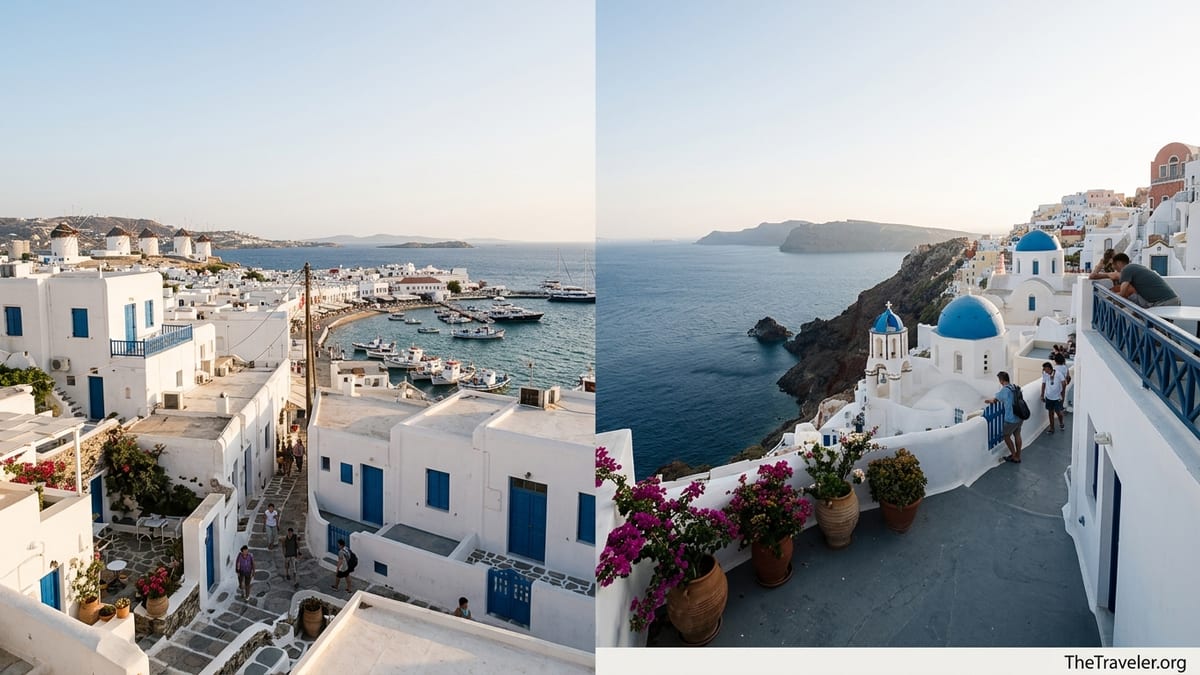
First Impressions: Postcards vs. Pulse
Arriving in Mykonos Town, or Chora as locals call it, the first impression is kinetic. Ferries dock at Tourlos port and within minutes you are in a tangle of lanes where scooters buzz, music drifts from open doors and the breeze carries the scent of sunscreen and grilled octopus. Little Venice, the waterfront quarter with houses perched almost in the sea, can feel like stepping into a live postcard, but the overall energy is urban-beach: stylish, extroverted and in motion.
Oia on Santorini feels deliberately slowed down. Most visitors arrive from Athinios port by bus or taxi that climbs a serpentine road through volcanic cliffs before continuing along the rim of the caldera. The first glimpse of Oia’s white cubes and blue domes spilling along the cliff edge is often silent; people simply stop and stare. Traffic is tightly controlled, so the soundscape is quieter: footsteps on stone, distant church bells, the hum of conversation on terraces facing the sea. The mood is contemplative rather than electric.
These first few minutes set the tone for the entire stay. Mykonos Town announces itself as a place where you will join a crowd and a rhythm. Oia suggests you will step out of time. Many travelers report remembering the “feeling” of their arrival more vividly than any individual sight, which is why this initial emotional hit matters when deciding which town will stick with you.
Scenery and Atmosphere: Labyrinth Lanes or Caldera Drama
Visually, both towns are undeniably striking, but in different ways. Mykonos Town’s charm comes from human scale and intimacy: narrow alleys that twist unexpectedly, bougainvillea spilling over balconies, tiny chapels tucked between shops, and the iconic row of 16th‑century windmills standing guard above the sea. It is best appreciated by wandering aimlessly at golden hour, ducking down side streets where an elderly resident waters geraniums or a cat curls in a doorway.
Oia’s scenery is cinematic. The town is carved into the caldera rim, so almost every terrace and alley opens to a sheer drop toward the Aegean. White cave houses, infinity pools and domed churches stack along the cliffs, interspersed with pastel mansions and lava‑stone paths. At sunset, hundreds of people line the paths near Oia Castle, watching the sky shift from gold to deep orange as sailing boats glide below. Even seasoned travelers describe this first caldera sunset as one of the most intense visual memories of their lives.
In daily life, Mykonos Town feels more like a working town that happens to be glamorous. You will see delivery carts squeezing through alleys at dawn, laundry hanging over side streets and locals chatting outside bakeries in the morning. Oia is more curated. Many properties are boutique hotels and high‑end rentals, so the built environment feels like a continuous luxury resort. For some, that perfection is precisely what makes it unforgettable; for others, it can feel less authentically lived‑in than Mykonos Town.
Nightlife vs. Nightfall: How Each Town Comes Alive After Dark
If nights are the heart of your trip, Mykonos Town typically leaves the deeper imprint. After sunset, the maze of streets becomes a multi‑layered nightlife scene. Small bars along Matogianni Street serve cocktails at standing‑room counters, while waterfront spots in Little Venice offer cushioned seats inches from the waves. Iconic venues such as Scandinavian Bar or smaller spots scattered through the alleys pack out by midnight, and late‑night kebab shops stay open to feed the spillover at 3 a.m. or later during July and August.
Oia after dark is a different story. Once the last rays of sunset fade and excursion buses leave, the town becomes hushed. Many travelers retreat to their cave suites or terrace restaurants for long, slow dinners with wine and candlelight. There are a few atmospheric wine bars and lounges, but if you are seeking a “big night out” you will usually be heading to Fira instead, Santorini’s main nightlife hub, where clubs and bars stay open into the small hours.
This contrast means the memories you carry home will differ. From Mykonos Town, people often recall laughing with strangers in crowded alleys, impromptu dancing, and the thrill of navigating home through a still‑awake town as the sky lightens. From Oia, the enduring images are quieter: the glow of lanterns on white walls, the sound of cutlery and conversation on terraces, and the calm of walking back to your room under a dark, starlit sky.
Costs, Crowds and Practical Realities
Both Mykonos Town and Oia are among the most expensive places in the Cyclades, but the way you spend your money differs. In peak summer, a simple double room in or just above Mykonos Town can easily start around a mid three‑figure amount per night, with stylish small hotels and suites reaching far higher, especially for properties with direct sea views. You can moderate daily costs by ducking into back‑street gyros shops for under ten euros or choosing local bakeries and simpler tavernas for lunch.
Oia tends to be where Santorini’s highest room rates concentrate, especially for cliff‑side suites with private plunge pools and uninterrupted caldera views. It is common for couples to book one or two nights in such a suite as a “trip highlight” and then base themselves in a more affordable village like Firostefani or Imerovigli for the rest of their stay. Daily spending can also be high, as many restaurants and bars command premiums for sunset terraces, while groceries and casual snacks are slightly more limited than in larger Fira.
Crowding is an important factor in how memorable each town feels. In Mykonos Town, the busiest hours are late afternoon and night, when cruise excursion groups mingle with beach‑club returnees. The lanes can become shoulder‑to‑shoulder, especially around Matogianni and Little Venice. In Oia, crowding peaks before sunset, when tour buses and cruise passengers surge into the village. Popular viewpoints near Oia Castle can feel jammed well over an hour before the sun actually sets, and staff at terrace restaurants often remind guests of time limits during this window.
Outside high season, the experience changes. In late May or late September, you might pay significantly less for lodging in both towns and find that you can actually pause in an empty alley to hear church bells or the wind. These shoulder months often produce the most balanced impressions: vibrant yet breathable.
Experiences Beyond the Postcard: What You Actually Do All Day
How you spend your days shapes which town lingers in your memory. Mykonos Town is less about ticking off monuments and more about a lifestyle rhythm: slow breakfast on a café terrace, a wander through boutiques and galleries, then a bus or taxi out to one of the island’s famous beaches such as Psarou, Ornos or Paradise. Many visitors treat town as home base, returning in the evening to shower, shop, dine and go out. Even non‑shoppers enjoy the people‑watching as locals and visitors in resort wear drift between stores and bars.
There are still cultural anchors. The small but atmospheric churches sprinkled around Chora, the Archaeological Museum near the old port and the nearby island of Delos, reached by short boat trip, all offer glimpses of history. Yet for most, the defining “activity” remains that feeling of being part of an animated, cosmopolitan crowd in a compact, walkable setting.
In Oia, daylight hours tilt toward quiet exploration and scenic lingering. Many travelers rise early to walk the main pedestrian path before day‑trippers arrive, photographing blue domes and side alleys in soft morning light. Late morning might mean a wine tasting at a nearby winery on the island or a hike along part of the caldera trail toward Fira, with Oia as your starting or ending point. Others descend to Ammoudi Bay at the base of the cliffs for a seafood lunch by the water and a swim from the rocks.
Oia also lends itself to staying put. With many hotels built as self‑contained mini‑resorts with pools and sweeping views, guests often spend long stretches on their own terrace, reading, napping and watching the changing light across the caldera. That slower pace, combined with the volcanic landscape, is what many people recall years later: less a list of sights, more a specific mood of suspended time.
Accessibility, Logistics and Getting Between the Two
From a practical standpoint, both towns can be reached relatively easily from Athens, but the final approach shapes your first impressions. Mykonos has a small island airport about a ten‑minute drive from Mykonos Town, with seasonal direct flights from European hubs. Many visitors arrive by ferry from Piraeus or Rafina ports near Athens to Tourlos port. From there, a short taxi or shuttle ride brings you into Chora’s pedestrian zone, where vehicles largely stop at the outskirts.
Santorini also has an airport near Kamari and a busy ferry port at Athinios. Reaching Oia requires a drive of roughly 30 to 40 minutes from either, along winding roads that can be congested at peak times. Travelers sensitive to road motion sometimes feel this journey as part of the adventure, while others may find it tiring after a long journey. Luggage handling in both towns can also be a consideration, as many hotels in Oia sit down steps on the cliff, and some properties in Mykonos Town are accessible only via narrow alleys.
If you hope to experience both towns in one trip, ferries between Mykonos and Santorini typically run seasonally, most frequently from late spring through early autumn. During these months, high‑speed boats usually cover the route in roughly two to three hours, with prices varying depending on company and seat class. Tickets often sell out on popular dates, so advance booking is recommended if you are traveling between June and September. Weather can disrupt sailings, particularly during windy spells, so building a small buffer into your itinerary is wise.
In terms of getting around once you are there, neither town requires a car. Mykonos Town is entirely walkable, and buses or taxis link it to beaches and the airport. Oia is also pedestrian at the core, with local buses and taxis connecting it to Fira, the port and the airport. Travelers with mobility challenges may find Mykonos Town’s relatively flatter lanes slightly easier than Oia’s many staircases, though both require comfort with uneven surfaces.
Romance, Groups and Solo Travel: Who Each Town Suits Best
Matching each town to your travel style can help predict which will leave the stronger mark. Couples, especially on honeymoons or anniversaries, often gravitate toward Oia. The combination of private terraces, plunge pools, cliffside dining and iconic sunsets format the town as an almost ready‑made romantic backdrop. Many boutique hotels specialize in adults‑only stays, and days naturally fall into a pattern of shared slow rituals: coffee on the terrace, walks at sunrise, wine at sunset.
Mykonos Town, by contrast, tends to shine for groups of friends and sociable solo travelers. Its compact center encourages chance encounters and bar‑hopping, and the nightlife makes it easy to meet people from around the world. Groups often remember nights in Mykonos Town as the social high point of their holiday, even if they spend their days scattered across beach clubs and excursions.
Families find merits in both. Mykonos Town’s busy lanes can be overwhelming with young children, but older kids and teens often enjoy the energy, gelaterias and quick access to beaches. In Oia, the steep drops and many steps require close supervision, yet multigenerational groups appreciate the calm, views and the option to retreat to shared villas. For solo travelers seeking reflection and photography, Oia can feel like an open‑air studio, while solo visitors wanting conversation and nightlife may bond more easily in Mykonos Town.
The Takeaway
When travelers look back years later, what they remember most about Mykonos Town is its buzz. The late‑night alleys, the music spilling from doors, the stylish visitors weaving between shops and bars and the sense that, for a few days, they were part of a glamorous, ever‑awake village by the sea. Its impression is urban and social, defined as much by people as by place.
Oia’s memory is more elemental. The caldera view, the silence at sunrise, the way houses cling to dark cliffs above an ancient volcanic sea, and the ritual of gathering to watch the sun slip below the horizon. Visitors often describe Oia not as a town they “did things in,” but as a landscape they inhabited: a stage for reflection, romance and awe.
So which Cycladic town leaves a bigger impression? For many couples and photographers, it is Oia, thanks to its singular volcanic setting and almost unreal sunsets. For party‑leaning travelers, groups of friends and those who come alive in crowds, it is Mykonos Town, where human energy rivals the beauty of the whitewashed lanes. The honest answer is that each excels in a different emotional register. If your trip allows, letting Mykonos Town provide the heartbeat and Oia deliver the heartbeat‑slowing finale can create a Greek island journey that feels complete.
FAQ
Q1. Is Mykonos Town or Oia better for a first-time visitor to the Greek islands?
For a first visit focused on iconic views and an easier pace, Oia often feels more quintessentially “Greek island.” If you are excited by nightlife and people‑watching, Mykonos Town might make a stronger first impression.
Q2. Which is more expensive overall, Mykonos Town or Oia?
Both are among the priciest spots in the Cyclades, but Oia typically has higher average room rates, especially for caldera‑view suites, while Mykonos Town may see more of your budget go to bars and nightlife.
Q3. Where will I find better nightlife, Mykonos Town or Oia?
Mykonos Town has far more nightlife, with bars and clubs that stay busy into the early morning. Oia is calm at night, with a focus on restaurants, wine bars and quiet terraces.
Q4. Which town is more relaxing during peak summer?
Oia can still feel busy around sunset, but overall it usually offers a calmer environment than Mykonos Town in July and August, especially if you stay in a property slightly away from the main paths.
Q5. Is it easy to visit both Mykonos Town and Oia in one trip?
Yes, in the main season high‑speed ferries usually connect Mykonos and Santorini in roughly two to three hours, making it practical to include time in both towns on a single itinerary.
Q6. How many nights should I spend in Mykonos Town vs. Oia?
Many travelers find two to three nights in each ideal: long enough to experience Mykonos Town’s nightlife and nearby beaches, and to enjoy Oia’s caldera views without rushing.
Q7. Which town is better for families with children?
Both can work, but families with very young children may find Mykonos Town’s flatter streets easier than Oia’s many steps and steep drops, though Oia’s quieter evenings can be appealing.
Q8. Where will I get better photos, Mykonos Town or Oia?
Oia offers the most iconic cliffside and sunset shots, while Mykonos Town excels at charming street scenes and harbor views. Serious photographers often appreciate having time in both.
Q9. Is either town suitable for travelers on a tighter budget?
Neither is ideal for strict budgets, but you can soften costs by traveling in shoulder season, staying a short walk outside the center and favoring casual tavernas and takeaway spots.
Q10. If I prefer authentic local life over luxury, which should I choose?
Mykonos Town generally feels more like a lived‑in island town beneath the gloss, while Oia leans more toward a polished, boutique atmosphere centered on views and upscale stays.