


More news on this day
Operations at Manila’s Ninoy Aquino International Airport (NAIA) gradually returned to normal on Sunday evening, November 29, after the airport’s main runway was shut for several hours when a Philippine Airlines flight to Daraga, Albay, made an emergency landing and suffered burst tires, triggering diversions, cancellations and delays during a busy holiday travel weekend.
Get the latest news straight to your inbox!
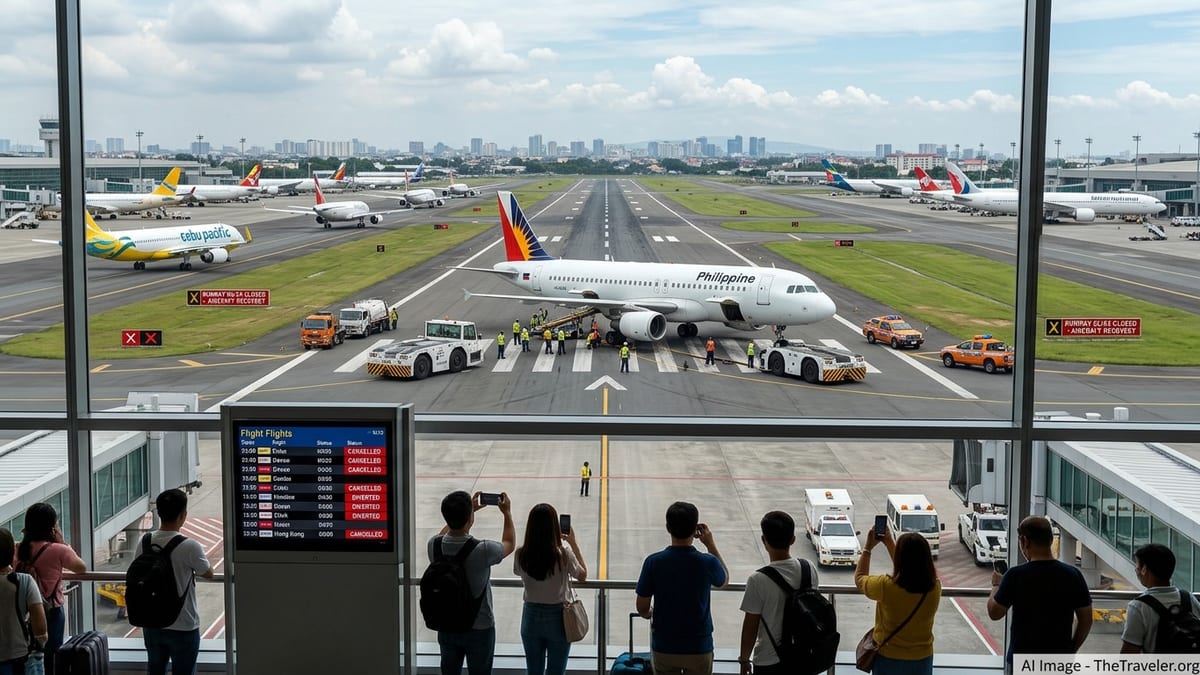
What happened on NAIA’s main runway
According to official notices and airline statements, Philippine Airlines flight PR 2923, an Airbus A320 operating on behalf of PAL Express, departed Manila bound for Daraga, Albay, on Sunday, November 29. Partway into the flight, the crew reported a hydraulic system problem and requested to return to Manila as a precautionary measure. The aircraft landed back at NAIA at around 11:45 a.m. local time, with all passengers and crew reported safe and able to disembark normally.
During the landing roll, multiple main landing gear tires burst, leaving the aircraft disabled on Runway 06/24, NAIA’s primary runway for most jet operations. Aviation authorities and NAIA’s private operator, New NAIA Infra Corp (NNIC), said the damage and the position of the aircraft made its removal more complex, requiring specialized equipment and inspection of the pavement before the runway could be declared safe for use again.
The Civil Aviation Authority of the Philippines confirmed that the incident was linked to a hydraulic issue and described the aircraft as a disabled A320 occupying the center portion of the runway. While the investigation into the exact technical cause is ongoing, there have been no reports of injuries or fire, and the event is currently treated as an operational incident rather than a major accident.
Runway closure, diversions and cancellations
Runway 06/24 was declared temporarily closed shortly before midday, effectively reducing NAIA’s available runway capacity for several hours. NAIA operates with two runways, but the main runway handles the bulk of jet traffic, including most international and widebody services. During the closure, authorities kept the secondary Runway 13/31 open, but its shorter length and configuration limited the number and type of aircraft that could use it, prioritizing narrowbody and turboprop movements.
With the primary runway blocked, arriving aircraft already en route to Manila were placed in holding patterns or diverted to other airports, most notably Clark International Airport north of the capital. Civil aviation and airport bulletins referenced several diversions, including Taipei to Manila services and other regional flights that did not have sufficient fuel reserves to continue holding while the runway remained unavailable. Some carriers chose to delay their departures from origin airports rather than risk diversions into Clark.
By mid afternoon, Philippine aviation authorities reported multiple domestic and international flights either diverted or cancelled because of the incident. A partial list released by Cebu Pacific as of around 5 p.m. included cancellations on its Manila services to and from Hong Kong, Cebu, Davao and General Santos. Philippine Airlines and PAL Express also confirmed the cancellation of some domestic rotations and the diversion of several inbound flights, including regional services that eventually operated into Clark instead of NAIA.
Timeline to reopening and how airlines responded
Airport operator New NAIA Infra Corp and the Civil Aviation Authority deployed recovery teams to stabilize the disabled Airbus, change the burst tires and tow the aircraft clear of the active runway. Ground crews also inspected the surface for debris and possible damage from the tire failure, a standard safety procedure after such events. The combination of technical work on the aircraft and inspection of the runway contributed to the multi hour closure of Runway 06/24.
By early evening, authorities announced that the main runway had been cleared and inspected, allowing it to reopen for both arrivals and departures at approximately 5:48 p.m. Manila time. Shortly after, NAIA and NNIC issued public advisories stating that operations on the main runway had resumed, while cautioning that delays would persist into the evening as airlines worked through a backlog of arrivals and departures built up during the closure period.
Philippine Airlines stated that all passengers from PR 2923 were safe and had disembarked normally, and that it was coordinating with aviation authorities and maintenance providers on the technical assessment of the aircraft. The flag carrier also said it was arranging onward travel for passengers affected by diverted and cancelled flights, using a mix of rebooked services from Clark and Manila and, where necessary, hotel accommodation or surface transport. Cebu Pacific and other airlines operating at NAIA similarly notified customers about cancellations and significant delays, offering rebooking options in line with their standard disruption policies.
Impact on travelers using Manila as a hub
The incident occurred over the Bonifacio Day long weekend in the Philippines, a period that typically sees elevated domestic and international travel as residents take short holidays or visit family. With NAIA still operating under capacity constraints while undergoing longer term modernization and reconfiguration works, the loss of its primary runway for several hours had a substantial knock on effect on schedules.
Passengers connecting through Manila on Sunday afternoon and evening were particularly affected. Those on diverted international flights to Clark faced extended onward travel times, as they had to wait for repositioned aircraft or ground transport down to Metro Manila. For some, missed connections meant involuntary overnight stays either in Clark or Manila, depending on where they eventually disembarked and whether replacement flights or alternative connections were available the same day.
The disruption also reached travelers departing from secondary Philippine cities who were due to connect at NAIA. With aircraft and crews displaced by the runway closure, some later evening domestic departures experienced delays even after the main runway reopened. Airlines warned in social media advisories that irregular operations could extend into November 30, particularly for early morning flights using aircraft that had been stranded away from their planned bases on Sunday.
What travelers should do next
With Runway 06/24 back in service, aviation authorities and NAIA’s private operator expect operations to normalize progressively over the next 24 hours, subject to residual delays as airlines reposition aircraft and clear the backlog in their schedules. There has been no indication of long term capacity reduction stemming from the incident, and the runway inspection did not prompt further structural closures beyond Sunday’s emergency measures.
Travelers booked to depart from or arrive in Manila through Monday, November 30, are advised to monitor their flight status directly with their airlines before leaving for the airport. Many carriers maintain live status updates on their websites and mobile apps and use text messages or email to notify affected customers of schedule changes. Allowing extra time for check in and security on the first operating day after a major disruption is also prudent, as longer than usual queues are possible even once runway operations are restored.
For passengers whose flights were cancelled or significantly delayed on November 29, the applicable options will depend on the airline and fare purchased. Typically, carriers in the Philippines offer free rebooking within a specified travel window during major operational disruptions, and some may permit conversion of the ticket value into travel credits or, in limited circumstances, refunds. Travelers are advised to review the latest policies published by their airline for this incident and retain boarding passes, emails and receipts in case they need to make a claim for additional costs such as hotels or ground transport under any applicable regulations or travel insurance policies.