


More news on this day
Early evidence from federal data, flight trackers and holiday travel forecasts indicates that U.S. air travel over the core Thanksgiving 2026 period was heavily affected by storms and peak‑season congestion but avoided a repeat of this month’s nationwide technology failure, leaving airports crowded and frequently delayed yet broadly operational.
Get the latest news straight to your inbox!
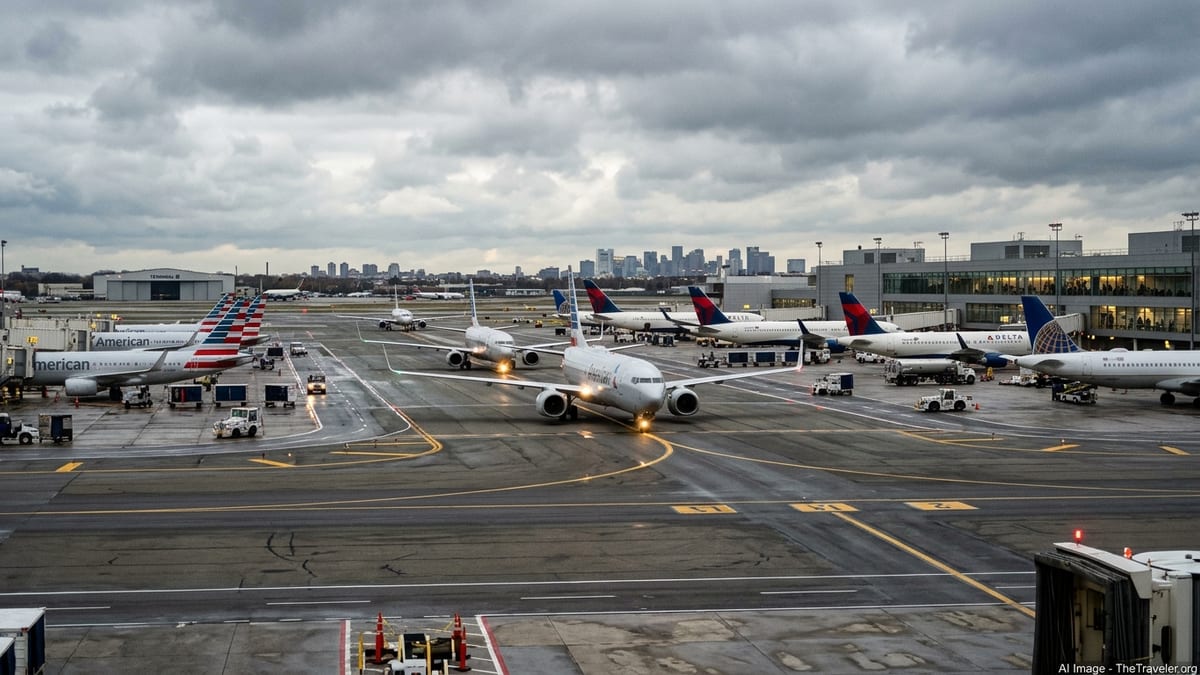
Holiday skies busy but mostly resilient under storm pressure
Across the main Thanksgiving window from Tuesday 24 November to Monday 30 November 2026, the U.S. aviation system operated close to capacity, with elevated disruption but no sign of another nationwide ground stop. Forecasts from the Transportation Security Administration (TSA) anticipated about 17.6 million passengers passing through airport checkpoints from 24 to 29 November, a volume comparable to the 2025 record but spread across slightly fewer total travelers. Early daily figures published by data compilers that track TSA’s checkpoint table show more than 2.7 million passengers screened on Tuesday 24 November and a higher total on Wednesday 25 November, placing both days among the busiest of the year.
On the airline side, planning documents cited by industry analysts suggested that U.S. carriers scheduled more than 400,000 flights across a broader nine day Thanksgiving horizon, which the Federal Aviation Administration (FAA) described as the busiest Thanksgiving air schedule in at least 16 years in terms of planned movements. That density meant minor weather or staffing constraints at hub airports quickly converted into queues of aircraft waiting for takeoff or arrival slots, although most flights were still able to operate.
Flight tracking services reported a pattern consistent with heavy holiday congestion amplified by severe regional weather rather than by a fresh systems failure. On Thanksgiving Day itself, Thursday 26 November, the nor’easter that lashed much of the Eastern Seaboard contributed to just over 2,200 flights within, into or out of the United States running late and slightly more than 400 cancellations, according to figures provided by FlightAware and echoed in national press coverage. Those numbers, although disruptive to many individual trips, represented a fraction of the tens of thousands of flights scheduled nationally that day.
Where and how storms disrupted Thanksgiving travel
The geography of delay across the week closely followed the sequence of November storm systems documented by the National Weather Service and emergency management briefings. In the first half of Thanksgiving week, low clouds, fog and a persistent marine layer affected key West Coast airports including San Francisco and Seattle–Tacoma. When ceilings and visibility dropped, the FAA reduced arrival and departure rates, increasing spacing between aircraft and triggering arrival and departure metering programs. With holiday schedules already concentrated in morning and late afternoon banks, those measures quickly translated into rolling gate holds and airborne holding patterns.
Farther south, bands of heavy rain and thunderstorms along the Gulf Coast and in parts of Florida and Texas periodically disrupted operations at major hubs. Airports such as Miami, Fort Lauderdale and Houston George Bush Intercontinental reported periods of strong winds, lightning in the vicinity and torrential rain as the Thanksgiving nor’easter formed over the Gulf of Mexico and moved northeast. During the most active convective periods, the FAA implemented temporary ground stops or ground delay programs, and airport authorities pulled ramp workers back from exposed areas, slowing boarding, baggage loading and aircraft turnarounds. These local safety measures increased the national tally of delayed flights but rarely triggered large runs of cancellations.
The most significant single weather event for aviation came on Thanksgiving Day, when the 2026 Thanksgiving nor’easter intensified along the East Coast. Weather bulletins described strong onshore winds, heavy rain and pockets of coastal flooding stretching from the Carolinas through the Mid‑Atlantic and into New England. The storm’s impacts extended well beyond aviation, flooding communities, cutting power to hundreds of thousands of customers and even forcing the postponement of New York City’s Thanksgiving Day parade. For airlines and airports, the system led the FAA to apply repeated ground delay programs at major Northeast hubs including New York LaGuardia, John F. Kennedy and Boston Logan, reducing arrival rates and pushing some departures into lengthy queues. As the storm lifted north and east into Friday, constrained arrival flows at these hubs continued to generate knock‑on delays across the national network as aircraft and crews arrived late for subsequent segments.
November 13 nationwide ground stop remained a concern but did not repeat
Thanksgiving travel played out less than three weeks after the 13 November 2026 nationwide ground stop, the most extensive systemwide halt to U.S. flight departures in roughly a quarter century. According to an analytical brief from the Congressional Research Service and public statements by Transportation Secretary Sean Duffy and the FAA, that earlier incident began during a telecommunications upgrade at an FAA radio facility in El Dorado, Arkansas, where contractor L3Harris was replacing legacy copper‑based communications lines and routers with newer Juniper devices as part of a multi‑year modernization program.
Investigators have said that after one of the new Juniper routers in El Dorado was brought online, it began sending a high volume of connection attempts into the FAA’s operational network, overwhelming older equipment and contributing to instability across multiple air route traffic control centers. A second Juniper router installed weeks earlier at a radar facility near Amarillo, Texas generated similar network traffic. As radar feeds and communications links fluctuated at what federal summaries describe as 17 of the FAA’s 22 en route centers, the agency ordered a nationwide ground stop on the afternoon of Friday 13 November. The halt, which lasted for about four hours and forty five minutes, resulted in more than 17,000 flights being canceled or delayed over subsequent days as airlines worked through backlogs.
In the wake of the outage, the Department of Transportation paused further Juniper router installations in FAA facilities while internal and external experts assess the failure mode and the broader risk to the National Airspace System. Members of Congress sent detailed information requests to the department and the FAA seeking timelines and documentation of the modernization effort, which covers several thousand devices across the country. The specific routers involved in El Dorado and Amarillo have been isolated for testing, and the FAA has indicated that it will issue additional public findings as they become available. Against that backdrop, any sign of disruption around Thanksgiving attracted scrutiny from policymakers and travelers alike, but available operational reports for the week show only localized issues typical of a high‑demand, weather‑affected holiday period.
High demand exposed tight capacity and limited recovery options
Even with delays largely tied to storms and routine congestion, the scale of Thanksgiving 2026 travel magnified the impact on individual passengers. AAA’s national holiday forecast, issued in mid‑November, projected that around 81.5 million Americans would travel at least 50 miles from home between Tuesday 24 November and Monday 30 November, a slight decline from an estimated 81.6 million in 2025 and the first forecast year‑on‑year drop since 2023. Within that total, the organization estimated that about 5.96 million people would fly on domestic routes during the core Tuesday to Monday window, a small decrease compared with last year that AAA and travel industry reports linked partly to higher average airfares.
Despite that modest dip, U.S. airlines still entered the period with dense schedules and high expected load factors. Forecasts compiled by aviation data firms and cited in financial and policy coverage described the broader nine day Thanksgiving horizon as the busiest in at least 16 years in terms of scheduled flights, reflecting carriers’ decisions to restore and add capacity following pandemic‑era reductions. With many routes already operating with limited slack and late evening departures tightly banked for connecting flows, even short‑lived flow restrictions could have outsized effects on passengers relying on tight connections.
Airports and airlines reported that on the busiest days, modest reductions in an airport’s arrival or departure rate, such as a 20 or 30 minute slow‑down for storm activity or runway configuration changes, quickly produced long queues. Departing aircraft could face extended waits for takeoff slots, while arriving flights stacked into holding patterns if gates were occupied by earlier delays. For travelers starting in smaller cities and connecting through hubs, a half hour delay leaving the origin airport was often enough to jeopardize onward connections, especially if later flights were heavily booked or crew duty limitations constrained late night schedules. Although overall cancellation rates across the week remained, by early indications, lower than during major winter storms or airline‑specific meltdowns seen in recent years, limited availability of spare aircraft and rested crews late in the day reduced carriers’ ability to reaccommodate disrupted passengers on same‑day services.
Return‑wave outlook and what travelers should watch next
Attention now turns to the inbound surge on Sunday 29 November and Monday 30 November, historically the most delay‑prone days in the Thanksgiving cycle. TSA and aviation data services identify the Sunday after Thanksgiving as the day that most often records the highest number of passengers screened at security checkpoints each year, and federal statistics for recent years show that Sunday typically posts the highest share of flights arriving at least 15 minutes late. For 2026, TSA forecasts indicated that more than 3 million passengers could be screened on Sunday 29 November alone, although as of 29 November final counts for the latter part of the week were not yet published.
National Weather Service outlooks for the back half of the holiday period highlight lingering unsettled conditions over parts of the East Coast and Midwest as the principal remaining risk to air travel. Low ceilings, patchy fog, variable winds and renewed rain at major hubs such as New York area airports, Chicago, Atlanta and Boston have the potential to trigger additional ground delay programs or require controllers to increase spacing between arriving aircraft, which in turn pushes departure slots on connecting routes later into the day. Major carriers have issued targeted travel advisories and flexible rebooking waivers for passengers scheduled to pass through certain hubs and time windows, typically tied to official forecasts of adverse weather rather than internal technology concerns.
Airport operators and security agencies continue to advise domestic passengers to arrive at least two hours before scheduled departure and international travelers at least three hours, particularly on the Sunday and Monday after Thanksgiving when road congestion, parking constraints and security queues tend to peak. Several large hubs have warned that central parking garages could reach or exceed capacity during the return wave, with drivers potentially redirected to remote or off‑airport lots and shuttle services, adding extra time to the journey. Travelers connecting through busy hubs are encouraged to rely on airline apps and direct text alerts for gate and schedule changes, as same‑day operational adjustments are often reflected there more quickly than in printed itineraries or third‑party booking confirmations.
More detailed insight into how Thanksgiving 2026 unfolded will emerge over the coming weeks as the Department of Transportation’s Bureau of Transportation Statistics releases finalized November on‑time performance and cancellation data and as the FAA publishes its breakdown of delay causes across categories such as weather, volume, carrier operations, security and national airspace issues. In parallel, the agency has said it will provide further public updates on its investigation into the 13 November nationwide ground stop, including any changes to equipment rollout, network monitoring or contingency procedures before the end‑of‑year holiday travel peaks. For travelers planning winter and 2027 trips, those findings, combined with the early Thanksgiving data, will help clarify how much of this year’s disruption can be attributed to normal holiday pressures and storms and how much reflects deeper questions about capacity and resilience in the U.S. air traffic system.