


More news on this day
Early figures from federal agencies, flight trackers and transport forecasters indicate that U.S. air travel over the core Thanksgiving 2026 period has been disrupted primarily by storm systems and peak-season congestion, while avoiding a repeat of the nationwide technology failure that triggered a four-hour-plus ground stop on November 13, leaving airports busy and often delayed but broadly functional.
Get the latest news straight to your inbox!
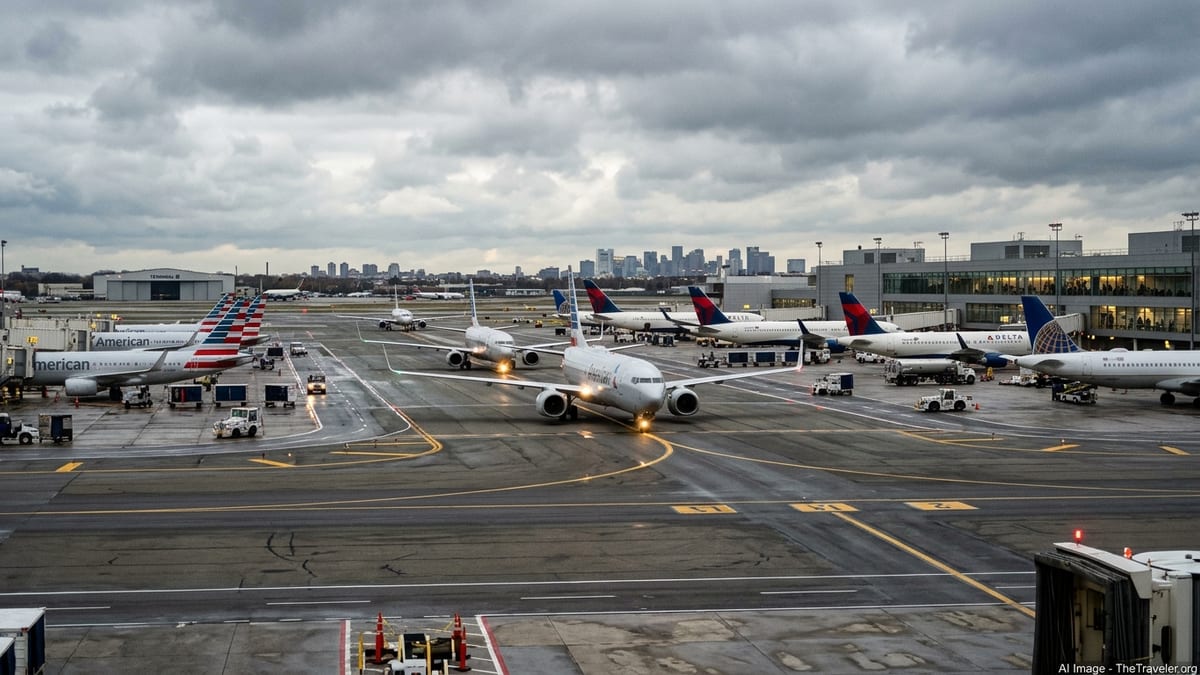
Holiday skies strained but systemwide collapse avoided
Preliminary checkpoint counts show that the Transportation Security Administration screened roughly 17 to 18 million passengers between Tuesday 24 November and Monday 30 November 2026, in line with the agency’s pre-holiday forecast of about 17.6 million travelers for that seven-day window and only slightly below the 2025 record. Although final daily tallies for the Sunday and Monday return wave are not yet posted, TSA’s running table already places Tuesday 24 November above 2.7 million passengers screened and indicates that Wednesday 25 November was even busier, consistent with recent Thanksgiving patterns.
On the operational side, industry schedules compiled ahead of the holiday show that U.S. airlines planned more than 400,000 flights across a broader nine-day Thanksgiving horizon, which the Federal Aviation Administration described in briefings as the busiest Thanksgiving period in at least 16 years when measured by scheduled movements. Analysts comparing schedules with published load-factor guidance note that airlines put more flights into the system than in 2025 even though total passengers were expected to be slightly lower, tightening margins for delay recovery when weather or local staffing issues slowed operations.
Flight status data from tracking services for Tuesday 24 November through Saturday 28 November point to a disruption pattern dominated by weather and volume controls rather than nationwide infrastructure problems. Delays tended to cluster at specific hubs when fog, low ceilings, thunderstorms or strong crosswinds forced the FAA to reduce arrival and departure rates or introduce ground delay programs, while most of the network continued operating. Even on Thanksgiving Day itself, Thursday 26 November, when a developing nor’easter affected much of the Eastern Seaboard, the number of delayed and canceled flights remained well below levels seen during the 13 November technology outage or past winter storm collapses.
Where storms hit hardest and how they translated into delays
The distribution of delays closely tracked a sequence of November storm systems documented by the National Weather Service, complicating travel first on the West Coast and Gulf Coast and then across the Eastern seaboard as the Thanksgiving nor’easter intensified. In the first half of the week, a combination of low clouds, fog and a marine layer repeatedly lowered ceilings and visibility at major West Coast gateways, including San Francisco and Seattle–Tacoma. When those conditions fell below thresholds for standard visual operations, the FAA temporarily reduced arrival and departure rates through air traffic programs that increase spacing between aircraft, which quickly produced rolling gate holds and airborne holding patterns during already concentrated morning and afternoon departure banks.
In the Gulf Coast region and parts of Florida and Texas, bands of heavy rain and embedded thunderstorms periodically disrupted operations at key connecting hubs. Major airports such as Miami, Fort Lauderdale and Houston George Bush Intercontinental reported periods of strong winds, lightning in the vicinity and intense rainfall as the Thanksgiving nor’easter formed over the Gulf of Mexico before tracking northeast. Safety protocols required the FAA at times to impose short ground stops or ground delay programs and prompted airport operators to suspend some ramp work when lightning or extreme wind readings were recorded, slowing boarding, baggage handling and refueling. These measures increased the share of flights arriving 15 minutes or more behind schedule but did not generally produce large blocks of outright cancellations.
The most consequential single weather event for aviation came on Thanksgiving Day and into Friday as the nor’easter intensified along the East Coast. Forecast discussions highlighted strong onshore winds, heavy rain and pockets of coastal flooding from the Carolinas through the mid-Atlantic into New England, conditions that led New York City authorities to scale back parts of the Thanksgiving Day parade and caused localized power outages and roadway flooding. For aviation, the storm prompted the FAA to apply repeated ground delay programs at major Northeast hubs, including New York LaGuardia, John F. Kennedy and Boston Logan, lowering arrival rates below scheduled demand. Airlines responded by slowing their approach flows, re-timing some departures and, in some cases, preemptively canceling a limited number of flights in the most constrained windows to avoid extensive rolling disruptions later in the day.
Technology scare remains in the background after 13 November ground stop
The Thanksgiving period unfolded less than three weeks after the nationwide ground stop on Friday 13 November 2026, which federal analysts describe as the most extensive systemwide halt to U.S. flight departures since immediately after the September 11 attacks. According to an analytical brief from the Congressional Research Service and public statements by Transportation Secretary Sean Duffy and FAA officials, that incident began during a telecommunications upgrade at an FAA radio facility in El Dorado, Arkansas, where contractor L3Harris was replacing older copper-based communications lines and routers with newer Juniper devices as part of a longer-term modernization effort.
Investigators have said that after one of the new Juniper routers in El Dorado was brought online, it began generating a high volume of connection attempts that flooded related parts of the FAA’s operational network, overloading legacy equipment and causing instability at multiple air route traffic control centers. A second Juniper router, installed several weeks earlier at a radar facility near Amarillo, Texas, produced similar network behavior. As radar and communications links became unreliable at what official summaries list as 17 of 22 en route centers, the FAA ordered a nationwide ground stop on the afternoon of 13 November. FEMA and congressional documentation indicate that the halt lasted about four hours and forty-five minutes and that disruptions continued into the weekend, with thousands of cancellations on 14 and 15 November as airlines worked to reposition aircraft and crews.
In response, the Department of Transportation has paused further installation of Juniper routers in FAA facilities while internal engineers and external experts examine the failure mode and overall risk to the National Airspace System. Letters from bipartisan groups in Congress have requested detailed timelines, test documentation and contingency plans, and the specific routers in El Dorado and Amarillo have been isolated for forensic analysis. The FAA has said it will release additional findings and any resulting changes to equipment deployment, network monitoring and backup procedures once its investigation progresses. Against this backdrop, policymakers, airlines and passengers scrutinized any irregularities over Thanksgiving for signs of recurring technology issues, but available operations summaries attribute the week’s interruptions primarily to weather and volume-related controls rather than new systemwide outages.
High demand exposed tight capacity and limited room to recover
Even with delays traced mainly to storms and routine congestion, the scale of Thanksgiving 2026 travel magnified the impact for individual passengers. In a forecast issued on 16 November, AAA projected that about 81.5 million Americans would travel at least 50 miles from home between Tuesday 24 November and Monday 30 November, a slight 0.1 percent dip from its estimate of 81.6 million travelers in 2025 and the first projected year-on-year decline since 2023. Within that total, the organization estimated that just under 6 million people would fly during the core Tuesday-to-Monday window, a marginal decrease that AAA and transport commentators linked partly to higher average airfares and to strong competition from road and rail on shorter routes.
Despite that modest drop in expected passengers, U.S. airlines entered the holiday with dense schedules and high projected load factors on many routes. Data compiled by industry analysts and cited in financial coverage describe the broader nine-day Thanksgiving horizon as the busiest in at least 16 years for scheduled flight movements, reflecting carriers’ strategies to restore or add capacity following the pandemic period. That structure left little slack: many trunk routes operated with banks of late-morning and late-afternoon departures designed around connections, and evening flights were tightly scheduled to support next-morning rotations. In this environment, even a brief slowdown in an airport’s arrival or departure rate, whether caused by a thunderstorm cell, low visibility or a runway configuration change, could quickly turn into queues that spilled across much of a day’s operation.
Operational updates from airlines and hubs during the week describe a pattern in which modest flow restrictions translated into long waits for some travelers. A 20 to 30 minute reduction in an airport’s hourly arrival rate during a storm often produced extended takeoff queues and holding patterns, especially during peak bank periods when multiple inbound and outbound waves overlapped. For passengers starting their journeys at smaller regional airports and connecting through hubs, a delayed departure of even half an hour was frequently enough to put tight onward connections at risk, particularly where subsequent flights were already heavily booked. While preliminary figures suggest that overall cancellation rates for the week have remained lower than during recent winter storms or single-airline meltdowns, limited availability of spare aircraft and rested crews late in the day constrained airlines’ ability to reaccommodate disrupted passengers on same-day services.
Return wave, early lessons and what travelers should monitor next
Attention now centers on the inbound surge on Sunday 29 November and Monday 30 November, which in previous years have been among the most delay-prone days in the Thanksgiving cycle. TSA, historical data compilers and independent aviation analysts all identify the Sunday after Thanksgiving as the day that most often records the highest number of passengers screened at U.S. airport security each year, and federal statistics show that it typically posts one of the highest daily shares of flights arriving at least 15 minutes late. For 2026, TSA’s holiday planning forecast pointed to more than 3 million passengers potentially passing through checkpoints on Sunday 29 November alone, although the agency’s official table has not yet published final counts for that date.
National Weather Service outlooks for the final holiday days highlight lingering unsettled conditions over parts of the East Coast and Midwest as the main remaining risk to air travel. Forecasters point to a combination of low ceilings, patchy fog, variable winds and renewed rain at major hubs such as the New York area airports, Chicago, Atlanta and Boston, any of which could require controllers to increase spacing between arriving aircraft or bring in additional ground delay programs. That in turn would push departure slots later, particularly on connecting routes scheduled in tightly packed evening banks. Several large carriers have issued weather-related travel advisories and flexible rebooking waivers for passengers ticketed through specific hubs and time windows, generally linked to formal meteorological alerts rather than to internal technology concerns.
Airport operators and security agencies are continuing to advise domestic passengers to arrive at least two hours before scheduled departure and international travelers at least three hours, with extra margin recommended on Sunday 29 November and Monday 30 November because of expected road congestion, full parking structures and extended security queues. Some hubs have signaled that central parking garages may reach or exceed capacity during the return wave, in which case drivers would be redirected to remote or off-airport lots with shuttle transfers, adding time at the start and end of trips. Airlines and airports also urge travelers to monitor official apps and direct text alerts for gate and schedule changes, since same-day operational adjustments from weather and flow control decisions are typically reflected there faster than in printed itineraries or third-party booking tools.
More precise assessments of how Thanksgiving 2026 unfolded will emerge over the coming weeks as the Department of Transportation’s Bureau of Transportation Statistics releases final on-time performance and cancellation data for November and as the FAA publishes its breakdown of delay causes across categories such as weather, volume, carrier operations, security and national airspace issues. In parallel, the FAA has said it will provide further public updates on its investigation into the 13 November nationwide ground stop, including any changes to modernization timelines, network safeguards and contingency plans before the late December and New Year travel peaks. For travelers planning winter and early 2027 trips, those findings, together with the Thanksgiving data, will help clarify how much of this season’s disruption reflects predictable holiday weather and congestion and how much signals deeper structural constraints in the U.S. air traffic system.