


More news on this day
Delta Air Lines says its flight operations have largely stabilized after a November 22 failure of the carrier’s automated weight‑and‑balance system in Atlanta caused more than 1,600 delays across the United States, briefly halted some flights into its largest hub and added fresh scrutiny to aviation technology resilience heading into the 2026 Thanksgiving travel peak.
Get the latest news straight to your inbox!
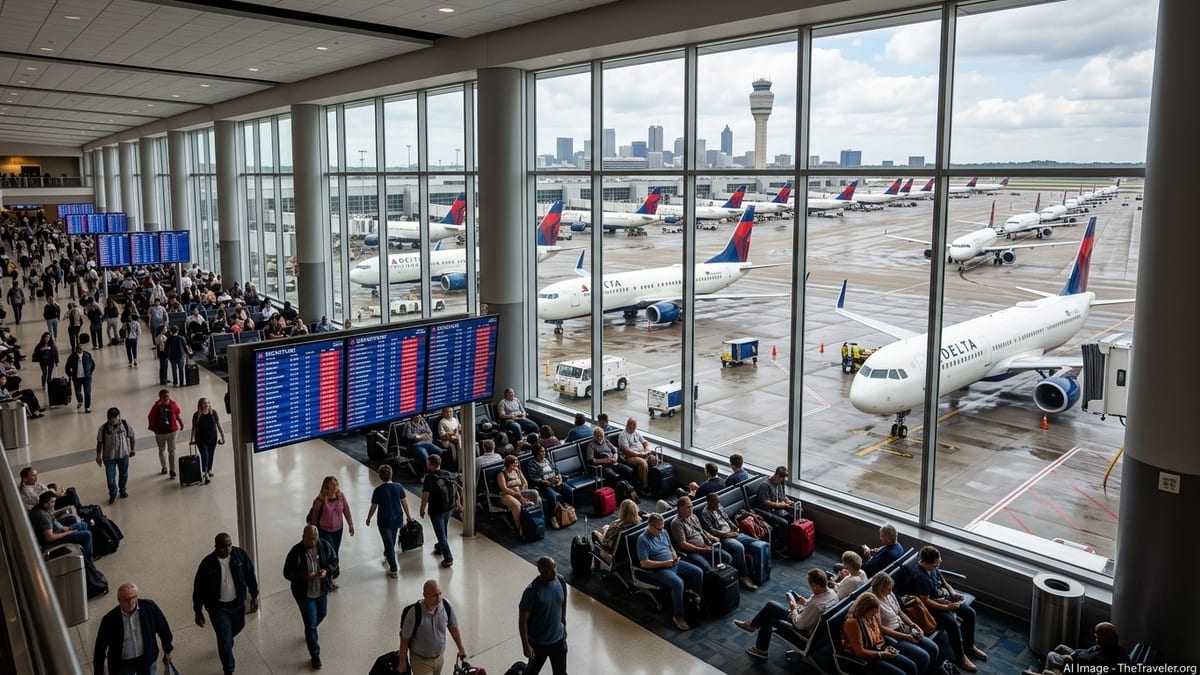
What happened to Delta’s weight‑and‑balance system on November 22
Delta’s disruption began on the morning of Sunday, November 22, 2026, when the airline reported a problem with one of its automated systems for calculating aircraft weight and balance for departing flights. The carrier uses an Automated Load Instruction System, or ALIS, based at its Atlanta headquarters to plan how passengers, bags and cargo are distributed on each aircraft and to transmit final load data and performance numbers to airport teams and flight crews across the network.
According to Delta statements and federal updates issued that day, the problem affected the automation used to generate and send those instructions rather than basic airport infrastructure. As the system malfunctioned, dispatchers and ground staff at multiple airports had difficulty receiving the final weight, balance and performance data needed before pushback. In aviation safety guidance, the Federal Aviation Administration (FAA) notes that staying within aircraft weight limits and center‑of‑gravity envelopes is critical, and that operating outside those limits can compromise structural integrity or controllability, which meant flights could not depart until reliable numbers were available.
The first visible effects appeared at Hartsfield‑Jackson Atlanta International Airport, Delta’s primary hub and one of the world’s busiest passenger airports. Aircraft that had boarded on time remained at gates while crews waited for load paperwork from operations. Delta requested that the FAA slow the flow of traffic into Atlanta to avoid gridlock on the ground while aircraft already at the airport held for dispatch clearance. The FAA responded with an approximately hour‑long ground stop for some flights bound for Atlanta, while emphasizing publicly that the issue originated with Delta’s automation, not with federal air‑traffic systems.
Scale of the disruption and how quickly Delta recovered
As the outage unfolded, its impact spread beyond Atlanta to Delta stations across the United States, including Boston, Washington, Seattle and Boise, where pilots told passengers that the airline’s systems were down and that they were waiting for weight‑and‑balance data from Atlanta. Same‑day flight‑tracking data and airline tallies reported in national and local media indicate that more than 1,600 Delta flights were delayed on November 22, placing the event among the carrier’s more disruptive days of 2026 outside major storms.
Public databases and airline tracking services showed that roughly half of Delta’s schedule departed late that Sunday, with many flights experiencing delays of 30 to 90 minutes and some waiting on the ground for several hours while manual procedures were put in place. While cancellation rates remained lower than during severe weather or the FAA’s earlier nationwide ground stop, a number of flights did ultimately cancel after extended onboard holds as crew duty limits and airport curfews approached.
Throughout the day, Delta said it was using “manual workarounds” to safely dispatch flights, with airport staff and dispatchers reverting to backup methods for calculating loads and verifying that each aircraft stayed within required limits. By Sunday evening, the airline told passengers and media that the affected automation used for departing‑flight weight and balance had been restored and that it was working to return operations to normal. Flight‑tracking data corroborate a gradual improvement in on‑time performance later that night, although some services continued to face longer‑than‑usual ground times as aircraft and crews were repositioned and as air‑traffic control managed the flow of delayed departures into and out of Atlanta to avoid renewed congestion.
On Monday, November 23, Delta still recorded several hundred delays, but the pattern shifted from a systemwide technology outage to more localized knock‑on effects as aircraft and staff moved back into their scheduled rotations. Travelers reported that many flights outside the busiest morning and evening hub banks operated close to schedule, while some departures still encountered extended holds at the gate as dispatchers double‑checked weight‑and‑balance figures and worked through the backlog. By that afternoon, Atlanta‑area broadcasters and airport updates were describing Delta’s operation as stabilizing, with disruptions tapering off into the middle of Thanksgiving week.
How the outage compares with the November 13 nationwide ground stop
The November 22 Delta outage came just nine days after a separate, high‑profile technology failure in the U.S. aviation system. On Friday, November 13, 2026, the FAA ordered a rare nationwide ground stop that paused new departures across the country for about four hours and forty‑five minutes while flights already in the air were allowed to continue to their destinations. Federal situation reports and subsequent technical summaries describe that event as a telecommunications disruption affecting radio and data connectivity at multiple air‑traffic facilities rather than an individual airline’s computer problem.
Congressional correspondence, emergency‑management documents and a recent non‑partisan research brief indicate that the November 13 network instability was linked to the installation of new routers at an FAA communications site in El Dorado, Arkansas, and at a radar facility in Amarillo, Texas. The new equipment generated abnormally high levels of data traffic that overwhelmed older, legacy components at a set of air‑route traffic control centers and related facilities, triggering widespread communication problems. To protect safety while technicians isolated the fault and rerouted traffic, the FAA issued the nationwide ground stop, which took the better part of an afternoon to lift and resulted in several days of follow‑on cancellations and delays while airlines rebuilt their schedules.
Industry and government tallies cited in those reports estimate that more than 12,000 flights across the United States were canceled in connection with the November 13 ground stop and its aftermath, including thousands at major U.S. carriers. Federal agencies including the FAA and the Department of Transportation have begun technical reviews focused on how the new routers interacted with existing systems, why overload safeguards did not prevent the instability from spreading, and what changes are needed to avoid a repeat.
By contrast, authorities say the November 22 disruption was contained within Delta’s own operations and customer center and did not involve FAA communications, radar or navigation infrastructure. In a public update on social media during the November 22 event, the FAA stated that Delta was working to resolve issues with its weight‑and‑balance automation system and that the resulting delays were not related to any FAA air‑traffic systems. Federal officials and the airline have said there is currently no evidence linking the two November events to a common technical cause, and there are no public indications so far of a cyberattack tied to either incident.
Even so, the proximity of the two disruptions has sharpened questions among policymakers and passengers about the resilience of both federal and airline‑owned technology. The FAA’s own review of the November 13 ground stop and Delta’s internal assessment of its automation failure are expected to feed into broader discussions about how quickly critical aviation systems are modernized and how robust backup procedures are when digital tools go offline during peak travel periods.
Timing during Thanksgiving week and what travelers experienced
The impact of both November disruptions was heightened by their timing within the broader 2026 Thanksgiving travel window, historically one of the busiest weeks of the year in the United States. In a forecast released on November 16, AAA projected that about 81.5 million Americans would travel at least 50 miles from home between Tuesday, November 24 and Monday, November 30, a slight decline from record volumes in 2025 but still a very heavy travel period. Of those, an estimated 5.96 million were expected to travel by air, leaving airlines and airports operating near recent holiday highs.
By the time that forecast period began on November 24, airlines and the FAA said they had largely restored normal operations after the November 13 nationwide ground stop. While residual delays and some cancellations continued in the days immediately afterwards as aircraft and crews were repositioned, federal situation reports indicate that major carriers and air‑traffic facilities were running full schedules by the start of Thanksgiving week, with additional monitoring in place for potential network stress.
The November 22 Delta outage, however, introduced a fresh disruption in the two days immediately before the AAA forecast window. Because Atlanta is both Delta’s main hub and a key connecting point for domestic and some international routes, technology failures there tend to echo widely across the airline’s schedule. Passengers traveling through Atlanta and through other major Delta stations reported long lines at gates, extended time sitting on parked aircraft, and occasional returns to the gate for additional checks as flight crews waited for final load numbers and dispatch clearance from the operations center.
Individual accounts documented in local news coverage and across online forums describe a wide range of outcomes. Some travelers saw near on‑time departures where manual procedures were implemented quickly, while others reported multi‑hour delays that led to missed connections or late‑night arrivals at their final destination. In some cases, passengers said information posted at the gate differed from what they heard on board, reflecting the challenge of keeping communication synchronized across multiple channels during a rapidly evolving technology outage. Although anecdotal, these reports align with the elevated same‑day delay statistics captured for Delta on November 22 and with the airline’s acknowledgment that a systemwide automation issue affected load calculations that day.
How Delta handled waivers, refunds and customer support
The November 22 outage followed shortly after the broader disruption caused by the FAA’s November 13 ground stop, during which Delta and other major U.S. airlines issued limited‑time travel waivers. For the FAA‑related event, Delta published an advisory allowing affected customers with tickets for travel between November 13 and November 16 to change flights without standard change fees, subject to specific conditions. Rebooked trips under that waiver generally had to depart on or before November 23, follow the same origin and destination, and remain in the same cabin to avoid fare differences. That waiver applied only to travel disrupted by the FAA communications failure and is no longer in effect for new changes.
For the November 22 Delta‑specific outage, there has been no widely advertised, systemwide waiver of a similar scope. Instead, the airline appears to be managing passengers through its standard disruption rules. Travelers whose flights were canceled by Delta are typically reaccommodated on later departures operated by the airline, subject to seat availability and routing options. For flights that operated but experienced significant delays, Delta’s existing policies allow for assistance such as meal vouchers or overnight hotel accommodation in some cases when disruptions are considered within the airline’s control and when local hotel capacity makes this feasible.
Under current U.S. Department of Transportation regulations, passengers are entitled to a cash refund if an airline cancels a flight and the traveler chooses not to fly, even when the original ticket was sold as nonrefundable. Some carriers also offer refunds or credits in cases of substantial schedule changes or very long delays when a trip no longer serves its original purpose, but those thresholds are defined by each airline’s own contract of carriage and customer‑service commitments. U.S. rules do not require airlines to pay automatic cash compensation solely for delays caused by internal IT issues, although carriers sometimes choose to offer travel credits, bonus miles or vouchers as a goodwill gesture after widely reported technology failures.
As of the Thanksgiving holiday weekend, there have been no public indications from Delta or federal regulators that the November 22 automation failure is still constraining day‑to‑day flight operations. Airport status boards and flight‑tracking services over the weekend show delays that appear more closely tied to seasonal factors such as heavy traffic and weather systems rather than to a continuing IT outage at a specific carrier. Travelers affected by the November 22 event who believe they are due reimbursement or additional support are being advised by consumer advocates to review Delta’s published policies, check any travel‑insurance coverage they may hold and retain receipts for hotels, meals and alternative transport arranged during the disruption.
What travelers should watch for through the rest of the holiday season
Looking ahead to the remainder of the 2026 holiday season, the immediate technical issue behind Delta’s November 22 outage appears resolved, but the event serves as a reminder of how dependent modern air travel is on complex software and data networks. For travelers with upcoming flights on Delta or other U.S. carriers, checking flight status frequently via airline apps or websites remains one of the most effective ways to stay informed about changes tied to weather, air‑traffic flow programs or technology issues that arise with little warning.
On the busiest travel days, arriving early at large hubs such as Atlanta, Chicago, Dallas–Fort Worth, Denver, Los Angeles and the New York‑area airports can provide extra margin if security lines or check‑in areas become crowded when multiple delays cluster together. Travelers with tightly timed plans, such as same‑day weddings, business meetings or onward cruise departures, may wish to build additional buffer into their itineraries while the aviation system manages both heavy seasonal demand and ongoing technology upgrades. That can mean opting for earlier departures in the day, avoiding the final flight of the night where possible, or adding an overnight stop on complex multi‑leg trips so that a single delay is less likely to cascade into a missed connection.
Passengers concerned about the potential impact of future outages can also review the customer‑service dashboards and commitments that major U.S. airlines have posted in response to recent Department of Transportation initiatives. These tools summarize what each carrier offers in terms of meal vouchers, hotel rooms and rebooking options when disruptions are within the airline’s control. Combining that information with the protections available from certain credit cards or standalone travel‑insurance policies can help travelers decide how much risk they are comfortable assuming during peak periods when the system is running close to capacity.
Regulators and lawmakers, meanwhile, are expected to continue scrutinizing both the November 13 FAA ground stop and the November 22 Delta outage as part of broader efforts to modernize aviation technology and improve contingency planning. While those reviews will take time, travelers heading into the December holidays can expect airlines and federal agencies to remain particularly focused on monitoring critical systems and on managing traffic flows at major hubs so that any new disruptions are contained as quickly and safely as possible.