


More news on this day
Early data from U.S. aviation and transport agencies indicate that storm systems and peak-season congestion, rather than a repeat of this month’s nationwide technology failure, were responsible for most flight delays over the core Thanksgiving 2026 travel period, leaving airports crowded and often late but generally functioning as scheduled.
Get the latest news straight to your inbox!
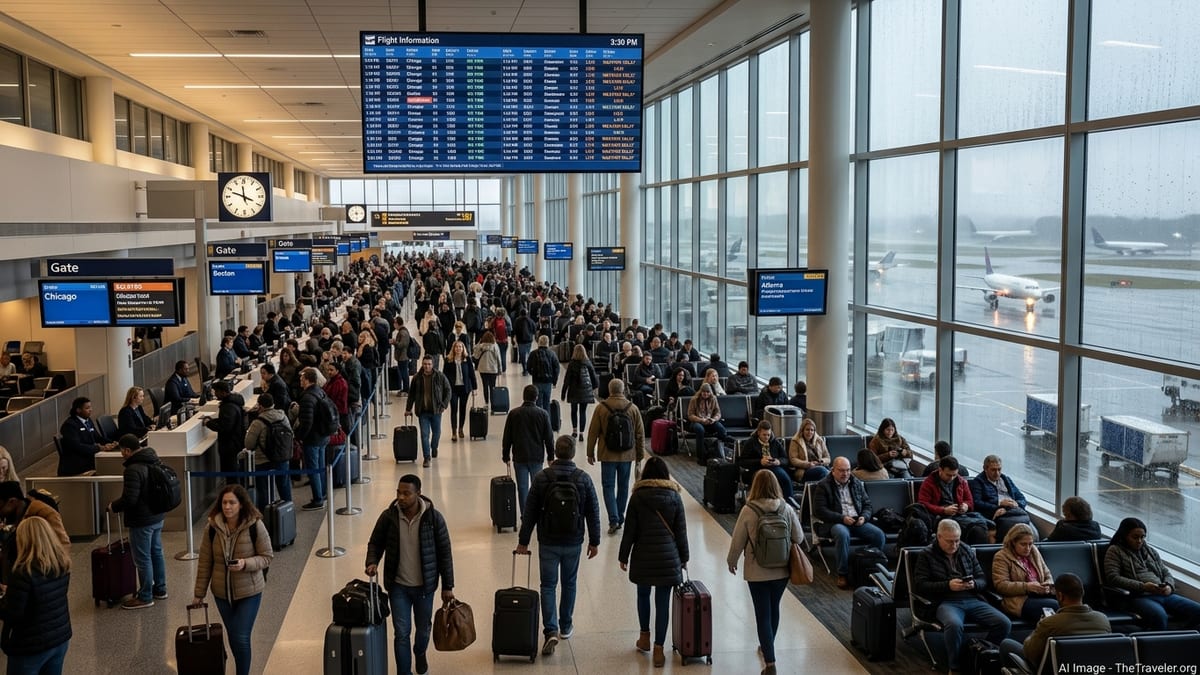
Heavy holiday traffic, but no repeat of nationwide tech outage
Security and scheduling data published during the week point to a Thanksgiving travel period that was close to record volumes but largely free of new systemwide technology failures. In a forecast issued on 24 November, the Transportation Security Administration said it expected to screen about 17.6 million passengers nationwide between Tuesday 24 November and Monday 30 November, with more than 3 million of those travelers projected on Sunday 29 November, traditionally the busiest day of the period. Initial daily counts released since then show checkpoint numbers in line with that forecast, including more than 2.8 million people screened on Wednesday 25 November, which TSA data described as the highest day-before-Thanksgiving total in its current table.
On the airline side, schedule datasets compiled ahead of the holiday showed U.S. carriers planning what several analysts described as the busiest Thanksgiving period in at least 15 to 16 years when measured by the number of scheduled flights, even though overall passenger totals were expected to be slightly below last year. Airlines added frequencies and restored routes compared with the immediate post-pandemic years, which increased connectivity but also reduced slack in the system when weather or local staffing constraints forced operations to slow.
These patterns unfolded less than three weeks after the Federal Aviation Administration ordered a nationwide ground stop on Friday 13 November 2026, following a malfunction linked to new networking equipment at an FAA facility in Arkansas. Investigations summarized by the Department of Transportation and congressional researchers indicate that a newly installed router began flooding parts of the FAA’s operational network with connection attempts, overloading older equipment and disrupting data flows at most en route air traffic control centers. The resulting halt to flight departures lasted for roughly four and three quarter hours, with knock-on delays and cancellations stretching into the weekend as airlines repositioned aircraft and crews.
Storm systems, not infrastructure, shaped where delays clustered
By contrast, the Thanksgiving travel period has so far shown a disruption pattern dominated by weather systems moving across the country and by routine traffic-management controls. Aviation weather outlooks from the National Weather Service and NOAA’s Aviation Weather Center ahead of the holiday flagged two main risks for flyers: a series of Pacific systems affecting the West Coast and a strengthening coastal storm tracking from the Gulf of Mexico to the Northeast around Thanksgiving Day itself. Those forecasts emphasized the potential for low ceilings, reduced visibility, strong winds and aircraft icing conditions, all of which typically lead the FAA to slow airport arrival and departure rates for safety reasons.
In the first half of the week, low clouds, fog and marine-layer conditions periodically reduced visibility at major West Coast gateways, including San Francisco and Seattle–Tacoma. When conditions dropped below the thresholds that support normal visual operations, air traffic managers applied tools such as miles-in-trail spacing and, at times, formal ground delay programs. These measures increase the separation between aircraft in the air and on the ground, which improves safety but reduces hourly arrival and departure capacity. In a holiday week when many flights are scheduled in tightly timed morning and afternoon banks, that loss of capacity quickly translated into rolling gate holds, airborne holding patterns and missed connections for some passengers, even though most flights still operated.
Farther south and along the Gulf Coast, bands of heavy rain and embedded thunderstorms disrupted operations at hubs in Florida and Texas as a developing coastal low formed over the Gulf of Mexico. Airports including Miami, Fort Lauderdale and Houston George Bush Intercontinental reported periods of strong winds and lightning in the vicinity, based on airport notices and local weather discussions. Standard lightning-safety rules require ramp crews to halt some outdoor work when strikes are detected nearby, which slows refueling, baggage loading and aircraft pushbacks. The FAA also issued short ground stops or traffic-management initiatives at times for these airports when convective weather or reduced visibility made it unsafe to operate at full schedule-based capacity.
East Coast nor’easter kept airports operating at reduced speeds
The most consequential single weather event for aviation arrived on Thanksgiving Day, Thursday 26 November, and continued into Friday, as a nor’easter intensified along the East Coast. NOAA and FEMA briefings described the system as a strong coastal storm bringing heavy rain, strong onshore winds and pockets of coastal flooding from the Carolinas through the Mid-Atlantic into New England. For ground travel, the storm produced localized roadway flooding and scattered power outages in several coastal communities on Thursday, although highway networks remained broadly open.
For air travel, the same system brought a mix of low cloud ceilings, gusty crosswinds and reduced visibility at some of the country’s most capacity-sensitive hubs, including New York’s LaGuardia and John F. Kennedy airports, Newark Liberty and Boston Logan. Faced with these conditions, the FAA used a series of ground delay programs and other flow-control tools that reduced the number of arrivals permitted per hour below what the published flight schedules assumed. Airlines responded by slowing their approach flows, retiming certain departures and, in the most constrained periods, preemptively cancelling selected flights in order to avoid extended rolling disruptions that could spill into the next day’s operations.
Preliminary data from flight-tracking services and airport-information feeds suggest that, even at the height of the nor’easter on Thanksgiving Day, the number of delayed and cancelled flights remained significantly below levels recorded during the 13 November nationwide outage or during certain past winter storm collapses. Most delays were classified as late arrivals of 15 minutes or more, rather than all-day disruptions. While some connecting passengers, particularly those traveling through Northeast hubs in the mid-afternoon and evening, experienced missed onward flights or late arrivals, the national network continued to function, with unaffected regions operating largely as planned.
Importantly for travelers concerned about technology after the mid-month ground stop, there have been no public reports from the FAA, the Department of Transportation or major carriers of new systemic IT or network failures during the Thanksgiving week. Instead, operational summaries and public statements have consistently attributed delays to weather-related flow restrictions, normal congestion at peak times and local staffing constraints. The Department of Transportation has confirmed that it has paused further deployment of the type of router implicated in the 13 November incident while internal engineers and outside experts review the failure mode and recommend additional safeguards, but those reviews are ongoing and did not directly affect routine holiday operations.
High demand, tight capacity and what it meant for passengers
The scale of Thanksgiving 2026 travel amplified the effect of even modest weather disruptions. In a forecast issued on 16 November, AAA projected that about 81.5 million Americans would travel at least 50 miles from home between Tuesday 24 November and Monday 30 November, a slight decline of around 0.1 percent compared with its estimate of 81.6 million travelers for Thanksgiving 2025. Within that total, AAA expected just under 6 million people to travel by air during the core Tuesday-to-Monday window, with the vast majority of the remainder traveling by car and a smaller share using rail and bus services.
Airlines scheduled their fleets to capture as much of this demand as possible, keeping average load factors high on many routes and concentrating departures in connecting banks designed around key hubs. Industry data indicate that, across a wider nine-day Thanksgiving period, the number of scheduled flights was higher than in 2025 and among the highest since at least the late 2000s. Because aircraft and crew rosters are planned months in advance and spare aircraft are limited, particularly in the evenings, this structure leaves little room for the system to absorb disruptions. A temporary reduction in an airport’s hourly arrival rate due to a thunderstorm cell or a runway configuration change can cause queues that take many hours to work off.
Reports from major carriers and hub airports during the week describe a pattern in which even relatively short operational constraints resulted in noticeable waits for some travelers. A 20 to 30 minute reduction in allowable arrivals per hour during a storm often produced long departure queues and holding patterns during peak banks, especially when multiple inbound and outbound waves overlapped. For passengers beginning trips at smaller regional airports and connecting through large hubs, a departure delay of half an hour was often enough to jeopardize tight onward connections, particularly where subsequent flights were nearly full. While early figures suggest that cancellation rates for the week have been lower than during major winter storms or single-airline operational breakdowns in recent years, limited availability of open seats and rested crews late in the day constrained airlines’ ability to reaccommodate disrupted passengers on same-day alternatives.
From a traveler-experience perspective, this meant that a holiday period without a new nationwide system collapse could still feel highly strained. Security lines at some large airports stretched beyond the usual queueing areas at peak times, particularly on the afternoon of Wednesday 25 November and during the outbound and inbound surges on the Tuesday and Sunday bookending the holiday. Airport operators reported full or near-full parking structures at several hubs and, in some cases, temporarily diverted drivers to remote lots with shuttle transfers. Inside terminals, gate areas were crowded and boarding was often slower than usual because of weather holds, last-minute gate changes and the challenge of fitting carry-on bags aboard full flights.
Return wave, ongoing investigations and what travelers should watch
Attention for both travelers and aviation planners now turns to the inbound surge on Sunday 29 November and Monday 30 November 2026, which in many past years have ranked among the most delay-prone days in the Thanksgiving cycle. Historical data compiled from TSA’s public checkpoint table show that the Sunday after Thanksgiving often records the highest single-day passenger screening total each year; in 2025, for example, Sunday 30 November was the busiest day in the agency’s 2019 to 2025 dataset, with more than 3.1 million people screened. For 2026, TSA’s pre-holiday forecast again pointed to Sunday 29 November as the peak travel day, with “more than 3 million” passengers expected, although the official count for that date will not be available until TSA publishes it in the coming days.
Weather outlooks from the National Weather Service for the final days of the holiday period highlight lingering unsettled conditions over parts of the East Coast and Midwest as the main remaining risk to flight punctuality. Forecasters point to a mix of low ceilings, patchy fog, variable winds and periods of rain at major hubs including New York area airports, Chicago, Atlanta and Boston. Any of these factors could prompt air traffic controllers to increase spacing between arriving aircraft or to activate additional ground delay programs, which would push some evening departure slots later, especially on connecting routes scheduled in tightly packed banks. Several large U.S. airlines have issued weather-related travel advisories and voluntary rebooking waivers for passengers ticketed through specific hubs and time windows, tying those waivers directly to forecast or active weather alerts rather than to new technology concerns.
For travelers still in transit or planning year-end trips, the main practical guidance from agencies and operators remains consistent. Airport authorities and the TSA continue to advise domestic passengers to arrive at least two hours before scheduled departure and international passengers at least three hours before departure, with extra margin recommended on Sunday 29 and Monday 30 November because of anticipated road congestion, full parking facilities and extended security queues. Some airports have warned that central garages could reach capacity during the return wave, in which case drivers may be redirected to more distant lots served by shuttles, adding time to the start and end of journeys.
Looking further ahead, more detailed assessments of how Thanksgiving 2026 unfolded will emerge over the coming weeks as the Department of Transportation’s Bureau of Transportation Statistics releases on-time performance and cancellation data for November and as the FAA publishes its breakdown of delay causes across categories such as weather, volume, carrier operations, security and national airspace constraints. In parallel, the FAA has said it will provide further public updates on the investigation into the 13 November nationwide ground stop, including any changes to equipment deployment, network monitoring and contingency plans before the late December and New Year travel peaks. For travelers booking winter 2026–27 flights, monitoring those formal updates, along with route-specific weather outlooks and airline travel advisories, will be key to understanding whether future disruptions are likely to stem primarily from predictable holiday congestion and seasonal storms or from deeper structural constraints in the U.S. air traffic system.