


More news on this day
Delta Air Lines says its flight operations are largely back to normal after a November 22 failure of its automated weight and balance system in Atlanta triggered widespread delays across its network just days before the peak Thanksgiving travel rush, prompting a brief FAA ground stop into the carrier’s largest hub and raising fresh concerns about the resilience of aviation technology ahead of one of the busiest weeks of the year.
Get the latest news straight to your inbox!
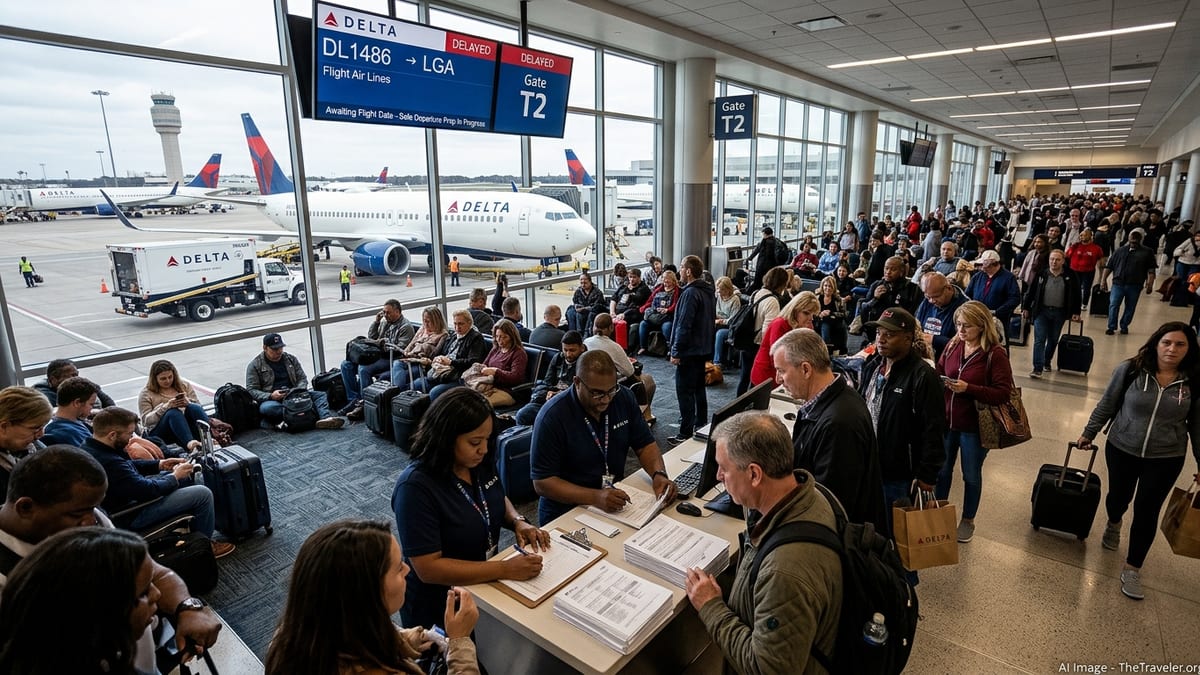
How the November 22 Delta outage unfolded
Delta’s disruption began on the morning of Sunday, November 22, 2026, when the airline reported a problem with its automated system for calculating aircraft weight and balance for departing flights. The system, which generates the final load data pilots need before takeoff, is managed from Delta’s operations center in Atlanta and feeds instructions to airports across the network. According to airport and airline statements, the malfunction affected the carrier’s ability to transmit those instructions, forcing crews to shift to manual backup procedures on a busy pre-holiday travel day.
The issue was first visible at Hartsfield-Jackson Atlanta International Airport, where Delta is the dominant carrier and where many flights begin or end their routes. As flights waited on the ground for load information, Delta requested that the Federal Aviation Administration temporarily halt some inbound departures to prevent gridlock in the ramp and taxiway system. The FAA subsequently issued a brief ground stop affecting certain flights bound for Atlanta while the airline worked through the outage and began performing manual weight and balance calculations where possible.
Delta later confirmed that the problem involved its automated load instruction system for weight and balance calculations. Public flight-tracking data and same-day media tallies indicate that the outage quickly spread beyond Atlanta to other airports served by Delta in the United States, with delays reported on routes into and out of cities including Boston, Washington, Seattle and Boise as crews waited for clearance to depart. Passengers posting on social media and in local news reports described extended onboard waits while pilots explained that the airline’s systems were down, consistent with a systemwide technology failure rather than a localized airport issue.
Scale of the disruption and how operations recovered
Independent delay statistics compiled that Sunday show that nearly half of Delta’s flights worldwide departed late on November 22, placing the day among the airline’s most disrupted of 2026 outside of major weather events. Several analyses based on federal data and flight-tracking services reported more than 1,000 delayed Delta flights, with average departure delays of roughly one hour. While the ratio of cancellations to total schedule volume remained comparatively low, many passengers on operating flights faced ground waits of one to four hours as dispatchers worked through manual calculations and revised paperwork.
By Sunday evening, Delta said the automation issue affecting its weight and balance system had been resolved and that it was gradually restoring normal operations. Local broadcasters in Atlanta and airline updates indicated that the carrier began clearing the backlog of departures later that night as the automated system resumed sending data to airports. Even after the fix, some flights continued to experience extended ground times as crews caught up on aircraft positioning and as air traffic control managed the flow of delayed departures into and out of Atlanta to avoid congestion.
Operational data from Monday, November 23, show that Delta still recorded several hundred delays, but the pattern by then had shifted from a systemwide outage to more localized knock-on effects as aircraft and crews moved back into their planned rotations. Travelers reported that many flights were operating close to schedule, particularly outside the busiest hub banks, while some services still encountered longer-than-usual ground holds as dispatchers manually verified weight and balance numbers. By that afternoon, Atlanta-based news outlets were describing the airline’s operation as stabilizing, reflecting a gradual return to normal performance even though some residual disruptions persisted into the new week.
By the final weekend of the Thanksgiving travel period, there was no indication from Delta, the FAA or major U.S. airports that the November 22 failure was continuing to constrain flight operations. Flight-tracking services and airport status boards over the holiday weekend showed delays more closely aligned with typical seasonal factors such as heavy traffic volumes and weather systems rather than any continuing IT outage at Delta. Regulators and airport authorities are still monitoring system performance, but the immediate disruption linked to the weight and balance issue appears to have run its course.
Relationship to the November 13 nationwide ground stop
The Delta outage occurred nine days after a separate aviation technology failure, when the Federal Aviation Administration ordered a rare nationwide ground stop on Friday, November 13, 2026. In that incident, a telecommunications disruption affected multiple FAA air traffic control facilities, triggering an order that halted new departures nationwide for several hours while already airborne flights were allowed to continue to their destinations. Federal briefings and early technical summaries describe the event as a network problem within the FAA’s own systems, rather than an airline-specific failure.
According to congressional correspondence and government situation reports, the November 13 network instability was linked to the installation of new routers at a communications site in El Dorado, Arkansas and a radar facility in Amarillo, Texas. The new equipment generated unusually high levels of data traffic across the FAA’s telecommunications infrastructure, overwhelming older legacy components at air route traffic control centers and associated facilities. To protect safety while technicians isolated the fault, the FAA issued a nationwide ground stop that lasted for roughly four hours and forty-five minutes that Friday afternoon.
Federal summaries and industry tallies indicate that the November 13 ground stop and its immediate aftermath led to the cancellation of more than 12,000 flights across the United States, including in excess of 9,000 at major U.S. airlines, along with many more delayed services. The agency and the Department of Transportation have both launched technical reviews of the network failure, with particular attention on how legacy systems interacted with the new routers and why existing safeguards did not prevent the instability from spreading.
In contrast, the November 22 outage was contained within Delta’s internal systems and did not involve FAA communications or radar infrastructure. Federal officials and the airline have said there is no evidence so far that the two events share a common technical cause. Current public statements from the FAA indicate that investigators have not identified any sign of a cyberattack related to either the nationwide ground stop or Delta’s weight and balance failure. While the two disruptions were separate in origin, their proximity in time has sharpened questions about the resilience of both federal and airline-owned technology that underpins routine air travel in the United States.
Impact on Thanksgiving travel and what passengers experienced
The timing of both incidents amplified their effect on travelers because they fell within the broader Thanksgiving travel window, historically one of the busiest weeks of the U.S. travel year. In a forecast published on November 16, 2026, AAA projected that 81.5 million Americans would travel at least 50 miles from home between Tuesday, November 24 and Monday, November 30. Of those, about 5.96 million were expected to travel by air, leaving airlines and airports operating close to record holiday volumes.
By the time the forecast window formally began on November 24, airlines and the FAA had largely restored normal operations after the November 13 nationwide ground stop. While residual delays and some cancellations continued in the days immediately following that event, major carriers and federal facilities reported that they were running full schedules by the start of Thanksgiving week with additional monitoring in place. There is currently no indication from regulators that capacity limits stemming from the November 13 telecommunications failure persisted into late November.
The Delta outage on November 22 introduced a more immediate disruption for travelers flying in the two days before the official start of the core Thanksgiving period. Because Atlanta is not only Delta’s primary hub but also one of the world’s busiest airports by passenger numbers, any significant operational problems there rapidly affect connecting traffic across the United States and on some international routes. Passengers traveling through Atlanta and other major Delta stations reported long lines at gates, extended onboard waits and occasional returns to the gate for additional checks while flight crews awaited final load numbers from the operations center.
Individual accounts documented in local news coverage and online forums describe a wide range of experiences, from near on-time departures where manual procedures were implemented quickly to multi-hour delays that resulted in missed connections and late-night arrivals. Some travelers also reported confusion about the cause of their delay when information at the gate differed from announcements on board, reflecting the challenges of communicating during a rapidly evolving technology outage. Although these accounts are anecdotal, they are consistent with the elevated same-day delay statistics recorded for Delta on November 22 and with the airline’s acknowledgment of a systemwide issue affecting load calculations.
Rebooking, refunds and what travelers should check now
When the November 13 FAA ground stop unfolded, Delta, along with other major U.S. carriers, issued a temporary travel waiver allowing passengers affected by the federal disruption to change flights without standard change fees over a limited period. According to the airline’s advisory, the waiver applied to travel between November 13 and November 16, with rebooked itineraries permitted on or before November 23 on the same routing and in the same cabin without a fare difference. That waiver was tied specifically to the air traffic control failure and has since expired for new changes, although tickets that were reissued during the waiver period remain governed by their updated terms.
For the November 22 Delta-specific weight and balance outage, there has been no widely publicized, broad systemwide waiver comparable to the one issued during the FAA event. Instead, Delta has been handling affected travelers through its standard disruption policies. Passengers whose flights were canceled by the airline have generally been reaccommodated on later Delta services without change fees, subject to seat availability. Customers whose flights operated but experienced significant delays have been assisted under normal delay procedures, which can include meal vouchers or overnight accommodations in some circumstances when the cause of the disruption is within the airline’s control. The precise support offered depends on the details of each itinerary, the length of delay and local conditions such as hotel availability near the airport.
Under current U.S. Department of Transportation rules, travelers are entitled to a cash refund if a flight is canceled by the airline and the passenger chooses not to travel, even on a nonrefundable ticket. Some airlines also offer refunds or credits in cases of substantial schedule changes or very long delays when a trip no longer serves its original purpose, but those thresholds are set by individual carrier policies rather than a single nationwide standard. There is no U.S. requirement for airlines to pay cash compensation solely for delays stemming from internal IT issues, though carriers sometimes provide travel credits or frequent flyer miles as a goodwill gesture, particularly after highly visible disruptions.
Looking ahead to the rest of the holiday season, travelers with upcoming Delta flights may wish to take a few practical steps. Checking flight status directly via the airline’s website or mobile app before leaving for the airport, and again after arriving, can provide the most current information if schedules change quickly due to weather or technology issues. Arriving early on peak days remains advisable at large hubs such as Atlanta, Chicago, Dallas–Fort Worth, Denver, Los Angeles and the New York area airports, where even moderate clusters of delays can spill over into longer security lines and busier gate areas.
Passengers with time-critical plans, such as same-day events or onward cruise departures, might consider building additional margin into their itineraries while the aviation system continues to manage both heavy seasonal demand and ongoing technology upgrades. This could mean booking earlier departures, avoiding the final flight of the day when feasible, or adding an overnight buffer on complex, multi-leg trips. Travelers whose flights are canceled or severely delayed should retain receipts for hotels, meals and alternative transportation and review their airline’s published policies, along with any coverage provided by their credit card or travel insurance, to understand what reimbursement or assistance may be available if further disruptions occur.