


Landing at Nairobi’s Jomo Kenyatta International Airport (NBO) is the start of most journeys into Kenya, whether you are heading straight to the Masai Mara or spending a few days in the capital. For first-time visitors, JKIA can feel intense: late-night arrivals, long immigration lines, touts outside the terminal and a confusing choice of taxis, apps and toll roads into the city. This guide walks you step by step through what to expect and how to move confidently from the aircraft door to your hotel or safari vehicle, using the most recent on-the-ground information available in 2026.
Get the latest updates straight to your inbox!
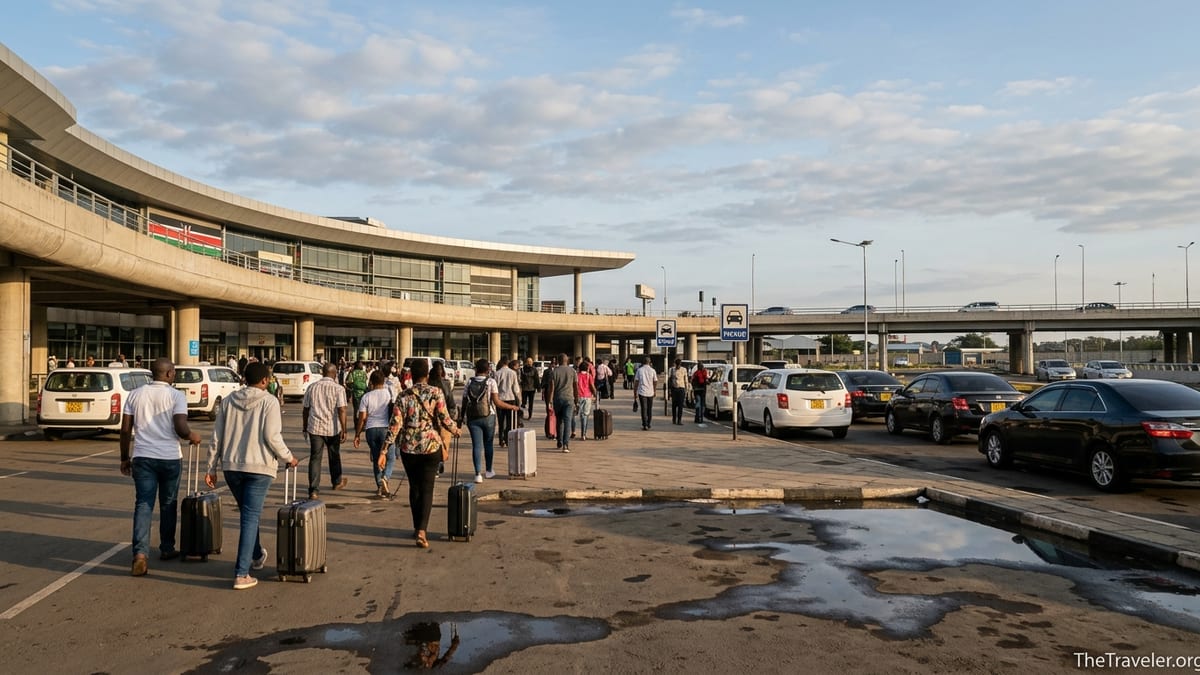
Understanding Jomo Kenyatta International Airport and Its Terminals
Jomo Kenyatta International Airport sits about 16 kilometers southeast of central Nairobi and is Kenya’s main international gateway. The airport layout has evolved over the past decade, and for a first-time traveler the most important fact is that almost all international flights now use Terminal 1, which is a single building divided into several concourses. Signs inside the building usually mention the concourse letters rather than separate terminal buildings, so do not be surprised if your boarding pass shows Terminal 1A but airport screens just say “Terminal 1, Departures.”
Within Terminal 1, concourse 1A is the main international arrivals and departures area used by many large carriers such as Kenya Airways and several European and Middle Eastern airlines. Concourse 1B and 1C are often used for other international services, including some regional flights, while 1D and 1E handle a mix of regional and domestic traffic. The exact allocation changes from time to time, so always trust what your airline lists on your ticket and what is shown on the airport monitors on the day you fly, rather than blog posts or forums that may be out of date.
Terminal 2 is a smaller, separate building primarily used for certain low-cost and regional carriers. It is not directly connected to Terminal 1 by a walkway. If you have to transfer between Terminal 1 and Terminal 2, you will leave the secure area, pass through the public landside zone and then take a vehicle around the airport perimeter. In practice this usually means a 10 to 20 minute official taxi ride, or a longer wait for a shuttle if one is running. If you have an international-to-domestic safari connection on different tickets, allow several hours of buffer time, especially if it involves a change between Terminal 1 and Terminal 2.
Facilities inside Terminal 1 have improved noticeably in recent years. There are functioning ATMs from major Kenyan banks, several currency exchange booths, official Safaricom and Airtel mobile stands, coffee shops with recognizable brands, and basic duty-free outlets. Wi-Fi works reasonably well in most gate areas, although speeds and reliability vary. Seating can still be tight at peak times, so if you have a long layover consider buying lounge access through your airline or a paid lounge service to get a quieter space, power outlets and showers.
Arrivals, Immigration and Baggage: What To Expect Step by Step
On arrival, aircraft usually disembark directly onto air bridges into the terminal rather than remote buses, although during busy periods some flights still park on the apron. Follow the “Arrivals” and “Immigration” signs along the corridor; Jomo Kenyatta has separate queues depending on nationality and visa status. Kenya operates an electronic travel authorization system, so most travelers from Europe, North America and many Asian countries are expected to apply online before they fly. Border officers normally just verify the approval on their system, scan your fingerprints and stamp your passport, but they may ask for proof of onward travel, an accommodation address in Kenya and sometimes your yellow fever certificate if you are coming from a country where the disease is present.
At peak arrival times, particularly when multiple evening flights land between about 8 pm and midnight, immigration queues can stretch to 45 minutes or more. Families with young children and older passengers are sometimes pulled forward informally, but you should not rely on this. Once cleared, you move directly into the baggage claim hall, where several carousels serve multiple flights. Screens show flight numbers above each belt, but luggage can take 20 to 40 minutes to appear, especially for long-haul flights from Europe and North America. Porters operate inside the baggage hall and outside customs; tipping is customary if you use them, and an amount in the range of a few US dollars equivalent is usually appreciated.
After collecting your bags, you walk through customs screening. Officers may x-ray all luggage or use a green and red channel system depending on staffing. They are generally more concerned with commercial goods and professional camera equipment than with personal clothing or standard tourist gear. If you are carrying high-value drones, large film kits or multiple expensive lenses, be ready to explain that they are for personal use and to show supporting documents if you are on an assignment. For most leisure travelers bringing standard cameras and binoculars, customs is usually a formality.
Once you clear customs you step into the public arrivals area. This is where you see driver name boards for pre-booked hotel shuttles and safari operators, several currency exchange booths, ATMs, and mobile phone counters. The atmosphere can feel hectic, particularly late at night when several wide-body flights arrive close together. Take a moment to stop to one side, secure your bags, and identify the official counters you need before engaging with anyone offering you transport or assistance.
Safe Transport into Nairobi: Taxis, Uber, Bolt and the Nairobi Expressway
For most first-time visitors, the biggest decision after collecting bags is how to get into the city. Nairobi traffic is notoriously heavy, but new options such as the Nairobi Expressway mean that you can now cover the distance from JKIA to central areas like Westlands or Lavington in about 25 to 40 minutes outside of extreme rush hours. The safe, mainstream choices are licensed airport taxis, ride-hailing apps such as Uber and Bolt, and private hotel or safari transfers pre-booked with a reputable company.
Official airport taxis wait at a designated rank just outside the arrivals area. The vehicles are usually white sedans or minivans with visible airport or NTSA licensing. Fares are negotiated before the journey, and drivers may show you a laminated fare card as a reference. As a rough 2026 example, a ride from the airport to the central business district might be in the ballpark of the equivalent of 20 to 30 US dollars, depending on time of day, traffic and whether you use the Expressway. To areas further out such as Westlands or Karen the fare can be higher. Many drivers will ask for an extra amount on top of the base price to cover the Expressway toll if you choose that route, which is normal practice.
Uber and Bolt both operate in Nairobi and are widely used by residents. However, pickup at JKIA works slightly differently from a typical city curbside pickup. In practice, many travelers walk a short distance from the main arrivals exit toward the public parking area or the nearby petrol station so that they are outside the immediate airport taxi zone, then request an Uber or Bolt. Drivers sometimes call or message on WhatsApp to agree on a precise pickup point, such as “parking C, ground floor, near the lifts.” Prices fluctuate with demand, but app rides from JKIA to popular neighborhoods like Kilimani or Westlands are often cheaper than negotiated airport taxis, even after adding the Expressway toll.
The Nairobi Expressway is a 27 kilometer elevated toll road linking the airport area with Nairobi’s Westlands district. Using it can cut travel time dramatically, especially during weekday morning and evening peaks when the old Mombasa Road below is heavily congested. Most airport taxis and app drivers are familiar with the entry ramp closest to JKIA and will suggest using it if traffic is heavy. As a visitor you normally pay for the toll indirectly, since the driver’s electronic tag or cash payment is included in your agreed fare or itemized as an extra. If a driver hesitates to take the Expressway despite heavy traffic and you prefer to arrive quickly, it is reasonable to insist politely, offer to cover the toll, or to choose another driver.
Regardless of the option you choose, avoid accepting unsolicited rides from individuals who approach you inside or just outside the terminal without clear identification. Stick with the official taxi rank, your clearly confirmed hotel or safari driver, or an in-app ride you have booked yourself. If your flight lands in the small hours of the morning, consider arranging a transfer in advance through your hotel or tour operator so that someone is waiting with your name. This is especially reassuring after long overnight flights when you may be tired and less focused.
Getting Connected: SIM Cards, eSIMs and Mobile Money
Staying connected in Kenya is straightforward if you know where to go. Three mobile networks dominate consumer service: Safaricom, Airtel Kenya and Telkom Kenya. Safaricom has the broadest coverage, especially in safari destinations like the Masai Mara and Amboseli, while Airtel is often a little cheaper for data in urban areas. All three operate official kiosks or small shops in and around Terminal 1 arrivals, so you can get a local line within minutes of clearing customs.
At the airport kiosks, staff are used to tourists and can usually set up both physical SIMs and, on newer phones, eSIM profiles. Travelers report that at least one Safaricom outlet at JKIA operates 24 hours, which is helpful for late-night arrivals, while Airtel and Telkom desks often mirror the main flight banks, staying open for most of the night. To buy a SIM or eSIM you will need your passport; Kenyan regulations require registration, and the attendant takes a photo or scan of the document and enters your details into the system. The process usually takes around 10 to 20 minutes per person if there is no queue.
For practical 2026 examples, many short-term visitors choose a Safaricom bundle with a few dozen gigabytes of data valid for 30 days, which is typically priced in the same rough range as a mid-tier data plan in other African capitals. Airtel’s tourist data bundles are often slightly cheaper for the same volume. Staff at the counter will usually offer to insert the SIM for you, help you switch your phone’s data settings, and show you how to dial a USSD code or use the carrier app to check balances. If you arrive very late and find a long queue or a closed outlet, you can rely on a pre-purchased international eSIM like Airalo or Holafly for the first night and then visit a larger Safaricom or Airtel shop in a mall such as The Hub Karen or Two Rivers the next day for a local SIM.
Mobile money is a major part of daily life in Kenya, and if you plan to be in the country for more than a few days it is worth activating M-Pesa on your Safaricom line or the equivalent wallet on Airtel. With M-Pesa you can pay for small taxis, coffee shops, national park fees and even tips using your phone rather than handling cash. Activation typically involves setting a PIN at the same time you register your SIM or via a short self-service sequence, and can be done at the airport shop. Tourists do not need a Kenyan ID; a passport is accepted. Once active, you can load funds at any M-Pesa agent, many of which are just small counters inside supermarkets and petrol stations around Nairobi.
If you prefer not to swap SIMs, roaming with your home operator is an option, but costs can climb quickly once you leave Wi-Fi. A balanced approach for many first-time visitors is to keep their home SIM active for two-factor codes and banking, use a local eSIM or physical SIM for data, and rely on Wi-Fi at hotels and lodges for large uploads. Nairobi’s better hotels, co-working spaces and cafes generally provide solid Wi-Fi, but coverage in rural conservancies or smaller beach towns is more uneven, making a Safaricom SIM a useful backup even for short stays.
Money, ATMs, Exchange and Paying Safely
Kenya’s currency is the Kenyan shilling, and you will want at least a small amount of local cash for tips, small purchases and emergencies. In the arrivals area you will see multiple currency exchange booths and several ATMs from major Kenyan banks. Exchange rates at airport counters are usually slightly less favorable than in the city, but the convenience is worth it if you need cash immediately for a taxi or snacks. Many travelers withdraw a modest sum at the airport, such as the rough equivalent of 50 to 100 US dollars, and then use ATMs in reputable city banks for larger amounts later.
ATMs are a straightforward way to access Kenyan shillings if your card works internationally. Machines from banks such as KCB, Equity Bank and Co-operative Bank are commonly found at JKIA and generally accept Visa and Mastercard debit cards. It is wise to notify your bank before travel to avoid fraud blocks when the first withdrawal hits from Nairobi. When using ATMs, shield your PIN, keep your luggage close, and avoid machines that look tampered with or are in poorly lit corners. Inside the terminal or in large malls, security and CCTV coverage are usually adequate.
Card payments are widely accepted in mid-range and upscale hotels, safari camps targeting international guests, chain restaurants and larger shops. It is increasingly common to tap a contactless Visa or Mastercard card to pay for a coffee at a place like Java House in a Nairobi mall, or to settle a hotel bill electronically at check-out. However, smaller guesthouses, local eateries and craft markets may take cash or M-Pesa only. Plan on using a mix of card, mobile money and cash rather than assuming one method will work everywhere.
Outside the secure area, informal money changers and touts may offer you slightly better exchange rates. For a first-time visitor these offers are not worth the risk of counterfeit notes, shortchanging or simple confusion when you are jet-lagged. Stick with recognizable bank ATMs and licensed exchange counters, keep large sums of cash out of public view, and carry your money split between a wallet, a money belt or pouch, and perhaps a backup card in your luggage in case one item is lost or stolen.
Airport Hotels, Overnight Stops and Safari Connections
Flight schedules into Nairobi often mean you will land late at night or in the very early morning, with your safari or domestic connection only departing later that day. Fortunately, there is a growing cluster of airport-area hotels that cater specifically to transit passengers. Within a short drive of JKIA you will find recognizable international brands and reliable local properties with free shuttles, on-site restaurants and basic business facilities. For example, travelers regularly choose hotels in the airport area when they land around midnight from Europe and have an 8 am flight from the smaller Wilson Airport to the Masai Mara.
If you are connecting to a safari, clarify with your tour operator whether you are flying out of JKIA again or from Wilson Airport, which lies closer to the city center and serves many safari routes operated by airlines such as Safarilink and AirKenya. The road transfer between JKIA and Wilson can take anywhere from 30 minutes to well over an hour depending on traffic and whether your driver uses part of the Expressway. Many safari companies include this transfer and will meet you in the arrivals hall with a branded sign, then whisk you to a nearby hotel or directly to Wilson if time allows.
For do-it-yourself connections, remember that domestic flights to parks like the Masai Mara often have strict baggage limits, such as soft-sided bags only and lower weight allowances than your international flight. Consider packing a small duffel with your safari essentials and leaving a heavier suitcase in secure storage at your Nairobi hotel. Several hotels near JKIA and in areas like Karen or Westlands offer luggage storage for clients who overnight before and after a safari loop. Always get a written tag or receipt for any bags you leave behind.
If your schedule allows at least one full day in Nairobi before or after a safari, it is worth staying in a neighborhood with more character than the airport strip. Karen offers access to the Karen Blixen Museum and Nairobi National Park gate, while Westlands has a cluster of restaurants, malls and nightlife. In those cases you would typically take a transfer from JKIA into the city, settle into your hotel, then have your safari operator collect you the next morning. This breaks up the journey and offers a softer landing, especially for families or older travelers.
First-Time Arrival Tips: Health, Safety and Local Etiquette
Nairobi is a major African capital, and the same common-sense precautions that apply in other big cities apply here. Inside JKIA, security is generally tight: vehicles are screened before entering the airport compound and bags pass through scanners at the entrance to terminal buildings. Once in the public arrivals area, keep your valuables close, avoid leaving bags unattended on trolleys and be cautious when using your phone in crowded spaces directly outside the doors, where opportunistic snatch theft can happen.
For health, carry a small kit with any essential prescription medicines in your hand luggage, along with basic items such as painkillers and rehydration salts. Nairobi sits at altitude, so evenings can feel cooler than many visitors expect, especially after warm flights from coastal hubs. A light jacket or fleece in your carry-on will make late-night taxi rides more comfortable. Tap water in Nairobi is not considered reliably safe to drink, so stick with sealed bottled water or filtered water provided by reputable hotels and camps. At the airport, you can easily buy bottled water from kiosks after you exit baggage claim.
Local etiquette is welcoming but relatively formal with strangers. A simple “Habari” or “Jambo” and a smile goes a long way when dealing with immigration officers, ATM guards, taxi coordinators and mobile phone staff. Tipping is appreciated but not obligatory; for example, you might give a porter a small amount equivalent to one or two US dollars for helping with bags, or add around 10 percent to a restaurant bill if service is not already included. When negotiating taxi fares, firm but polite bargaining is normal. Once a price is agreed, it is respected.
Jet lag and sensory overload are real factors on arrival, especially if you have flown overnight from North America or Europe. To make the first hours in Kenya smoother, consider booking the first night in a hotel with airport pickup, ordering a basic meal upon arrival, and going to bed rather than trying to explore the city immediately. Many travelers who rush straight into a long road transfer after landing regret not taking a few hours to rest and rehydrate first. Building a buffer of even half a day into your schedule also protects you if your inbound flight is delayed.
FAQ
Q1. How long does it take to get from Nairobi’s airport to the city center?
In normal traffic using the Nairobi Expressway, it often takes around 25 to 40 minutes from JKIA to central areas like the CBD or Westlands; without the Expressway in heavy rush hour it can stretch to an hour or more.
Q2. Is it safe to arrive at Jomo Kenyatta Airport late at night?
Yes, many international flights land around midnight and the airport is active and secured, but you should arrange transport in advance, stay in well-lit areas, and avoid unofficial taxi offers outside the terminal.
Q3. Should I use airport taxis or Uber/Bolt from JKIA?
Both are viable. Official airport taxis are straightforward and easy for first-timers, while Uber and Bolt can be cheaper; with apps you may need to walk to a designated pickup spot away from the busiest curb.
Q4. Do I need cash immediately on arrival or can I rely on cards?
You can pay many airport expenses by card, but it is practical to withdraw a small amount of Kenyan shillings at an ATM or exchange desk on arrival for tips, smaller taxis and minor purchases.
Q5. Can I buy a local SIM or eSIM at Nairobi airport, and what do I need?
Yes, Safaricom, Airtel and Telkom all have counters at JKIA where you can buy SIMs or set up eSIMs; bring your passport for registration and allow about 10 to 20 minutes.
Q6. How do I get from JKIA to Wilson Airport for a safari flight?
Most safari operators arrange this road transfer, which can take 30 minutes to over an hour depending on traffic; if you book it yourself, use a reputable taxi or ride-hailing app and allow generous time.
Q7. Is the Nairobi Expressway worth paying tolls for as a visitor?
For most travelers the Expressway is worth the extra cost, as it significantly cuts travel time between the airport and key neighborhoods, especially during weekday peaks when regular roads are congested.
Q8. Are there hotels close to the airport for overnight layovers?
Yes, several mid-range and international-brand hotels lie within a short drive of JKIA, many offering free shuttles and late check-in specifically for transit passengers with early or late flights.
Q9. What is the best mobile network for safari areas like the Masai Mara?
Safaricom generally has the broadest coverage in remote and rural areas, so most visitors heading to national parks and conservancies choose a Safaricom SIM or eSIM for more reliable service.
Q10. What are the main safety tips for first-time travelers arriving at NBO?
Keep valuables close, use official or pre-booked transport, be cautious with unsolicited offers of help, use ATMs in well-lit secure areas, and give yourself time to rest before long onward journeys.