

More news on this day
Amsterdam’s Schiphol Airport has become the latest flashpoint in Europe’s mounting summer aviation disruption, as delays and cancellations ripple across major hubs from Portugal to Finland at the start of the peak holiday season.
Get the latest news straight to your inbox!
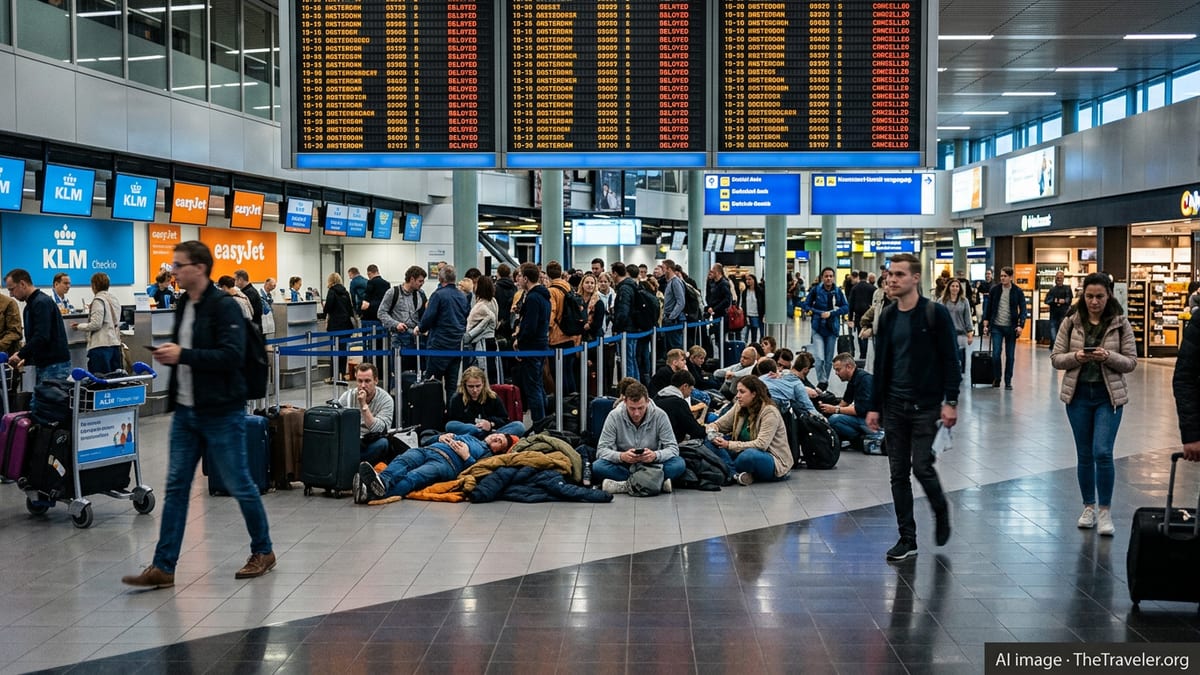
Schiphol Under Pressure as Runway Works Meet Peak Demand
Operational strains at Amsterdam Airport Schiphol are intensifying just as passenger numbers climb for the core summer months. Runway maintenance on the busy Zwanenburgbaan, part of a scheduled program of airfield upgrades and safety work, has temporarily reduced flexibility in how arrivals and departures are sequenced. Publicly available information on the project indicates that the closure, which began in May, was timed to be completed ahead of the highest summer traffic but is still overlapping with the early season surge.
Alongside runway constraints, the airport has warned travelers to expect longer security queues and advised arriving earlier than usual. Dutch broadcasters report that Schiphol has adjusted its security planning and passenger flow controls in an effort to avoid scenes reminiscent of 2022, when long lines stretched outside terminal buildings. The combination of infrastructure work and renewed volume is leaving little margin when weather or upstream delays disrupt schedules.
Recent tracking data and traveler accounts describe a pattern of rolling delays that start with relatively minor schedule changes and then cascade through the day. Because Schiphol is a crucial transfer point for intra European and intercontinental flights, disruption on a handful of morning departures can quickly result in missed connections, aircraft out of position and late evening arrivals, compounding the impact for passengers across the region.
Network Effects From Portugal to Finland Drive Fresh Chaos
The Netherlands is not alone in facing early summer turbulence. Reports from aviation data providers and European media point to widespread delays and a smaller but persistent number of cancellations across a broad belt of hubs including Lisbon, Paris, Frankfurt, Munich, Madrid, Barcelona, Brussels, Helsinki and major Italian airports. On some recent high traffic days, tracking summaries show more than 1,200 delayed services and dozens of cancellations concentrated in these hubs, underlining the scale of the disruption.
Air traffic management statistics compiled by Eurocontrol for the opening weeks of June 2026 highlight how sensitive the system remains to any capacity shortfall. While total traffic is only modestly above last year, network reports show that en route air traffic flow management restrictions remain a leading cause of delay minutes, particularly in busy segments of French and Spanish airspace. When restrictions are imposed for reasons such as staffing limits or sector overload, flights are held on the ground or slowed en route, often bunching arrivals into already congested airports.
Finland and northern Europe are also feeling the knock-on impact. Although these countries may have fewer structural constraints at their own airports, flights to and from southern hubs or overflying busy central European corridors are subject to the same bottlenecks. Publicly available operational briefings describe a tightly coupled network in which a storm cell over Germany, a staffing constraint in French airspace or a ground stop in Spain can quickly generate delays for passengers landing in Helsinki, Brussels or Porto hours later.
Weather, Staffing and Border Systems Combine to Strain Capacity
Multiple structural and short term factors are converging to set the stage for a volatile summer. Eurocontrol’s recent assessments of European aviation performance underline that air traffic control capacity and staffing remain dominant sources of en route delays during peak periods, even as network managers try to optimize routing and sector opening schemes. Forecasts issued ahead of the 2026 season anticipated elevated delay levels compared with pre pandemic summers, with relatively little buffer to absorb unexpected shocks.
Adverse weather remains an unpredictable wildcard. Earlier in the year, winter storms and heavy snow in the Netherlands and Germany forced hundreds of cancellations at Schiphol and other airports over several days, illustrating the vulnerability of dense schedules when runway capacity is constrained. Summer brings different challenges, including convective storms, strong crosswinds and high temperatures that can reduce payload or require increased separation between aircraft, all of which can trigger flow restrictions and temporary airport closures.
On the ground, border processing is another pressure point. Airport and airline associations have warned that the gradual rollout of the Schengen Entry/Exit System is causing longer processing times at some external border checkpoints, especially where staffing and equipment have not kept pace with rising passenger numbers. Industry groups have called for flexibility in how the system is implemented through October 2026, noting that bottlenecks at passport control can spill back into departure and transfer areas, further complicating efforts to keep flights on time.
Summer 2026 Shaping Up as a Critical Stress Test
Although early June network data suggest that punctuality on average is slightly better than in some previous summers, the scale of recent multi airport disruption shows how quickly conditions can deteriorate when several factors align. Analysts note that even with new capacity management tools in place, such as more dynamic airspace configuration and closer coordination between air navigation service providers, structural challenges like staffing gaps and infrastructure limits cannot be resolved overnight.
For travelers, the experience is uneven but increasingly unpredictable. Some days pass with only minor delays, while others see clusters of late departures and missed connections centered on a handful of key hubs. Amsterdam Schiphol’s inclusion in the latest wave of disruption means that passengers using the Dutch hub as a gateway to long haul destinations face many of the same risks as those transiting Paris Charles de Gaulle, Frankfurt, Munich or Madrid.
Industry observers describe the coming weeks as a critical stress test for Europe’s aviation recovery. If traffic continues to climb toward late July and August peaks, the combination of weather volatility, limited spare capacity and evolving border control procedures could sustain a pattern of rolling disruption across the continent. With the Netherlands now firmly part of that picture, the summer of 2026 is emerging as another challenging season for European air travel.