


More news on this day
The Netherlands has emerged as the European Union’s most active aviation market, with new Eurostat and Eurocontrol data showing commercial flights across the bloc climbing above 6.9 million and Amsterdam Schiphol consolidating its position as the EU’s busiest airport for aircraft movements.
Get the latest news straight to your inbox!
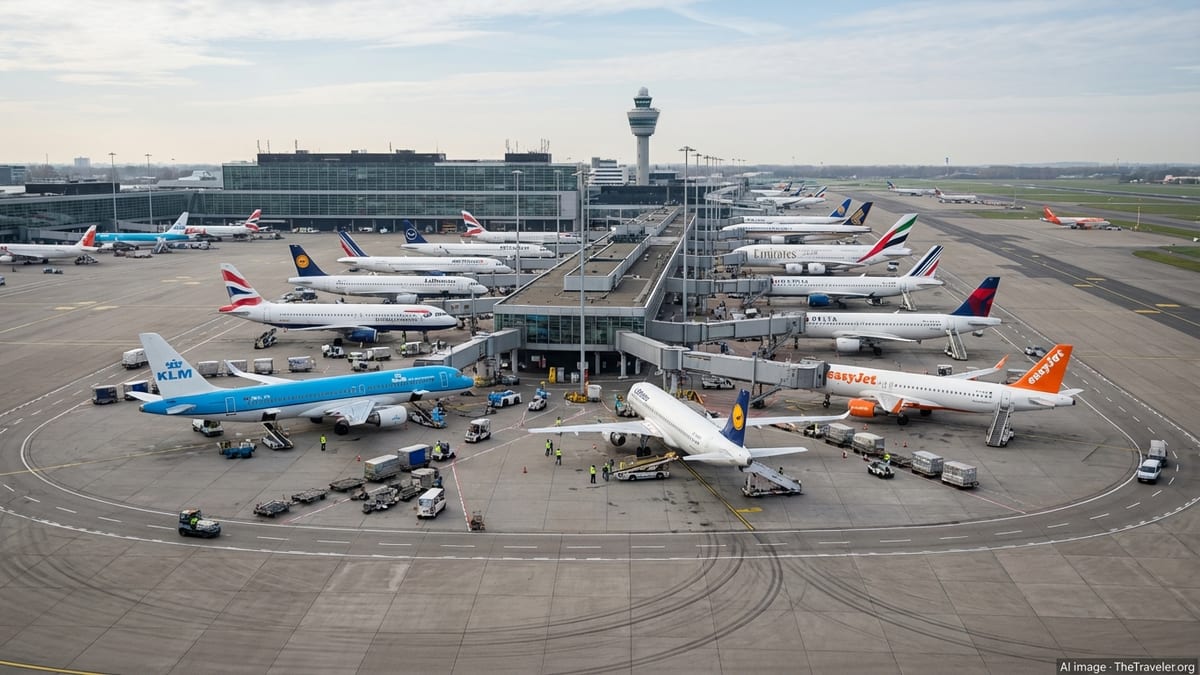
Amsterdam Schiphol Moves to the Top of the EU Rankings
Recent Eurostat figures based on Eurocontrol traffic data show that commercial flights in the European Union reached 6.7 million in 2024, up 5.8 percent on 2023 but still slightly below 2019 levels. Within that total, Amsterdam Schiphol recorded around 484,000 commercial flights, the highest count of any EU airport and ahead of Paris Charles de Gaulle and Frankfurt.
Publicly available information from Schiphol’s own 2024 traffic and financial updates indicates a similar scale for overall aircraft movements. The airport group reports 473,815 aircraft movements at Amsterdam in calendar year 2024, with traffic growth driven by a rebound in passenger demand and more intensive use of the airport’s hub role for connections.
Analysts note that the combination of Eurostat and airport data places the Netherlands at the core of European air traffic flows. While large hubs in France, Germany and Spain continue to handle heavy volumes, the concentration of flights at Amsterdam gives the Dutch market an outsized influence on EU aviation totals.
Netherlands Consolidates Its Role as EU Aviation Hub
National statistics from Statistics Netherlands and Schiphol Group show that Dutch airports handled around 76 million air passengers in 2024, with Amsterdam accounting for the vast majority of that traffic. Growth at Schiphol was the main factor behind the overall increase in flights and passengers across the Netherlands compared with 2023.
European airport association data indicate that Amsterdam welcomed about 66.8 million passengers in 2024, representing an 8 percent rise year on year but remaining moderately below pre‑pandemic volumes. Despite this gap, the airport’s ranking among Europe’s top hubs, combined with a strong network of intercontinental and intra‑European routes, has strengthened the Netherlands’ role as a primary gateway for the EU single market.
Sector reviews published by Eurocontrol describe 2024 as a year of strong recovery for European aviation, with traffic nearing 2019 levels and growth concentrated at major hub airports. In this context, Amsterdam’s leading position in flight movements means that developments in Dutch aviation policy, capacity planning and sustainability initiatives are increasingly important for the wider European network.
Capacity, Constraints and the Path to 6.9 Million Flights
The reported 6.7 million commercial flights in the EU for 2024 are seen by industry observers as a stepping stone toward and beyond the 6.9 million mark that characterized pre‑pandemic activity. Network operations reports from Eurocontrol suggest that continued growth in 2025 and 2026 is likely to push annual commercial flight totals back into, and potentially beyond, that range.
For the Netherlands, this trajectory is closely tied to how much capacity remains available at Schiphol. Earlier government consultations and airport planning documents have considered limits on annual flight movements for environmental and noise reasons, while also acknowledging strong underlying demand for air travel and connectivity. Schiphol has reported record levels of investment to upgrade infrastructure and improve operational performance, positioning the airport to handle more passengers even under a cap on aircraft movements.
At EU level, Eurocontrol’s performance reviews highlight that capacity constraints, air traffic control staffing and weather‑related disruptions have all contributed to delays as traffic has recovered. Major hubs such as Amsterdam have faced these pressures alongside efforts to maintain punctuality and reduce congestion. How quickly European commercial flights can sustainably rise and stabilize around or above 6.9 million annually will depend in part on how efficiently such constraints are managed at the busiest airports.
Environmental Pressures and Policy Debates Intensify
The Netherlands’ leading role in EU aviation comes amid intense scrutiny of aviation’s environmental impact. Assessments compiled by European agencies show that aviation‑related emissions in Europe have moved back toward 2019 levels as traffic has recovered, even though the overall number of flights remains slightly lower than before the pandemic.
Dutch policymakers and the aviation sector are engaged in an ongoing debate about balancing environmental targets with the country’s connectivity needs. Schiphol Group has publicly committed to large‑scale investments in infrastructure, operations and energy use as part of a broader sustainability roadmap. The airport has also acknowledged that its long‑term development is likely to depend on airlines deploying more efficient and, in some cases, larger aircraft, enabling passenger growth without a corresponding rise in flight movements.
At the same time, EU‑level discussions on emissions trading, sustainable aviation fuels and noise regulation are expected to shape how quickly traffic can expand in the coming years. With Amsterdam now at the forefront of EU air traffic in terms of flights, decisions taken in the Netherlands on climate obligations and airport capacity are likely to have a disproportionate effect on the trajectory of European commercial aviation.
What Amsterdam’s Lead Means for Travelers and Airlines
For travelers, Amsterdam’s position as the EU’s busiest airport for commercial flights translates into extensive route choices and connection possibilities. Data on passenger flows show that the airport serves hundreds of destinations worldwide, maintaining dense networks within Europe while also offering long‑haul links across North America, Asia, Africa and the Middle East.
For airlines, Schiphol’s scale and connectivity help support hub‑and‑spoke strategies and transfer traffic, but they also create competition for scarce slots and runway access during peak periods. Eurocontrol reporting on network operations indicates that high traffic levels at major hubs have been associated with operational bottlenecks at certain times of day, underlining the importance of careful scheduling and capacity management.
As EU commercial flights edge back toward and beyond the 6.9 million threshold, the Netherlands’ aviation footprint is expected to remain central to how the European air transport system evolves. Amsterdam’s current lead in flight activity underscores both the opportunities and the constraints facing a region where demand for air travel is rising alongside pressure to cut emissions and noise, and where a single hub can play a decisive role in the continent’s aviation balance.
Eurostat: Commercial flights reach 6.7 million in the EU in 2024
Schiphol Group: Annual traffic review and key figures