


More news on this day
Washington’s three major airports have become the first in the United States to test a new artificial intelligence system designed to spot flight disruptions earlier, giving air traffic managers more time to reroute aircraft and potentially reduce the kind of cascading delays that routinely snarl travel along the busy Northeast Corridor.
Get the latest news straight to your inbox!
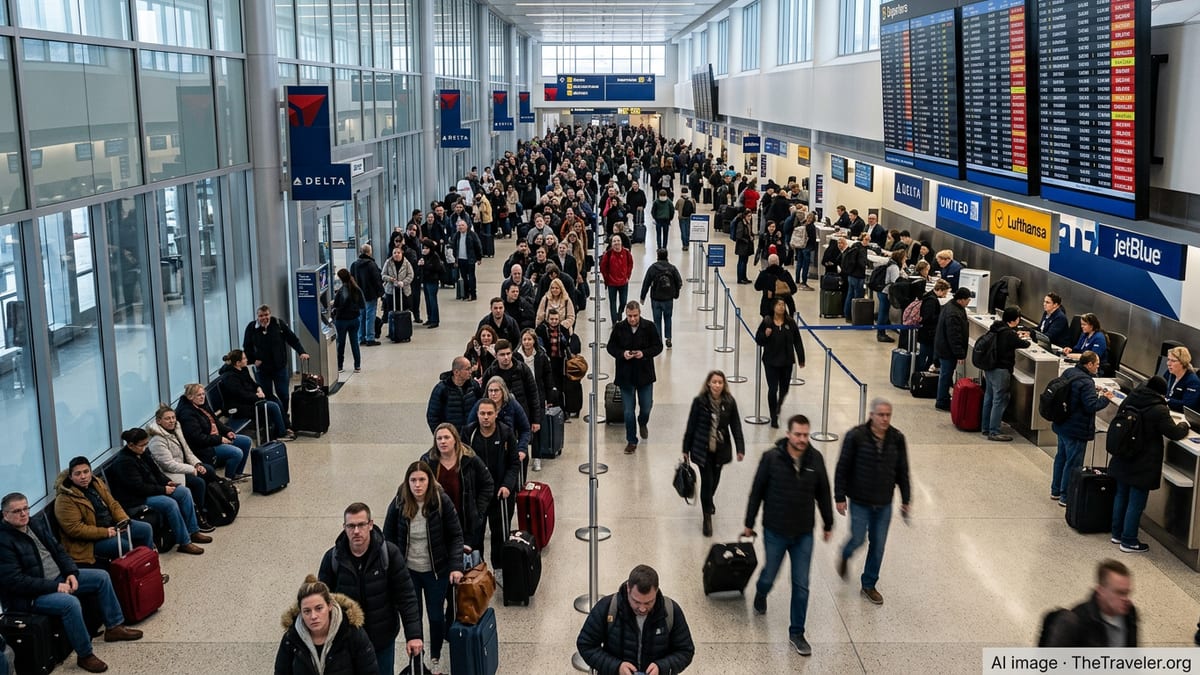
DC Region Chosen as Test Bed for AI-Driven Airspace Management
According to recent coverage of the Transportation Department’s air traffic modernization efforts, the new system is being rolled out initially at Ronald Reagan Washington National, Washington Dulles International and Baltimore/Washington International Thurgood Marshall airports. The Washington region was selected in part because of its dense airspace, frequent summer thunderstorms and heavy mix of government, business and leisure travel, which together create a demanding environment for traffic managers.
Publicly available information describes the platform as a cloud-based decision-support tool that ingests real-time data on weather, aircraft positions, airport capacity and traffic flow constraints. Using machine learning models, it generates recommendations for routing and metering flights before bottlenecks fully form, rather than relying only on traditional ground delay programs and airborne holding patterns.
Reports indicate that the Federal Aviation Administration signed a multiyear contract in June 2026 with California-based Air Space Intelligence to supply both the new scheduling and routing capability, branded as the SMART tool, and an upgraded data backbone known as Flow Management Data and Services. The Washington deployment, announced in late September, is described as the first operational use of SMART at civilian airports in the United States.
Transportation officials have linked the AI rollout to a broader effort to improve on-time performance after several summers of weather-related disruptions in the Northeast. The DC-area trial is intended to show whether more accurate, earlier predictions of congestion can prevent the domino effect that often turns a short thunderstorm into a daylong backlog of delayed flights.
How the AI System Aims to Cut Delays for Travelers
Technical material published by NASA and the FAA over the last several years outlines the basic concept behind these new tools. Machine learning models trained on historical radar tracks, weather patterns and controller decisions attempt to forecast how storms and traffic surges will affect specific routes, arrival streams and departure banks hours in advance. The goal is to recommend minor adjustments early, instead of drastic last-minute actions once congestion is fully developed.
Field trials in other metropolitan areas, including around Dallas Fort Worth and Houston, have shown that AI-guided reroutes around storms can significantly reduce delay minutes per flight and lower passenger delay costs. Documentation of those tests indicates that, in some events, individual rerouted flights saved close to an hour of aggregate metroplex delay, offering a benchmark for what Washington passengers might expect if similar performance is achieved.
In the DC region, the SMART platform is expected to focus on some of the most persistent trouble spots: summer thunderstorms that park over key arrival fixes, ground stops triggered by low visibility, and saturation of departure routes up and down the East Coast. By simulating different traffic-management options in the cloud, the system can highlight scenarios that move the same number of flights with fewer choke points, helping decision-makers choose strategies that minimize disruption for travelers.
For passengers, any gains are likely to appear first as incremental improvements rather than dramatic overnight change. More precise slot management could mean slightly shorter tarmac waits before takeoff, fewer surprise gate holds after boarding and a reduction in long airborne holding patterns as flights queue for a constrained runway. Over a full travel day, those small savings can accumulate into more reliable connections and fewer missed itineraries.
Local Airport Operators Already Building on AI Foundations
The new FAA-led initiative arrives in a region where airport managers have already been experimenting with artificial intelligence to smooth passenger journeys. The Metropolitan Washington Airports Authority, which operates Reagan National and Dulles International, has spent several years developing in-house AI models to monitor congestion from parking garages to security checkpoints and departure gates.
Technology profiles of the authority’s innovation arm, MWAA Labs, describe tools such as Queue Hub, which uses sensors, cameras and machine learning to track curbside traffic and terminal flows in real time. The system provides operations staff with dashboards showing where parking facilities are nearing capacity, where security wait times are building and how passenger flows are shifting as flights are delayed or rescheduled.
Interviews and presentations from MWAA’s digital leadership indicate that these platforms feed into a broader “real-time intelligence” environment covering parking, check-in, security and gate areas. By correlating data from roadway congestion, metro ridership and in-terminal sensors, the authority seeks to anticipate pinch points and reassign staff or adjust signage before lines become unmanageable, a capability that becomes more important when flight schedules are disrupted.
Alongside these airport-run systems, regional planning documents highlight the vulnerability of access roads and public transport corridors serving the three Washington-area airports. Surface congestion on key routes can compound the impact of flight delays, making predictive tools for landside operations a natural complement to the new airspace-focused AI now arriving from the federal side.
What the Pilot Means for Upcoming Travel Seasons
The initial AI deployment in the Washington area is being framed as an operational test rather than a full replacement for existing traffic management procedures. Air traffic controllers and traffic managers continue to make final decisions, with the SMART platform providing advisory information based on its predictive models. If the system performs as expected through the fall and winter travel periods, federal planners have indicated that it could be expanded to other busy hubs.
Public briefings and fact sheets emphasize that safety oversight and certification requirements remain unchanged as AI-based decision support enters the national airspace system. The models are designed to work within established separation standards and airspace rules, and regulators are still developing longer-term frameworks for validating and updating AI and machine learning components as more data is collected in live operations.
In practical terms, the coming holiday travel period will provide one of the first real tests of how the new system handles peak traffic combined with winter weather. Travelers flying through Reagan National, Dulles or BWI may not notice any visible interface with the AI tools, but schedule statistics over the season are likely to be closely watched by airlines, regulators and airport operators assessing whether the technology is delivering measurable benefits.
If the Washington trial produces sustained reductions in delay minutes and cancellations, the DC area’s experience could become a template for rolling out predictive traffic management tools nationwide. For now, the region’s travelers are at the forefront of an experiment that uses artificial intelligence not as a novelty, but as a behind-the-scenes tool intended to make everyday air journeys a little more predictable.