


More news on this day
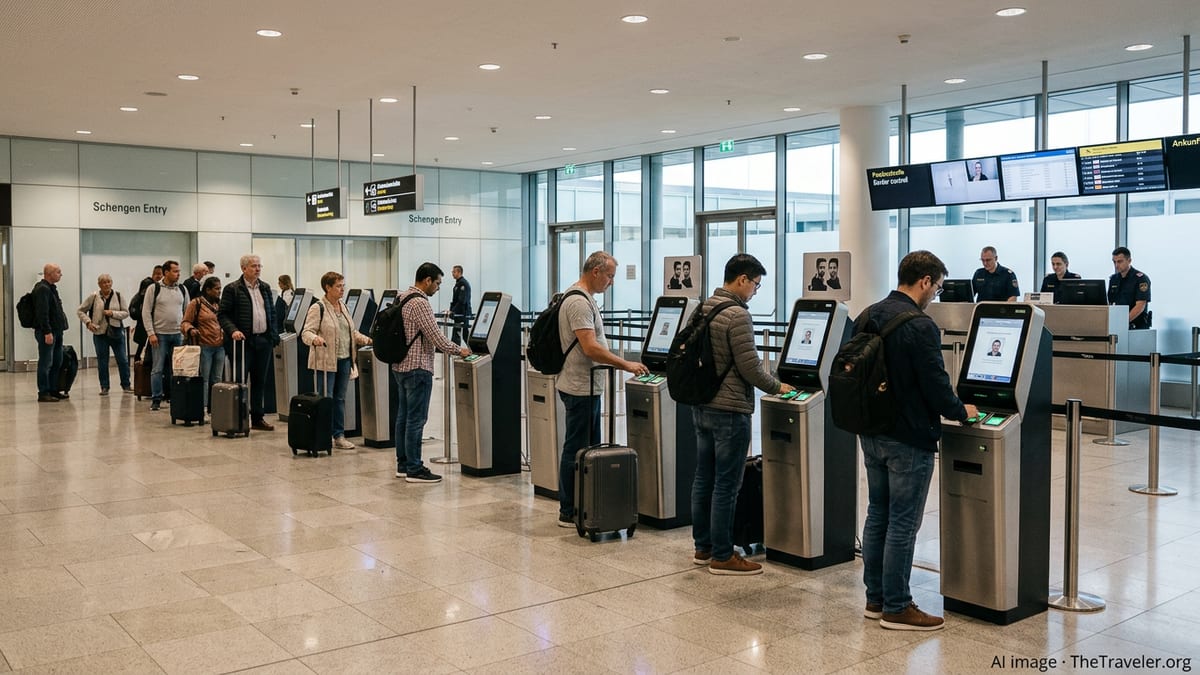
UK holidaymakers heading for European beach breaks and city escapes this summer are encountering a new kind of travel roulette, as the European Union’s biometric Entry/Exit System transforms passport control into a critical bottleneck, producing long queues, fraught arrivals and a spike in missed connections across some of the continent’s busiest airports.
Get the latest news straight to your inbox!
Biometric Border Revolution Collides With Peak Holiday Traffic
The EU’s Entry/Exit System, known as EES, is now fully operational across 29 European countries, replacing manual passport stamping for most non EU nationals, including UK travellers, with digital registration of fingerprints, facial images and travel documents. Publicly available information from EU institutions describes it as one of the bloc’s most advanced border management tools, intended to strengthen security and track overstays more accurately.
The system began phased operations in October 2025 and reached full functionality in April 2026, just months before the main summer getaway period. Airports and airlines had warned in advance that introducing biometric checks at the same time as peak demand risked slower processing at border booths, even if the technology ultimately aims to speed journeys in the long term.
Reports from travel industry bodies and European media outlets now point to a clear pattern: while some hubs have integrated EES with relatively little disruption, others are experiencing extended queues as first time users pause at self service kiosks and border staff work through technical glitches and unfamiliar procedures.
For UK tourists, who suddenly fall into the category of “third country nationals” after Brexit, the change means that the easy onward stroll from aircraft to hotel transfer has been replaced in several destinations by a tense wait at passport control, often stretching well beyond the standard two hour connection cushion.
Hours in Line: Delays Mount at Major European Gateways
Evidence from airport associations, airline groups and consumer travel coverage indicates that processing times at some Schengen airports have risen sharply since EES became compulsory. Airport Council International Europe and major airline federations have highlighted waiting times of up to three hours at border control in peak periods, particularly where infrastructure or staffing has lagged behind demand.
Media reports from hubs including Lisbon, Milan and popular Spanish and Greek destinations describe dense, snaking queues of arriving passengers funnelled toward new biometric kiosks and e gates. In some cases, authorities have temporarily suspended or scaled back EES use to clear backlogs, underlining how sensitive the system is to surges in arrivals or minor technical failures.
Travel features in UK and European outlets recount multiple instances of passengers missing onward flights, with families arriving at passport control in good time but remaining stuck in queues while boarding closes at nearby gates. At least one major southern European airport has been cited as seeing entire planeloads of UK visitors arriving late to baggage reclaim, leaving transfer companies and tour operators scrambling to adjust schedules.
Industry data and on the ground coverage suggest that delays are especially acute for first time registrants, who must complete the full biometric capture process. Once enrolled, subsequent trips should in theory be faster, but with millions of UK leisure travellers hitting the continent this summer, the initial wave of registrations is proving a significant choke point.
Patchwork Performance Across the Continent
One of the striking features of the EES rollout is its uneven impact. Reports from airlines and passenger groups note that some major hubs, particularly those that invested early in extensive banks of kiosks and clear wayfinding, are handling the new formalities with comparatively modest extra waiting times.
Elsewhere, smaller or seasonal airports that see heavy flows of UK holiday traffic during the summer but have more limited infrastructure appear more exposed. Coverage from Mediterranean gateways indicates that a lack of space for queuing, combined with high numbers of arrivals bunched into short timeframes, can lead to sudden spikes in congestion even when systems are functioning as designed.
There is also a split between air and land or sea borders. For cross Channel routes, some of the biometric processing takes place on UK soil before boarding, which spreads the workload but also extends the time needed at departure terminals. Guidance on the UK government’s own information pages acknowledges that travellers may be required to provide fingerprints and facial images at the start of their journey rather than only upon arrival in the EU.
Consumer advocacy organisations point out that the lack of a uniform passenger experience makes planning difficult for holidaymakers. A UK traveller may breeze through border control on one trip and then face substantial delays at a different airport weeks later, even on similar flights at similar times of day.
Airlines, Airports and Ministers Scramble for Fixes
As pressure has built, airlines and airports have stepped up warnings to UK customers. Budget and network carriers alike are advising passengers to arrive at their departure airport at least three hours before scheduled take off for flights into the Schengen area, citing evidence that passport control queues are increasingly the weak link in the journey rather than check in or security.
Industry statements from European and international airline groups have called for a formal review of the EES rollout, arguing that there is a gap between optimistic assessments of the system’s performance and the reality of disruption being reported by front line staff. Airport organisations have gone further in some cases, suggesting that they should have authority to relax biometric checks temporarily when waiting times exceed agreed thresholds.
In the UK, publicly available readouts of recent ministerial discussions indicate that the transport department has been engaging with EU counterparts about how to minimise disruption for British holidaymakers. The conversations have focused on capacity planning, clearer communication for passengers and ensuring that technical support is available quickly if systems fail at critical moments.
Despite the concerns, European institutions and national border agencies continue to frame EES as a necessary modernisation that will, in time, make travel smoother and more secure. Official explanations emphasise the benefits of automated data capture and the potential for quicker repeat crossings once the initial enrolment wave has passed.
What UK Travellers Can Expect for the Rest of Summer
For the immediate peak season, analysts and travel commentators broadly agree that UK tourists should expect continued pressure at certain airports, particularly at weekends and in the early morning and late evening “banker” slots that serve the main holiday markets. Even where operations have stabilised since April, the combination of school holidays, higher passenger volumes and a still maturing system is likely to generate periodic flashpoints.
Consumer travel guides now commonly recommend that UK visitors build in extra time not only at departure, but also between connecting flights in Europe. Longer minimum connection times, while inconvenient, can help reduce the risk of missed onward services when border queues suddenly lengthen.
Families and older travellers are being urged by tour operators and travel advisers to prepare in advance where possible, for example by keeping passports easily accessible, travelling with simple hand luggage where practical and following airport signage carefully to avoid joining the wrong lines. Some guidance also suggests that those with mobility needs or hidden disabilities should notify airlines ahead of time, as assistance desks are increasingly busy.
Looking beyond this summer, the expectation is that biometric registration will gradually become a routine part of the European holiday experience for UK nationals, much as fingerprinting and facial scans have become standard in other parts of the world. For now, however, the continent’s vast network of airports is still in the middle of a disruptive adjustment phase, and British travellers are finding themselves playing an unwelcome game of delays every time their passports meet the new machines.