


More news on this day
Rail passengers in South Devon faced significant disruption after a fire at Paignton station led to widespread delays, cancellations and diversions on key routes along the English Riviera.
Get the latest news straight to your inbox!
Fire brings services to a standstill at coastal hub
Early reports indicate that the incident at Paignton involved a fire affecting part of the station environment, prompting rail staff to suspend movements while emergency procedures were followed. The station, a key gateway to the Torbay resort, sits at the end of a busy branch that links seaside towns with Exeter, Newton Abbot and onward main line services toward London and the Midlands.
Publicly available information shows that services were quickly halted in both directions while the extent of the damage and any risk to signalling or electrical equipment was assessed. Trains already en route were held outside the area or terminated short of Paignton as control teams attempted to stabilise the timetable.
The pause in operations created an immediate bottleneck along the Riviera Line, which normally carries a mix of local stopping services and longer-distance trains serving holidaymakers heading to the coast. With Paignton acting as a terminus, disruption there can rapidly spill back along the route, affecting stations across Torbay and beyond.
As the situation unfolded, rail operators warned that disruption could continue even after the fire was brought under control, due to the need for safety checks on infrastructure and rolling stock before normal operations could resume.
Knock-on delays for regional and long-distance passengers
The closure of platforms at Paignton and associated signal restrictions had consequences well beyond the immediate area. Trains scheduled to start or finish at the station were cancelled or turned around at alternative locations, affecting passengers travelling between South Devon, Exeter and key interchange hubs on the Great Western main line.
According to journey planners and operator updates, some services were removed from the timetable at short notice, while others ran with substantial delays. This created crowding on the trains that did operate, particularly on services timed to connect with onward journeys toward London Paddington, Bristol and the North of England.
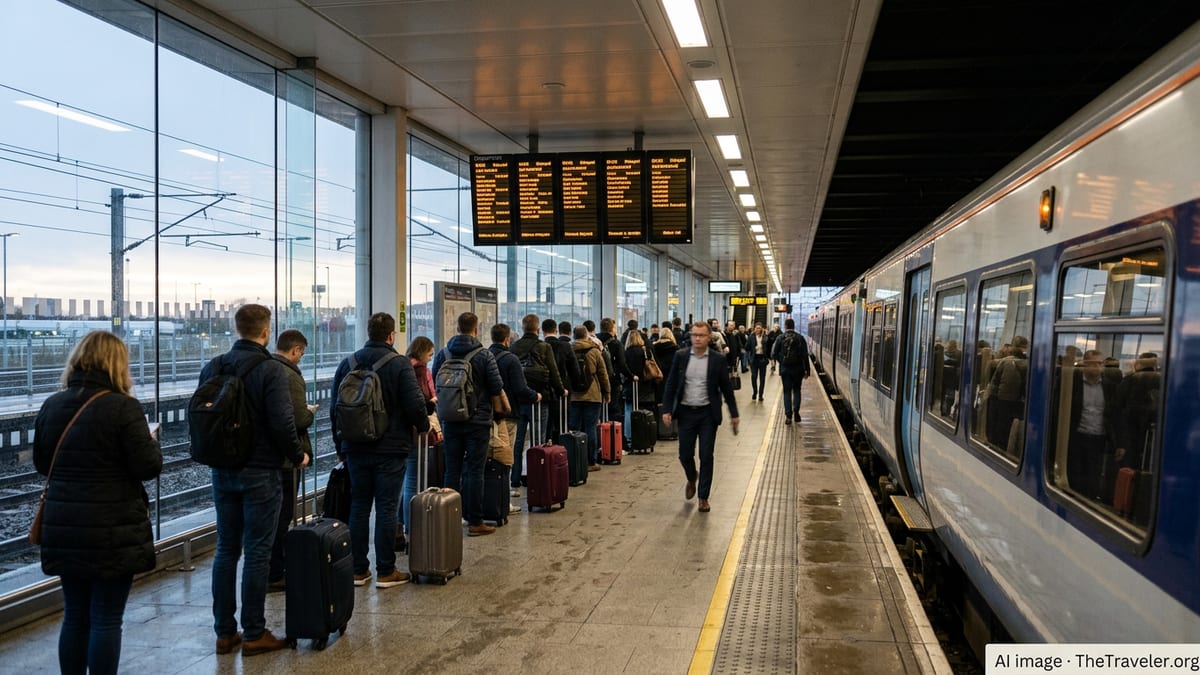
Holidaymakers and day-trippers were especially affected, with many people travelling with luggage or beach equipment finding themselves waiting on concourses and platforms for revised departure times. The incident came during the busy summer period, when routes into Torbay typically experience high seasonal demand from visitors heading to Paignton’s seafront, Goodrington Sands and nearby attractions.
Rail industry data and recent disruption patterns elsewhere in the network show that incidents involving fire in or near stations can take many hours to clear, as engineers assess signalling, cabling and lineside equipment. Similar events at major stations have led to residual delays well into the evening peak, even after tracks have nominally reopened.
Alternative routes and replacement transport for stranded travellers
In response to the suspension of normal services, operators directed passengers to alternative routes and replacement road transport. Publicly accessible travel advice pointed towards local bus networks and nearby railheads as temporary options while trains were unable to reach Paignton.
Coastal bus services linking Torquay, Paignton and Brixham, together with regional routes toward Newton Abbot and Exeter, formed an important fallback for those needing to continue their journeys. However, road congestion on key approaches into Torbay meant journey times were often significantly longer than the equivalent rail services.
Some passengers were advised to travel to or from other stations on the Riviera Line, using road transport to bridge the gap. Others were encouraged to delay non-essential travel or rebook for later in the day, once a clearer picture of the service pattern had emerged.
Travel commentators note that while the local network is relatively well served by buses compared with some rural areas, the sudden transfer of rail demand onto roads can place additional pressure on traffic flows around seaside towns already busy with peak-season visitors.
Tourism impact on the English Riviera corridor
The timing and location of the Paignton incident raised particular concern for the visitor economy along the South Devon coast. Paignton station is a primary arrival point for tourists staying in seafront hotels, guesthouses and holiday parks, and also a link for attractions further afield that depend on rail access.
Published tourism material highlights Paignton as a convenient base for exploring the English Riviera, with frequent train connections to Exeter and links to heritage rail and river services in the wider South Devon area. Any prolonged reduction in reliability on this corridor risks discouraging rail-based visitors at a time when operators and local authorities are promoting car-free travel to coastal resorts.
Businesses near the station, including cafes, shops and accommodation providers, are likely to have experienced a mixture of increased footfall from stranded passengers and cancellations from visitors whose plans were disrupted. Experience from previous transport incidents elsewhere suggests that even short-term rail problems can lead to knock-on effects for bookings and spending if travellers decide to shorten or shift their stays.
Local travel guides and destination marketing campaigns have increasingly emphasised the ease of reaching Paignton by train. A sudden high-profile disruption can undermine that message, although the long-term impact will depend on how quickly services recover and how clearly passengers are informed about alternative options.
Calls for resilience and clear communication
The Paignton fire has renewed attention on the resilience of rail infrastructure at coastal and tourist-focused stations. Recent cases across the rail network show that incidents involving fire near tracks or station buildings can rapidly escalate into widespread disruption if critical signalling or power systems are affected.
Industry analysis in the wake of similar events has highlighted the importance of robust contingency planning, including pre-arranged diversionary routes, standby replacement buses and clear passenger information. When the incident at Paignton unfolded, travellers turned to online journey planners, departure boards and operator messaging channels for updates on cancellations, revised timetables and ticket acceptance on alternative routes.
Passenger advocacy groups regularly stress that timely, consistent information can make a considerable difference to how disruption is experienced, even when delays are unavoidable. Clear guidance on refund and compensation policies, connection protection and rebooking options is seen as a key part of maintaining confidence in rail travel.
As services through Paignton gradually return to normal, attention is likely to focus on what lessons can be drawn from the response, both locally and across the wider network. The incident underscores how a single fire at a busy seaside station can ripple across regional and long-distance journeys, particularly at the height of the summer travel season.