


More news on this day
Air traffic has resumed at New York’s major airports after a severed telecom line near Philadelphia triggered hours of ground stops and widespread delays across the U.S. Northeast at the start of a busy United Nations General Assembly week.
Get the latest news straight to your inbox!
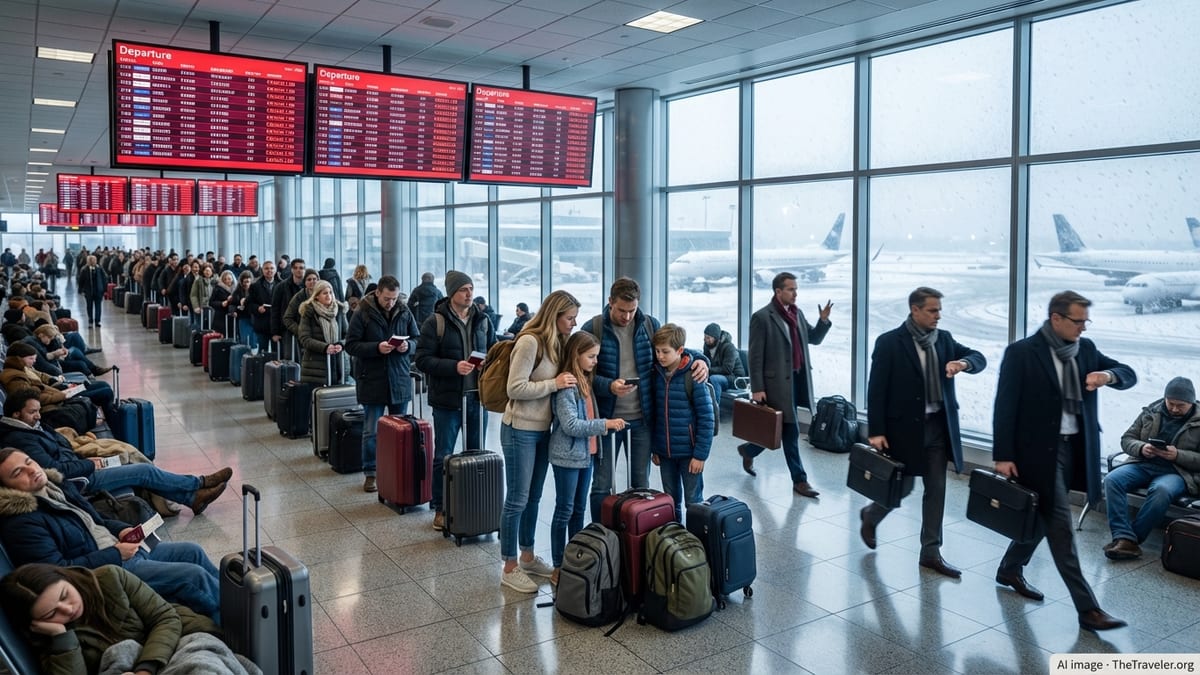
Telecom Failure Near Philadelphia Ripples Across the Northeast
Published coverage indicates that operations at John F. Kennedy, LaGuardia and Newark Liberty airports were severely disrupted on Monday, September 21, 2026, after a fiber-optic communications line serving a key Federal Aviation Administration facility near Philadelphia was damaged during construction. The outage affected both the primary circuit and a backup system, interrupting radio and data links used to manage dense traffic in the New York and Philadelphia airspace.
According to reporting from national outlets, the failure prompted ground stops at five major airports: Newark Liberty, New York’s JFK and LaGuardia, Philadelphia International, and Teterboro in New Jersey. Hundreds of flights were delayed or canceled as controllers restricted the number of departures and arrivals while technicians worked to restore connectivity.
The incident came at a particularly sensitive moment for New York aviation. The region was handling heightened demand as heads of state, ministers and delegates traveled to the city for the United Nations General Assembly. Tracking data referenced in news reports showed arrivals diverted or slowed across the Northeast corridor while the outage was addressed.
Publicly available information from aviation trackers and airline updates shows that, at the peak of the disruption, large portions of inbound traffic to New York were held at origin airports or placed in extended ground-delay programs, contributing to crowding and long waits throughout the day.
New York Airports Reopen, But Delays Linger
By Monday evening, transportation officials announced that the damaged telecom lines had been repaired and that airport operations across the affected Northeast hubs were allowed to resume. On Tuesday, September 22, reports from outlets including the Associated Press and ABC News described New York airports as open but still working through significant residual delays and schedule imbalances.
At John F. Kennedy International Airport, long-haul international operations were able to restart, but a backlog of displaced aircraft and crew resulted in scattered cancellations and rolling delays into Tuesday morning. LaGuardia, heavily dependent on short-haul and shuttle traffic, continued to post longer-than-usual waits at security and gate areas as airlines rebuilt their rotations.
Newark Liberty, which had experienced multiple rounds of disruption tied to the same Philadelphia-area facility earlier in the year, again showed some of the highest cancellation totals in the region. Data cited in media coverage indicated that more than 200 flights through Philadelphia alone were canceled on Monday, with knock-on effects stretching into Tuesday across New York, Boston and other connected hubs.
The restart allowed airlines to resume normal check-in and boarding processes, but travelers arriving at New York-area terminals on Tuesday still encountered crowded departure halls and longer customer-service lines as carriers rebooked passengers and repositioned aircraft.
What Travelers Flying To or Through New York Should Expect
For travelers heading to or connecting through New York this week, airline advisories and published travel alerts underscore that conditions may remain uneven even though the technical fault has been resolved. Carriers including major U.S. network airlines have issued waivers allowing affected passengers to change flights between September 21 and 23 without additional change fees, provided they keep the same origin and destination and rebook within a specified window.
Public flight-status boards for JFK, LaGuardia and Newark on Tuesday show many services operating, but with a higher-than-normal share of late departures and arrivals. Travelers are being urged, through airline and airport statements, to check flight status frequently, arrive earlier than usual for departures, and be prepared for last-minute gate or timing changes as schedules stabilize.
Because the telecommunications issue arose in one of the country’s most congested airspace corridors, aircraft and crews were left out of position across multiple cities. Industry commentary in business and aviation publications notes that this type of disruption can take more than a full operating day to unwind, even after the underlying technical problem has been fixed.
Rail and highway routes along the Northeast corridor also experienced increased demand during the outage, as some travelers shifted from air to ground transport. However, available reporting indicates that the primary bottleneck for most passengers remains the process of securing new flight options as airlines work through their backlog.
Spotlight on Aging Air Traffic Infrastructure
The episode has renewed attention on the resilience of the U.S. air traffic control network, particularly in the New York and Philadelphia region. Coverage from CNN and other national outlets highlights that the outage originated with an aging circuit and its backup, underscoring concerns that critical communications pathways can still be compromised by single points of failure.
Federal documents and prior regulatory notices had already flagged capacity and staffing constraints at key facilities managing New York-area airspace. In recent years, the FAA has granted temporary slot relief at JFK, LaGuardia and Newark in recognition of controller shortages and modernization work, while shifting some responsibilities from the New York terminal radar facility to Philadelphia in an attempt to improve reliability.
Aviation analysts quoted in industry reports say the latest disruption illustrates how vulnerable complex hub systems can be when basic infrastructure, such as buried telecom lines, is not sufficiently protected or redundantly routed. They point to past outages, including earlier communications problems connected to the same Philadelphia-area center, as evidence that resilience upgrades have not fully insulated the network from local failures.
Policy discussions referenced in business filings and federal notices suggest that additional investment in hardened fiber routes, diversified backup systems and controller staffing remains a priority for the region. For travelers, these technical debates translate directly into questions about how often severe, system-wide delays may occur on some of the world’s busiest air corridors.
Impact on the Wider Northeast Travel Network
Although New York’s three major airports captured much of the attention, the communications failure had far-reaching effects across the Northeast. Reporting from regional outlets notes significant delays and cancellations at Boston Logan International Airport on Monday and into Tuesday, as ground stops in New York forced airlines to adjust routings and aircraft utilization.
Flights bound for or departing from smaller regional airports that rely on New York or Philadelphia for connections also experienced knock-on disruptions. Publicly available scheduling data shows that some routes saw multiple cancellations in a single day, with passengers rebooked through alternative hubs or onto later services.
The timing of the outage, on the eve of high-profile diplomatic events in New York, added to its global visibility. International arrivals carrying foreign officials and business delegations were delayed or rerouted, with media in several countries highlighting the episode as an example of strain within U.S. aviation infrastructure.
While full operations have now resumed, transportation and aviation observers caution in published commentary that similar incidents could recur unless long-discussed infrastructure upgrades in the Northeast are accelerated. For passengers traveling through New York in the coming days, the immediate advice from airlines and airports remains straightforward: monitor flight status closely, allow extra time at the airport, and be prepared for schedules that may continue to shift as the system gradually returns to normal.