


Landing at Nice Côte d’Azur Airport is one of the most scenic arrivals in Europe, with the runway stretching out into the Mediterranean and the city’s pastel façades just beyond the bay. The good news for travelers is that getting from the airport to central Nice is straightforward, with several viable options depending on your budget, luggage and where your hotel is located. This guide explains, in practical detail, how to choose between tram, taxi, Uber or private transfer and local buses, with real-world examples for the most common hotel areas in Nice.
Get the latest updates straight to your inbox!
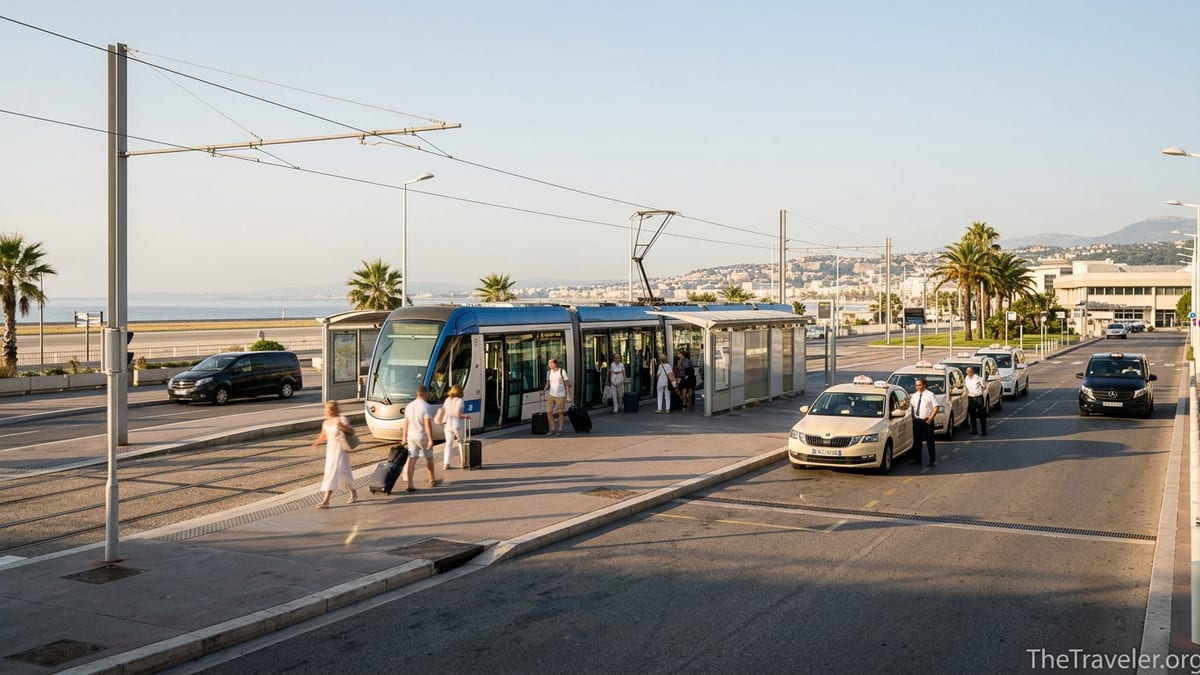
Overview: How Far Is Nice Airport From the City Centre?
Nice Côte d’Azur Airport (NCE) sits on the western edge of the city, roughly 7 kilometers from central Nice around the Jean Médecin shopping axis and about 8 to 9 kilometers from the Old Town and Port Lympia. In normal traffic, a car or taxi can reach most central hotels in 15 to 25 minutes, while the tram takes around 25 to 30 minutes to reach the main downtown stops.
The airport has two passenger terminals, Terminal 1 and Terminal 2, both directly connected to Nice’s tram network. Many low-cost airlines and some long-haul flights use Terminal 2, while Terminal 1 handles a mix of European carriers. The transport options described in this guide are available from both terminals, although in practice some are slightly more convenient from one terminal than the other.
Because the airport is inside the city limits, Nice does not have a dedicated express train line to the centre like you find in Paris or London. Instead, the backbone of airport access is the city tram system, supplemented by metered taxis, ride-hailing services such as Uber and a handful of urban and regional buses. For most visitors, the real decision is between the tram and a car-based option.
When planning your arrival, factor in the time to clear immigration and baggage claim. In peak summer, queues can be longer, so it is wise not to book any fixed-time transfer with a very tight margin. Once outside, though, the airport forecourts are compact and well signposted, so you will not spend much time hunting for stops or ranks.
Tram Line 2: The Cheapest and Most Reliable Option
For the majority of travelers staying in central Nice, Tram Line 2 (often simply called L2 or "Aéroport – Port Lympia") is the best-value way to reach the city. The line connects both airport terminals with key downtown stops such as Grand Arénas, Alsace-Lorraine, Jean Médecin and eventually Port Lympia near the harbour. Typical travel time from Terminal 2 to Jean Médecin is about 25 to 30 minutes, depending on the time of day.
As of mid 2026, a single tram ticket with Lignes d’Azur, the local network, costs approximately 1.70 euros and is valid across city trams and buses for a limited time window, which makes it significantly cheaper than any car-based option. The same ticket can be used on the airport segment as on any other part of the network. Services run roughly every 6 to 10 minutes during the day, with slightly reduced frequency early in the morning and late at night according to current timetables.
The tram stops are immediately outside the terminals. At Terminal 1, the station is signposted and a short walk from arrivals. At Terminal 2, the stop is located just beyond the main forecourt, with clear pictograms directing you past the car parks. Trams are low-floor and designed for wheeled luggage, with wide doors and designated spaces inside, which makes them relatively easy to use even if you are pulling a large suitcase.
For example, if you are staying at a hotel on Avenue Jean Médecin, such as near the Nice Étoile shopping centre, you can board Tram Line 2 from the airport and ride straight to the Jean Médecin stop with no changes. From there, most hotels in this strip are within a 5 to 10 minute walk. Travelers heading to the Old Town can either alight at Jean Médecin and walk downhill for 10 to 15 minutes, or stay on until the terminus at Port Lympia, which is very handy for harbour-side apartments and some boutique hotels.
Buying Tickets, Validation and Practical Tips for the Tram
Ticketing is the part that can feel confusing to new arrivals, but in practice is straightforward if you know what to expect. You will generally have three main ways to buy a tram ticket at the airport. The first is through the ticket machines at the tram stops, which accept coins and bank cards and allow you to load trips onto a reusable card. The second is via the official Lignes d’Azur mobile ticketing app, which sells dematerialised tickets that you validate on board. The third, on many vehicles, is contactless bank card validation at the onboard validators, where you tap your card or phone directly.
It is important to validate your ticket as soon as you board, even if you bought it from a machine on the platform. Inspectors do patrol the lines, and on-the-spot fines for unvalidated tickets are significantly higher than the fare itself. When using the app, you typically have to activate the ticket in the app and then show the QR code to a validator or inspector. Contactless validation usually involves simply tapping your card on the marked reader until you hear a beep or see a green light.
With luggage, aim for the middle section of the tram, where doorways are widest and there is more standing space. In busy summer afternoons, airport-bound and city-bound trams can be quite full between the Promenade des Anglais stops and Jean Médecin, but it is still manageable for most travelers with one wheeled suitcase and a backpack. Those with multiple large checked bags or bulky sports equipment may find the tram more challenging and might consider a car option instead.
One practical example: a solo traveler landing in Terminal 2 in early afternoon, staying at a mid-range hotel near Place Masséna, might walk out of arrivals, follow signs to Tram Line 2, buy a 1.70 euro single at the machine, board the next tram, validate the ticket and get off at Jean Médecin or Masséna depending on convenience. The whole journey door to door could cost under 2 euros and take around 40 to 50 minutes including walking, which is significantly cheaper than a taxi for a relatively small time trade-off.
Taxi From Nice Airport: Fixed Rates and When It Makes Sense
Official city taxis are the classic door-to-door option and can be a good choice for groups, late-night arrivals or travelers with heavy luggage. Nice operates regulated flat fares between the airport and the city centre. In 2026, the indicative fixed price from Nice Côte d’Azur Airport to central Nice is around 32 euros in daytime for journeys within the defined central zone, with small supplements sometimes added for night hours, public holidays or particularly large baggage.
Taxi ranks are clearly signposted outside both Terminals 1 and 2. Look for the official taxi queue rather than following informal touts inside the terminal. Licensed taxis display standard markings and a meter, and staff at the rank can direct you to the next available car. Travel time into the centre is usually 15 to 25 minutes in normal traffic, though in peak summer or during major events such as the Nice Carnival and Monaco Grand Prix, the Promenade des Anglais can become congested and journeys may stretch closer to 30 minutes or more.
For a concrete example, a family of four arriving in the evening and staying near the Cours Saleya in the Old Town might find a taxi cost of around 32 to 40 euros reasonable compared with four separate tram tickets plus a potentially long walk over cobblestones with suitcases. The driver will drop them directly at the nearest accessible point to their hotel, which is particularly useful in the narrow streets of Vieux Nice where walking from the tram can be awkward.
While scams are not as widespread as in some larger cities, anecdotal reports suggest visitors should still be careful. Make sure the driver acknowledges that you are on the fixed airport-city fare if your destination is within central Nice. Decline any suggestion that the meter is "broken" and agree the approximate fare before setting off if you are going beyond the fixed zone, such as to Villefranche-sur-Mer or Saint-Paul-de-Vence, where normal per-kilometre rates apply and costs can rise quickly.
Uber and Private Transfers: Comfort, Predictability and Early Mornings
Ride-hailing services, especially Uber, are active in Nice and can be an appealing middle ground between taxis and public transport. Using the Uber app, you can request a ride from either terminal, see the estimated fare before you confirm and pay automatically with a stored card. Typical quoted prices from Nice Airport to central Nice often fall in the approximate range of 20 to 30 euros for a standard ride, though this can vary with demand, time of day and traffic conditions.
Pick-up points may vary slightly depending on airport operations, but they are typically located near the arrivals forecourt or at designated ride-hailing zones by the car parks at Grand Arénas. The app will show you the exact meeting point once you request. Some travelers prefer to walk a short distance to the Grand Arénas area or the nearby tram stop to slightly reduce the fare, especially at busy times when there is high demand for airport pick-ups.
Where Uber and similar services really shine is during early-morning departures or late-night arrivals when tram frequencies are lower or when you prefer not to handle luggage on public transport. For instance, a couple staying near Place Garibaldi with a 7:00 a.m. flight might book an Uber for around 15 to 25 euros to reach the airport in 15 minutes, avoiding the need to change overnight connections or wait on a platform in the dark. Many drivers are used to airport runs and will help with bags and timing.
For those who value predictability even more, pre-booked private transfers offer fixed prices agreed in advance, often including flight tracking and meet-and-greet in the arrivals hall. A pre-booked sedan or van from a specialist provider can cost more than a standard Uber or taxi, but for larger groups, travelers with mobility needs or business travellers arriving on tight schedules, that premium can be worthwhile. For example, a group of six colleagues staying at a seafront hotel on the Promenade des Anglais might reserve a minivan for a known price, ensuring everyone travels together with luggage handled at both ends.
Local and Regional Buses: When They Are Useful
In addition to the tram, Nice Airport is served by several bus routes that can be useful if your accommodation is along their path or if there is a temporary disruption to the tram service. City bus line 12, for example, runs along the Promenade des Anglais and connects the airport vicinity with central points such as Promenade des Arts and the edge of the Old Town. There are also regional ZOU! buses connecting the airport to destinations like Antibes, Cannes, Monaco and other Riviera towns.
For purely airport-to-city-centre travel, however, most visitors find the tram more straightforward than navigating bus routes, especially with luggage. Buses can be slower due to frequent stops and traffic lights along the seafront, and boarding with suitcases may be less comfortable at busy times. The main advantage of certain buses is that they can drop you closer to specific hotels located further from tram stops, such as properties clustered around the western Promenade or near Cap 3000 and Saint-Laurent-du-Var.
A practical example might be a traveler staying in a budget hotel near the western Promenade, beyond the most central tram stops. If a city bus line passes almost outside the door with a stop marked “Aéroport / Promenade” or similar, it might make sense to use that bus directly from near the terminal, especially if the walk from the nearest tram stop would be long with bags. In such cases, the same basic ticketing rules as for the tram apply, with similar fares and validation requirements.
Regional buses come into their own when your destination is not Nice itself. For instance, someone heading straight to Cannes or Monaco may choose a direct regional coach from the airport rather than going into Nice and taking a train. These services are usually more expensive than the city tram but cheaper than a taxi for the same long-distance route, and can save a change of transport with luggage at Nice-Ville station.
Choosing the Best Option by Hotel Location and Luggage
To decide which option makes the most sense, it helps to think in terms of where exactly you are staying and how much luggage you have. For hotels around Avenue Jean Médecin, Nice-Ville station, Masséna and the nearby pedestrian streets, Tram Line 2 is usually the simplest and cheapest choice. You step off at Jean Médecin or Masséna, walk 5 to 10 minutes and you are there. This works particularly well for solo travelers, couples and anyone with a single rolling suitcase and small carry-on.
If your hotel is in the Old Town (Vieux Nice) or near Cours Saleya, the tram still works, but you should factor in the final walk on cobblestones and narrow lanes. You can ride Tram Line 2 to Jean Médecin or Port Lympia and then walk, or connect to another tram or bus depending on your exact address. For short stays or evening arrivals, some visitors prefer to spend extra on a taxi or Uber that drops them as close as possible to the entrance, especially if they are carrying heavy bags or traveling with children.
For seafront hotels on the Promenade des Anglais between Magnan and the central area, you can often use Tram Line 2 to a nearby stop like Alsace-Lorraine or Centre Universitaire Méditerranéen and then walk along the seafront for 5 to 15 minutes. If your hotel is directly opposite a tram stop, this becomes very straightforward. If, however, you are staying farther west on the Promenade or in residential areas up the hills behind the city, a taxi, Uber or pre-booked transfer may be more comfortable.
Luggage is another key factor. A light traveler with a cabin bag can easily manage the tram and some walking. A family with two large checked suitcases, a stroller and hand luggage might find the tram far less convenient, especially in peak times, and could benefit from the door-to-door simplicity of a taxi or Uber. For example, a couple arriving for a two-week holiday with large bags at a hilltop hotel in Cimiez might face multiple changes or steep walks from the tram, making a 30 to 40 euro car ride feel like good value.
Cost, Time and Comfort: Side-by-Side Comparison
Comparing the main options side by side helps clarify the trade-offs. The tram is by far the cheapest, with a single journey costing around 1.70 euros per person to central stops. Travel time airport to Jean Médecin is roughly 25 to 30 minutes, plus whatever walking you need afterward. Comfort is decent, particularly outside the absolute rush hours, but you will share space with locals, commuters and other travelers, and you handle your own bags.
Official taxis operate on a flat fare of around 32 euros between the airport and central Nice, with journey times typically 15 to 25 minutes. For a solo traveler, this is a major premium over the tram, but for a group of three or four it can make financial sense while also providing more comfort and minimal walking. Uber and other ride-hailing options often land in a similar band, sometimes a bit cheaper or more expensive depending on demand at the moment you book.
Private transfers usually cost more than standard taxis or Uber, but the price is known in advance and includes meet-and-greet. Time is similar to a taxi, but the experience can be smoother, particularly if your driver tracks your flight and adjusts for delays. Buses can be the slowest into central Nice due to traffic and stops, but may offer door-step convenience for certain coastal addresses and are priced similarly to the tram when using standard city lines.
In practical terms, a budget-conscious solo traveler staying near Jean Médecin or the train station will almost always choose the tram. A couple with one checked bag each might still take the tram during daytime but switch to Uber for very late arrivals. A family of four staying in the Old Town or up a hill may value a taxi or pre-booked car more highly, especially after a long flight. Thinking through your own tolerance for stairs, distances and crowds is the best way to apply this comparison to your situation.
The Takeaway
Getting from Nice Côte d’Azur Airport to the city centre is generally easy and relatively quick, especially compared with many other European airports. The modern tram line that runs directly from both terminals into the heart of Nice gives most visitors a dependable and low-cost option, with clear stops for the main hotel districts and simple ticketing once you know how it works. For many travelers, the tram will be the default choice, particularly during the day and for stays in and around the Jean Médecin, Masséna and Promenade areas.
At the same time, taxis, Uber and private transfers remain valuable parts of the picture, especially when you are tired, carrying heavy luggage or staying in hilltop and Old Town locations that are not an easy walk from tram stops. The fixed taxi fare between the airport and the city helps remove some uncertainty, and ride-hailing apps provide transparent estimates so you can decide whether the additional comfort is worth the extra euros.
Before you fly, it is worth looking at your hotel on a map relative to the main tram stops and seafront. If it sits within one or two blocks of a Line 2 stop, the tram will likely serve you very well. If not, you can plan ahead for a taxi or ride-hail and budget accordingly. By thinking about location, luggage and arrival time together, you can choose the option that makes your first and last journeys in Nice as smooth as the views from the airplane window.
FAQ
Q1. How much does the tram from Nice Airport to the city centre cost?
The standard single ticket on the Lignes d’Azur network is around 1.70 euros per person, and this covers the airport segment as well as journeys on the rest of the tram and city bus network within its time validity.
Q2. How long does the tram take from Nice Airport to central stops like Jean Médecin?
From Terminal 2 to Jean Médecin in central Nice, the journey usually takes about 25 to 30 minutes, depending on the time of day and intermediate stops. You should also factor in a few extra minutes to walk from the tram platform to your hotel.
Q3. Are there fixed taxi fares from Nice Airport to the city centre?
Yes, Nice has regulated flat fares between the airport and the defined city-centre zone. In 2026 the indicative flat fare is around 32 euros between the airport and central Nice, with possible modest supplements for late-night rides, holidays or extra-large baggage.
Q4. Is Uber cheaper than a taxi from Nice Airport?
Uber fares from the airport to central Nice often fall in the broad range of about 20 to 30 euros for a standard ride, but prices can fluctuate with demand. Sometimes Uber can be slightly cheaper than the fixed taxi fare, but at very busy times it can also be similar or higher.
Q5. What is the best option if my hotel is in the Old Town (Vieux Nice)?
If your hotel is deep in the Old Town, a taxi or Uber can be more comfortable, especially with heavy bags, as streets are narrow and often cobbled. You can also take Tram Line 2 to Jean Médecin or Port Lympia and walk, but expect 10 to 15 minutes on foot and some uneven surfaces.
Q6. Can I use contactless payment for the tram from the airport?
On many trams and buses in Nice, you can tap a contactless bank card or phone directly on the onboard validators to buy a ticket. There are also machines at the stops that accept cards and a mobile ticketing app from Lignes d’Azur for digital tickets.
Q7. What should I do if I arrive late at night?
Late in the evening, tram frequencies decrease, though services generally run until around midnight. If your flight lands very late or is significantly delayed, ordering a taxi or Uber from outside arrivals can be more reassuring and avoid long waits on the platform.
Q8. Is the tram suitable if I have a lot of luggage or a stroller?
The trams are low-floor with space for strollers and suitcases, so they are technically suitable. However, at busy times they can be crowded and maneuvering several large bags can be uncomfortable. In that case, a taxi, Uber or private transfer may give a more relaxed arrival.
Q9. How do I reach Nice-Ville train station from the airport?
You can take Tram Line 2 from the airport to the Jean Médecin stop, then either walk about 10 minutes uphill to Nice-Ville station or connect to another tram or bus depending on your preference. Many travelers simply walk, as the route is straightforward and well signposted.
Q10. What is the best option for an early-morning flight from Nice?
For flights departing very early in the morning, many travelers pre-book an Uber, taxi or private transfer from their hotel to the airport. This avoids dependence on early tram services and reduces stress, especially if you are catching a long-haul connection or traveling with family.